A riser check valve lets water flow one way up a sprinkler riser and closes automatically when flow reverses, so the pressure above it is held. In Saudi Arabia AZEIDK supplies the Shurjoint RCV grooved riser check valve, a ductile iron, grooved end check valve designed for the risers of wet sprinkler systems.
This guide covers how the RCV works, its size and dimension table from the Shurjoint catalogue, how it differs from a swing check and a wet alarm valve, and what to watch during installation.
Key points
- Shurjoint RCV: ductile iron, grooved end check valve for wet system risers.
- Single clapper with dual springs for non-slam closing, streamlined body with low friction loss.
- Installs vertically or horizontally; valves are tested to UL 312.
- Working pressure in the catalogue table: 300 psi (20 bar) for 2½ to 6 in.
- Side port in NPT or BSP: 1¼ in up to 3 in, 2 in from 4 in upward.
What is a riser check valve?
The riser is the vertical pipe feeding floors or sprinkler zones. When flow stops or supply pressure drops, the check valve stops water returning from the system to the main, so the riser stays full and pressurised. This matters where there is more than one supply, or where part of a system must be separated hydraulically from another by design.
In the RCV a single clapper is assisted by two springs. The springs return the clapper to its seat as soon as flow falls away, before a strong reverse velocity builds, which reduces water hammer caused by a clapper slamming onto a returning water column.
Shurjoint RCV catalogue data
- Body: ductile iron with grooved ends, joined directly with grooved couplings.
- Closing: single clapper, dual springs, non-slam operation.
- Flow: streamlined body with low friction loss.
- Position: vertical or horizontal.
- Testing: valves tested to UL 312.
- Pressure: 300 psi (20 bar) in the dimension table, based on roll or cut grooved standard wall carbon steel pipe.
In the catalogue’s fire protection section, the RCV appears in the UL and FM approved pressure table at 300 psi UL and 300 psi FM for 2½ to 6 in. For listing details the catalogue refers to Shurjoint Data Sheet B-42, which should go into the submittal with the catalogue page.
Riser check valve RCV sizes and dimensions
Values from the RCV table in the Shurjoint catalogue, where A is end-to-end length and B the side dimension as drawn, all at 300 psi:
| Size (pipe O.D.) | A | B | Side port (NPT or BSP) | Weight |
|---|---|---|---|---|
| 2½ in (73.0 mm) | 190 mm | 114 mm | 1¼ in | 4.98 kg |
| 76.1 mm | 190 mm | 114 mm | 1¼ in | 5.13 kg |
| 3 in (88.9 mm) | 178 mm | 114 mm | 1¼ in | 4.99 kg |
| 4 in (114.3 mm) | 216 mm | 146 mm | 2 in | 8.49 kg |
| 139.7 mm | 330 mm | 210 mm | 2 in | 23.34 kg |
| 5 in (141.3 mm) | 330 mm | 210 mm | 2 in | 23.80 kg |
| 165.1 mm | 305 mm | 210 mm | 2 in | 22.83 kg |
| 6 in (168.3 mm) | 305 mm | 210 mm | 2 in | 23.10 kg |
The table includes metric sizes (76.1, 139.7 and 165.1 mm) next to US sizes. They do not match standard 3, 5 and 6 in pipe, so the valve must match the actual outside diameter of the pipe supplied, or the joint will not seal. See Shurjoint grooved couplings for fire systems.
RCV, swing check or alarm valve?
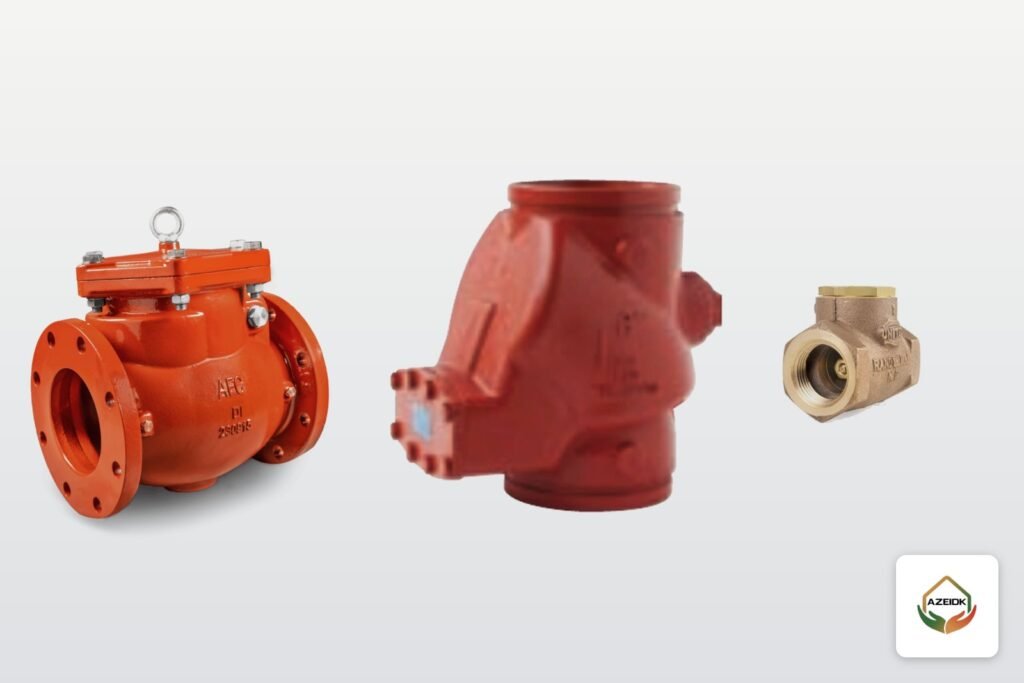
- Swing check valve: a clapper hinged on a pin that closes by its weight and reverse flow, common in pump rooms and mains. See AFC swing check valves.
- RCV riser check: spring assisted clapper, short streamlined body, vertical or horizontal, suited to risers where space is tight.
- Wet alarm check valve: also a check valve, but with alarm trim that signals when a sprinkler opens. See AFC ACV-300 wet alarm check valve.
The RCV has no alarm trim, so where it serves a zone riser, waterflow alarm usually comes from a flow switch on the line, such as the units in Potter waterflow and supervisory switches.
Installation notes
- Flow arrow: install with the body arrow pointing from supply to system.
- Correct grooves: the 300 psi rating assumes standard wall pipe with grooves to specification; grooves too deep or narrow weaken the joint.
- Side port: used for drain or gauge connection per the design; state NPT or BSP in the order to match the project’s trim.
- Supervised control valve: risers usually have a control valve with a tamper switch upstream of the check valve, so the zone can be isolated for maintenance with a signal to the fire alarm panel.
- Testing: hydrostatically test the riser to the adopted standard before handover.
These are general site points. The detailed design and valve positions are set by the consultant under SBC 801 and Civil Defense requirements, with NFPA as a technical reference.
When is the RCV a good fit?
In multi-storey buildings or projects with several sprinkler zones, a short valve that installs vertically and joins with the same coupling system as the rest of the network has clear value. Grooved ends save installation time compared with flanges, but the choice between RCV, swing check and alarm valve remains an engineering decision tied to the valve’s role on the drawing.
How AZEIDK helps
AZEIDK supplies the Shurjoint RCV with catalogue pages and listing data for the submittal, checks sizes, pipe outside diameters and side port threads on the drawings, and can extend the work to installation and testing. The full network is under fire fighting systems.
FAQ
What is a riser check valve?
A valve that allows one-way flow up a sprinkler riser and closes on reverse flow, holding pressure above it.
What is the working pressure of the Shurjoint RCV?
300 psi (20 bar) in the catalogue table, and the UL and FM table lists 300 psi for 2½ to 6 in.
Can the RCV be installed horizontally?
Yes, the catalogue states vertical or horizontal installation.
What sizes are available?
2½ to 6 in, plus metric 76.1, 139.7 and 165.1 mm per the catalogue table.
Does an RCV replace a wet alarm valve?
No. The RCV has no alarm trim, while an alarm valve combines check and alarm functions. The design role decides.
Why does the RCV use two springs?
To return the clapper to its seat quickly as flow falls, so it closes without a hard slam.
Summary
The Shurjoint RCV riser check valve is a short grooved solution for wet system risers, with a spring assisted clapper and a 300 psi catalogue rating. Match the size to the real pipe outside diameter, specify the side port thread and include Data Sheet B-42 in the submittal.
Need RCV valves for your project? Send riser sizes and pipe type, and we will send suitable sizes and catalogue pages for your submittal. Contact the AZEIDK team
Related guides
- Fire Systems Maintenance for Wedding Halls and Cinemas: Pre-Season Checks and Records for Salamah Renewal
- Sprinkler Head Types: K-Factor, Temperature Rating and Response
- Voice Evacuation Commissioning: PA Zoning, Wiring and STI Testing
- Fire Alarm Systems in Buraydah and Qassim: Panels and Detectors for Date Warehouses, Shops and Factories