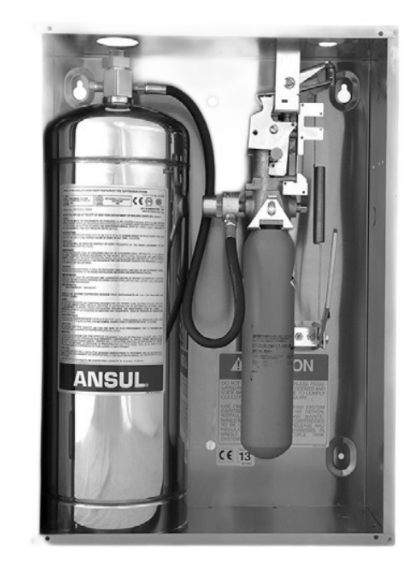
ANSUL is a fire suppression brand of Johnson Controls, and AZEIDK supplies its R-102 system for commercial kitchens. R-102 is a pre-engineered wet chemical system that protects hoods, exhaust ducts, filters and cooking appliances against grease fires, with automatic and manual actuation.
Key takeaways
- ANSUL states that R-102 is UL and ULC listed to the requirements of UL 300 and meets NFPA 96 and NFPA 17A requirements.
- Fusible links or thermal detectors trigger discharge, a remote pull station allows manual release, and gas, power and fire alarm interfaces are available.
- NFPA 96 (2011 edition; 2027 is current) requires kitchen fire-extinguishing systems to be serviced at least every 6 months by trained, qualified persons.
- The Saudi Fire Protection Code (SBC 801) and Civil Defense set kitchen protection requirements and the applicable editions.
Who is ANSUL?
Johnson Controls lists ANSUL under fire suppression in its brand directory, and ANSUL’s website, which shows the restaurant systems, carries a 2026 Johnson Controls copyright.
R-102 is pre-engineered: its components and coverage limits are tested and set out in the manufacturer’s listed design and installation manual, and the design must stay within them. UL 300 (fourth edition, 2019) covers fire testing of these systems, while standards such as NFPA 17A and NFPA 96 set installation requirements.
The ANSUL R-102 system from AZEIDK
Our ANSUL R-102 product page describes an automatic system for cooking areas and their ventilation equipment, with the technical data sheet. Key features as ANSUL publishes them:
- Agent: a wet chemical that ANSUL calls ANSULEX Low pH Liquid Agent, which the company says knocks down flames, cools hot surfaces and forms a vapor blanket that helps prevent re-flash.
- Coverage: hoods, ducts, plenums and filters, auxiliary grease extraction equipment, and appliances such as fryers, griddles, range tops, broilers, char-broilers and woks.
- Detection and actuation: fusible links that separate at a rated temperature or electric thermal detectors, plus a remote manual pull station.
- Agent tanks: 1.5 gallon (5.7 L) and 3.0 gallon (11.4 L), per the data sheet.
- Additional functions: mechanical or electrical gas valve shut-off, electrical shutdown of appliances, and fire alarm panel interface, as the project requires.
The AZEIDK product page states that the system must be designed, installed, inspected, maintained and recharged according to the manufacturer’s listed instruction manual.
System components and what to check
| Component or function | Purpose | As ANSUL publishes it, or what to check |
|---|---|---|
| Agent tank and release | Stores and releases the agent | 1.5 or 3.0 gallon tank, mounted where air temperature stays between 0 and 54°C |
| Nozzles | Direct agent to appliances, hood, duct and plenum | Appliance-specific or overlapping, per the listed design manual |
| Fusible links or thermal detectors | Automatic detection | Link rating per the manual; NFPA 96 (2011) requires metal alloy links to be replaced at least semiannually |
| Remote manual pull station | Manual release | Tested at each six-month service under NFPA 96 (2011) |
| Gas and power shut-off | Stops the heat source on discharge | Mechanical or electrical gas valve and electrical switches, per the data sheet and design |
| Fire alarm interface | Signals the building system | Per the approved design |
Where the system is used
The AZEIDK product page lists restaurants, hotels, hospitals, nursing homes, schools, airports and similar facilities with commercial kitchens, including hotel and hospitality kitchens and food courts in malls. The adopted code and Civil Defense decide when hood and duct protection is required, and which standard and edition apply.
AZEIDK also supplies alternatives such as Hood Safer kitchen suppression, and our commercial kitchen fire suppression guide explains how systems compare.
What to check before approval and in maintenance
- Ask for evidence of a UL 300 listing; NFPA 96 (2011 edition, Section 10.2.3) requires automatic dry and wet chemical systems to be listed to that standard.
- Confirm that appliance types, nozzle positions and tank count fall within ANSUL’s listed manual, and recheck the design whenever cooking equipment changes.
- Check tank locations against the data sheet limit of 0 to 54°C, indoors or with weather protection, which matters in hot kitchens and outdoor locations.
- Specify fuel or power shut-off to protected appliances on discharge, which the 2018 International Fire Code (IFC) model, as published in the Seattle Building Code, requires in Section 904.12.2, and define the fire alarm interface.
- Locate the pull station as the design and manual require; the same model code places it at or near a means of egress from the cooking area, 10 to 20 ft (3 to 6 m) from the exhaust system and 42 to 48 in. (1.07 to 1.2 m) above the floor.
- Provide a Class K extinguisher; the 2018 IFC model in the Seattle Building Code (Sections 906.1 and 906.4) requires one within 30 ft (9.1 m) travel distance of commercial cooking equipment using oils and fats, as our NFPA 10 extinguisher guide explains.
- Service the system at least every 6 months and replace metal alloy fusible links at least semiannually, as NFPA 96 (2011) requires; in Saudi Arabia, SBC 801 and Civil Defense set the requirements.
- After any discharge, recharge the system per the manufacturer’s manual, and clean exhaust ducts of grease regularly.
How AZEIDK helps
AZEIDK lists ANSUL among the brands available within its supply scope on our products page, and our special fire suppression systems solutions include restaurants and kitchens among the sectors served. Our services include technical supply of the system and its documents and Civil Defense approval support.
Our annual maintenance contracts keep the six-month service on schedule and documented, and we interface the system with building fire alarm systems where needed, drawing on more than 16 years in the Saudi market.
FAQ
Is ANSUL a Johnson Controls brand?
Yes. Johnson Controls lists ANSUL among its fire suppression brands, and ANSUL’s website carries a Johnson Controls copyright. This matters when you request support, spare parts or the design manual, since documents should come from the manufacturer and match the system supplied.
What does a UL 300 listing mean?
UL 300 sets fire tests for pre-engineered extinguishing systems protecting commercial cooking equipment in restaurants, cafeterias and similar places; its fourth edition was published in 2019. It does not cover installation, which standards such as NFPA 17A and NFPA 96 address. ANSUL states that R-102 is UL and ULC listed to its requirements.
How often must an ANSUL R-102 system be serviced?
NFPA 96 (2011 edition) requires kitchen fire-extinguishing systems to be serviced at least every 6 months by trained, qualified persons, including testing the manual pull station and replacing metal alloy fusible links. SBC 801 and Civil Defense set the requirements for your project, and the manufacturer’s manual applies at every visit and after any discharge.
Can the tanks be installed in a hot or outdoor location?
ANSUL’s data sheet requires release and tank assemblies to be mounted where air temperature stays between 0 and 54°C, indoors or with weather protection. Avoid exposed roofs and spots next to heat sources, and fix tank locations early in the design.
Do I still need a Class K extinguisher with a hood system?
Usually, yes. The 2018 IFC model in the Seattle Building Code requires a Class K extinguisher within 30 ft (9.1 m) travel distance of cooking equipment using oils and fats; it supplements the fixed system rather than replacing it, and kitchen staff should be trained to use it. Confirm Civil Defense requirements for your facility.
Need to protect a commercial kitchen? Send us the kitchen layout and appliance list, and our team will help you select, install and maintain the right system. Contact the AZEIDK team