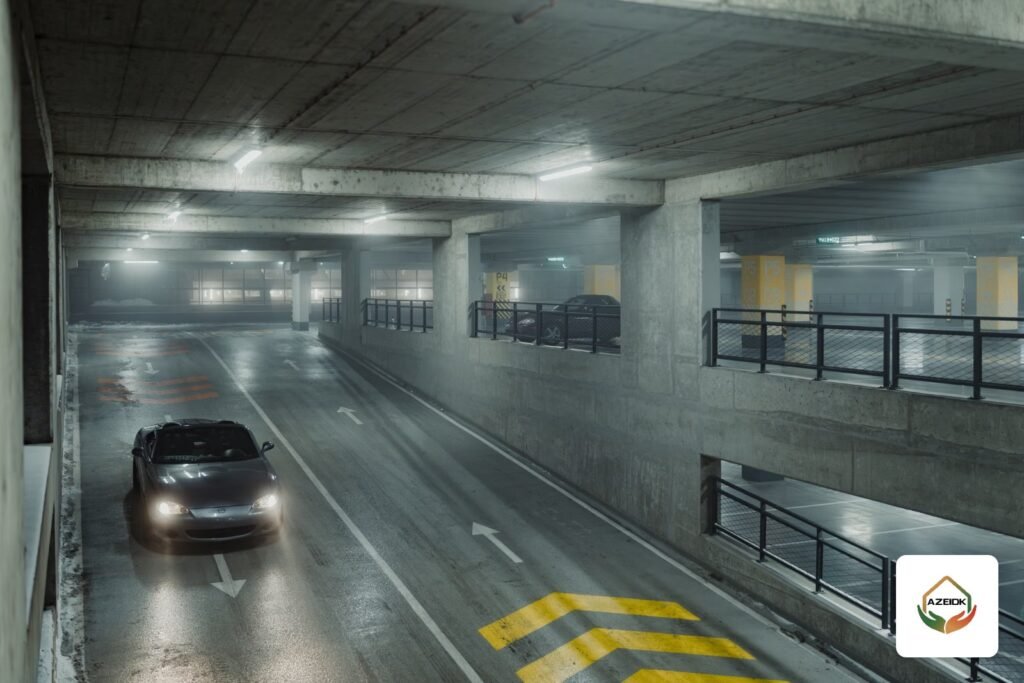
Jet fans (also called thrust or impulse fans) are compact fans hung under the soffit of enclosed car parks and basements. They push air in a set direction towards the main extract points, replacing long runs of ductwork. Day to day they clear exhaust fumes and carbon monoxide; in a fire they work as part of the smoke extraction system to clear smoke or control where it goes.
This guide explains how a jet fan system works, the difference between everyday and emergency ventilation, what decides the number and position of fans, how the system ties into the fire alarm and CO detection, and what to check before handover. AZEIDK delivers this work under its smoke extraction and emergency ventilation systems.
Key takeaways
- Jet fans do not take air out of the building themselves. They move it inside the car park towards the main extract fans, while replacement air enters through ramps or dedicated openings.
- The system has two modes: everyday ventilation controlled by CO detection, and fire mode triggered by the fire alarm under an approved sequence.
- The number and layout of fans come from the project design study, often supported by CFD modelling, not from a rule of thumb.
- Fans that run during a fire must be temperature rated, with power supply and cabling suited to the required running time.
In this article
- What are jet fans in a car park?
- How does a jet fan system work? The main components
- Everyday ventilation and fire mode: what is the difference?
- What decides the number and position of jet fans?
- Choosing a jet fan: what to check in the datasheet
- Connecting jet fans to the fire alarm and sprinklers
- Common mistakes on jet fan projects
- Testing, handover and maintenance
- Jet fan systems with AZEIDK
- Frequently asked questions
- Conclusion
What are jet fans in a car park?
A jet fan is an axial fan in a short cylindrical casing, fixed horizontally under the slab or between beams. It discharges a fast jet that entrains the surrounding air and carries it forward. Rows of fans set up an air stream across the car park, from the replacement air side to the extract side.
Thrust fans started in tunnel ventilation in the 1960s and moved into car parks later. A CIBSE Journal article by a CFD engineer at Fläkt Woods describes them as the first choice in car park ventilation in the UK and worldwide. A related type, the induction fan, uses a different outlet design and is chosen according to ceiling height and the throw needed.
How does a jet fan system work? The main components
- Main extract fans: discharge air and smoke outside through a fan room or shaft.
- Replacement air path: vehicle ramps, openings or supply fans so clean air replaces what is extracted.
- Jet fans: steer the flow inside the car park and prevent stagnant zones.
- CO detectors: control everyday operation according to concentration.
- Control panel: links detection and fire alarm signals to fan start and speed commands.
If any link in this chain is weak, adding jet fans will not fix it. An undersized extract fan or a blocked replacement air path makes the jets push smoke the wrong way.
Everyday ventilation and fire mode: what is the difference?
In everyday operation the goal is to keep exhaust and CO levels within safe limits with the least energy, so fans run at low speed or intermittently according to detector readings. We cover this in car park carbon monoxide detection and extraction fan control.
Fire mode has a different goal, set by the approved design for the project. The CIBSE Journal article separates two objectives:
| Design objective | What it does | Notes |
|---|---|---|
| Smoke clearance | Removes smoke after the fire is under control at a set air change rate | Does not account for fire size or location; not designed to protect escape or firefighter access |
| Smoke control | Keeps smoke away from escape routes and fire service access points | Designed on fire scenarios; common in large single-level car parks |
The same article notes that UK building regulations set 10 air changes per hour for smoke extraction and 6 for pollution extraction. These are UK figures, given here for comparison only. In Saudi Arabia the Saudi Building Code and the design approved by the authority having jurisdiction govern each project.
What decides the number and position of jet fans?
- Floor area and shape: long narrow levels behave differently from wide square ones.
- Ceiling height and downstand beams: a deep beam can break the jet and shorten its throw.
- Columns, rooms and stair cores: obstructions divert the flow and create dead zones.
- Extract and replacement air locations: these set the overall flow direction, and fans are placed to serve it.
- Manufacturer performance data: the datasheet velocity profile shows throw, jet width and air moved over distance.
The article gives an example of how sensitive layout is: a 400 mm fan at 10 m lateral spacing instead of 15 m shows a clearly different velocity profile. It also warns that an unbalanced automated system, or one running too many fans, can push smoke back or spread it quickly beyond the zone boundary.
Why CFD modelling is used
Airflow in a car park with columns, beams and ramps cannot be calculated reliably by hand, so designers have relied on computational fluid dynamics (CFD) for years to test fire scenarios and fan layouts. Results depend heavily on inputs such as the fire source and boundary conditions, so those assumptions need review before results are accepted.
Choosing a jet fan: what to check in the datasheet
- Temperature and time rating: fans used in fire mode must be rated for hot smoke for the duration the design requires. See high-temperature smoke exhaust fans.
- Thrust: the key performance figure for jet fans, more useful for comparison than airflow alone.
- Unidirectional or reversible: reversible fans allow the flow to change direction with fire location where the design calls for it.
- Two speeds: low for everyday ventilation, high for fire mode.
- Noise and depth: the space left under the slab after lighting, sprinklers and cable trays.
Connecting jet fans to the fire alarm and sprinklers
The ventilation system receives the fire signal from the fire alarm panel through output modules or a direct link to the fan control panel. The sequence is written in the cause and effect matrix: which detector or zone starts which fans, at what speed and when.
- Start on the first detector or on a confirmed alarm: the approved design decides.
- In zoned smoke control, only fans for the affected zone run in the set direction; others stop or change.
- Fan positions are coordinated with sprinklers and linear heat detection so the jet does not disturb them. For car park detection, see linear heat detection cable.
- Civil Defense crews get clear manual control of the fans.
Common mistakes on jet fan projects
- Moving fans to convenient positions instead of the design locations, especially where beams and ducts clash.
- Ignoring the replacement air path, for example a closed entrance gate or openings turned into storage.
- Supplying a fan with a lower temperature rating than required, or feeding a fire-mode fan with ordinary cable.
- Programming fire mode without a real sequence test with the fire alarm panel.
- Only switching fans on at handover without measuring air speeds or checking direction.
Testing, handover and maintenance
Before handover the sequence is tested from the detector to every fan, and direction, speed, extract fans and replacement air are verified. The steps are in smoke control system testing before and after handover. In operation, fans need periodic checks of motors, fixings and vibration, and CO detectors need calibration to the manufacturer’s instructions.
Jet fan systems with AZEIDK
Under its smoke extraction and emergency ventilation systems, AZEIDK handles site study, supply and installation of extraction fans and control components, connection to the fire alarm, testing and follow-up. Fan capacities, quantities and extraction rates follow the approved design study for each project, and our engineering design and calculations service can review the design. For the wider picture, see parking garage fire protection.
Frequently asked questions
What is a jet fan in a car park?
A thrust fan hung under the slab that moves air and smoke through the car park towards the main extract fans, replacing much of the ductwork.
Can jet fans extract smoke on their own?
No. The system needs main extract fans that discharge outside and a replacement air path; jet fans only steer the flow between them.
How many jet fans does a car park need?
The design decides, based on area, height, beams, extract positions and the chosen fan, and it is often checked with CFD.
Do jet fans run every day?
In most systems yes, at low speed under CO control, switching to fire mode when the fire alarm signal arrives.
Do jet fans have to be heat resistant?
If they run in fire mode, yes, with a temperature and time rating set by the design and suitable power and cabling.
Jet fans or ducted extraction?
Ducted systems move air through ducts across the ceiling; jet fans move it through the open space, saving height and easing coordination with other services.
Conclusion
A working jet fan system starts with a design that defines the fire mode objective, extract points and replacement air, followed by fans with the right thrust and temperature rating, installation at the approved positions and a real sequence test with the fire alarm.
Enclosed car park or basement that needs ventilation and smoke extraction? Send us the drawings and Civil Defense requirements, and we will review supply, installation, interfacing and testing with you. Talk to the AZEIDK team
Related guides
- Building Compliance Certificate on Balady: Civil Defense and Fire System Tests Before Occupancy
- Mall Fire Sprinkler Systems: Corridors, Shops, Hypermarkets, Car Parks and High Ceilings
- Fiber Optic Backbone in Buildings: Types and Testing
- Network Switch and Wi-Fi Brands in Saudi Arabia: Cisco, Huawei, Ruijie, TP-Link, Alcatel and UTEPO Compared