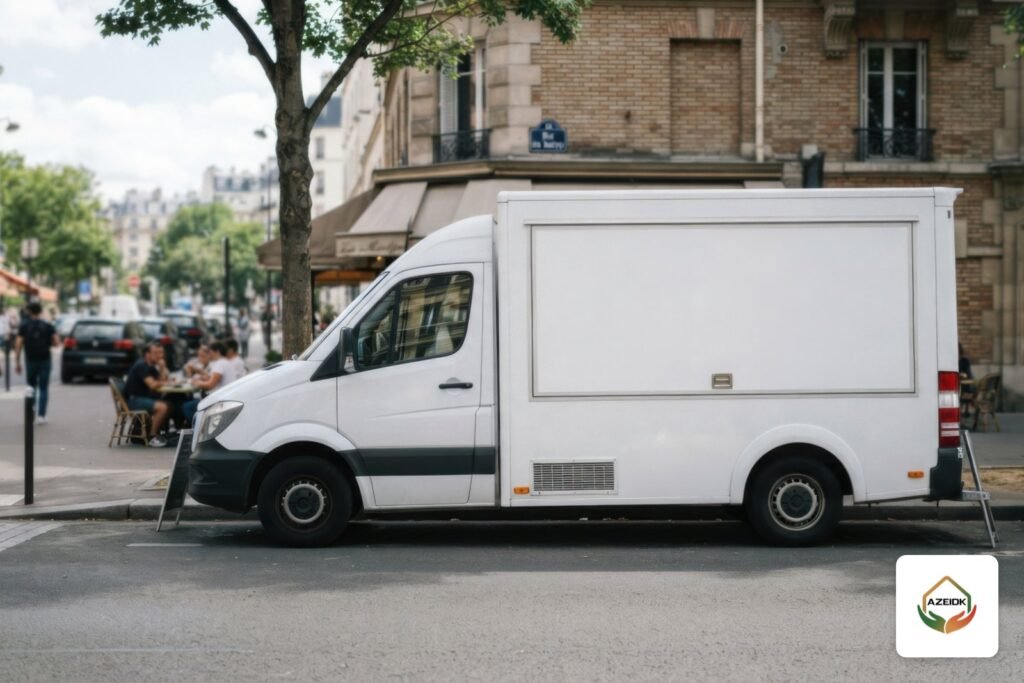
Food truck safety requirements in Saudi Arabia start with the Municipal Requirements for Mobile Vehicles issued by the Ministry of Municipalities and Housing (1447 AH / 2025). They require two 6 kg dry chemical powder fire extinguishers, set rules for the generator and fuel, and require any charcoal or wood cooking to happen in a separate trailer. The document does not specify a hood suppression system or LPG cylinder details, and it refers fire protection to Civil Defense requirements, so these points are settled with the authority and with technical references such as NFPA 96 and NFPA 58.
Key takeaways
- Two dry chemical powder extinguishers of 6 kg each: this is the explicit text of the municipal requirements for mobile vehicles.
- Charcoal and wood are not used inside the food truck itself, only in a separate trailer.
- Gas-fired lamps are banned, and the truck may not stand within 10 m of fuel stations and gas shops.
- The hood suppression system and LPG cylinder details are not set in the document. They are agreed with Civil Defense and the consultant.
- Staff must know how to respond to fire and gas leaks and how to notify the authorities.
In this article
- What do the municipal food truck safety requirements say?
- Food truck fire extinguishers: how many and which type?
- Food truck hood suppression: is a system required?
- The LPG cylinder in a food truck: what to get right
- Civil Defense requirements for food trucks: where to start
- Pre-opening checklist for a food truck
- Frequently asked questions
- Conclusion
What do the municipal food truck safety requirements say?
The Ministry of Municipalities and Housing issued the Municipal Requirements for Mobile Vehicles to regulate food and non-food activities run from a vehicle, trailer or semi-trailer. The table collects the fire-related clauses as they appear in the document published on the ministry’s website:
| Clause | What the document says | Practical note |
|---|---|---|
| 5.9.1 Extinguishers | Two dry chemical powder extinguishers, 6 kg each | This is the written minimum, not a ceiling |
| 5.9.2 Generator | Compliant with approved standards, located away from exits, buildings, walkways and the public, and fenced if separate from the vehicle | Plan the generator position before arriving on site |
| 5.9.2 Exhaust and refuelling | Exhaust pipe pointing up, 20 cm above the vehicle if the generator is attached, and refuelling outside working hours with the generator off | No refuelling while serving |
| 5.9.2 Electrical | Wiring protected and compliant, and street lighting or public facilities may not be used as a power source | A direct grid connection needs the electricity provider’s approval |
| 5.1 Charcoal and wood | No meal preparation outside the vehicle, and charcoal or wood use must be in a separate trailer | Keep charcoal and LPG in different units |
| 4.1 Lighting | Gas-fired lamps are banned | Use electric lighting |
| 3.1 Locations | At least 10 m from fuel stations and gas shops, and no parking in spots reserved for Civil Defense, ambulance, police and traffic | Check the site before every event |
| 5.1 First aid | A first aid kit must be provided | Keep it visible |
| 7.1 References | Civil Defense fire protection requirements are listed among the reference codes | This is where the details not covered by the document come in |
The document also has many health and operating clauses, such as following the general requirements for preparing and handling shawarma and a ban on making mayonnaise and sauces inside the vehicle. Those are outside the scope of this article.
Food truck fire extinguishers: how many and which type?
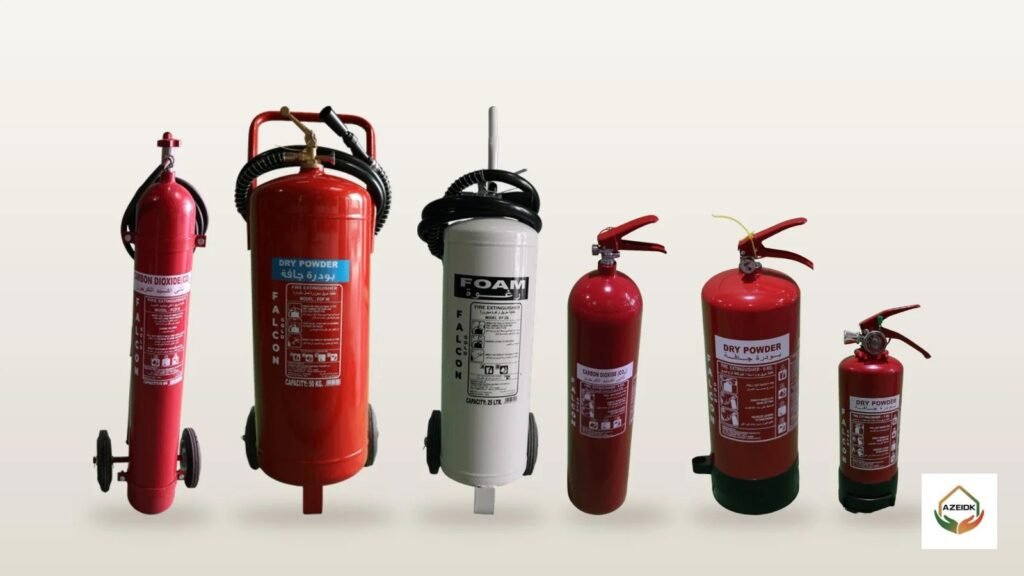
The municipal text is clear: two dry chemical powder extinguishers of 6 kg each. An ABC dry powder extinguisher handles fires in ordinary solids, flammable liquids and gas. One example available from AZEIDK is the Falcon Gold 6 kg dry powder extinguisher (model FDP6), which its product page lists for classes A, B, C and E.
A food truck with a fryer or an oiled griddle also faces cooking oil and grease fires, which is the hazard a wet chemical extinguisher is designed for. That is why many operators add the FG 6 kg wet chemical extinguisher, made for oil and grease fires in commercial kitchens (class K/F, rated 13A 75B on its data sheet). It is an optional addition next to the cook line. It does not replace the two extinguishers the requirements call for.
Placement and inspection tips (good practice, not municipal text):
- One extinguisher near the truck door, where staff can grab it on the way out, not behind the cook line.
- A second one within reach of the generator or electrical panel.
- Brackets for every extinguisher so they do not fall while driving.
- A monthly visual check of the gauge, seal and hose, plus periodic certified servicing. See our guide to fire extinguisher maintenance and refilling.
Food truck hood suppression: is a system required?
The municipal requirements for mobile vehicles do not mention a hood suppression system, and they refer fire protection to Civil Defense. We therefore do not say it is required by municipal text, but here is what the technical references say:
- NFPA’s 2018 food truck safety fact sheet, based on the 2017 edition of NFPA 96, calls for appliances using combustible cooking media (such as frying oil) to be protected by an approved fire extinguishing system (10.1.2).
- The same fact sheet calls for solid fuel appliances that produce grease-laden vapors to be protected by listed fire-extinguishing equipment (14.7.1), and draws its mobile and temporary cooking items from Annex B of NFPA 96.
In practice: if the truck has a fryer, griddle or grill under a hood, ask the consultant or Civil Defense about hood suppression before fitting out the truck, because adding it after the finishes are done is harder and costs more. The American Fire Control kitchen fire suppression system supplied by AZEIDK comes in 7.5, 12.5, 17.5, 22.5 and 27.5 litre sizes, selected by hood length, appliance type and ductwork. The manufacturer’s catalog states that activation shuts off electrical and gas supplies immediately and that the system includes a manual pull station. More detail is on our kitchen fire suppression systems page.
The LPG cylinder in a food truck: what to get right
The municipal requirements do not set the size, number or position of the LPG cylinder. What they do set is the ban on gas lamps, the minimum 10 m from fuel stations and gas shops, and staff training on gas leaks. For the rest, the designer turns to Civil Defense requirements and to NFPA 58, the technical reference for liquefied petroleum gas. NFPA’s food truck fact sheet cites these NFPA 58 points:
- The main shut-off valve is readily accessible.
- Portable cylinders stand upright and are secured against tipping.
- Every new connection, and every connection disturbed by a cylinder change, is leak tested, and the test is documented.
- A flexible connector is fitted between the regulator outlet and the fixed piping.
- Appliance and cylinder valves are closed when the equipment is not in use.
The fact sheet also cites NFPA 96 on inspecting the gas system before each use and testing any installed gas detection system to the manufacturer’s instructions. AZEIDK offers gas detection systems in Saudi Arabia.
Civil Defense requirements for food trucks: where to start
The municipal document lists the Civil Defense fire protection requirements among its references, and we did not find a published Civil Defense document specific to food trucks that we could rely on here. We recommend two steps: confirm with Civil Defense or the municipality at licensing what your truck needs, and prepare a short file with the truck layout, extinguisher and appliance positions, and the power and gas sources. For fixed premises, safety licensing goes through the Salamah platform. Our Salamah certificate guide explains how the platform works. Check with the authority whether it applies to your mobile activity.
Pre-opening checklist for a food truck
| Item | Source | Done? |
|---|---|---|
| Two 6 kg dry powder extinguishers, mounted and in service | Municipal requirements 5.9.1 | |
| Wet chemical extinguisher near the fryer | Good practice | |
| Hood suppression system if required by Civil Defense or the consultant | Civil Defense / NFPA 96 | |
| LPG cylinder upright and secured, shut-off valve accessible | NFPA 58 (technical reference) | |
| Leak test after every cylinder change | NFPA 58 (technical reference) | |
| No charcoal or wood inside the truck | Municipal requirements 5.1 | |
| Generator away from the public, exhaust 20 cm up | Municipal requirements 5.9.2 | |
| First aid kit | Municipal requirements 5.1 | |
| Staff know how to respond to fire and gas leaks | Municipal requirements 5.9.2 |
Frequently asked questions
How many fire extinguishers does a food truck need?
The Municipal Requirements for Mobile Vehicles call for two dry chemical powder extinguishers of 6 kg each.
Is a hood suppression system mandatory in a food truck?
The municipal document does not mention it and refers fire protection to Civil Defense. NFPA 96, as a technical reference, calls for an approved extinguishing system on appliances that use cooking oil, so confirm with the authority before fit-out.
Dry powder or wet chemical for an oil fire?
Wet chemical extinguishers are designed for kitchen oil and grease fires. Keep the two required powder units and add a wet chemical extinguisher next to the fryer if you have one.
Can I grill on charcoal inside the food truck?
No. The municipal document requires charcoal or wood use to be in a separate trailer, and it bans meal preparation outside the vehicle.
What are the Civil Defense requirements for food trucks?
The municipal document refers to Civil Defense fire protection requirements without detailing them. Ask Civil Defense or the municipality at licensing what your truck needs.
Where should the LPG cylinder go in a food truck?
The municipal document does not set a position. NFPA 58, as a technical reference, calls for an upright, secured cylinder, an accessible main shut-off valve and a leak test after every cylinder change.
Conclusion
Saudi food truck safety requirements clearly set the two extinguishers, the generator and charcoal rules and the distance from fuel stations, and they leave hood suppression and gas details to Civil Defense requirements. Fit the truck with what the text requires first, ask the authority about the hood and gas before the finishes go in, and use the technical references for the details.
Fitting out a food truck and need extinguishers or a hood suppression system? AZEIDK supplies Falcon Gold and FG extinguishers and the American Fire Control kitchen suppression system, with installation and maintenance. Talk to the AZEIDK team
AZEIDK supplies fire extinguishers of all common types and sells them to individuals and businesses from its branches in Saudi Arabia.