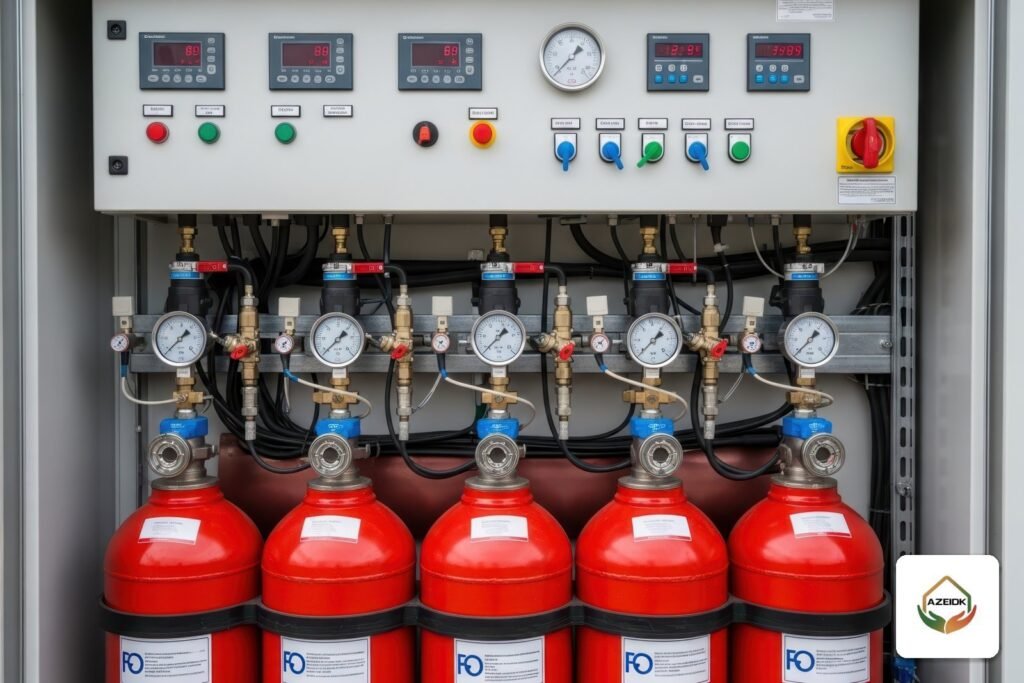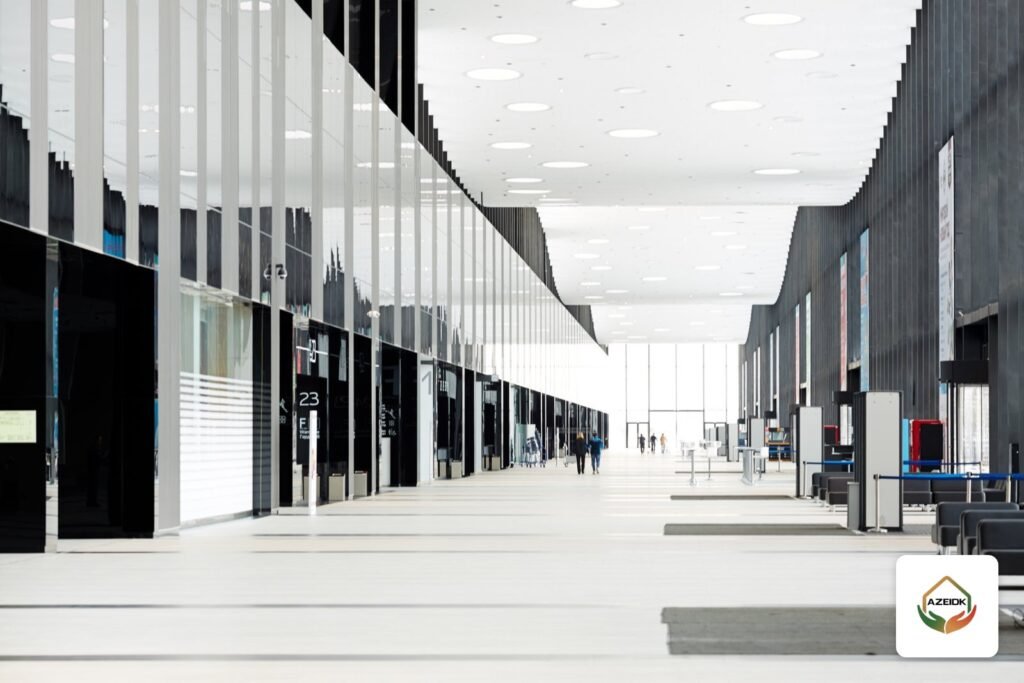
Exhibition centre fire safety starts from one fact: the hall is fixed, but what is inside it changes with every event. A venue therefore needs detection that works under very high ceilings, such as beam detectors, sprinklers that temporary booth roofs do not block, entry gates that manage crowds without closing escape routes, and cameras covering halls, entrances and outdoor areas. Exhibition halls are normally classified as assembly occupancies, with the engineering office confirming the classification on each project, and the SBC 801 alarm thresholds then apply.
Key takeaways
- In the Arabic text of SBC 801 (2018 edition), assembly occupancies need a manual fire alarm system at 300 occupants or more (Section 907.2.1) and emergency voice/alarm communication at 1,000 or more (Section 907.2.1.1).
- Point smoke detectors lose effectiveness under very high ceilings. Beam detectors are the usual answer in exhibition halls.
- Covered booths and multi-storey booths shield the floor beneath them from the hall sprinklers, and international references treat them as needing their own protection.
- Turnstiles manage crowds but are not emergency exits, and access-controlled doors must release on fire alarm.
- CCTV installation and operation fall under the Saudi Security Surveillance Cameras Law and its implementing regulations.
In this article
- Why is exhibition centre fire safety different from other commercial buildings?
- Regulatory frame: what applies in Saudi Arabia?
- Beam detectors for high ceilings: how are they selected?
- Temporary exhibition booths: when do they block sprinklers?
- Entry gates and crowd control without locking exits
- CCTV in exhibition centres
- Pre-event checklist
- Frequently asked questions
- Conclusion
Why is exhibition centre fire safety different from other commercial buildings?
A mall or office tower is designed for a fairly fixed pattern of use. An exhibition hall may host a furniture show full of timber and fabric this week, a conference with thousands of delegates next week, and a car or industrial equipment show after that. With each event three things change:
- Fire load: the amount of combustible material inside booths, from MDF to carpet and printed material.
- Layout: where booths and aisles go. A booth can cover a hose cabinet or an exit if the plan is not checked.
- Crowd size and movement: peaks at opening time and at the end of sessions, concentrated at the entrances.
Fire and security systems in an exhibition centre are therefore designed for the worst expected layout, and each event plan is reviewed before build-up. AZEIDK covers these facilities under its malls and commercial buildings sector. On the exhibitor side, AZEIDK took part with its own booth at ERFL2026 in Jubail in February 2026, which shows clearly how much a hall changes between build-up day and opening day.
Regulatory frame: what applies in Saudi Arabia?
The basis is the Saudi Fire Protection Code SBC 801, and the 2024 edition of the Saudi Building Code has been mandatory since 30 June 2025. For assembly occupancies, SBC 801 sets:
- A manual fire alarm system where the occupant load is 300 or more (Section 907.2.1, Arabic text of the 2018 edition).
- Alarm initiation through an emergency voice/alarm communication system where the occupant load is 1,000 or more (Section 907.2.1.1).
Most large exhibition halls pass both thresholds easily, so an addressable fire alarm with voice evacuation is the normal arrangement. Always check the figures in the edition the building permit was issued under, and the design is approved through Civil Defense.
Beam detectors for high ceilings: how are they selected?
In very tall halls, smoke cools and spreads before it reaches a ceiling-mounted point detector, so the alarm is late or never comes. That is why optical beam smoke detectors are used: they send a light beam across the hall and detect smoke when the beam is obscured.
Beam detectors AZEIDK supplies from the Context Plus range include:
| Model | Type | Range per product page | Note |
|---|---|---|---|
| BeamRay RFX70 | Reflective (transmitter and receiver in one head with a reflector plate), conventional | Up to 70 m, extendable to 160 m with extra reflector kits | Product page lists EN 54-12:2015 and VdS approval |
| SA7100-100 | Intelligent auto-aligning beam detector, addressable on the loop | Up to 100 m | Connects directly to the addressable panel |
At design stage the engineer checks three practical points:
- Mounting stability: long-span roof steel moves with temperature, which can shift the beam. Auto-aligning detectors reduce the false alarms this causes.
- Beam path: hanging banners, rigging and tall booth structures can cut the beam. Event organisers must know where the beams run so nothing is hung across them.
- Maintenance access: a detector at high level needs a lift to service it, so models that can be tested from a ground-level controller are preferred.
Other detection options are on the fire alarm systems page.
Temporary exhibition booths: when do they block sprinklers?
Hall sprinklers are designed to cover an open floor. A booth with a roof, or a two-storey booth, creates an enclosed space the hall sprinklers cannot reach. NFPA 101 (Life Safety Code) contains specific provisions for exhibits, as the Minneapolis Fire Prevention Bureau notes, and the Maine State Fire Marshal’s Office, for example, summarises requirements of this kind:
- Single-level booths over 300 sq ft (about 28 m²) covered with a ceiling need automatic extinguishing protection.
- Each level of a multi-level booth, including the top level, needs the same.
- No booth may block access to exits or fire-fighting equipment.
- Combustibles in a booth are limited to a one-day supply, and storage behind booths is prohibited.
These are examples of international practice, not Saudi text, but they give venue management a clear list to ask of booth contractors. The practical approach in Saudi Arabia is an exhibitor manual from the venue that sets what roofs and materials are allowed, with any covered or multi-level booth reviewed by the engineering office before build-up. Sprinkler network details are on the fire fighting systems page.
Entry gates and crowd control without locking exits
Large conferences use turnstiles or speed gates to read tickets and badges. Gates AZEIDK supplies include ZKTeco models such as the MTS1000 tripod turnstile and the FHT2400D series. The access gates and turnstiles guide explains the differences between types.
When gates go into an exhibition centre, these safety rules apply:
- A turnstile is a control point, not an emergency exit. Free doors or passages of the width set by the egress design are left next to each gate line.
- Electrically locked doors in the access control system are interfaced with the fire alarm so they release on alarm or on power failure.
- Outdoor queues are not formed in front of emergency exits or in the Civil Defense vehicle route.
CCTV in exhibition centres
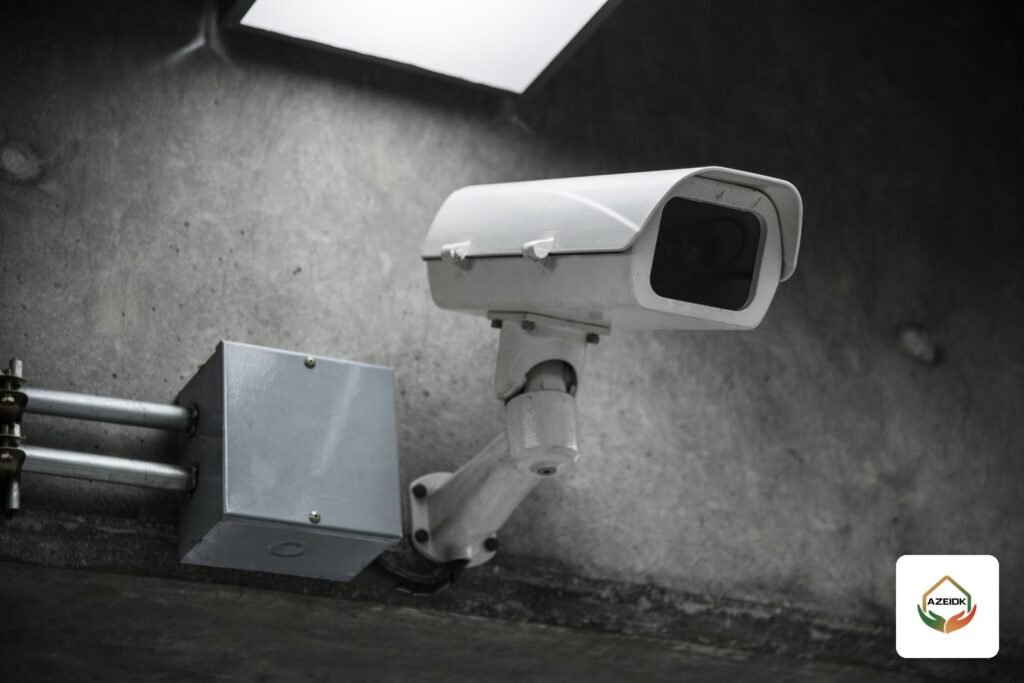
Cameras in an exhibition centre do two jobs: day-to-day security and crowd monitoring during events. Installation falls under the Security Surveillance Cameras Law, whose main obligations are covered in the Saudi CCTV law article.
The design checks:
- Entrances and gates: resolution high enough to identify faces at entry points.
- Large halls: wide-angle or PTZ cameras covering aisles between booths.
- Forecourts and car parks: outdoor cameras with good night performance.
- Storage: the required retention period drives recorder sizing. The CCTV storage calculator helps with a first estimate.
Available systems are on the security and surveillance systems page. Note that CCTV and low-current maintenance is a separate contract from fire and alarm system maintenance.
Pre-event checklist
| Item | What to check | Usually responsible |
|---|---|---|
| Booth layout | Aisles, exits and hose cabinets clear and uncovered | Venue management with the organiser |
| Covered and multi-level booths | Reviewed by the engineering office and protection resolved | Booth contractor and engineering office |
| Beam detector paths | No banners or structures hung across the beams | Venue management |
| Temporary power | Booth wiring safe and not run across aisles | Booth contractor |
| Extinguishers | In place, visible, not hidden by displays | Venue management |
| Gates and doors | Release on alarm; free exits beside them open | Venue management and security team |
| Control room | Fire panel and CCTV monitored throughout the event | Security and safety team |
Frequently asked questions
What are exhibition centre fire safety requirements in Saudi Arabia?
SBC 801 applies to the assembly occupancy, including a fire alarm at 300 occupants and emergency voice communication at 1,000 under the 2018 edition, with the design approved through Civil Defense and CCTV installed under the Security Surveillance Cameras Law.
Why are standard smoke detectors not enough in exhibition halls?
Smoke cools and spreads before reaching a very high ceiling, so the alarm is delayed. A beam detector covers long distances at a suitable height and detects smoke along its path.
Do covered exhibition booths need sprinklers?
International references such as NFPA 101 call for automatic protection of covered booths above a certain area and of multi-level booths. In Saudi Arabia the booth is reviewed by the engineering office and venue management to decide the solution.
Can turnstiles count as emergency exits?
No. Free exits are left beside them, and electrically locked doors are interfaced with the fire alarm to release in a fire.
Who maintains fire systems and CCTV in an exhibition centre?
Usually under two separate contracts: one for fire, safety and alarm systems, and another for low current, CCTV and access control.
What is the range of the BeamRay RFX70 beam detector?
According to the AZEIDK product page, up to 70 m, extendable to 160 m with extra reflector kits.
Conclusion
Exhibition centre fire safety is shared between a fixed design and a changing operation. The design provides detection suited to high ceilings, sprinklers and voice evacuation, and gates and cameras tied to the alarm. Operation makes sure temporary booths do not undo what the design provides. Make the review of each event plan a fixed step before build-up, not after it.
Running an exhibition or convention venue? Send the hall layouts, ceiling heights and number of entrances, and our engineering team will propose suitable detection, voice evacuation, gates and CCTV. Talk to the AZEIDK team
Related guides
- Automatic Ceiling Fire Extinguishers and CO2 Extinguishers for Electrical and Server Rooms: SFFECO SFM and CD
- Common Intercom Faults and Fixes: Audio, Video, Door Release and Mobile App
- AFFF Foam Concentrate Shelf Life: Storage, Annual Testing and Replacement
- AFC Fire Protection Butterfly Valves: Grooved BFG-300/301 or Wafer BFW-300, and When to Choose One Over an OS&Y Valve