The Context Plus AVAC voice alarm amplifier packs a digital store of Evacuate, Alert and Test messages, a priority mixer, two 60 W Class D amplifiers and a battery charger into one wall-mounted enclosure. The VA403 master works with VA402 slave amplifiers for wider coverage and with the VA405 fireman’s microphone for live announcements. This guide shows how to size the number of amplifiers from loudspeaker loads and what the datasheet battery figures actually mean.
The products covered here are listed on AZEIDK GROUP’s AVAC VA403 and VA402 voice alarm master and slave amplifiers page and the AVAC VA405, VA405X and 1ZDM emergency paging microphones page. All technical figures come from those pages and the datasheet published on them. For when a building needs voice alarm in the first place, start with Voice Evacuation Alarm Systems.
Key takeaways
- The VA403 is a wall-mounted master with two 60 W Class D amplifiers, a stored message bank and three balanced line inputs.
- Each loudspeaker circuit takes up to 60 W; the datasheet recommends 50 W to leave room for changes.
- Space for two 12 V 7 Ah batteries, typically giving 24 hours standby and 30 minutes alarm.
- AZEIDK GROUP’s page states up to 10 VA402 slaves per VA403 and a VA405 microphone linked to up to 10 masters.
- The datasheet describes the system as suitable for category V1 and V2 to BS 5839-8 (2008), with an EN 54-4 compliant power supply.
In this article
- How does the AVAC voice alarm amplifier work?
- VA403 master amplifier: datasheet specifications
- How does it connect to the fire alarm panel?
- VA402 slave amplifier: when do you need one?
- How to size the number of voice alarm amplifiers
- Voice alarm batteries: what “24 hours plus 30 minutes” means
- VA405 fireman’s microphone and 1ZDM paging unit
- What the datasheet states, and what it does not
- Common installation mistakes
- Frequently asked questions
- Summary
How does the AVAC voice alarm amplifier work?
Its job is to broadcast a clear voice message on fire, under the control of the fire alarm panel. When it receives a trigger, it plays the matching message (Evacuate, Alert or Test) from its store, amplifies it and sends it to the building loudspeakers.
The datasheet says messages are stored in MP3 format on a monitored, non-volatile memory card. Internal links adjust the wording: the Evacuate message can say that “a situation has arisen” or “a fire has been reported”, and can warn people not to use the lifts. AZEIDK GROUP’s page also mentions custom recorded messages.
Priority mixer: who talks first?
When several audio sources are active at once, only the most urgent one is broadcast. The order given in the datasheet:
| Priority | Source | Note |
|---|---|---|
| 1 | Emergency (fireman’s) microphone | Overrides all stored messages |
| 2 | Evacuate, Alert or Test message | Evacuate overrides Alert, Alert overrides Test |
| 3 | Paging / public address microphone | Not monitored; cut off on mains failure |
| 4 | Background music | Not monitored; cut off on mains failure |
VA403 master amplifier: datasheet specifications
These are the points a consultant usually checks in the material submittal:
- Enclosure: one compact wall-mounted unit.
- Amplification: two 60 W continuous average power Class D amplifiers, with an optional standby amplifier on some units that switches in if either main amplifier fails.
- Loudspeaker outputs: two 100 V line circuits through step-up transformers, an end-of-line device across the last loudspeaker on each circuit, and calibration of both circuits with the calibrate button at commissioning.
- Audio inputs: three balanced line-level inputs for the emergency microphone, paging and background music.
- Power: EN 54-4 compliant switch-mode power supply and battery charger, 230 V AC input.
- Batteries: space for two 12 V 7 Ah VRLA batteries.
- Monitoring: loudspeaker lines, power supply, batteries, emergency microphone and message store are monitored for short circuit, open circuit, earth fault, discharge, disconnection and data corruption.
How does it connect to the fire alarm panel?
Conventional trigger inputs
Three polarised, opto-isolated trigger inputs activate on a steady 24 V DC. They can be driven by input/output units on the loop of any analogue addressable panel, or by conventional panel outputs. A fault output and a reset (silence) input are also provided.
Direct connection to a Context Plus loop
The unit can connect directly to an XP95, Discovery or Xplorer protocol loop through its LOOP input. It then takes an address as a sounder control module: a continuous sounder command plays Evacuate, an intermittent command plays Alert, and any AVAC fault is reported to the panel as a general fault. On projects using Context Plus fire alarm systems, this saves I/O units and puts amplifier faults on the panel display.
This is also how phased evacuation works: one master per zone or floor, with the panel sending Evacuate to the affected floor and Alert to the rest. The datasheet positions AVAC for single-zone installations as well as most small to medium projects, including phased evacuation.
VA402 slave amplifier: when do you need one?
A slave repeats every emergency microphone and stored-message broadcast made at the master, extending loudspeaker coverage in large areas such as warehouses. Each slave has its own paging and background music inputs, so a tenant floor can have local paging or music without affecting the rest of the building.
On numbers: AZEIDK GROUP’s product page states up to 10 VA402 slaves per VA403 master, and that is the figure we design to. The general AVAC datasheet does not name the models and gives different figures in its text and its wiring diagram, so the final count for the supplied model is fixed by written manufacturer confirmation in the submittal.
How to size the number of voice alarm amplifiers
- Define message zones. Any area that needs a different message from its neighbour (Evacuate here, Alert there) needs its own master triggered by the panel, because a slave repeats the master’s message.
- Add up loudspeaker taps. Each 100 V loudspeaker has a wattage tap. Total the taps per zone once the acoustic designer has fixed quantities and positions for the required intelligibility.
- Split into circuits. Keep each circuit at or below the recommended 50 W (60 W maximum). A master gives you two circuits.
- Add slaves. If a zone needs more than two circuits, add VA402 units within the allowed number per master. Check the VA402 output rating and circuit count on its own datasheet before finalising.
Worked example: an office floor with 30 ceiling speakers tapped at 3 W totals 90 W. Two circuits at 45 W each sit under the 50 W recommendation, so one VA403 covers the floor. With 40 speakers (120 W), the load exceeds the 100 W recommended for both circuits, so add a slave or review the taps.
Cable lengths
The datasheet wiring diagram shows 2-core screened 1.5 mm² loudspeaker cable up to 500 m at 50 W, and 4-core screened 1.5 mm² emergency microphone cabling; maximum microphone cable lengths differ between the datasheet drawings, so confirm them with the manufacturer. Fire resistance and cable type are still set by the project specification and the adopted code; review them with our engineering design and calculations team.
Voice alarm batteries: what “24 hours plus 30 minutes” means
The enclosure takes two 12 V 7 Ah batteries. The datasheet says they typically give at least 24 hours standby followed by 30 minutes alarm. Part of this comes from automatically cutting the non-critical paging and music inputs on mains failure.
“Typically” matters. The figure assumes a typical load; real duration depends on loudspeaker load, battery age and plant-room temperature. So:
- If the specification or approving authority requires longer standby or alarm time, ask the supplier for a battery calculation using the model’s published consumption figures, and do not assume the enclosure fits larger batteries.
- Every master and slave carries its own batteries; count batteries by the number of amplifiers.
- Record the battery installation date in the maintenance file; batteries are the first item replaced under an annual maintenance contract.
VA405 fireman’s microphone and 1ZDM paging unit
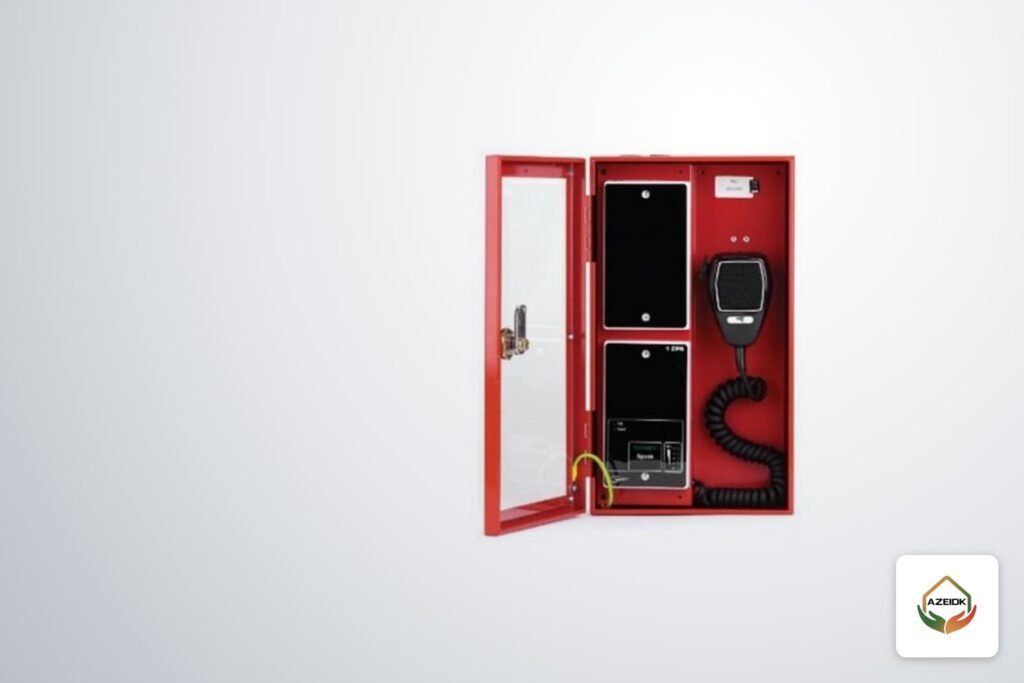
The VA405 is a noise-cancelling handheld microphone with push-to-talk and OK/Fault indicators, housed in a red hard box with a transparent window and a lockable door. According to AZEIDK GROUP’s page, a system can take one VA405 or up to four VA405X units, and a VA405 links to up to 10 masters.
The general datasheet calls the additional emergency microphones VA407, while AZEIDK GROUP’s page lists them as VA405X, the name used in this article. The datasheet also states that the number of masters that can be interlinked falls as emergency microphones are added, down to 6 masters with four microphones. If the project needs more than one control point, size the masters on that basis and confirm the limit with the manufacturer before material approval.
The 1ZDM is a desk paging unit with a gooseneck microphone, talk button and output level indicator in an ABS body. AZEIDK GROUP’s page notes it can replace the VA405 where it is installed in a tamper-proof location such as a security room or reception. The units share 3:1 compression, a three-band equaliser (100 Hz, 1 kHz, 10 kHz) and audio line monitoring with 15 V phantom power from the AVAC.
What the datasheet states, and what it does not
Before submitting to the consultant or as part of a Civil Defense approval file, separate what is written from what must be requested:
| Item | Stated on datasheet or AZEIDK GROUP page | Request before approval |
|---|---|---|
| Voice alarm system standard | Suitable for V1 and V2 to BS 5839-8 (2008) | Manufacturer statement against the edition the specification calls for, since newer editions exist |
| Power supply | EN 54-4 compliant | Certificate of conformity if the consultant asks |
| Approval of the amplifier itself to the voice alarm control equipment standard | Not stated | Do not assume; request in writing if specified |
| Slaves per master | Up to 10 per AZEIDK GROUP page; the general datasheet does not name the model and gives different figures | Manufacturer confirmation for the supplied model |
| Battery duration | Typically 24 h standby and 30 min alarm | Battery calculation if the specification requires other times |
Speech intelligibility on site depends on design and installation, not the amplifier alone. Intelligibility measurement and STI testing before handover are covered in PA and voice evacuation installation and STI testing, and form part of testing, commissioning and handover.
Common installation mistakes
- Loading a circuit to 60 W: any speaker added later pushes it over. Stay at 50 W.
- Missing end-of-line device or calibration: line monitoring will not work as intended.
- A slave serving a zone that needs a different message: slaves repeat the master; an independent zone needs its own master.
- Relying on paging during mains failure: paging and music inputs are cut on battery; live emergency speech goes through the emergency microphone.
- 1ZDM in a public area: AZEIDK GROUP’s page requires a tamper-proof location for it to replace the VA405.
Frequently asked questions
What is the difference between the VA403 master and the VA402 slave?
The master holds the message store and receives panel commands. The slave repeats the master’s messages and emergency microphone speech to extend coverage, and has its own local paging and music inputs.
How many speakers can a VA403 drive?
It is set by watts, not speaker count: two circuits at a recommended 50 W each. For example, 30 speakers at 3 W (90 W) split across both circuits.
Does AVAC work with non-Context Plus fire alarm panels?
Yes, per the datasheet, through its 24 V DC trigger inputs and I/O units on any analogue addressable loop. Direct loop connection is available for XP95, Discovery and Xplorer protocols.
How long do the voice alarm batteries last?
The datasheet states two 12 V 7 Ah batteries typically give 24 hours standby and 30 minutes alarm. Actual time depends on load and battery age.
Can more than one emergency microphone be connected?
Yes, up to four per AZEIDK GROUP’s page and the datasheet, with fewer masters allowed as microphones are added.
Summary
Selecting an AVAC voice alarm amplifier starts with message zones, then loudspeaker loads in watts, then the number of masters, slaves and microphones. Where the product page and the general datasheet differ, as with slave counts, settle it with the manufacturer before material approval, not after delivery.
Preparing a voice alarm bill of quantities? Send us the drawings, number of zones and fire alarm panel type, and we will review the VA403, VA402, microphone and battery quantities with you against the datasheet. Contact the AZEIDK GROUP team
Related guides
- Salamah Certificate in Saudi Arabia: What It Is, Who Needs It, Documents and Validity
- ZKTeco FaceDepot-7B Face Recognition Terminal: Capacity, Recognition Distance, Lock Wiring and the Hikvision Alternative
- Fire Alarm Spare Parts: Matching Detectors, Sounders and Batteries to Your Existing Panel
- Context Plus Fire Alarm Application Guide: Panel Selection, Programming, Commissioning and Maintenance