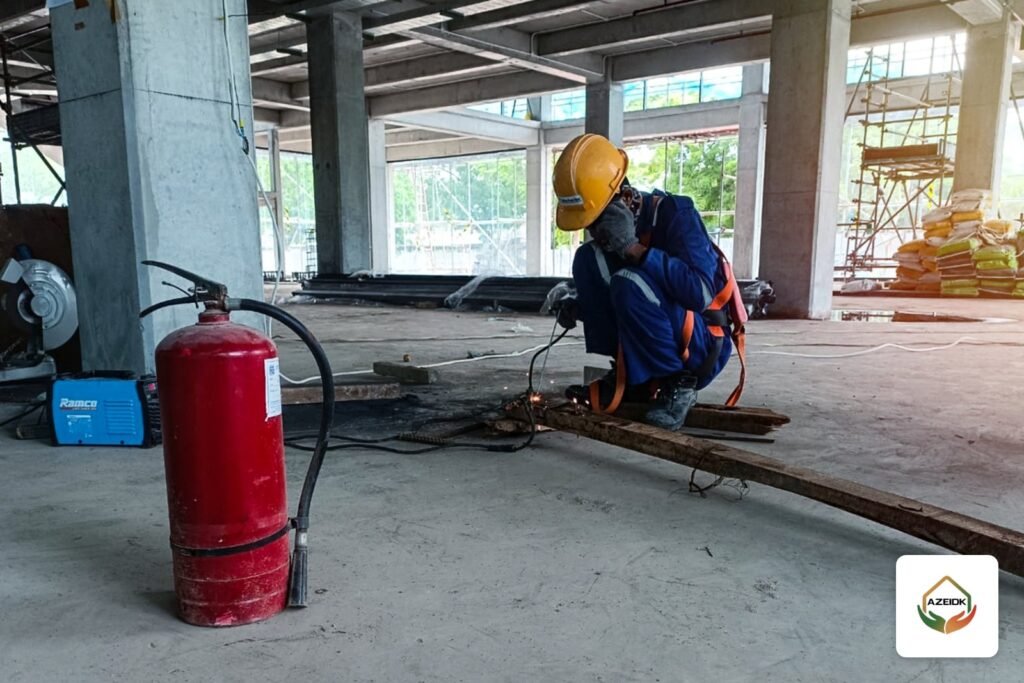
A construction site changes every week: a new slab is poured, the paint store moves, and a welding set travels from the ground floor to the roof. A fixed extinguisher plan written once at mobilisation cannot keep up. This guide explains how to choose and place fire extinguishers for construction sites: hot work points first, then paint, fuel and generator areas, then site offices, caravans and tower cranes, on projects such as the New Administrative Capital, New Alamein and Ain Sokhna.
AZEIDK Egypt supplies PYRAMID extinguishers (dry powder, wheeled powder, CO2, AFFF foam and automatic units) and provides maintenance services. See the fire extinguishers solution page for details.
Key takeaways
- Site fires usually start from hot work, flammable liquids or temporary electrics.
- Every welding or cutting point needs an extinguisher at the work position, not in the store.
- Paint and diesel stores need foam or powder close by, and a wheeled unit for large quantities.
- The number of extinguishers grows with every new floor. A common reference is at least one next to the stair on each floor.
- Sun and dust on open sites make monthly inspection essential, and more frequent checks are better in harsh conditions.
In this article
- Why a construction site is different from a finished building
- Fire extinguishers for construction sites by hazard area
- Welding and cutting points: the extinguisher moves with the crew
- Paint stores, fuel and generators
- Caravans, site offices and cranes
- Quantities grow as the floors go up
- Sun and dust on Capital and coastal sites
- Monthly inspection and maintenance during construction
- Common mistakes with construction site extinguishers
- Frequently asked questions
- Conclusion
Why a construction site is different from a finished building
A finished building has a fixed fire protection design. In Egypt it is governed by the Egyptian Code for the Design and Implementation of Fire Protection for Buildings, 2026 edition (Ministerial Decree No. 355 of 2026). A building under construction has no working sprinklers or complete alarm system yet, so portable extinguishers are almost the only first line of defence.
On site the fire load changes, subcontractor crews rotate, and combustibles (timber, cardboard, insulation, paint, diesel) sit in temporary locations. Many consultants base project safety plans on international references: NFPA 241 for safeguarding construction, alteration and demolition operations, NFPA 51B (2024 edition) for fire prevention during welding, cutting and other hot work, and NFPA 10 (2026 edition) for portable fire extinguishers. These are guidance references, not Egyptian law in themselves. What binds the contractor is the approved project safety plan and the contract specification.
Fire extinguishers for construction sites by hazard area
The table links each common site area to the most suitable PYRAMID extinguisher available in Egypt, in sizes actually available. The final choice depends on the risk assessment and on the rating on the label and in the datasheet.
| Site area | Main hazard | Suggested extinguisher |
|---|---|---|
| Welding, cutting and grinding points | Sparks and hot slag on timber, cardboard and insulation | ABC dry powder, 6 or 9 kg, at every work point |
| Paint and solvent store | Flammable liquids and vapours | AFFF foam 9 L or ABC powder, plus a 25 or 45 L wheeled foam unit for large stores |
| Diesel tank and equipment refuelling point | Fuel spills | Wheeled powder 25 or 50 kg, or wheeled foam |
| Temporary generators | Fuel and electrical equipment | ABC powder 6 or 9 kg, plus CO2 for the distribution board |
| Temporary electrical panels | Electrical fire | CO2, 3 or 6 kg |
| Caravans and site offices | Paper, furniture and IT equipment | ABC powder 6 kg at the door, CO2 next to computers and printers |
| Tower crane cab and heavy plant | Electrics and oils in a tight space | Small ABC powder, 1 or 3 kg, on a bracket |
| Timber, formwork and insulation store | Fast-burning solid materials | ABC powder 9 or 12 kg, wheeled if the area is large |
Welding and cutting points: the extinguisher moves with the crew
Welding, cutting and grinding are the best-known causes of site fires: sparks travel far and drop through slab openings and formwork to the floors below. The US OSHA construction regulation (29 CFR 1926.352) requires suitable fire extinguishing equipment to be immediately available in the work area and ready for use. It also requires combustibles to be moved or protected first, and a fire watch during the work and for a sufficient time afterwards when normal precautions are not enough. NFPA 51B (2024 edition) covers hot work permits and fire watch in more detail.
In practice this means:
- A 6 or 9 kg ABC powder extinguisher is issued with the hot work permit and stays with the welding crew as it moves.
- When welding on a wall or slab, a second extinguisher goes on the other side or on the floor below, because heat and sparks can pass through.
- No hot work near a paint store or where solvent vapours are present. The same regulation prohibits it.
- The fire watch checks the extinguisher before each shift: gauge in the green, pin and seal in place, hose undamaged.
Paint stores, fuel and generators
OSHA 1926.150 requires an extinguisher rated at least 10B within 50 ft (about 15 m) of any place where more than 5 gallons (about 19 L) of flammable or combustible liquids, or more than 5 lb of flammable gas, are in use. It is a useful reference figure, not an Egyptian legal requirement.
Paint store
The PYRAMID AFFF foam extinguisher in 6 or 9 L suits fires in oils, petroleum products and hydrocarbon solvents. Place it outside the store door so nobody walks towards the fire to reach it. For alcohol-based or polar solvents, confirm suitability with the supplier before relying on it alone. For large quantities, add a 25 or 45 L wheeled foam unit.
Diesel tank and generators
A temporary generator puts fuel and electrics in one place, so ABC dry powder is the main choice beside it, with a CO2 unit for its distribution board. A refuelling point or a large diesel tank suits a wheeled extinguisher with 25 or 50 kg of powder, which gives more agent and a longer throw. Position it so the operator approaches with the wind behind them, not in the corner behind the tank.
Caravans, site offices and cranes
A site caravan holds paper, drawings, computers and appliances on temporary power. A 6 kg ABC powder unit at the entrance usually suits a small caravan, with CO2 near the computers or electrical board because it leaves no residue. For labour camps and larger site offices, calculate the number by floor area and travel distance, as explained in how many fire extinguishers you need.
In a tower crane cab or on excavators and loaders, the tight space calls for a 1 or 3 kg powder unit in a bracket that resists vibration. Check the machine manual in case it specifies a type or location.
Quantities grow as the floors go up
A common mistake is counting extinguishers once at project start. Every new floor needs its own units, and units move with every relocated store. Reference figures from OSHA 1926.150 for construction:
- One extinguisher rated at least 2A for each 3,000 sq ft (about 280 m²) of protected building area.
- Travel distance from any point to the nearest extinguisher not more than 100 ft (about 30 m).
- At least one extinguisher rated at least 2A on each floor, and in multi-storey buildings at least one next to a stairway.
Check each size’s rating on its label and datasheet; do not assume every 6 kg unit has the same rating. Update the layout drawing at each stage and number and log every unit, so a moved or used one is spotted at once.
Sun and dust on Capital and coastal sites
Open sites expose extinguishers to sun, dust and sand, and North Coast and Sokhna sites add humidity and salt. These attack the paint, valve and hose, and shell temperature can exceed the manufacturer’s operating limits.
- Check the operating temperature range in the datasheet, and protect exposed units with a cover, cabinet or shade.
- Mount the extinguisher on a bracket, wall or stand, never on the ground where dust buries it or plant hits it.
- Clean sand from the hose and nozzle, because a blocked outlet can stop the agent discharging.
Monthly inspection and maintenance during construction
According to Amerex’s summary of NFPA 10 (2026 edition), each extinguisher is inspected at least every 30 days unless an approved alternative inspection program is in place, with annual maintenance and periodic testing by qualified personnel. On site, weekly checks are good practice for units near hot work and stores, because they are used or moved more often.
After any use, even partial, swap the unit for a charged one and send it for recharging. Keep spares in the site store to cover the gap. Inspection and recharging are covered in fire extinguisher maintenance and recharging, and maintenance support on the AZEIDK Egypt services page.
Common mistakes with construction site extinguishers
- Keeping all extinguishers in the store caravan, far from the work areas.
- Relying on CO2 alone in open areas, where the wind disperses the gas quickly.
- Placing water or foam extinguishers next to live temporary electrical panels.
- Leaving a partly used extinguisher in place as if it were still serviceable.
- Not moving the extinguishers when the paint store or generator is relocated.
- Buying extinguishers with no quality mark or clear label to save money on a temporary project.
Frequently asked questions
What is the best fire extinguisher for a building site?
ABC dry powder, because it covers solid, liquid and electrical fires. Add foam for paint stores and CO2 for electrical panels.
How many extinguishers does each floor of a building under construction need?
At least one per floor next to the stair, then more for floor area, travel distance, hot work and stores. OSHA, for example, gives one 2A unit per about 280 m² and a maximum travel distance of 30 m.
Does every welding machine need an extinguisher next to it?
Yes as good practice. The OSHA construction regulation requires firefighting equipment to be immediately available in the hot work area.
Which extinguisher suits a site paint store?
AFFF foam or ABC powder outside the store door, with a wheeled foam unit for large quantities. Check the type of solvents stored.
How often should site extinguishers be inspected?
The usual reference, NFPA 10, calls for inspection at least every 30 days. On site, weekly checks are better for units near hot work and stores.
Is a CO2 extinguisher suitable for open areas on site?
Not as a first choice, because wind disperses the gas. Use CO2 for panels and equipment inside caravans and rooms, and powder outdoors.
Conclusion
Fire extinguishers for construction sites are chosen by hazard area and work stage, not by count alone: welding points first, then paint, fuel and generator areas, then caravans and cranes. Update the layout with every floor, inspect at least monthly, and shield units from sun and dust.
Mobilising a new site or adding floors? Send us the project stages and hot work and store locations, and the AZEIDK Egypt team will propose PYRAMID extinguisher types and sizes. Talk to the AZEIDK Egypt team
Related guides
- Fire Triangle and Fire Classes A, B, C, D and K: Choosing the Right Extinguisher
- Fire Alarm Elevator Interface: Lift Recall, AHU Shutdown, Door Release and Gas Shut-off with Context Plus Outputs
- PYRAMID AFFF Foam Extinguishers: 6 to 45 L and When to Use Them
- Restaurant Fire Suppression: Sizing HoodSafer HS-4, HS-8 or HS-16