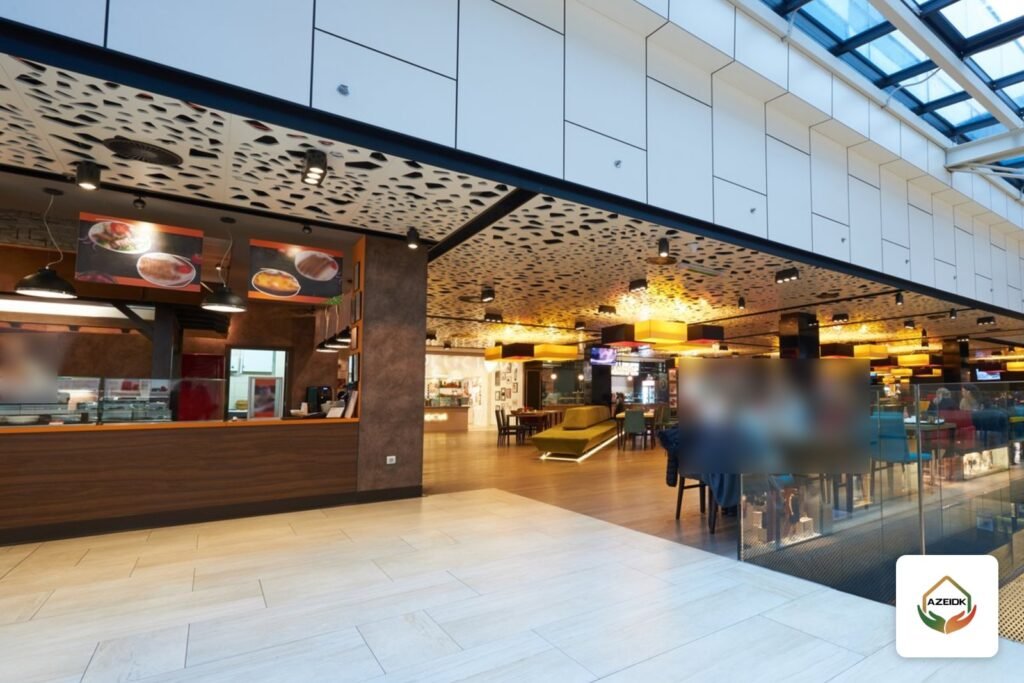
A food court in an Egyptian mall is a row of commercial kitchens, each with its own tenant and hood, all sharing one building, one fire alarm system and often one gas network. Food court kitchen fire suppression needs a clear decision on three points: an independent system for each unit, a signal that reaches the mall fire alarm panel, and automatic shutoff of gas and electric power to the cooking appliances.
This article covers how duties split between landlord and tenant, how a kitchen fire suppression system ties into the alarm panel, and how duct cleaning is coordinated.
Key takeaways
- The clearest approach in a food court is an independent suppression system per kitchen unit, covering its cooking surfaces, filters and duct entry.
- NFPA 96 requires the actuation of the automatic extinguishing system to actuate the building fire alarm system where one is provided.
- According to US fire department guides based on the IFC and NFPA 17A, gas and the electric power that produces heat shut off to the protected appliances when the system operates, and come back only after a manual reset.
- Mall management sets the specification, the alarm connection point and the shared duct cleaning schedule. The tenant supplies and maintains its own system.
- The binding reference in Egypt is the Egyptian fire code (2026 edition) and what the General Directorate of Civil Protection approves. NFPA is a design reference.
In this article
- Food court kitchen fire suppression: why it differs from a stand-alone restaurant
- One system per unit or one system for the whole food court?
- Splitting responsibility between mall management and the tenant
- Connecting to the mall fire alarm panel
- Gas and power shutoff on actuation
- Coordinating duct cleaning and maintenance
- When the tenant or the appliance layout changes
- Common mistakes in food court kitchens
- Frequently asked questions
- Conclusion
Food court kitchen fire suppression: why it differs from a stand-alone restaurant
In a stand-alone restaurant one owner controls the kitchen, duct and alarm panel. In a food court the unit belongs to the tenant, the alarm panel and sprinklers belong to the mall, and the duct may join a vertical riser serving several units. Tenants also change often, each bringing new appliances.
So most weak points are administrative: a system designed for the previous tenant’s appliances, a signal that never reaches the control room, or a gas valve that misses an appliance added later. Our article on mall fire protection covers the mall as a whole. This one focuses on the kitchens only.
One system per unit or one system for the whole food court?
One large system for a row of units is hard to manage: a discharge in one unit means recharging and stopping cooking in every unit tied to it. The better choice is a dedicated system per unit, with its own agent cylinder, manual pull station and gas valve.
What does the unit system cover?
The HoodSafer system supplied by AZEIDK Egypt protects the hood, filters, duct and cooking appliances with a wet chemical agent. The HS series is fully mechanical and needs no pressurised components for actuation. The HSP series uses pneumatic detection. The system operates automatically on heat or manually from a pull station, and shuts off gas to the kitchen through a gas shutoff valve. The HS-4, HS-8 or HS-16 model is selected by the number of flow points the unit’s appliances need. It is tested to EN 17446:2021 (BSI Kitemark KM 767382) and approved by Civil Protection.
Sizing starts from the actual appliance layout under the hood, not from the unit’s floor area.
Splitting responsibility between mall management and the tenant
Settle these duties in the tenant fit-out guide and the lease before fit-out. A common split:
| Item | Mall management (landlord) | Tenant |
|---|---|---|
| Kitchen suppression specification | Sets it in the tenant guide (system type, required approvals, connection point) | Follows it and submits the submittal for review |
| Supply and installation over the hood | Reviews drawings and attends acceptance | Supplies and installs through a specialist |
| Connection to the mall alarm panel | Provides the input module on the loop, programs it and labels the address | Provides the actuation signal from its system to the connection point, by the method set in the datasheet and submittal |
| Gas shutoff valve | Defines the unit valve location on the mall gas network, if any | Installs the system valve on the unit line and tests it |
| Power shutoff to electric appliances | Checks it at acceptance | Wires it in the unit panel, driven by the system |
| Duct inside the unit | Requires a cleaning schedule and asks for reports | Cleans it and keeps the reports |
| Shared vertical riser and roof fan | Cleans, maintains and schedules it | Gives access and keeps to the schedule |
| System maintenance and recharge | Tracks a valid maintenance certificate | Holds the maintenance contract and recharges after any discharge |
The alarm connection has two sides. If nobody writes down who provides the input module and who runs the cable, the unit is never connected.
Connecting to the mall fire alarm panel
NFPA 96, the US standard for ventilation control and fire protection of commercial cooking operations, requires that where a building has a fire alarm system, actuation of the automatic kitchen extinguishing system must actuate the fire alarm system. In Egypt it is a design reference; the approved Civil Protection drawings decide.
In practice, the unit system’s actuation signal is wired to an input module on the addressable panel loop. How the suppression system itself outputs that signal should be checked in the datasheet for the selected model and fixed in the submittal before the design is approved. Do not assume a specific component without that confirmation. Context Plus addressable panels (ZFP series) work with input/output modules for interfacing with building systems. Agree on the following with the alarm contractor:
- A separate address for each kitchen unit, labelled with its name and number, so the control room knows which unit discharged without searching.
- What the mall does on receiving the signal: general alarm, or zone alarm first and then escalation, per the approved project scenario.
- What happens to the unit’s exhaust fan, whether it keeps running or stops, per the system manufacturer’s instructions and the approved design, not an improvised decision by the HVAC contractor.
- A live signal test at acceptance and at every service visit.
Gas and power shutoff on actuation
US fire department guides (Thornton and Arlington), based on the IFC and NFPA 17A, state this clearly: when the suppression system operates, every fuel source and all electric power that produces heat in the appliances it protects must shut off, and the shutoff devices need a manual reset before gas or power is restored. Otherwise the oil can reignite after discharge ends.
Gas in the food court
HoodSafer closes the gas shutoff valve on the unit line when it operates, automatically or manually. The valve must sit on the line feeding every gas appliance under the hood, not on one appliance branch. Any gas appliance added later must be downstream of the system valve.
Electric appliances
Electric fryers, grills and ovens under the hood need shutoff too. This is usually done in the unit’s electrical panel with a contactor that drops these circuits when the suppression system operates, with a manual reset. Confirm how the signal is taken from the datasheet and the submittal.
Coordinating duct cleaning and maintenance
Grease in a shared duct can carry fire far from the unit. According to the Kansas State Fire Marshal’s summary of NFPA 96 (based on earlier editions of the standard), with the same schedule appearing in the Massachusetts fire code, grease build-up inspection frequency depends on the type of cooking: monthly for solid fuel cooking, quarterly for high-volume cooking such as 24-hour operation, charbroiling or wok cooking, semiannually for moderate volume, and annually for low volume. The same source calls for hood suppression system service at least every six months.
These intervals come from official US summaries. Check the current edition of NFPA 96 before using them in a design. They are not Egyptian legal frequencies. In a food court:
- One mall schedule for the shared riser and roof fans, outside trading hours.
- Each unit’s duct cleaned on the same date or before, so the unit is not clean while the shared riser stays dirty, or the other way round.
- Notice to the suppression maintenance company before cleaning, since hood work can move nozzles.
For semiannual service and recharge details, see our article on HoodSafer kitchen suppression maintenance.
When the tenant or the appliance layout changes
A new tenant may swap a grill for two fryers or extend the hood, leaving an appliance without a nozzle. The tenant guide should therefore require a design review of the system on any appliance change, and a full re-acceptance: discharge or function test per the manufacturer’s instructions, gas shutoff, power shutoff and the signal reaching the mall panel. The closest case, with several brands in one place, is covered in our article on cloud kitchen fire suppression.
Common mistakes in food court kitchens
- Relying on the food court ceiling sprinklers instead of a hood system. Water sprinklers are not suitable for oil fires on cooking appliances.
- A working suppression system that is not connected to the alarm panel.
- One address on the alarm panel for all units.
- A gas valve that closes the line to one appliance only, while other appliances under the same hood keep running.
- A manual pull station deep inside the kitchen, away from the path of egress or behind equipment, so staff cannot reach it during a fire.
- Handing over a unit to a new tenant without re-testing the previous tenant’s system after the appliances change.
Frequently asked questions
Are the mall sprinklers enough to protect food court kitchens?
No. Sprinklers protect seating and corridors, not oil fires on appliances. Every hood needs a wet chemical kitchen suppression system covering surfaces, filters and duct.
Who pays for the unit suppression system, the mall or the tenant?
Commonly the tenant supplies and maintains it, while the mall sets the specification and provides the alarm connection point. Write the split into the lease.
Must the kitchen suppression system be connected to the mall alarm panel?
NFPA 96 requires actuation of the automatic extinguishing system to actuate the building fire alarm system where one exists. In Egypt the final decision rests with the drawings approved by Civil Protection, and connecting it is the right practice in any mall.
Does HoodSafer cut power to electric fryers?
The system shuts off gas through its gas shutoff valve. Electric appliances are usually isolated from the unit’s electrical panel. How the actuation signal is taken from the system should be confirmed in the datasheet for the selected model and fixed in the submittal.
How often should a food court kitchen duct be cleaned?
According to US fire marshal summaries of NFPA 96, the frequency depends on the type of cooking: from monthly for solid fuel to annually for low volume, with quarterly for high-volume cooking. Check the current edition of the standard. Most food court units that fry and grill for long hours are closer to the high-volume category.
Conclusion
Food court kitchen fire suppression works when three things are settled on paper before installation: an independent system per unit sized on its actual appliances, an actuation signal with its own address on the mall alarm panel, and automatic gas and power shutoff that only comes back manually. Then keep a joint cleaning schedule and re-test on every tenant change. AZEIDK Egypt provides technical consultancy, supply, installation, testing and maintenance for HoodSafer systems and Context Plus panels.
Fitting out a new food court or reviewing the tenant guide of an existing mall? Send us the appliance layout under each hood and the alarm panel schematic, and we will propose a system for each unit and how to connect it. Talk to the AZEIDK Egypt team