


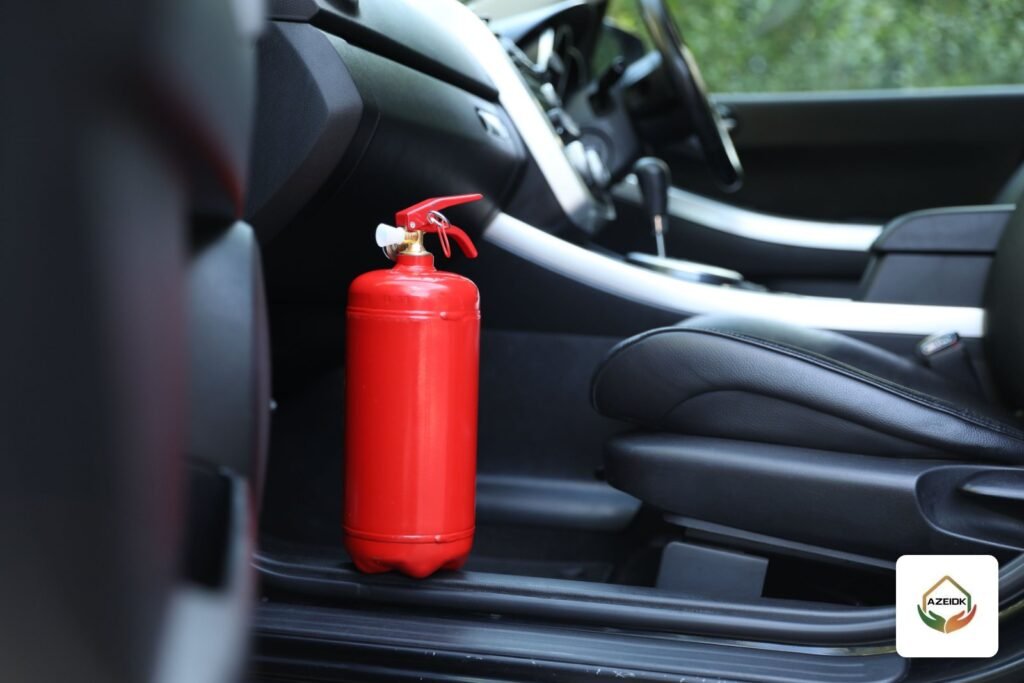
When you license a vehicle in Egypt or renew its licence, the inspector at the traffic unit checks for a car fire extinguisher that works and sits within the driver’s reach. Any extinguisher will not do. The executive regulations of the Traffic Law set the type, the minimum weight and the number of units for each vehicle category: private car, taxi, pickup, bus or fuel tanker.
This article sets out what the regulation says, separates the legal requirement from good practice in mounting and upkeep, and then works out quantities for a company fleet. AZEIDK GROUP supplies PYRAMID dry powder extinguishers in 1, 3 and 6 kg sizes in Egypt through its fire extinguisher solutions for companies and fleet operators.
Key takeaways
- The requirement is in the executive regulations of Traffic Law No. 66 of 1973, issued by Minister of Interior Decree No. 1613 of 2008, in the article on fire extinguishing equipment.
- Private cars, taxis, hearses, agricultural tractors and tuk-tuks: one ABC dry powder extinguisher of at least 1 kg.
- Pickups and vehicles up to 3 tonnes: one ABC dry powder extinguisher of at least 3 kg.
- Buses, gas and petroleum tankers and other goods vehicles: two dry powder extinguishers of at least 6 kg each.
- The extinguisher is checked at first licensing and at every technical inspection, and its type is recorded on the vehicle licence.
- The regulation requires conformity with international standards or Egyptian Standard 734 of 1992; the current mandatory Egyptian standard for portable extinguishers is ES 8442/2021.
In this article
- Where the Traffic Law sets the requirement
- Car fire extinguisher requirements by vehicle type
- The standard in the regulation and the current standard
- What the technical inspection usually checks
- Mounting the extinguisher in the vehicle
- Company fleets: quantities and a replacement plan
- Common mistakes when equipping a vehicle
- Frequently asked questions
- Conclusion
Where the Traffic Law sets the requirement
Traffic Law No. 66 of 1973 sets the general framework. The technical vehicle details sit in its executive regulations, issued by Minister of Interior Decree No. 1613 of 2008. Among the technical conditions for vehicles there is an article on fire extinguishing equipment. It is Article 152 in the published text of the regulations, while some news sites cite it as Article 155. The numbering difference does not change the content:
- Every vehicle carries extinguishers that conform to international standards or Egyptian Standard No. 734 of 1992, with no specific trade name required.
- The extinguisher must be serviceable and within reach of the driver and passengers, not buried under a load or locked away.
- The extinguisher type is recorded on the vehicle licence.
- The extinguisher is checked at first licensing and at every technical inspection, and the traffic unit then issues a validity certificate for a fee.
The text does not require a specific brand. What matters is type, weight, conformity and condition.
Car fire extinguisher requirements by vehicle type
The regulation splits vehicles into four groups. The table gives the minimum for each:
| Vehicle type | Units | Type | Minimum size |
|---|---|---|---|
| Liquefied gas and petroleum tankers, other goods vehicles, and tractors with non-agricultural trailers | 2 | ABC dry powder | 6 kg each |
| Pickups and vehicles with a payload up to 3 tonnes | 1 | ABC dry powder | 3 kg |
| Passenger buses | 2 | Dry powder | 6 kg each |
| Private cars, taxis, hearses, agricultural tractors and tuk-tuks | 1 | ABC dry powder | 1 kg |
These weights are minimums, so a 2 kg unit in a private car or a 6 kg unit in a pickup is acceptable where space allows. For vehicles whose category is not obvious, such as a microbus, the category on the vehicle licence decides. Ask the traffic unit that holds the vehicle’s file before you buy.
The standard in the regulation and the current standard
The text accepts conformity with international standards or with Egyptian Standard No. 734 of 1992, a reference written years before the Egyptian standards were updated. The current mandatory Egyptian standard for portable extinguishers is ES 8442/2021, issued under Decree 220 of 2021, and the Egyptian Organization for Standardization and Quality (EOS) grants the Egyptian quality mark to models that pass its tests.
In practice, the inspector checks that the extinguisher is the right type and weight, has a clear label and shows pressure in the green zone. If you run a large fleet, ask the traffic unit you deal with about any extra labelling requirement before you order large quantities. For the full picture on Egyptian extinguisher standards and the quality mark, see Egyptian fire extinguisher standards.
If an imported car comes with a factory extinguisher, news reports say it is accepted when it conforms to the standards, subject to the competent authority. The inspector’s decision is final, so do not assume acceptance.
What the technical inspection usually checks
The regulation requires the extinguisher to be checked but does not list the inspection items. Anyone who licenses vehicles regularly knows what inspectors look at, and you can prepare for it:
- The extinguisher is where the driver can reach it, not at the bottom of the boot under cargo.
- The pressure gauge reads green, and the pin and tamper seal are intact.
- The label is legible: ABC type, weight and fill date.
- The cylinder has no rust or dents, and the hose or nozzle is not cracked.
- The number of units matches the vehicle category, especially on buses and heavy goods vehicles that need two.
An extinguisher with low pressure, or one filled a long time ago, may be rejected even at the right weight. To know when to refill and when to replace, see fire extinguisher expiry.
Mounting the extinguisher in the vehicle
The law asks for the extinguisher to be within reach. How it is fixed is good practice, guided by the manufacturer’s manual and the vehicle itself. In daily use these points help:
- Use a bracket: a loose extinguisher on the floor becomes a projectile under hard braking. A metal bracket under the front seat or beside the driver in a car, or next to the entry door in a bus, is the usual answer.
- Heat: a car parked in the August sun gets very hot inside. Check the operating temperature range on the extinguisher label, and keep it off the dashboard and away from direct sun behind glass.
- Vibration: powder can compact after long periods of road vibration. Turning the extinguisher over now and then and checking the gauge monthly is a useful habit, especially in goods vehicles on highways.
- After any use: even a one-second squeeze means the unit needs refilling, because pressure leaks once the valve has opened.
Company fleets: quantities and a replacement plan
A distribution company in 10th of Ramadan, 6th of October or Sadat City may run dozens of vehicles across several categories. Start from the vehicle licences, not from estimates. A hypothetical mixed fleet:
| Category | Vehicles | Per vehicle | Total |
|---|---|---|---|
| Private cars (sales reps) | 10 | 1 x 1 kg | 10 x 1 kg |
| Pickups up to 3 tonnes | 6 | 1 x 3 kg | 6 x 3 kg |
| Staff buses | 4 | 2 x 6 kg | 8 x 6 kg |
| Diesel tankers | 2 | 2 x 6 kg | 4 x 6 kg |
That is 28 extinguishers: 10 at 1 kg, 6 at 3 kg and 12 at 6 kg. A useful fleet practice is to keep a small spare stock of each size, so a replacement goes in at once when a unit is sent for refilling or after use, and no vehicle is held back from licensing or work. It also helps to track extinguisher checks against each vehicle’s technical inspection date in one schedule.
Dry powder extinguishers from PYRAMID cover all three required sizes at 1, 3 and 6 kg. According to the brand page on the AZEIDK site, they conform to EN3 and Egyptian Standard ES 8442/2021, are approved by EOS and carry the Egyptian quality mark. To compare sizes and where each fits, see PYRAMID dry powder extinguishers.
Common mistakes when equipping a vehicle
- Buying a 1 kg extinguisher for a pickup that needs at least 3 kg.
- Fitting one extinguisher in a bus or tanker that needs two.
- Choosing an unlabelled unit without a quality mark because it is cheaper, then failing inspection. To tell a genuine extinguisher from a fake, see genuine vs counterfeit fire extinguishers.
- Leaving the extinguisher loose in the boot under cargo, out of the driver’s reach the text requires.
- Putting the extinguisher back after a short discharge without refilling it.
- Ordering for a whole fleet at once without checking each vehicle’s licence category.
Frequently asked questions
What size extinguisher does a private car need in Egypt?
One ABC dry powder extinguisher of at least 1 kg. The same applies to taxis, hearses, agricultural tractors and tuk-tuks.
What does a pickup need?
Pickups and vehicles with a payload up to 3 tonnes need one ABC dry powder extinguisher of at least 3 kg.
How many extinguishers does a bus need?
Two dry powder units of at least 6 kg each. Gas and petroleum tankers and other heavy goods vehicles need the same, and for them the ABC type is specified.
Which article sets the requirement?
The article on fire extinguishing equipment in the executive regulations of Traffic Law No. 66 of 1973 (Minister of Interior Decree No. 1613 of 2008). It is Article 152 in the published text, and some sites cite it as Article 155.
Is the extinguisher checked at licence renewal?
Yes. The text requires a check at first licensing and at every technical inspection, and the extinguisher type is recorded on the vehicle licence.
Can I use a CO2 extinguisher in the car instead of powder?
The text specifies dry powder for every category and the ABC type for most. Do not rely on CO2 or foam to meet the licensing requirement.
Is a specific brand required?
No. The requirement covers type, weight, conformity and condition, not a brand.
Conclusion
Choosing a car fire extinguisher starts with the vehicle category on the licence: 1 kg for private cars and taxis, 3 kg for pickups, and two 6 kg units for buses, heavy goods vehicles and tankers, all dry powder. Then comes proper mounting and regular checks, so the vehicle passes inspection and the extinguisher actually works when needed. For fleets, counting from the licences and keeping an organised spare stock saves a lot of downtime.
Running a transport fleet or staff buses? Send us the number of vehicles in each category, and we will prepare the PYRAMID extinguisher quantities you need with the datasheets. Talk to the AZEIDK GROUP Egypt team





