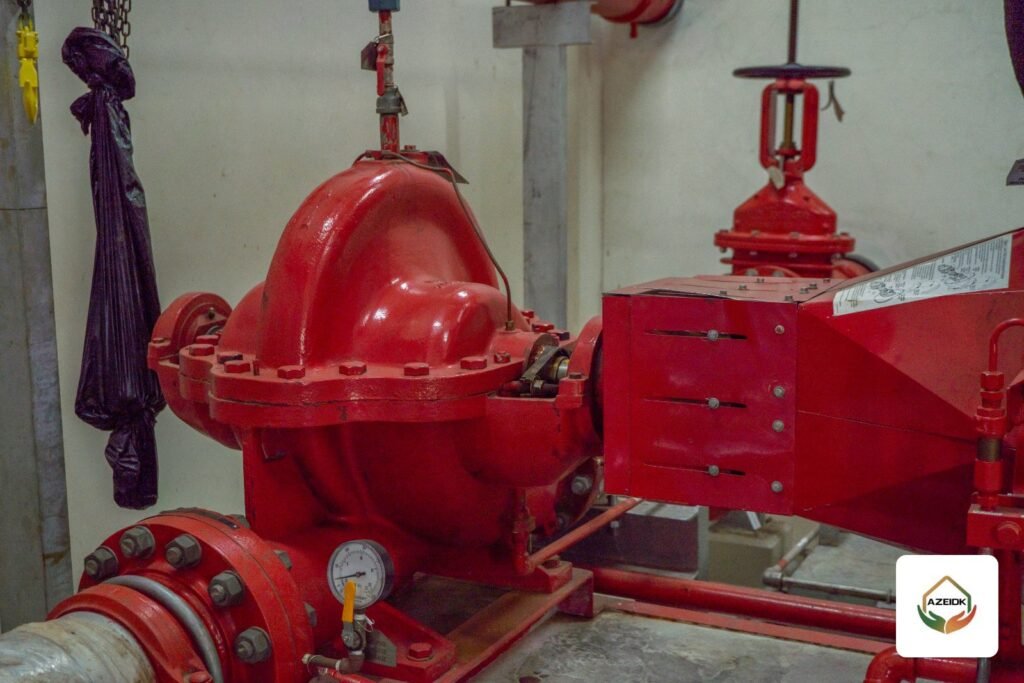
When a designer writes “fire pump 750 gpm at 9 bar” in a specification, they fix one point on the performance curve. The datasheet says much more: what the pump delivers when demand rises, the highest pressure that can reach the network, the motor power and current, the diesel engine and the jockey pump. This guide walks through the published datasheet of the 3PUMP 750 gpm fire pump set at 9 bar, item by item.
The set is one of the duty points available in Egypt in the 3PUMP fire pump sets supplied by AZEIDK Egypt as part of its fire pump solutions. It is Non-Listed, and UL/FM versions can be supplied on request to project requirements.
Key takeaways
- The set: an electric main pump and a diesel standby pump, both end suction rated 750 GPM at 9 bar, plus a jockey pump and controllers on one base.
- At 150% of rated flow, the datasheet records 7.60 bar for the electric pump and 7.52 bar for the diesel pump, about 84% of rated pressure, above the 65% limit in NFPA 20.
- Churn pressure is 10.15 bar (electric) and 10.31 bar (diesel), about 113% and 115% of rated pressure, within the 140% upper limit.
- The motor is 75 kW (100 HP) at 415 V, with a full-load current of 141 A at 380 V.
- The diesel engine is a 4105BZ rated 80 kW, and the jockey pump is an RV10-10 rated 30 GPM at 9.5 bar.
In this article
- What a 750 GPM fire pump at 9 bar means in the units used in Egypt
- Electric and diesel pumps: the key data
- The 150% point and churn pressure: is the curve acceptable?
- The electric motor: what the electrical engineer needs
- Diesel engine, jockey pump and controllers
- When does this set suit your project?
- Common mistakes when reading a fire pump datasheet
- Frequently asked questions
- Conclusion
What a 750 GPM fire pump at 9 bar means in the units used in Egypt
750 US gallons per minute is about 170 cubic metres per hour, and 9 bar is about 130 psi. This is the rated point: the flow and pressure the pump is designed to deliver. The pump in this set carries the designation 3P 5×4-10.2 according to 3PUMP data for this duty point.
As an estimate under NFPA 14, the first standpipe in a standpipe system flows 500 gpm and each additional one adds 250 gpm, so 750 gpm often goes with buildings that have two risers. The final figure always comes from the approved hydraulic calculation. All duty points are compared in our article on selecting 3PUMP sets by flow and pressure.
Electric and diesel pumps: the key data
| Item | Electric main pump | Diesel standby pump |
|---|---|---|
| Type | End suction | End suction |
| Rated point | 750 GPM @ 9 bar | 750 GPM @ 9 bar |
| Speed | 2950 rpm | 3000 rpm |
| Pressure at 150% flow | 7.60 bar | 7.52 bar |
| Churn pressure | 10.15 bar | 10.31 bar |
| Casing | Cast iron | Cast iron |
| Shaft | Stainless steel | Stainless steel |
| Shaft seal | Mechanical seal | Mechanical seal |
Source: the published 3PUMP datasheet for the 750 GPM @ 9 bar set (Non-Listed). Ask for the project-specific datasheet at supply, as it is the reference in the submittal.
The 150% point and churn pressure: is the curve acceptable?
A fire pump does not always run at its rated point. If more outlets open than expected, flow rises and pressure drops. If outlets close, pressure rises up to churn. NFPA 20 therefore sets two conditions on the curve, as summarised by the Hydraulic Institute: the pump must deliver 150% of rated flow at no less than 65% of rated pressure, and churn pressure must fall between 101% and 140% of rated pressure. NFPA 20 is a technical reference for design and testing here; the binding rules in Egypt are the Egyptian fire protection code (2026 edition) and the General Directorate of Civil Protection requirements in the approved design.
Applying that to the datasheet figures:
- 65% of 9 bar is 5.85 bar. The datasheet records 7.60 bar (electric) and 7.52 bar (diesel) at 150% flow, about 1,125 gpm, which leaves a comfortable margin above the minimum.
- 140% of 9 bar is 12.6 bar. The recorded churn pressures of 10.15 and 10.31 bar are well below that upper limit.
Churn pressure matters in practice: it is the highest pressure the network will see from the pump, plus any suction pressure. Check it against the pressure rating of valves and pipes and against the pressure at lower-floor outlets. Field testing of these points is covered in our article on fire pump testing in Egypt.
The electric motor: what the electrical engineer needs
The datasheet gives the main pump motor as 75 kW (100 HP), 415 V three-phase 50 Hz, 2960 rpm, frame 250S-2, insulation class F, IP55 protection, 92.7% efficiency at full load in the IE2 class, and a weight of 515 kg. Full-load current is 141 A at 380 V, 134 A at 400 V and 129 A at 415 V.
These are the figures the electrical engineer needs to size the cable, the breaker and the supply. The power calculation method itself, with a worked example on a 1000 GPM set, is in our article on fire pump motor power calculation.
Diesel engine, jockey pump and controllers
Diesel engine
The datasheet engine is a 4105BZ: vertical, four cylinders, four-stroke, direct injection and water cooled, with a 105 x 118 mm bore and stroke, 4.087 L displacement, 80 kW (108 HP) rated power at 3000 rpm, 260 N·m maximum torque, electric start and a net mass of 380 kg. Sizing the diesel tank for this set is covered in our article on diesel fire pump fuel consumption and tank size.
Jockey pump
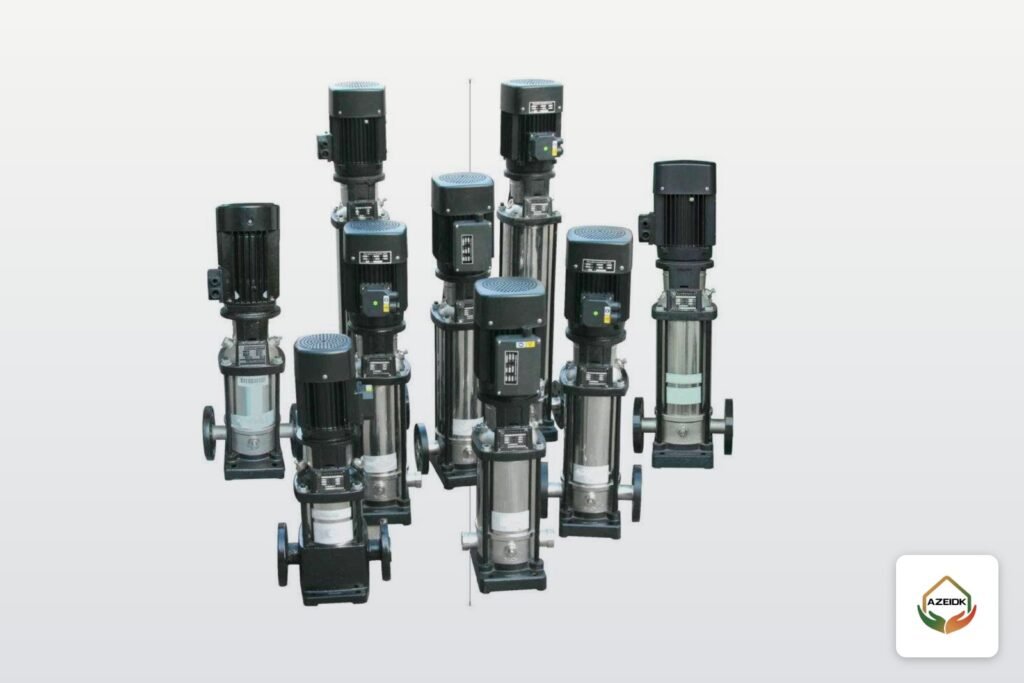
The jockey pump is an RV10-10 rated 30 GPM at 9.5 bar, with a 4.0 kW 50 Hz motor and stainless steel impeller and shaft. Its pressure is slightly above the main pump’s rated pressure because it holds the network above the main pump’s start point. Setting the start and stop pressures is explained in our article on the jockey pump in a fire system.
Controllers
The datasheet lists three individual controllers, one per pump, with a 415 V three-phase 50 Hz incoming supply. Controller types and selection criteria are covered in our article on fire pump controllers.
When does this set suit your project?
The set suits a project when the hydraulic calculation gives a demand of up to 750 gpm at no more than 9 bar at the pump. If the demand is lower in flow and slightly higher in pressure, the pump curve may still cover it, because pressure rises as flow falls until it reaches churn. That must be checked on the manufacturer’s actual curve, not estimated. If the demand goes beyond what the curve covers, the options are a higher duty point such as 1000 GPM @ 10 bar, or a UL/FM set built to the project.
Common mistakes when reading a fire pump datasheet
- Looking only at the rated point and ignoring the 150% point and churn pressure.
- Comparing offers on flow and pressure only, without comparing motor power, diesel engine and jockey pump.
- Forgetting that churn plus suction pressure is the highest pressure on valves and pipes.
- Writing “UL/FM” in the specification and then accepting a Non-Listed set, or the reverse, although approval is stated product by product.
- Not sending motor data to the electrical engineer early.
Frequently asked questions
How many cubic metres per hour is a 750 gpm pump?
About 170 cubic metres per hour at the 9 bar rated point.
What is the motor power of the 3PUMP 750 GPM @ 9 bar set?
75 kW (100 HP) at 415 V three-phase 50 Hz, according to the published datasheet.
Does the pump curve meet NFPA 20 conditions?
The datasheet figures at 150% flow (7.60 and 7.52 bar) are above 65% of rated pressure, and churn (10.15 and 10.31 bar) is within the 140% limit.
Is this set UL or FM approved?
The set available in Egypt is Non-Listed. 3PUMP manufactures UL/FM sets, supplied on request to project requirements.
Which jockey pump comes with it?
An RV10-10 rated 30 GPM at 9.5 bar with a 4.0 kW motor, according to the datasheet.
Where can I find the full datasheet?
It is published on the 3PUMP page of the AZEIDK Egypt website, and the project-specific datasheet is sent with the submittal at supply.
Conclusion
The 3PUMP 750 GPM @ 9 bar set is not one number but a data package: a curve that holds about 84% of pressure at 150% flow, churn at about 113%, a 75 kW motor, an 80 kW diesel engine and a 30 GPM jockey at 9.5 bar. Reading this data before approval avoids many surprises on site, from the motor cable to the pressure rating of the valves.
Reviewing a fire pump submittal or comparing offers? Send us the required duty point and project data, and we will send the right datasheet and review it with you. Talk to the AZEIDK Egypt team