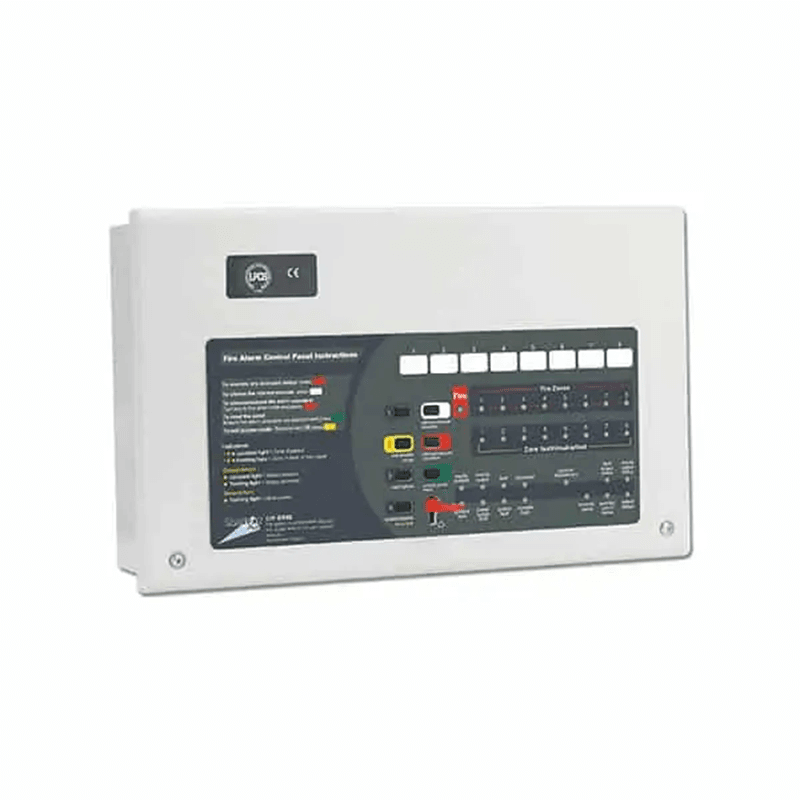
A fire pump does not decide to start on its own. The decision comes from the fire pump controller. It reads system pressure, starts the electric motor or diesel engine, and reports pump status to the fire alarm panel. A good pump with the wrong controller will not do its job in a fire.
Below: controller types, start and stop logic, sensing lines, alternate power, alarm signals, listing status and datasheet checks.
Key takeaways
- The electric starting method (across-the-line, star-delta, soft starter, autotransformer, VFD) depends on motor size and what the power source can take.
- A diesel controller cranks from two independent battery sets in turn and alarms if the engine fails to start.
- Starting is automatic on pressure drop. Stopping is manual, or automatic after a minimum run timer, as the designer specifies.
- Where the pump room is not constantly attended, NFPA 20 requires pump running and controller fault signals to reach an attended location. They can be wired to the fire alarm panel.
- 3PUMP sets supplied in Egypt are Non-UL (non-listed). UL/FM-listed versions are manufactured and supplied on request.
In this article
- What does a fire pump controller do?
- Electric fire pump controllers and starting methods
- Diesel engine controllers: batteries, crank cycles and alarms
- Start and stop logic and the pressure sensing line
- Alternate power and power transfer
- Signals to the fire alarm panel
- Listed and non-listed controllers
- What to check in the datasheet and submittal
- Common mistakes with fire pump controllers
- Frequently asked questions
- Conclusion
What does a fire pump controller do?
The controller is an electrical panel dedicated to one pump. It sits in the pump room within sight of the driver. It senses pressure, starts the driver, protects it without stopping the pump in a fire, stops it by a defined logic, and reports its status.
Unlike an industrial starter, it puts keeping the pump running before protecting the motor. So an electric controller has no thermal overload relay. Instead it uses locked rotor protection and a dedicated circuit breaker. It also has a mechanical emergency run handle that closes the contactor if the control circuits fail.
The reference framework in Egypt
The legal framework is Egyptian Building Law No. 119 of 2008 and its executive regulations, together with the Egyptian Code for the Design and Implementation of Fire Protection for Buildings — 2026 edition (Ministerial Decree No. 355 of 2026). Its Part 2 covers mechanical firefighting systems and Part 3 covers electrical requirements, detection and alarm. The General Directorate of Civil Protection (Ministry of Interior) reviews and approves the system drawings. NFPA 20 (2025 edition) is a technical reference that designers use for controller details. It becomes contractually binding when the project specification calls for it.
Electric fire pump controllers and starting methods
A motor on direct start draws several times its rated current. The starting method follows motor size, transformer or generator capacity, and the allowed voltage drop. Listed controllers come with across-the-line, star-delta (open or closed transition), part winding, primary reactor, autotransformer, soft start or variable speed starting. NFPA 20 (2025 edition) covers starting reactors and autotransformers, a paragraph NFPA amended through TIA 25-1.
| Starting method | How it works | Typical use | What to check |
|---|---|---|---|
| Across-the-line (DOL) | Connects the motor to full voltage at once | Small motors or a strong power supply | Can the transformer or generator handle full starting current? |
| Star-delta (Wye-Delta) | Starts in star, then switches to delta | Medium and large motors, to cut starting current | Suitable six-lead motor; open or closed transition |
| Autotransformer or primary reactor | Starts at reduced voltage through an autotransformer or reactor | Large motors on limited-capacity supplies | Component ratings, manufacturer instructions, motor compatibility |
| Soft starter | Ramps voltage up electronically, then closes a bypass contactor | When a smooth start and less water hammer are needed | Adjustable ramp time; backup across-the-line mode |
| Variable speed (VFD) | Adjusts motor speed to hold discharge pressure | Large swings in suction pressure, or to avoid overpressure | Bypass path if the drive fails; pump curves with and without variable speed |
A VFD does not replace pressure calculations. If variable speed mode fails, the pump runs at full speed. The designer must therefore compare shutoff pressure at rated speed with the system component ratings and decide whether a pressure relief valve is needed.
Diesel engine controllers: batteries, crank cycles and alarms
A diesel controller runs on battery DC power, because it must work when mains power is lost. It has two independent battery sets (A and B), each with an automatic charger, and alternates between them on each crank attempt.
In the specification of a listed diesel controller such as the Hubbell Metron FD2, for example, the sequence is six 15-second crank periods with 15-second rests. After six failed attempts, the controller raises a fail-to-start (overcrank) alarm.
Typical diesel controller alarms
- Fail to start after all crank cycles.
- Low oil pressure and high cooling water temperature.
- Overspeed, which is both an alarm and an engine shutdown.
- Failure of either battery set, or loss of charger output or its AC supply.
- Selector switch in the Off or Manual position.
Many diesel controllers include a weekly test timer that starts the engine by dropping pressure through a solenoid drain valve. See also fire pump testing in Egypt.
Start and stop logic and the pressure sensing line
Starting
The controller starts the pump automatically when pressure falls to the set start point. Manual and remote start (for example from a deluge system) are also possible. Modern controllers use a pressure transducer with a continuous, recorded reading instead of an on/off pressure switch.
Stopping
The common rule is automatic start, manual stop. Repeated starts with no clear cause must be investigated. Automatic stop is also possible after the start cause clears and a minimum run timer elapses. Hubbell Metron specifications, for example, give a factory setting of 10 minutes on the M700 electric controller and an adjustable 30 minutes on the FD2 diesel controller, so check the value in each model’s datasheet. The designer must state the required stop mode clearly.
The pressure sensing line
The controller takes its pressure signal from a small sensing line connected to the discharge piping, between the discharge check valve and the discharge control valve. Each controller has its own line, including the jockey pump controller. Some design specifications, such as the University of Florida standards, call for brass, copper or 300-series stainless steel. A wrong connection point or a blocked line leads to frequent or delayed starts. Its routing is part of the fire pump room layout.
Jockey pump controller
The jockey pump makes up small leaks so the main pump does not start without need. Its controller simply starts and stops between two pressure settings, set above the main pump start point. Electric and then diesel start points are staged below it, calculated per project.
Alternate power and power transfer
If normal power alone is not reliable enough, the designer adds an alternate source such as a standby generator, fed through a dedicated automatic transfer switch. In this case NFPA 20 requires a dedicated transfer switch for each fire pump, with the transfer taking place inside the pump room.
With a diesel standby pump, the designer decides whether the electric pump also needs an alternate source, per the Egyptian code and project specification. The generator must also handle the starting current.
Signals to the fire alarm panel
When the pump room is not constantly attended, NFPA 20 requires controller alarms to be sent to an attended location. This can be done through input modules on the fire alarm panel. Controllers provide dry contacts for these signals:
- Electric controller: pump running, power available or power loss, phase reversal or phase loss, and alternate source in use where a transfer switch is fitted.
- Diesel controller: pump running, switch in Off or Manual, battery failure, and a common fault covering fail to start, oil pressure, temperature, overspeed and charger.
Listed and non-listed controllers
NFPA 20 requires the controller to be listed for fire pump service. A UL listing or FM approval covers a specific model, horsepower, voltage and starting method. Verify it in the official UL and FM directories, not the catalogue.
3PUMP sets supplied in Egypt are complete packages (electric main pump, diesel standby pump and jockey pump) with their controllers on a common base. They are Non-UL (non-listed), with duty points of 500 GPM at 8 bar, 750 GPM at 9 bar, 1000 GPM at 10 bar, 1500 GPM at 10 bar and 1500 GPM at 12 bar. UL/FM-listed versions are manufactured and supplied on request. If the specification requires listed controllers, ask for the listed version from day one.
What to check in the datasheet and submittal
- Voltage, frequency and phases versus the site supply (for example 380 V, 50 Hz).
- Motor horsepower, full load current and a matching starting method.
- Breaker and isolating switch ratings, and withstand rating versus the fault level at the feeding panel.
- Listing status: listing body, file number and exact model, or a clear statement that it is non-listed.
- Default stop mode and the adjustment range of the minimum run timer.
- Pressure sensor type, range and event log.
- The list of dry contacts for remote signals, matched to the fire alarm panel points.
- Enclosure rating (for example NEMA 2, 4 or 12) for the room conditions and humidity.
- For diesel: battery voltage and capacity, charger type and weekly test timer.
Common mistakes with fire pump controllers
- Across-the-line starting of a large motor on a small generator or transformer, so the start fails.
- Connecting the jockey and main pump controllers to one shared sensing line, or tapping it after a closed valve, so the readings conflict.
- Start pressures not staged between jockey, electric and diesel pumps, so pumps cycle for no reason.
- Leaving the controller in Manual or Off after maintenance, unsupervised.
- Not wiring the alarm contacts to the fire alarm panel, so nobody knows about a battery failure or phase loss.
- Submitting a non-listed set where the specification requires listed controllers.
Frequently asked questions
Can a fire pump run from a standard motor starter panel?
It is not recommended. A standard panel trips the motor on overload and lacks the alarms, signals and start logic of a fire pump controller.
Which is better: star-delta or soft starter?
There is no single answer. It depends on motor size, supply capacity and voltage drop limits.
Why does a diesel controller need two batteries?
Starting depends entirely on the batteries. Two sets used in turn stop one weak set from causing a failed start.
Should the pump stop automatically once pressure recovers?
The common rule is manual stop. Automatic stop after a minimum run timer is allowed if the designer selects it and the authority accepts it.
Are 3PUMP sets supplied in Egypt UL listed?
No. Sets supplied in Egypt are Non-UL (non-listed). UL/FM-listed versions are manufactured and supplied on request.
Conclusion
Choosing a fire pump controller runs from driver and power supply, to starting method and stop logic, to sensing line and alarms, to listing status. Settle these before supply, not on site. For sizing flow and pressure, see our fire pump selection guide. For complete packages, see fire pump systems.
Specifying fire pump controllers for your project? Send us the flow, pressure, supply voltage and listing requirements, and we will propose a suitable set with its datasheet. Talk to the AZEIDK Egypt team