Electric vehicle fires differ from petrol car fires in one key way: a lithium-ion battery can enter thermal runaway, generating its own heat, continuing to burn and reigniting after it appears to be out. As electric vehicles arrive in showrooms and service workshops across Saudi Arabia, owners need to review detection, suppression, charging locations and how to handle a damaged car.
This guide draws on recently published findings from UL Research Institutes’ Fire Safety Research Institute (FSRI) and links them to what can be done in the building. It sits under AZEIDK’s fire fighting systems and fire alarm systems for the car showrooms and workshops sector.
Key points
- In FSRI experiments published in August 2026, each vehicle typically burned out within about 90 minutes of ignition.
- FSRI guidance tells responders to assume persistent reignition risk unless the battery is clearly burned out.
- Using EV fire blankets indoors or in confined spaces can present a significant deflagration risk.
- The 2022 edition of NFPA 13 moved car parks and showrooms to Ordinary Hazard Group 2 to address modern vehicle fires, according to NFSA.
- Staff in a showroom or workshop raise the alarm, evacuate and call Civil Defense; they do not try to extinguish a burning battery.
In this article
- Why electric vehicle fires are different
- Electric vehicle fires: what the latest research says
- Early detection in showrooms and workshops
- Sprinklers and hazard classification
- Charging points inside showrooms and workshops
- Extinguishers: what they can and cannot do
- A practical plan for a showroom or workshop
- Frequently asked questions
- Summary
Why electric vehicle fires are different
An EV battery is made of hundreds or thousands of cells in a sealed pack under the car. If a cell is damaged by impact, a defect or faulty charging, its temperature can rise and spread to neighbouring cells. This thermal runaway releases flammable and toxic gases and continues even with water on the outside, because water does not easily reach inside the pack.
FSRI’s report “Full-Scale Electric Vehicle Fire Experiments and Recommendations for Fire Incident Response”, released on 4 August 2026, covered free-burn tests on nine vehicles, six EVs and three internal combustion vehicles, with EV packs fully charged. FSRI reports that each vehicle typically burned out within about 90 minutes once ignited.
Electric vehicle fires: what the latest research says
| FSRI finding | What it means for a showroom or workshop |
|---|---|
| Water from a standard handline is the first-choice tactic; no special equipment is needed | Firefighting is Civil Defense’s job; the building system limits spread |
| Copious water on the vehicle and pack is ineffective due to vehicle construction | Rely on containment and limiting spread, not on water reaching the pack |
| Assume persistent reignition risk | A damaged car remains a hazard after the fire and needs an isolation spot |
| Towed vehicles held at least 5 m apart at the tow yard | Set aside an outdoor spot away from the building and other cars |
| Deflagration risk when using blankets indoors | A blanket is not an indoor solution for a showroom or bay |
| Release of heavy metals, fluoride and VOCs | Fast evacuation, ventilation and clean-up after the incident |
Early detection in showrooms and workshops
The FSRI page does not discuss detection, but the engineering logic is clear: the earlier evacuation starts and help is called, the less damage. Showrooms usually suit smoke detectors because the air is clean. Service bays may need heat detectors to avoid false alarms from exhaust and welding, with additional detection studied for the charging area. The designer sets the type and layout based on ceiling height and ventilation.
One point often missed: an EV damaged in an accident or showing a battery fault should not be brought into a busy bay before assessment, because FSRI guidance treats the risk of thermal runaway and reignition as persistent unless shown otherwise.
Sprinklers and hazard classification
The National Fire Sprinkler Association (NFSA) notes that the 2022 edition of NFPA 13 reclassified car parks and showrooms from Ordinary Hazard Group 1 to Group 2 to address modern-day vehicle fires, and lists electric vehicles and charging stations among the risks car parks now face. NFPA 13 is a technical reference adopted by the designer; in Saudi Arabia the binding rules are the Saudi Fire Protection Code SBC 801 and Civil Defense requirements. In practice this means higher density and smaller coverage per sprinkler in new designs. Sprinklers do not extinguish the battery from inside, but they cool the surroundings and stop spread to neighbouring cars and the building. See our article on parking garage fire protection.
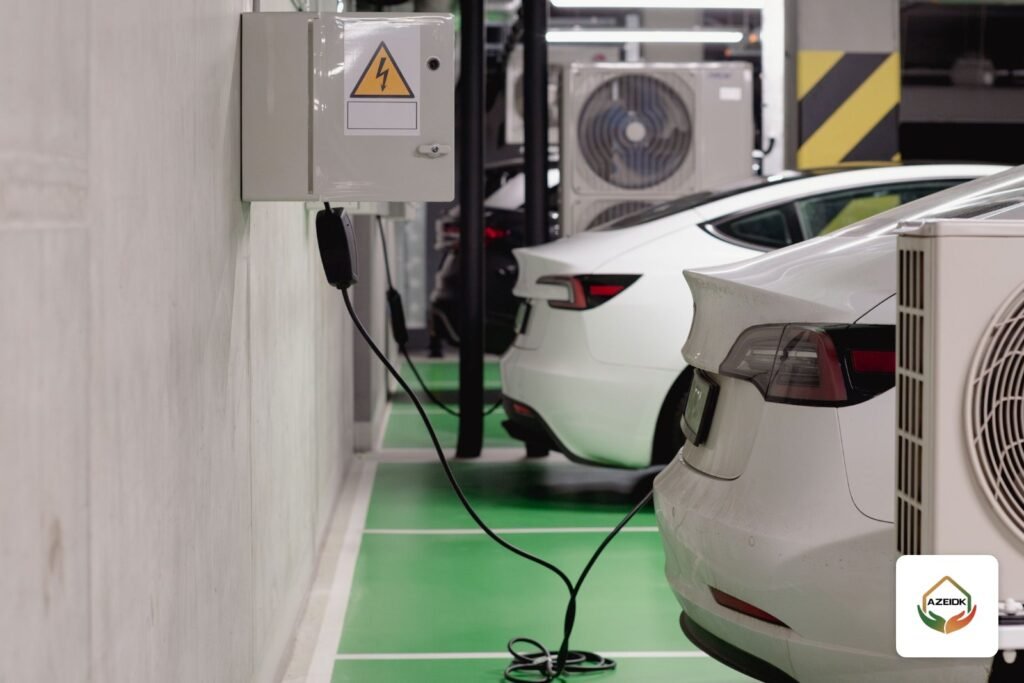
Charging points inside showrooms and workshops
- Location: near an exit or an area reachable from outside, not deep inside the showroom between cars.
- Separation: away from tyre stores, oils and packaging.
- Electrical isolation: a clear means of cutting power to chargers in an emergency, set by the electrical designer.
- Monitoring: cover the charging area with cameras and detectors linked to the alarm panel.
- Overnight charging: limit unattended charging after working hours.
Extinguishers: what they can and cannot do
An extinguisher helps with a small fire in the cabin or nearby materials before the battery is involved, and extinguishers must remain distributed through the showroom and bays as required. Once there are signs of battery thermal runaway, such as heavy smoke from under the car, popping sounds or jetting flames, no portable extinguisher is enough: raise the alarm, evacuate and call Civil Defense on 998. For loose battery storage in shops, see lithium battery storage in warehouses and shops.
A practical plan for a showroom or workshop
- Mark an outdoor isolation spot for a damaged EV on the site plan, away from the building and other cars.
- Review sprinkler classification if the design was based on an older NFPA 13 edition.
- Make sure the charging area has detection and cameras linked to the alarm panel.
- Train staff to recognise thermal runaway and to evacuate, not to fight a battery fire.
- Keep a wide route for Civil Defense crews to reach the vehicle.
AZEIDK’s engineering design and calculations service can review these points for an existing or new showroom.
Frequently asked questions
Are electric vehicles more likely to catch fire than petrol cars?
The FSRI report does not compare incident rates. It shows that battery fires behave differently, last longer and can reignite.
Do sprinklers put out an EV battery fire?
They do not extinguish the battery from inside, but they limit heat and stop spread to neighbouring cars and the building.
Is an EV fire blanket a solution inside a showroom?
FSRI guidance warns of deflagration risk when using these blankets indoors or in confined spaces, so they are not an indoor solution.
What should I do with an accident-damaged EV at my workshop?
Park it in an isolated outdoor spot away from the building and other cars, monitor it, and keep it out of the bay until the battery is assessed.
Do charging areas need special detectors?
The designer decides by location. What matters is detection suited to the conditions, linked to the alarm panel.
How long does an EV fire last?
In FSRI experiments each vehicle typically burned out within about 90 minutes of ignition, with reignition risk remaining afterwards.
Summary
Electric vehicles do not make a showroom or workshop dangerous by themselves, but they change the planning: early detection at charging points, sprinklers designed to a current classification, an isolation spot for damaged cars, and staff who know their role is to alarm and evacuate. These are design decisions, not decisions for the day of the incident.
Adding electric vehicles or chargers to your showroom or workshop? Send us the layout and proposed charging locations, and we will review detection, sprinklers and an isolation spot with you. Contact the AZEIDK team
Related guides
- Hotel Fire Maintenance Contract: Servicing Without Disturbing Guests, Room Schedules, Kitchens and the Safety Log
- Outdoor Fire Alarm Sounder IP65: Weatherproof Context Plus Sounders and Beacons for Roofs, Car Parks and Yards
- Access Control System Maintenance: Checking Locks, Readers and Controllers, and Door Release on Fire Alarm
- Common CCTV Camera Faults: No Video, Recording Stopped, Poor Night Vision and How to Fix Them