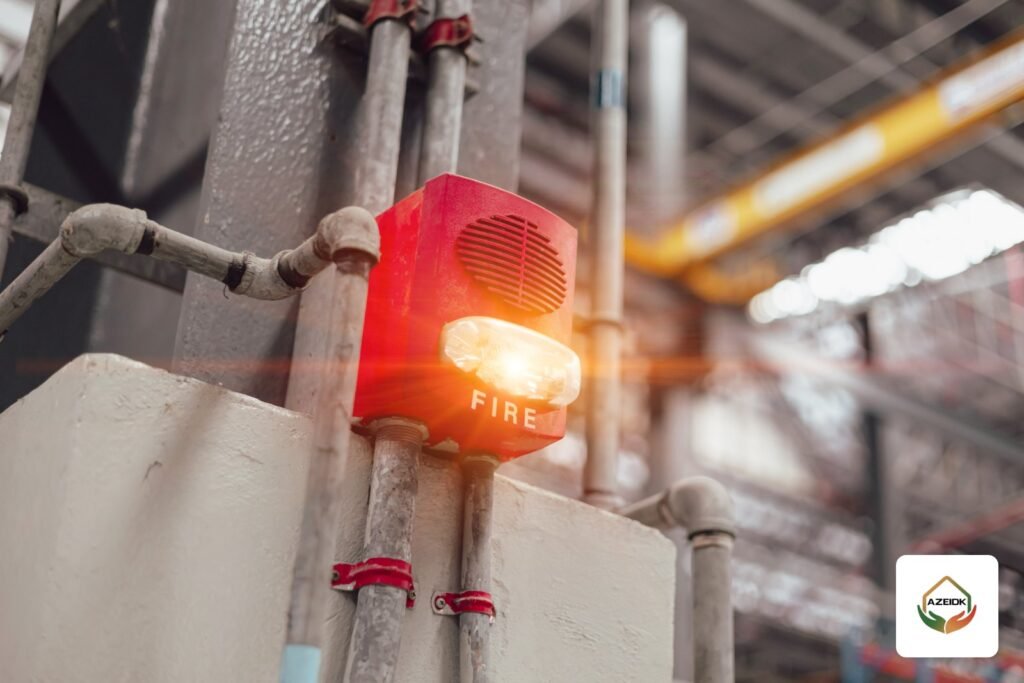
Industrial fire alarm systems differ from ordinary building alarms in one basic way: the signal has to rise above machinery noise, not disappear into it. NFPA 72 requires public mode audible signals at least 15 dB above the average ambient sound level, with a ceiling of 110 dBA. Where noise is very high or workers wear hearing protection, visible notification becomes a core part of the design, not an optional extra.
Key takeaways
- A factory alarm design starts by measuring the noise in each area during real production, not by using generic tables.
- NFPA 72: public mode audible signals at least 15 dB above the average ambient level, with a 110 dBA maximum.
- BS 5839-1: a general minimum of 65 dB(A), and in noisy areas such as factories at least 5 dB(A) above persistent background noise.
- NFPA 72 (2025 edition): an average ambient level above 105 dBA requires visible notification appliances.
- In very noisy areas, and where hearing protection is worn, visible devices (strobes or VADs) to UL 1971 or EN 54-23 are used.
- Classified hazardous areas need devices certified for explosive atmospheres, not a standard sounder.
In this article
- Industrial fire alarm systems: why is a factory different from other buildings?
- How loud must a sounder be above factory noise?
- When are visible alarms necessary in a factory?
- Are voice messages better than bells in a factory?
- Factory fire alarm by area: production, stores and hazardous zones
- Linking the alarm to machines and production lines
- Where does this sit in Civil Defense and Saudi Building Code requirements?
- Common mistakes in factory fire alarms
- Frequently asked questions
- Conclusion
Industrial fire alarm systems: why is a factory different from other buildings?
In an office building a standard sounder is usually enough because background noise is low. A factory is different: air compressors, presses, filling lines, extract fans and forklifts run through the whole shift. Some workers wear ear defenders as part of their PPE, others work in high-bay stores or open yards.
These conditions raise three questions before any device is selected. How loud is each area in practice? Will a worker wearing hearing protection hear the alarm? Is the area classified as an explosion risk because of flammable gas, vapour or dust? The answers decide the number and output of sounders, where strobes go, and what protection rating each device needs.
AZEIDK designs, supplies and installs fire alarm systems for industrial sites across the Kingdom, as part of its work for industrial facilities.
How loud must a sounder be above factory noise?
The two references most often written into Saudi project specifications are the American NFPA 72 and the British BS 5839-1. The designer works to one of them, depending on the specification and the consultant. The table summarises the key figures:
| Item | NFPA 72 | BS 5839-1 |
|---|---|---|
| General rule | 15 dB above the average ambient level in public mode | 65 dB(A) minimum in occupied areas |
| Sustained noise | Tone signals may instead be designed to the masked threshold method using octave band analysis rather than dBA levels | At least 5 dB(A) above persistent background noise |
| Maximum | 110 dBA at the minimum hearing distance | Check the text of the standard adopted for the project |
| Alternative in high noise | Average ambient above 105 dBA requires visible appliances (Section 18.4.1.1, 2025 edition) | Visual alarm devices (VADs) where sound alone is not enough |
In practice, if the average noise in a production hall is 90 dBA, the 15 dB rule calls for 105 dBA at every point in the hall. That is very close to the 110 dBA ceiling and hard to achieve evenly without making the sound harmful for anyone standing next to a device. This is why factory designs usually move from “a louder sounder” to “more sounders plus strobes”.
How is factory noise measured before design?
Use an A-weighted sound level meter (dBA) during full production, not on a day off or during a shutdown. Record the average level for each area separately: compressor house, production line, store, control room, workshop. For a plant still under construction, ask the owner or machine supplier for expected noise levels, then measure again during testing and commissioning.
After installation, the alarm level itself is measured in each area and recorded in the test report. Consultants check this closely at handover, and it should be repeated after any major change to production lines.
When are visible alarms necessary in a factory?
NFPA 72 (2025) requires visible notification where the average ambient level exceeds 105 dBA, and its annex notes that hearing protection reduces both machine noise and the alarm signal, so the designer has to account for it when designing the audible signal where workers wear it. In practice, strobes, or VADs (visual alarm devices), are needed in three common factory situations: noise that cannot be overcome safely by sound, areas where workers wear hearing protection, and staff with hearing loss. Many plants also add strobes in control rooms and attached offices so the signal is the same across the whole site.
Visible devices have their own standards. On the American route, strobes are tested to UL 1971 and rated in candela according to room size and mounting height. On the European route, EN 54-23 sets the performance of visual alarm devices and classifies them by mounting: ceiling (C), wall (W) or open class (O), where the manufacturer states the coverage, and must deliver at least 0.4 lux across the whole coverage area. Either way, the device is selected from the manufacturer’s official datasheet, and a device tested to one route is not used with the other route’s calculations. Our article on choosing UL or EN 54 alarm devices explains the difference.
Devices AZEIDK offers in this area include Notifier L-Series horn strobes and the Honeywell Gent S-Cubed sounder, voice and strobe unit. The right model for each area is chosen after reviewing the datasheet with the consultant.
Are voice messages better than bells in a factory?
Large halls with metal roofs create strong reverberation that makes speech hard to understand. A voice evacuation system only works in a factory if it is designed for speech intelligibility, not just loudness. Voice messages are very useful in the plant’s office blocks, and in large sites that need phased evacuation or different instructions for each building. See our article on voice evacuation alarm systems.
A common approach: noisy production halls use a clear alarm tone with strobes, while offices, meeting rooms and prayer rooms use voice messages or speakers. The final decision follows the project specification and the consultant’s approval.
Factory fire alarm by area: production, stores and hazardous zones
One factory contains areas that behave very differently, and each needs its own detection and alarm choices:
| Area | Main challenge | Alarm considerations | Detection considerations |
|---|---|---|---|
| Production halls | High noise, dust, heat, hearing protection | Enough sounders, with strobes in workers’ line of sight | Detectors suited to dust and heat, such as heat detectors instead of smoke detectors in some locations |
| High-bay stores | Height, racking, forklift traffic | Devices seen and heard in the aisles, not only above the racks | Detector type chosen for height and stored materials |
| Classified hazardous areas | Flammable gas, vapour or dust | Sounders and strobes certified for explosive atmospheres to suit the zone | Explosion-proof detectors such as certified flame detectors |
| Open yards | Dust, sun, rain, vehicle noise | Devices with an ingress protection (IP) rating suitable for outdoor use | Based on the hazard in the yard |
| Control rooms and offices | Low noise, more people | Standard sounders or voice, with strobes as specified | Standard smoke detectors |
In classified areas the most expensive mistake is installing a standard sounder or strobe where a device certified for explosive atmospheres is required. The zone classification is set by the process engineer or consultant, and the device and its certificate are chosen to match. For detection, AZEIDK offers the SFP-IR3-EXD explosion-proof triple IR flame detector; its protection type is checked in the datasheet against the zone before approval. For heat detection in production halls, see heat detector types and installation.
Linking the alarm to machines and production lines
In a factory the alarm panel does more than sound the sounders. Many projects need outputs to other systems: stopping extract fans or air handling units, opening certain gates, signalling the control room, or releasing a suppression system in a specific area. Every one of these links is written into the cause and effect matrix and approved before programming.
The key rule is that an alarm must not stop an industrial process in a way that creates a new hazard, and production managers must know in advance what will stop and what will keep running. Our article on the fire alarm cause and effect matrix explains how it is prepared.
Where does this sit in Civil Defense and Saudi Building Code requirements?
Factories in the Kingdom fall under the Saudi Fire Protection Code SBC 801 and the requirements of the General Directorate of Civil Defense, and the alarm layout is approved as part of the facility’s fire protection file. The detailed figures for sound levels and strobe layout come from the technical standard the designer adopts in the specification, usually NFPA 72 or BS 5839-1. Calculations and reports must therefore follow one clear standard, and the selected devices must be tested on the same route.
AZEIDK prepares and follows up approval files through its Civil Defense approval support service, and produces the calculations and drawings under engineering design and calculations.
Common mistakes in factory fire alarms
- Using the same number of sounders as an office in a noisy production hall.
- Designing on an assumed noise figure instead of measuring.
- Placing strobes behind machines or above racking where workers cannot see them.
- Turning up one device instead of adding devices, so the level next to it exceeds the limit.
- Installing devices not certified for explosive atmospheres in classified zones.
- Changing production lines or adding machines without re-measuring alarm levels.
Frequently asked questions
What fire alarm sound level is required in a factory?
Under NFPA 72, public mode audible signals must be at least 15 dB above the average ambient level, without exceeding 110 dBA. Under BS 5839-1 the general minimum is 65 dB(A), and at least 5 dB(A) above persistent background noise in noisy areas.
Is a bell enough in a production hall?
In a relatively quiet hall it can be, if it reaches the required level at every point. In noisy halls or where hearing protection is worn, strobes are added. The decision depends on the measured noise.
What is the difference between a UL 1971 strobe and an EN 54-23 VAD?
They are separate test routes. The first is rated in candela and laid out using NFPA 72 tables; the second is classified by mounting and the coverage declared by the manufacturer. Do not mix the two in one set of calculations.
Do I need explosion-proof devices across the whole factory?
No. Devices certified for explosive atmospheres are needed only in classified zones, as defined by the consultant or process engineer. The rest of the plant uses standard devices suited to its conditions.
When should the alarm level be re-measured?
At handover, and after any major change to production lines, new machines or changes to hall layouts, because the average noise changes and so does the required level.
Is voice evacuation suitable for production halls?
It can be, if it is designed for speech intelligibility despite reverberation and noise. Many factories use an alarm tone with strobes in the halls and voice messages in offices and admin buildings.
Conclusion
An industrial fire alarm system succeeds when every worker in every corner knows there is a fire, whatever the noise and whatever they are wearing. That starts with measuring real noise, then laying out sounders and strobes to the adopted standard, choosing suitable devices for hazardous zones, and finally measuring and recording the result at handover.
Planning a factory fire alarm, or reviewing an existing one? Send us the plant layout and what happens in each area, and the AZEIDK technical team will review device layout and selection. Talk to the AZEIDK team
Related guides
- Fire Hose Reel Guide: Lengths, Bores, Installation and Inspection in Saudi Arabia
- Fire Alarm System Installation in Saudi Arabia: Stages, Cabling and Pre-Approval Checks
- Fire Department Connection (FDC): Location, Components, Check Valve and Required Sign
- Fire Extinguisher Safety Pin and Tamper Seal: Purpose, Replacement and What a Broken Seal Means at Inspection