Bakery requirements in Saudi Arabia are set by the Ministry of Municipalities and Housing document “Requirements for Bakeries and Sweets” (1447 AH / 2025). On the safety side, the key points are Civil Defense approval before the licence, reference to the Saudi Fire Protection Code (SBC 801), ovens fuelled by gas, electricity or charcoal, non-combustible ceilings, and chimneys built to the ministry’s guide. Extinguishers, hood suppression and gas detection are decided by the code and by the type of cooking in the bakery, and that is what this article explains.
Key takeaways
- The document classifies bakeries as regular (including Arabic flatbread and tannour bakeries) or semi-automatic, plus sweets preparation and sweets sales shops.
- Minimum area is 16 m² for regular bakeries and sweets shops, and 150 m² for semi-automatic bakeries.
- Civil Defense approval is required before licensing, and all fire requirements are referred to SBC 801.
- Frying oil must not exceed 190°C, and used oil is collected in sealed, labelled containers.
- Where there is deep frying, a Class K kitchen extinguisher must be within about 9 m (30 ft) of the hazard under NFPA 10.
In this article
- What are the bakery requirements and who do they cover?
- Oven and tannour requirements: fuel, ceiling and chimney
- Gas in the bakery: cylinders, piping and gas detection
- Exhaust hood, frying oil and hood suppression
- Kitchen extinguisher and other extinguishers in a bakery
- Electrical, ventilation, cameras and first aid
- Quick table: what the document says and what you prepare
- Steps to license a bakery on the safety side
- Frequently asked questions
- Conclusion
What are the bakery requirements and who do they cover?
The reference is “Requirements for Bakeries and Sweets”, published by the Ministry of Municipalities and Housing (MOMAH), edition 1447 AH. It covers four activity types:
- Regular bakeries: including Arabic flatbread and tannour bakeries, the neighbourhood bakeries everyone knows.
- Semi-automatic bakeries: workers handle some steps such as kneading and shaping, while baking itself is automated.
- Sweets preparation shops.
- Sweets sales shops selling products from licensed factories.
Minimum area is 16 m² for regular bakeries and sweets shops and 150 m² for semi-automatic bakeries; kiosks need 4 m² in malls and markets and 10 m² on commercial land. One notable clause: a mezzanine is generally limited to one third of the floor below, rising to one half where an approved automatic extinguishing system and audible alarm are installed.
Under licensing requirements (clause 2.1) the document requires Civil Defense approval before the licence is issued. So safety preparation starts before the Balady application, which is what AZEIDK’s Civil Defense approval support covers.
Oven and tannour requirements: fuel, ceiling and chimney
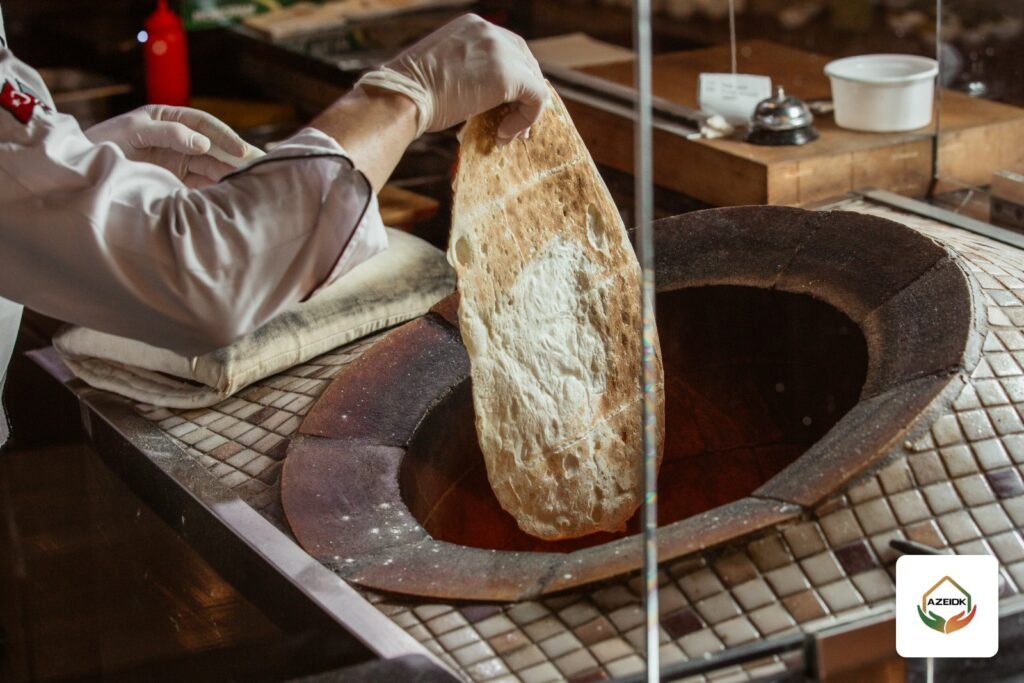
Clause 5.4.3 allows stoves and ovens to run on gas, electricity or charcoal according to the facility’s needs. Wood is not listed as a fuel, so if a tannour burns wood, check with the municipality before fitting out.
The document sets no clearances between the oven or tannour and the rest of the shop. Those details are reviewed under SBC 801 and Civil Defense requirements (clause 4.9.1), and the 2024 edition of the Saudi Building Code has been mandatory since 30 June 2025. The document does set three items tied directly to fire:
- Suspended ceilings in preparation areas must be non-combustible (clause 4.5.8).
- Walls must be fire and moisture resistant and easy to clean (clause 4.5.1).
- Chimneys must follow the ministry’s “Guide to Chimneys for Commercial Activities” (clause 4.7).
In practice, the tannour and the oven are the hottest points in the bakery. Keep flour sacks, cartons and plastics away from them, store nothing above the oven, and inspect and clean the chimney regularly so soot and grease do not build up.
Gas in the bakery: cylinders, piping and gas detection
The bakery document does not detail gas requirements. Clause 5.6 only requires the facility to maintain its service lines, including gas piping. Gas network design and the location of cylinders or a tank fall under the building code and Civil Defense requirements and should be reviewed with a specialist before installation.
Our advice for gas-fired bakeries: install a gas leak detector in the oven area for early warning, ideally linked to an automatic shut-off (solenoid) valve that cuts the gas on a leak. AZEIDK supplies gas detection systems for restaurants and buildings.
If you smell gas, Civil Defense sets out the correct steps: do not touch electrical switches or light a flame, get staff out, close the valve if it is safe to do so, open windows and doors, then call emergency services.
Exhaust hood, frying oil and hood suppression
Many bakeries also fry: pastries, fatayer and sweets such as luqaimat. The document deals with oil directly:
- Frying oil must not exceed 190°C, and oil is cooled at intervals between 90°C and 120°C (clause 5.5.4).
- Used oils and fats are collected in sealed, labelled containers, stored separately and disposed of properly (clause 5.8).
- Flour and sugar sifting areas need mechanical dust extraction (clause 5.5.4).
The bakery document does not mention hood suppression. Whether one is needed is decided by the fire code and Civil Defense review based on the cooking equipment, especially fryers that produce grease-laden vapours. If the bakery has a frying station under a hood, raise it with the designer early. AZEIDK supplies and installs kitchen fire suppression systems from brands such as Hood Safer, ANSUL and American Fire Control.
Kitchen extinguisher and other extinguishers in a bakery
Dry powder alone is not suited to a frying oil fire. For that hazard you use a wet chemical (Class K) extinguisher. Under NFPA 10, as summarised by the US Occupational Safety and Health Administration (OSHA), the travel distance to a Class K extinguisher must not exceed 30 ft (about 9 m) from the hazard. One example is the FG 6 kg wet chemical extinguisher.
The rest of the bakery usually needs dry powder for flour, carton and wood fires, and CO2 near the electrical panel and dough mixers. Quantity and spacing follow the area and the code; the fire extinguisher calculator gives a first estimate, and all types are in the fire extinguishers category. Place the kitchen extinguisher near the exit of the oven area, not behind the fryer, so staff can reach it without passing the fire.
Electrical, ventilation, cameras and first aid
- Electrical: comply with the Saudi Building Code including its electrical requirements; the Saudi Electrical Code SBC 401 is listed among the references.
- Ventilation: designed to the code, openings covered outside with metal mesh, and room temperature not above 25°C (clause 4.7).
- Cameras: security cameras installed under the Security Surveillance Cameras Law and its regulations (clause 5.3); cameras and screens may also be used to show customers the preparation area. See the Security Cameras Law article.
- First aid: a first aid box in the facility (clause 5.1).
- Exits: semi-automatic bakeries need emergency-only doors opening directly outward, and stairs and walkways must be free of anything that blocks evacuation.
Quick table: what the document says and what you prepare
| Item | What the bakery requirements say | What to prepare on site |
|---|---|---|
| Civil Defense | Approval before the licence (2.1) | Salamah licence before applying on Balady |
| Fire protection | Refer to SBC 801 (4.9.1) | Site survey to set extinguishers and any required system |
| Ovens and tannour | Gas, electricity or charcoal (5.4.3) | Keep combustibles away, clean the chimney |
| Ceiling and walls | Non-combustible suspended ceiling, fire-resistant walls | Check materials before finishing |
| Gas | Maintain gas piping (5.6) | Leak detector and automatic shut-off valve |
| Frying oil | Max 190°C, containers for used oil | Class K extinguisher nearby, hood suppression if required |
| Cameras | Per the Security Cameras Law (5.3) | Cover entrance, cashier and preparation area |
| First aid | First aid box (5.1) | Stocked box in a known location |
Steps to license a bakery on the safety side
- Confirm the bakery type and area, since semi-automatic bakeries carry wider requirements.
- Fix the positions of ovens, tannour, chimney and gas piping before finishing works.
- Book a site survey to set extinguishers and any hood suppression or gas detection.
- Install extinguishers and cameras and stock the first aid box.
- Go through the Salamah inspection checklist and the Salamah certificate guide, then apply on Salamah.
- After licensing, keep extinguishers and systems serviced under preventive maintenance contracts.
Frequently asked questions
Does a bakery need a Civil Defense licence?
Yes. The bakery and sweets requirements make Civil Defense approval a condition before the municipal licence, obtained through the Salamah platform.
What is the minimum area for a bakery?
16 m² for regular bakeries and sweets shops, 150 m² for semi-automatic bakeries, and 4 m² for kiosks inside malls and markets.
Is a charcoal tannour allowed?
The document allows ovens and stoves running on gas, electricity or charcoal. Wood is not listed, so check with the municipality before fitting out.
Which fire extinguisher suits a bakery?
A wet chemical (Class K) unit near the fryers, dry powder for general fires, and CO2 near the electrical panel. The number follows the area and the code.
Is hood suppression mandatory in a bakery?
The bakery document does not mention it. The fire code and Civil Defense review decide based on the cooking equipment, especially frying that produces grease-laden vapours.
Do traditional bakeries need a gas detector?
The document does not require one explicitly, but it is an important safeguard in any gas-fired bakery, ideally linked to an automatic shut-off valve.
Conclusion
Bakery safety requirements start with Civil Defense approval and are completed by SBC 801. The document sets the allowed fuels, frying oil temperature, chimneys and ceilings, and leaves the extinguisher count, hood suppression and gas detection to a specialist assessment of the bakery. Sorting these points early avoids costly changes after finishing works.
Fitting out a bakery for licensing? The AZEIDK team can survey the site, set the right extinguishers, gas detection and hood suppression, and support your Civil Defense requirements. Talk to the AZEIDK team
AZEIDK supplies fire extinguishers of all common types and sells them to individuals and businesses from its branches in Saudi Arabia.
Related guides
- How to Test Smoke Detectors: Monthly Checks, Battery Changes and When to Replace
- Car Fire Extinguisher: Right Type and Size, Where to Mount It, How to Check It and Why It Must Stay Out of the Sun
- CCTV Shop in Madinah: Directory of Companies and Shops and How to Check Licensing
- Automatic Ceiling Fire Extinguishers and CO2 Extinguishers for Electrical and Server Rooms: SFFECO SFM and CD