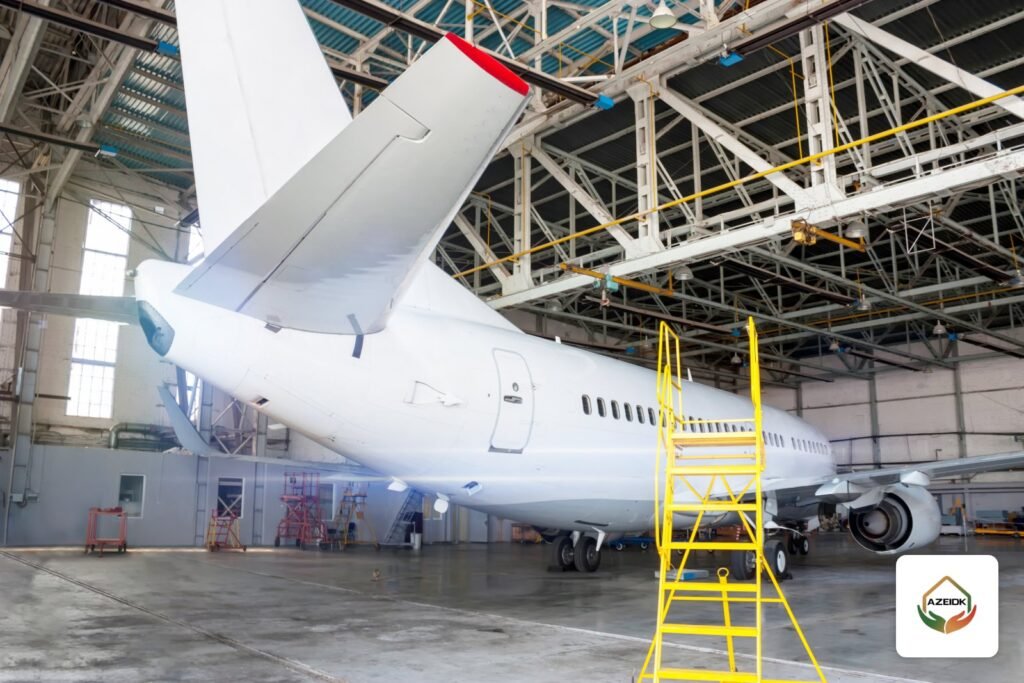
NFPA 409 is the standard used to design fire protection for aircraft hangars. It starts by placing the hangar in a group based on aircraft access door height, single fire area and construction type, and that group decides whether foam is needed, which type, and how spilled fuel must drain from the floor. The main hazard in a hangar is a fuel spill fire under the wings and fuselage, so the protection relies on foam, fast flame detection and a floor that stops fuel from spreading. This article explains those three elements for a Saudi project and links them to AZEIDK’s special fire suppression systems.
Key takeaways
- The current edition is NFPA 409 (2026). Tentative Interim Amendment TIA 26-1, effective 22 December 2025, changes sprinkler and foam discharge device rules.
- The hangar group (I, II, III or IV) drives the protection scheme. Settle it before selecting any equipment.
- Group I hangars usually need foam. Since the 2022 edition, some Group II hangars can be exempted under conditions.
- Multi-spectrum infrared flame detection is a common way to actuate foam systems, subject to AHJ approval.
- Floor drainage for spilled fuel is part of the design and has its own periodic tests in the standard.
In this article
- What is NFPA 409 and why does it matter for hangar projects in Saudi Arabia?
- How are aircraft hangars classified under NFPA 409?
- When does a hangar need foam, and what are the options?
- Which foam system components need careful selection?
- What role do flame detectors play in hangar foam actuation?
- Why is fuel drainage part of the protection?
- Common mistakes on hangar projects
- Frequently asked questions
- Conclusion
What is NFPA 409 and why does it matter for hangar projects in Saudi Arabia?
NFPA 409, Standard on Aircraft Hangars, covers construction, separation, floor drainage, suppression systems, testing and maintenance. The 2022 edition brought major changes, and the 2026 edition followed, announced by the US National Air Transportation Association (NATA) on 10 February 2026.
In Saudi Arabia, NFPA standards are technical references adopted by the designer and consultant. The final approval sits with Civil Defense and with the authority responsible for the airport or facility. State the adopted edition in the design basis from day one, then submit through the Salamah platform as part of Civil Defense approval support.
NFPA also issued TIA 409-26-1 on 2 December 2025, effective 22 December 2025. It revises sections 7.4.6.7, 7.5.4.10, 7.5.5.6 and 7.5.13.6 and adds 7.5.12.2.4. Among other points, foam discharge devices must be listed for the foam concentrate actually used, and nominal K-80 (K-5.6) or K-115 (K-8.0) and larger sprinklers are permitted in specific sections.
How are aircraft hangars classified under NFPA 409?
Classification comes first. It depends on aircraft access door height, single fire area and construction type. The table below follows NATA guidance based on the 2022 edition. Check it against the edition adopted for your project, because the 2026 edition changed some limits.
| Group | Short description | Typical protection |
|---|---|---|
| Group I | Access door 28 ft or higher, or a fire area above 40,000 ft² | Foam usually required |
| Group II | Mid-size fire areas, roughly 12,000 to 40,000 ft² depending on construction type | Foam or accepted alternatives, under conditions |
| Group III | Smaller hangars with lower doors | Depends on hazardous operations inside |
| Group IV | Membrane-covered rigid steel frame structures | Depends on area and the standard’s requirements |
According to NATA, the 2026 edition sets a minimum aircraft access door height of 35 ft for Group II, restores the separation criteria for Group III hangar clusters, and defines hazardous operations as activities that increase the likelihood of a fuel spill fire. These changes can move a hangar into a different group, so do not rely on an old classification.
When does a hangar need foam, and what are the options?
Foam is the main agent against a fuel spill fire. It blankets the fuel surface, cuts off oxygen and cools the fuel. Based on the available sources for NFPA 409 editions, the options include:
- Foam-water deluge: the standard defines it as a foam-water sprinkler or spray system with open discharge devices. It is released through a deluge valve such as the Cla-Val 134-05 solenoid-operated deluge valve. For the differences between system types, see wet, dry, pre-action and deluge sprinkler systems.
- Ceiling sprinklers with low-level foam: water sprinklers at roof level plus foam monitors or nozzles near the floor to cover the area under the aircraft. This is where SFFECO foam monitors fit; their page lists aircraft hangars among suitable sites.
- High-expansion foam: generators fill the hangar with a deep foam layer. NATA notes that hi-ex usually needs less concentrate.
- Closed-head sprinklers with synthetic fluorine-free foam: one of the alternatives NATA lists for Group II and III hangars.
Since the 2022 edition, NATA reports that Group II hangars that prohibit hazardous operations can be exempted from foam, that risk assessment and performance-based design paths are available, and that ignitable liquid drainage floors can be used instead of foam in defined cases. Any of these alternatives needs AHJ agreement before detailed design.
Which foam system components need careful selection?
A hangar foam system is a chain. One weak link stops the whole system:
- Fire pumps: sized for the largest combined water and foam demand. AZEIDK supplies WATEX UL/FM fire pumps, sized per project.
- Bladder tank and proportioner: stores the concentrate and mixes it with water at the set ratio without a foam pump. The WATEX UL foam bladder tank is UL listed under certificate EX29807 to UL 162, with a ratio controller from 65 to 200 NB, vertical sizes from 200 to 7,500 L, horizontal sizes from 1,000 to 15,000 L, and a 175 psi rating.
- Foam concentrate: for example Safe Guard 3% AFFF. The concentrate is a design decision. NATA notes that AFFF contains PFAS with environmental concerns and that synthetic fluorine-free foam is an alternative in use. TIA 26-1 also requires the discharge device to be listed with the concentrate actually used.
- Discharge devices: foam-water heads, monitors or hi-ex generators, each listed with the concentrate and proportioning ratio.
What role do flame detectors play in hangar foam actuation?
A fuel fire grows fast, so many designs use flame detection to release the system or to confirm release. NATA guidance mentions the following, all subject to AHJ approval:
- Optical flame detection in place of the sprinkler waterflow switch for foam actuation.
- Multi-spectrum infrared detectors with no UV component, because some aircraft landing lights emit UV that can cause false activation.
- Two-method actuation, such as two optical detectors, an optical detector with a waterflow switch, or an optical detector with a ceiling heat detector.
- Abort and stop stations to control unwanted discharge.
One detector AZEIDK supplies is the SFP-IR3-EXD explosion-proof triple IR flame detector: three sensors at 3.8, 4.4 and 5.3 µm, range up to 60 m for a 0.3 × 0.3 m n-heptane fire, 110° horizontal field of view, ATEX and IECEx approvals, and a product page that lists aviation fuels, kerosene and airports among its applications. Detectors connect to the control panel within fire alarm systems; check that their relay or 4–20 mA outputs match the releasing panel.
Why is fuel drainage part of the protection?
Fuel left on the floor carries the fire to other aircraft and adjacent areas. NFPA 409 therefore covers floor drainage. In the Second Draft text for the 2026 edition, section 6.8.4 applies to hangars with a fire area above 1,115 m² (12,000 ft²), and the inspection clauses read:
| Section (2026 Second Draft) | Requirement |
|---|---|
| 8.2.4.1 | Monthly visual inspection of hangar floor drainage for damage or debris |
| 8.2.5.4 | Semiannual functional test of ignitable liquid drainage floor assemblies |
| 8.2.5.6 | Full design flow test every 5 years for those floor assemblies |
In practice, trench drains run parallel to the hangar doors and the apron slopes away from the building. Drain capacity is sized to take fuel together with water and foam without flooding over the inlets. Coordinating civil works with the suppression design is part of engineering design and calculations.
Common mistakes on hangar projects
- Designing to an old NFPA 409 edition without checking the edition the AHJ will adopt.
- Choosing a concentrate that is not listed with the discharge devices or proportioner.
- Installing flame detectors that react to aircraft lights without a false-alarm study.
- Ignoring drain capacity, or covering trench drains during daily operation.
- No periodic test plan for foam, pumps and drainage floors after handover.
Frequently asked questions
What is NFPA 409?
The NFPA standard for aircraft hangars. It covers classification, construction, suppression, floor drainage and testing. The latest edition is 2026.
Does every aircraft hangar need a foam system?
No. Group I usually does. Since 2022, Group II can be exempted under conditions if hazardous operations are prohibited and the AHJ agrees.
Low-expansion or high-expansion foam for a hangar?
Low-expansion foam is applied by monitors or heads to blanket the fuel. High-expansion foam fills the hangar with a deep layer and usually needs less concentrate.
Which flame detectors suit aircraft hangars?
NATA guidance recommends multi-spectrum IR detectors without a UV component, to avoid false activation from aircraft lights.
How often are fuel drainage floors tested?
Per the 2026 Second Draft: monthly visual inspection of drainage, a semiannual functional test, and a full design flow test every 5 years for ignitable liquid drainage floors.
Is NFPA 409 mandatory in Saudi Arabia?
It is a technical reference adopted by the designer. The legal requirement comes from the adopted code, Civil Defense and the airport authority.
Conclusion
Hangar protection under NFPA 409 rests on three things: the right group under the adopted edition, a foam system whose components are listed together, and flame detection plus floor drainage that stop a fuel fire from spreading. Settle the classification and the approval path with the AHJ first, then select equipment.
Working on a hangar or fuel facility? AZEIDK can support design, supply of foam bladder tanks, fire pumps and flame detectors, and the approval file. Talk to the AZEIDK team