A failed camera does not always show on screen. The recorder can show a perfect live view while one channel stopped recording weeks ago, the disk filled up and overwrites footage sooner than required, or the clock drifted so timestamps are wrong. These faults usually surface only when footage is requested after an incident, which is why CCTV maintenance and security system maintenance must be periodic and documented.
This guide covers what a visit checks on cameras, recorders, the network, intrusion alarms, access control, intercom and barriers, a suggested schedule, and what the contract should include. AZEIDK delivers this work under its preventive and periodic maintenance contracts for fire and security systems, within the scope defined in each contract.
Key takeaways
- The worst surveillance faults are silent: stopped recording, a failing disk, short retention or unsynchronised time.
- The Executive Regulation of the Saudi Security Surveillance Cameras Law requires immediate reporting and prompt clearing of any fault that stops the equipment, and access limited to authorised persons with a log.
- The retention period and technical specifications are set by the Security Conditions and Requirements Document; check its approved text for each facility.
- Verify retention by opening the oldest recording on each channel, not from disk capacity on paper.
- Firmware, password and account management are ongoing maintenance, not a one-off handover task.
In this article
- What Saudi regulation says about operating surveillance systems
- What a CCTV maintenance visit checks
- Suggested periodic maintenance schedule
- Firmware and password hygiene
- Verifying storage and retention
- Reports and records
- What a security system maintenance contract should include
- Common mistakes in surveillance maintenance
- Frequently asked questions
- Conclusion
What Saudi regulation says about operating surveillance systems
The Law on the Use of Security Surveillance Cameras was issued by Royal Decree No. (M/34) dated 7/3/1444H, after Council of Ministers Resolution No. (164) dated 1/3/1444H. Minister of Interior Decision No. (22688) dated 3/11/1444H approved its Executive Regulation and the Security Conditions and Requirements Document, published in Umm Al-Qura in June 2023. For the covered facility types and penalties, see our news piece on surveillance systems in Saudi Arabia.
Provisions that bear on maintenance:
- Article 3: equipment in secure, clean locations under the facility’s continuous supervision; storage media dedicated to surveillance only; National Cybersecurity Authority requirements met when linking to other networks, after Ministry approval; access limited to authorised persons, with a log of their entry and exit; and immediate reporting through the electronic platform of any fault that stops the equipment, cleared as soon as possible.
- Article 4: the Directorate issues a certificate that installation requirements are met; licensing authorities may not issue or renew an activity licence without it.
- Article 6: once a security incident is reported, the facility keeps recordings until the investigation ends or for the period in the Conditions Document, whichever is longer.
- Article 10: no one other than authorised bodies may keep recordings contrary to the period set in the Conditions Document.
So retention is not the owner’s or contractor’s choice: the Conditions Document sets it, and maintenance confirms the system achieves it. The regulation sets no visit frequency; that comes from manufacturer instructions, site sensitivity and the contract.
What a CCTV maintenance visit checks
Cameras and image quality
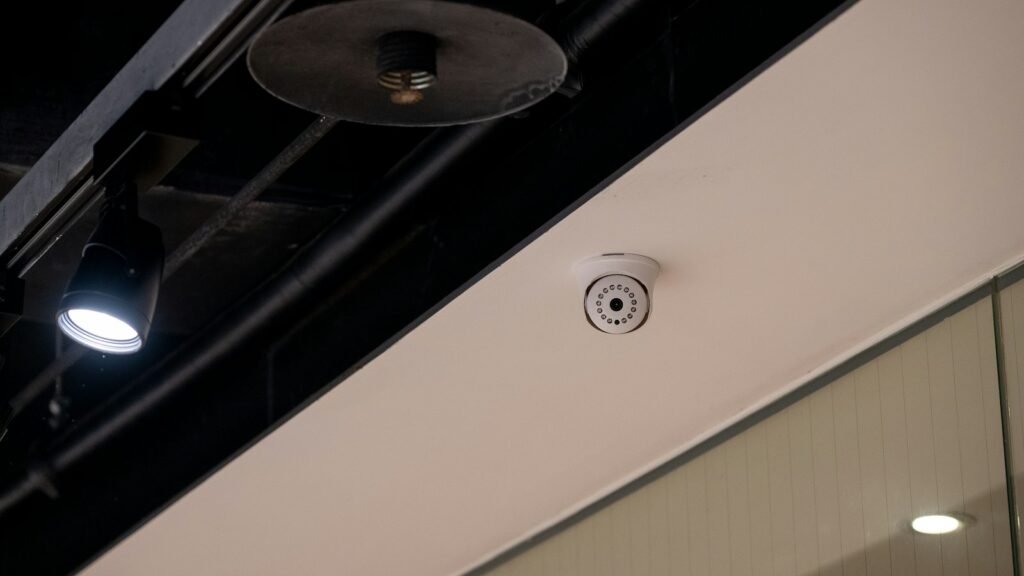
- Each camera’s field of view against the approved design; a loose bracket or a camera knocked during other works changes coverage unnoticed.
- Focus, and a clean lens and housing window, especially outdoors with dust and humidity.
- Night performance: infrared (IR) illumination, day/night switching, and no IR reflection from a nearby ceiling, wall or dirty dome.
- A recorded clip, not just the live view, as sub-stream settings may differ from recording settings.
- Cables, connectors and outdoor junction boxes, including water ingress.
Recorders (NVR/DVR) and hard disks
- Every channel records to the approved schedule (continuous, motion or event), and the log shows no camera dropouts or disk errors.
- Disk health: Hikvision NVRs, for example, offer S.M.A.R.T. detection and a disk self-test from the maintenance menu, with indicators that help anticipate failures.
- Time and date synchronised on all devices; wrongly timed footage loses value in an investigation.
- A test export that plays on another computer.
- Device cleanliness and ventilation.
Network and PoE switches
On IP systems the switch carries both data and power. The visit checks port status and errors, PoE draw against the switch budget, cabinet temperature and ventilation, cable labelling, and that no unrelated devices sit on the surveillance network. For network and storage planning at design stage, see CCTV and access control systems for building security.
Intrusion alarm, access control, intercom and barriers
- Intrusion alarm: walk or open test of every detector, wireless battery and signal levels, and alarm delivery to the designated receiver or app.
- Access control: user rights match reality, leavers’ cards and fingerprints are removed, locks and exit buttons work, and doors release on a fire alarm signal where designed to.
- Intercom: clear audio and video at both stations, and door release from the indoor unit.
- Gates and parking barriers: opening and closing times, safety sensors that stop the arm lowering onto a vehicle or person, and lubrication and adjustment per the manufacturer’s manual.
Suggested periodic maintenance schedule
This table is good practice, not a legal requirement. Adjust frequencies to manufacturer instructions, site sensitivity and the contract.
| Suggested frequency | Tasks |
|---|---|
| Monthly | Channel and recording status, recorder error logs, disk health, time synchronisation, and a sample of night recordings |
| Quarterly | Clean lenses and housings, check camera angles and focus, test intrusion detectors, locks and exit buttons, review the equipment access log, and measure actual retention |
| Six-monthly | Review and apply verified firmware updates, review user accounts and permissions, and check switches, PoE budget and cabinets |
| Annual | Full coverage review against design and site changes, export test, batteries and backup power, updated drawings and asset register, and disks nearing end of life |
Corrective maintenance sits outside this schedule: any fault that stops surveillance equipment is reported and fixed at once, as Article 3 requires.
Firmware and password hygiene
Recorders and IP cameras are networked devices; a weakness in either can expose footage or take the system down. Dahua’s security best practices list strong passwords and up-to-date firmware as mandatory basics. Its recommended extras include account lockout, disabling unused services such as UPnP and SNMP, HTTPS, least-privilege rights, log and online-user reviews, no router port forwarding, and network isolation.
Updating has its own rules. Hikvision’s NVR guidance says to use firmware that matches the unit’s hardware variant, export the configuration before upgrading, and avoid downgrading, which can reset the device to factory defaults. Ajax hubs update automatically by default and install only when the system is disarmed and on external power; auto-update can be turned off and updates run manually.
The contract should add documented updates with versions before and after, a configuration backup, default passwords changed at handover, and administrator accounts handed to the owner, not held only by the contractor.
Verifying storage and retention
Disk capacity is sized at design stage, but real retention changes in operation as cameras are added, resolution rises, compression changes, recording moves from motion to continuous, or a disk drops out. A practical method:
- Open the oldest available recording on each channel and count the days to the visit date.
- Compare it with the period the Conditions Document requires for that facility type.
- Check for gaps caused by camera dropouts or full disks.
- Review each disk’s health and record any warnings or bad sectors.
- If retention is shorter or longer than required, adjust settings or capacity and document it, since Article 10 prohibits keeping recordings contrary to the set period.
Reports and records
A report saying “system working” tells the owner nothing. A useful one lists devices checked by number and location, each channel’s status, measured retention per recorder, disk health, firmware versions, faults by impact, and what was fixed or awaits parts.
The owner keeps copies, with the access log the regulation requires and a log of fault reports and clearance dates, to demonstrate compliance at any inspection.
What a security system maintenance contract should include
General clauses such as pricing, response times and deficiency classification are covered in fire system maintenance contracts in Saudi Arabia, and most apply here too. Points specific to security systems:
- A full asset register of cameras, recorders, disks, switches, detectors, access points, intercom stations and barriers, with model and location.
- Clear scope per system and explicit exclusions, such as cameras damaged by external causes or system expansion.
- The task schedule annexed with its frequencies, including retention measurement at least every quarterly visit.
- Response time for faults that stop recording or take cameras offline, so the facility can clear them as soon as possible.
- A firmware, password and account policy, and who holds administrator accounts.
- Handling of replaced disks, which hold footage that must not leave the facility uncontrolled.
- Spare parts: whether disks, power supplies and batteries are included or priced separately.
AZEIDK supplies Hikvision, Dahua and EZVIZ cameras and recorders, ZKTeco access control and time attendance, Ajax intrusion alarms and BFT parking barriers as part of its security and surveillance solutions. For Hikvision’s range, see Hikvision in Saudi Arabia.
Common mistakes in surveillance maintenance
- Judging the system healthy from the live view alone.
- Leaving default passwords, or one shared administrator account.
- Updating firmware with a mismatched file or without a configuration backup.
- Not recalculating retention after adding cameras or raising resolution.
- Skipping night tests, so a good daytime image is unusable at night.
Frequently asked questions
How often should CCTV cameras be maintained?
The Executive Regulation sets no visit frequency. Common good practice is a monthly recording and disk check, quarterly cleaning and adjustment, and an annual full review, adjusted to manufacturer instructions and site sensitivity.
How long must CCTV recordings be kept in Saudi Arabia?
The Executive Regulation refers to the Security Conditions and Requirements Document for the period. After a reported incident, recordings are kept until the investigation ends or for that period, whichever is longer. Check the document’s approved text for your facility type.
What should I do if the recorder stops working?
The regulation requires immediate reporting through the electronic platform of any fault that stops the equipment, and clearing it as soon as possible. The contract should set a response time for such faults.
Is a firmware update needed if the system works?
Dahua lists keeping firmware up to date among its core security practices. Review each release before installing, back up the configuration, and record versions before and after.
Does a CCTV maintenance contract cover access control and barriers?
Not automatically. Name each system in the asset register and scope, with models, locations and its own schedule.
Conclusion
Maintaining CCTV and security systems means confirming the system records, keeps footage for the required period, gives a usable image day and night, and stays protected from unauthorised access. That takes a written schedule, measured retention, disciplined firmware and account management, and reports the owner keeps.
Want to check how ready your surveillance system is? Send us your camera, recorder and connected-system counts, and we will propose a visit scope and schedule for your site. Talk to the AZEIDK team