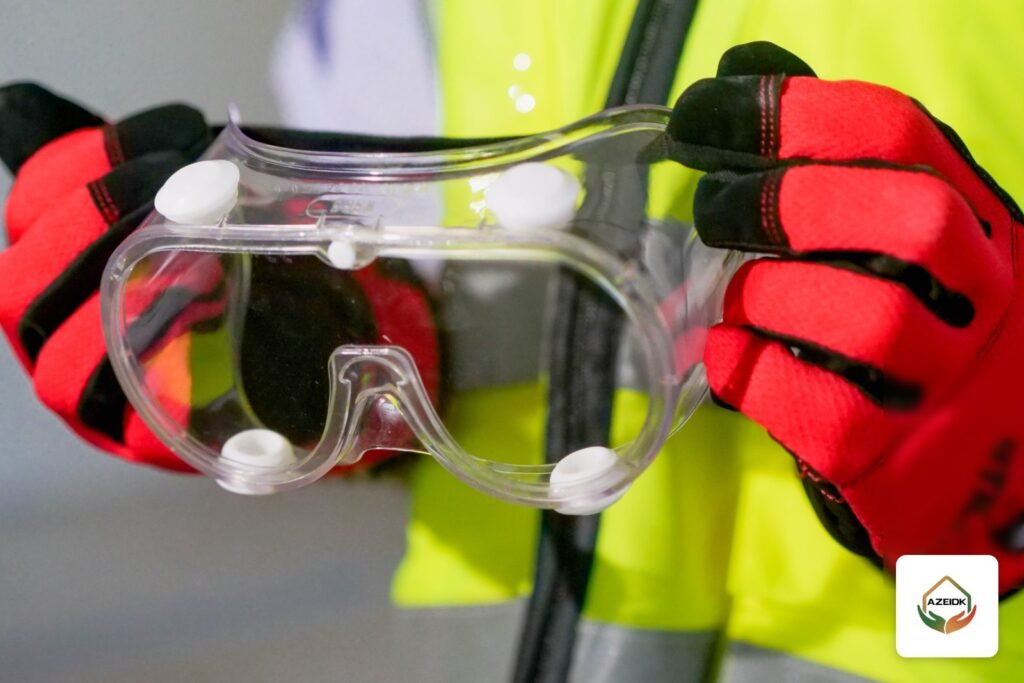
Safety glasses are among the cheapest items of personal protective equipment and among the most neglected on site. A chip from a cut-off saw, a splash of cleaning chemical or concrete dust is enough to cause an eye injury that stops a worker. Not every pair suits every hazard: spectacles protect against flying particles from the front and sides, goggles seal against splashes and fine dust, and a face shield covers what glasses cannot.
AZEIDK supplies safety glasses as part of its safety equipment range alongside other PPE such as Coverguard safety shoes and the bump cap, through its technical supply service for sites and factories.
Key points
- Choose by hazard: particles, liquid splash, fine dust or molten metal.
- Side protection is essential where objects fly; ordinary or sun glasses are no substitute.
- EN 166 marks performance on the frame and lens with codes such as F, B, 3, 4 and 5.
- Prescription wearers need safety glasses worn over their own or with prescription lenses.
- Replace scratched or fogged lenses, because they make workers take the glasses off.
Types of safety glasses
| Type | Protects against | Typical use |
|---|---|---|
| Safety spectacles with side protection | Flying particles from front and sides | Light cutting and grinding, installation, mechanical work |
| Goggles | Liquid splash and dust from all directions | Chemicals and cleaning agents, concrete breaking, dusty areas |
| Face shield | The whole face against particles and splash | Heavy grinding and pouring liquids; worn over glasses, not instead |
Welding and gas cutting need filters rated for the light level; ordinary safety glasses are not enough.
How to read EN 166 markings on safety glasses
Most safety glasses on the market carry the European EN 166 mark plus codes showing their performance. The main codes, as explained by Bullard:
- Impact resistance: S increased robustness; F low-energy impact (tested at 45 m/s) for all eyewear; B medium energy (120 m/s) for goggles and face shields only; A high energy (190 m/s) for face shields only.
- Field of use on the frame: 3 liquid droplets and splashes, 4 large dust particles, 5 gas and fine dust, 8 short-circuit electric arc, 9 molten metal and hot solids.
- Lens coatings: K resistance to surface damage by fine particles, N resistance to fogging.
In practice, a chemical splash area needs goggles marked 3, and fine dust needs 5. Since scratching and fogging are the main reasons workers remove glasses in site heat, K and N are worth checking.
What the US standard requires
Some projects and international contractors ask for ANSI Z87.1 eyewear. US OSHA regulation 1910.133 requires appropriate eye and face protection where there is a hazard, side protection where objects fly, and protection that incorporates or fits over prescription lenses for those who wear them. Treat this as a reference where the project calls for it; the site follows its project specification and safety plan.
Choosing safety glasses for a team
- Start with a risk assessment: each task and what it throws or splashes.
- Fit and comfort: no pressure on nose and ears, compatible with helmets and dust masks.
- Lens tint: clear for indoor and general work, tinted for outdoor work in the sun where no other hazard calls for something else.
- Quantity: allow spares, because glasses get scratched and lost faster than other PPE.
To equip a full team, see safety shoes, coveralls and work gloves and occupational safety clothing.
Care and replacement
Wash glasses with water and soap or a dedicated cleaner and dry them with a soft cloth, not a dusty sleeve. Store them in a pouch or case. Replace them at once after a crack, a scratch that blocks vision or a heavy impact, even if they look intact.
Frequently asked questions
Safety glasses or goggles?
Spectacles protect against particles from the front and sides; goggles seal around the eyes against splash and fine dust.
Can sunglasses replace safety glasses?
No. Sunglasses are not impact rated and leave the sides open.
What does F mean on safety glasses?
It passed the EN 166 low-energy impact test with a particle at 45 m/s.
I wear prescription glasses. What should I use?
Safety glasses designed to fit over prescription glasses, or safety glasses with prescription lenses.
When should safety glasses be replaced?
After a crack, a scratch that blocks vision, a heavy impact, or damage to the frame or strap.
Equipping a site or factory team? Tell us the headcount and type of work, and AZEIDK will supply suitable safety glasses and other PPE. Contact AZEIDK
Related guides
- Falcon Gold vs SFFECO: Comparing Fire Extinguishers by Type, Size and Approvals
- Variation Orders and RFIs on Fire Protection Projects in Saudi Arabia
- How to Choose a Fire Systems Contractor in Saudi Arabia: Approvals, Technical Criteria and Questions Before You Sign
- Hikvision Cameras: ColorVu, AcuSense, DarkFighter and Pro Series Explained, and How to Choose the Right Model