Pharmaceutical warehouse fire protection has to match the value of the stock and its sensitivity to temperature, and the security side has to keep unauthorised people away from controlled drugs. In practice that means a fire alarm system covering every area, sprinklers or gas suppression chosen room by room, then CCTV and access control with clear audit logs. The fire package and the security package are normally separate contracts, because each answers to a different authority and a different team.
Key takeaways
- The Saudi Food and Drug Authority (SFDA) Good Storage and Distribution Practices (GSDP) guideline asks warehouses to stop unauthorised people entering storage areas, and to keep controlled drugs and psychotropic substances in a safe or isolated area that cannot be tampered with.
- The same guideline asks for no ignition sources in the warehouse, no-smoking signs, and alarms on fridges and freezers when temperature rises or falls.
- Sprinklers or gas suppression depends on the room: general storage, cold room, freezer, or high-value store.
- Warehouse CCTV and access logs prove who entered the controlled-drug area and when. The executive regulations of the Saudi security cameras law list stores and warehouses among the places to be covered.
- The fire and alarm maintenance contract is separate from the CCTV and access control maintenance contract.
In this article
- What makes a pharmaceutical warehouse different?
- Pharmaceutical warehouse fire protection: detection first
- Sprinklers or gas suppression for cold stores and high-value stock?
- Warehouse CCTV for medical stores: where to install and what to record
- Access control for warehouses and controlled-drug cages
- Two separate contracts: fire and alarm, then CCTV and access control
- Safety licensing and who issues each document
- Frequently asked questions
- Conclusion
What makes a pharmaceutical warehouse different?
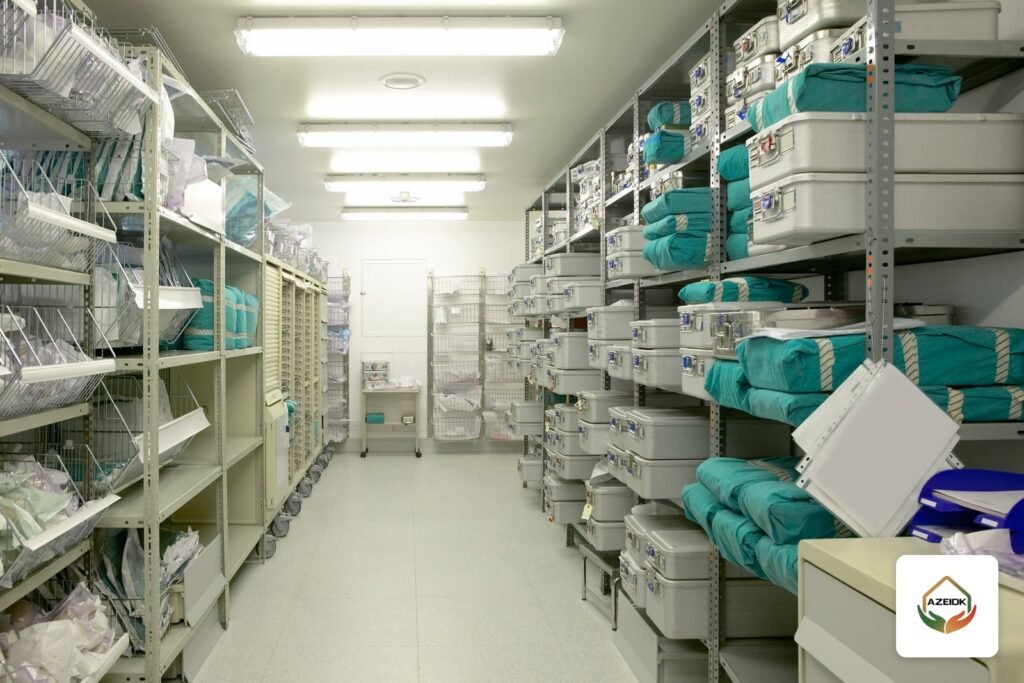
A normal warehouse protects goods that can be replaced. A pharmaceutical warehouse protects stock that is lost the moment it leaves its temperature range, even if the fire never reaches it. Smoke from a small fire in one corner can make a full shipment unfit for distribution. A few hours of failed cooling after a power cut can do the same.
Then there is control. Narcotics and psychotropic substances have their own storage rules. The SFDA GSDP guideline says a licensed responsible person must supervise them, that they are kept in a safe or isolated area inside the facility, and that this safe or area must be secure and impossible to break, move or tamper with. This is where security systems come in. A safe alone is not enough without an access log and video of what happens around it.
So we split the design into two layers: fire protection (alarm, suppression, emergency lighting and exits) and security (CCTV, access control and intrusion alarm). The two layers connect only at defined points, such as releasing electrically locked doors on fire alarm.
Pharmaceutical warehouse fire protection: detection first
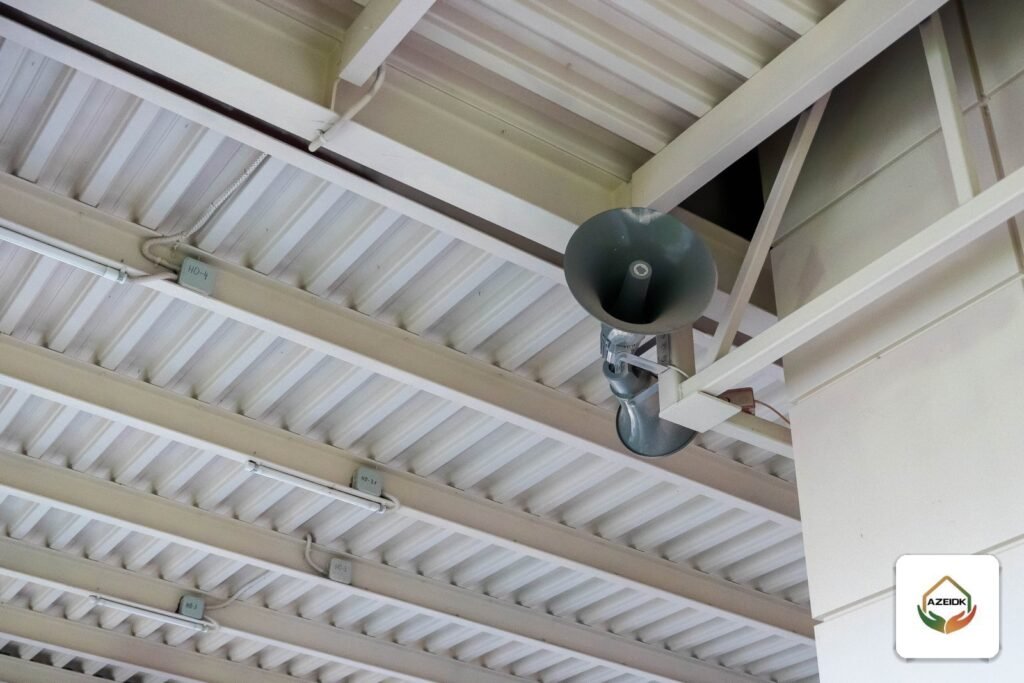
Early detection matters most here, because the loss starts with smoke, not flame. The fire alarm system covers storage areas, offices, electrical rooms, refrigeration compressor rooms and the loading dock. In medium and large warehouses we prefer an addressable panel, because it shows the exact detector location and shortens the time to reach the right aisle or room.
Points we check on this type of building:
- Cold rooms and freezers: a standard smoke detector may not suit every cold room because of condensation and humidity. The designer picks the detector type from the manufacturer’s datasheet for the actual room temperature.
- Electrical and compressor rooms: the most likely ignition source in a refrigerated warehouse. Cover them with detectors even when they are small.
- Loading dock: forklift exhaust can cause false alarms if the wrong detector is chosen. Review common causes of false alarms before fixing locations.
- Door interface: any electrically locked door on an escape route must release on fire alarm, and this is written into the cause and effect matrix.
Sprinklers or gas suppression for cold stores and high-value stock?
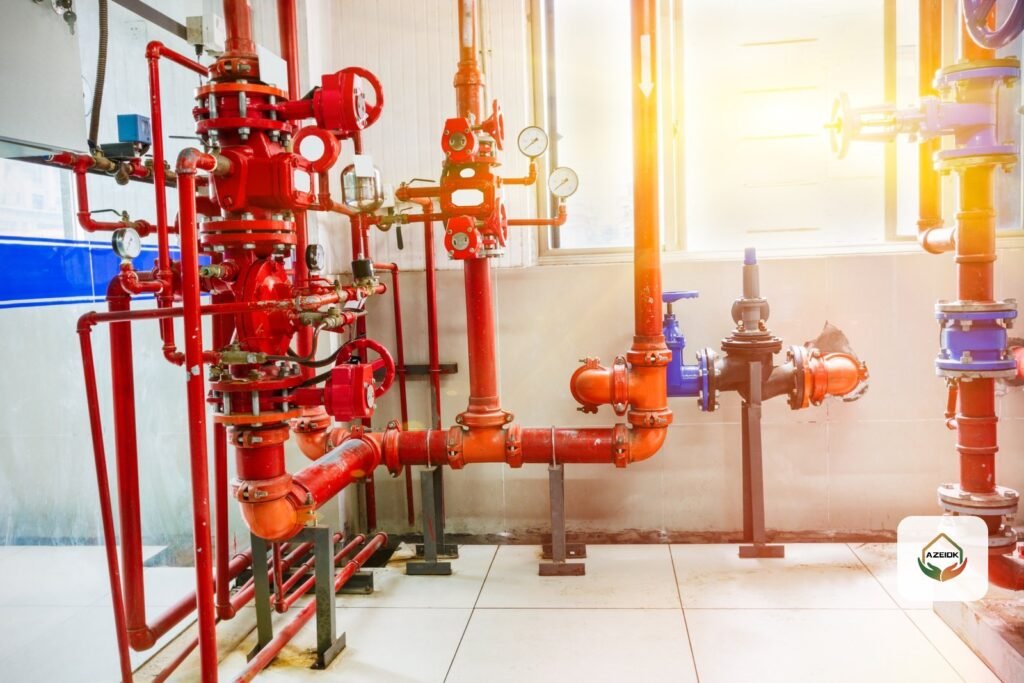
There is no single answer for the whole building. Sprinklers are the main protection for general storage and racking, and the code normally requires them based on occupancy, area and storage height. Some rooms need a different decision:
| Area | Typical protection | What the designer checks |
|---|---|---|
| General storage and racking | Wet pipe sprinkler system | Storage height, packaging (carton or plastic), need for in-rack sprinklers |
| Cold room (above 0 °C) | Usually wet sprinklers | Whether the room stays above freezing in all conditions, pipe routing around evaporators |
| Freezer (below 0 °C) | Dry pipe or pre-action system | Preventing water freezing in the pipes, dry air supply |
| High-value stock or records room | Clean agent or aerosol, after study | Room integrity, volume, occupancy, operating temperature in the datasheet |
| Electrical or server room | Gas suppression on many projects | Room integrity test, discharge delay, evacuation |
In a freezer, water in a wet system freezes, so dry pipe or pre-action systems are normally used. We explain the difference in wet, dry and pre-action sprinkler systems. Gas suppression is not chosen only because water “harms the medicines”. It is chosen because the room is closed, sealed and can be tested. If the door is opened all day or the room has large ventilation openings, the gas will not hold its design concentration. See the clean agent comparison and AZEIDK’s special fire suppression systems.
The permitted operating temperature of any gas or aerosol system comes from the manufacturer’s datasheet, never from assumption. In a low-temperature room the designer must confirm that cylinders or generators and valves are approved for that temperature.
Warehouse CCTV for medical stores: where to install and what to record
The executive regulations of the Law on the Use of Security Surveillance Cameras list stores and warehouses among the places to be covered, and the technical details come from the Security Requirements and Conditions Document. In a pharmaceutical warehouse we focus on views that help an investigation when an item goes missing or a shipment is damaged:
- Receiving and dispatch doors, angled to show the truck, the plate number and the pallet during loading.
- The entrance to the controlled-drug area and the safe, with a camera that shows the person’s face and their hands at the safe.
- Cold room doors, because doors left open are a common cause of temperature excursions and the footage shows what happened.
- Main aisles between racks. High racks block the view, so cameras go along the aisle, not only at its end.
The retention period is set by the requirements document. AZEIDK explains owner obligations in the security cameras law and facility obligations. Audio recording must not be enabled without approval from the General Directorate of Public Security, under the law’s executive regulations. AZEIDK’s security and surveillance systems include Hikvision and Dahua cameras and recorders, and storage is sized from the number of cameras and the required retention.
Access control for warehouses and controlled-drug cages
Access control turns “keep unauthorised people out” into something you can prove. Each sensitive door opens by card, fingerprint or face recognition, and every opening is logged with the person’s name and time.
A common permission layout:
- Staff entrance: card reader or face terminal, sometimes linked to time attendance.
- Controlled-drug area: a small group of people, with two-factor checks (card plus fingerprint) if the facility’s policy asks for it.
- Cold rooms: warehouse team only, with a door-held-open alarm, a feature most controllers offer.
- Electrical and server rooms: technicians only.
Where there are many doors, networked controllers such as ZKTeco InBio and C3 link them into one system with central permission management. The key design rule: every door on an escape route releases on fire alarm or power loss, as the designer specifies, so security never blocks evacuation.
For temperature itself, the SFDA mentions temperature and humidity devices at different locations and heights, and alarms on fridges and freezers. These systems usually belong to the refrigeration supplier or the warehouse quality system, not to the fire system.
Two separate contracts: fire and alarm, then CCTV and access control
AZEIDK works on pharmaceutical warehouses under two independent contracts, not one contract for everything:
| Item | Fire, safety and alarm contract | Low current and CCTV contract |
|---|---|---|
| Systems | Fire alarm, sprinklers and hose cabinets, gas suppression, extinguishers | Cameras and recorders, access control, intercom and their network |
| Reference authority | Civil Defense and the Salamah platform | Security cameras law requirements and facility policy |
| Maintenance | Planned maintenance contract for fire systems | Separate maintenance contract for CCTV and access control |
Interface points between the two are written clearly on the drawings: who supplies the release unit that opens doors on fire alarm, and who tests it at handover.
Safety licensing and who issues each document
Before operation the warehouse needs a safety certificate through the Civil Defense Salamah platform. The technical report the platform asks for is issued by approved engineering consultancy offices, not by the installer. AZEIDK issues the safety equipment installation certificate for the systems it installed, as part of Civil Defense approval support. The steps are in the Salamah certificate guide. See also our warehouses and logistics and healthcare pages for AZEIDK’s scope in both sectors.
Frequently asked questions
Does a pharmaceutical warehouse need sprinklers or is a fire alarm enough?
The code decides, based on occupancy, area and storage height, and the approved designer makes the call. Most medium and large warehouses need sprinklers in storage areas, with alarm coverage everywhere.
Can gas suppression replace sprinklers for the whole warehouse?
Rarely practical. Gas suppression needs a sealed room, and large storage halls are opened all day. It is normally used for specific rooms such as electrical rooms or high-value stores.
Which sprinkler system suits a freezer room?
Wet systems do not suit rooms below 0 °C because water freezes in the pipes, so a dry pipe or pre-action system is normally used, as designed.
Where should CCTV go in a medical warehouse?
At receiving and dispatch doors, the controlled-drug area entrance and the safe, cold room doors, and along the main aisles between racks.
Can warehouse cameras record audio?
Audio recording must not be enabled without approval from the General Directorate of Public Security, under the executive regulations of the security cameras law.
Does AZEIDK issue the Salamah technical report?
No. Approved engineering consultancy offices issue the technical report. AZEIDK issues the safety equipment installation certificate for the systems it installed.
Does fire system maintenance include CCTV?
No. Fire, safety and alarm maintenance is one contract. CCTV, access control and low current maintenance is a separate contract.
Conclusion
Pharmaceutical warehouse fire protection is a room-by-room decision: early detection everywhere, sprinklers for general storage, dry pipe or pre-action in freezers, and gas suppression for sealed high-value rooms. On top of that sits a security layer of CCTV and access control that proves who entered the controlled-drug area and when. Start with a drawing review before procurement, and separate the fire contract from the security contract from day one.
Fitting out a pharmaceutical or medical supplies warehouse? AZEIDK reviews your drawings, proposes protection for each room, and quotes fire systems and CCTV with access control as separate packages. Talk to the AZEIDK team
Related guides
- Fire Pump Testing in Saudi Arabia: Performance, Commissioning and Maintenance
- Prequalification Fire Contractor File: What Owners and Main Contractors Ask For
- FM-200 System Maintenance: Semiannual Checks and Cylinder Testing
- Safety and Security Systems Companies in Saudi Arabia (Al Alamiya, Al Najjar, Al Rumaih): How to Choose and Verify