Emergency and exit lighting keeps escape routes visible and exits clearly marked when normal lighting fails, so people can leave safely. Under the 2021 International Building Code (IBC), emergency illumination must last at least 90 minutes and start at an average of 1 foot-candle (fc), about 11 lux, along the path of egress. In Saudi projects, the requirements come from the Saudi Building Code and Civil Defense, and the design follows the editions they adopt.
Key takeaways
- Emergency lighting has two jobs: lighting escape routes and identifying exits with signs, both automatically on loss of normal power.
- The 2021 IBC requires at least 90 minutes, an initial average of 1 fc and minimum of 0.1 fc on the path of egress, falling to no less than 0.6 and 0.06 fc at the end, and a maximum-to-minimum ratio of 40:1.
- NFPA 101 (2021 edition) requires battery-powered emergency lighting to be tested for at least 30 seconds monthly and for 1.5 hours annually, with written records.
- British and European references were updated recently: BS EN 1838:2024, BS EN 50172:2024 and BS 5266-1:2025.
- Commission with a full-duration discharge test and illuminance measurements, not just a visual check.
In this article
- What emergency and exit lighting does
- Where emergency lighting is required in Saudi projects
- Duration and light levels
- Emergency lighting system types and how to choose
- Exit signs: placement and visibility
- Step-by-step: designing and commissioning emergency lighting
- Inspection, testing and maintenance
- Common mistakes and what drives cost
- How AZEIDK helps
- FAQ
What emergency and exit lighting does
Escape lighting illuminates corridors, stairs, exits and open areas so people can find and use the escape route, while exit and directional signs show where to go. The British Standards Institution (BSI) notes that emergency lighting also enables the immediate identification and use of fire alarm call points and firefighting equipment.
Standby lighting, which lets normal activity continue during an outage, is a different function: BS EN 50172:2024 states that it does not cover standby lighting, while BS 5266-1:2025 extends its scope to local area and standby lighting. A maintained luminaire is lit at all times and stays lit on battery; a non-maintained luminaire lights only when normal power fails. The 2021 IBC requires exit signs to be illuminated continuously and to stay lit for at least 90 minutes on loss of normal power, so specify them as maintained.
Where emergency lighting is required in Saudi projects
Means of egress requirements sit in the Saudi General Building Code (SBC 201), which is based on the IBC, alongside the Saudi Fire Protection Code (SBC 801) and Civil Defense requirements; the SBC 2024 edition has been mandatory since 30 June 2025. Where a specification cites NFPA 101 or British standards, the Saudi codes and Civil Defense set the edition that applies.
Under the 2021 IBC, as summarized by Consulting-Specifying Engineer, automatic emergency lighting is generally required in rooms and spaces that need two or more exits or access to exits, in aisles, corridors, exit access stairways and ramps, and in specific rooms such as electrical rooms, fire pump rooms and generator rooms. NFPA 101 also calls for emergency lighting at doors with delayed-egress locks, which our access control technologies guide discusses.
Duration and light levels
| Item | IBC 2021 edition | NFPA 101 2018 edition |
|---|---|---|
| Minimum duration | 90 minutes | 1.5 hours |
| Initial illumination on the path of egress | Average 1 fc (about 11 lux), minimum 0.1 fc (about 1 lux) | Average 1 fc, minimum 0.1 fc |
| End of duration | Average at least 0.6 fc, minimum at least 0.06 fc | A defined decline is allowed; check the adopted edition |
| Maximum-to-minimum ratio | Not more than 40:1 | Not more than 40:1 |
Values are measured along the path of egress at floor level. Under normal power, the IBC also requires means of egress illumination of at least 1 foot-candle (11 lux) at the walking surface (Section 1008.2.1 in the 2018 edition). Later editions may differ in detail, so confirm values in the edition your project adopts.
British and European standards
- BS EN 1838:2024: published by BSI on 31 December 2024, replacing the 2013 edition. Changes include escape route lighting across the route width rather than only the center line, an updated method for routes crossing open areas, and local area lighting for people who remain during a normal power failure.
- BS EN 50172:2024: approved by the European Committee for Electrotechnical Standardization (CENELEC) on 27 May 2024 and published by BSI on 31 July 2024. It covers installation, verification, the logbook and periodic testing of emergency escape lighting systems, and replaces the 2004 edition, which will be withdrawn on 27 May 2027.
- BS 5266-1:2025: the UK code of practice published in 2025, replacing the 2016 edition.
Take durations and lux values for these standards from the edition named in the specification, and do not mix IBC or NFPA values with BS or EN values in one design without agreement from the consultant and Civil Defense.
Emergency lighting system types and how to choose
| Type | How it works | Best fit | Watch for |
|---|---|---|---|
| Self-contained units | Battery, charger and control in each luminaire | Small and medium buildings, retrofits | Many batteries to test and replace |
| Central battery system | Central batteries feed luminaires over dedicated circuits | Large buildings, hospitals, towers | Protected cable routes, a ventilated battery room, and circuits arranged so one fault does not darken a whole area |
| Generator-fed lighting | Normal luminaires transferred to the emergency generator | Large facilities with generators | Transfer time and generator reliability |
| Self-test and addressable systems | Luminaires test themselves or report to a central panel | Sites with many luminaires | The annual full-duration test and record review still apply |
NFPA 101 (2021 edition) allows self-testing, self-diagnostic battery-operated equipment as an alternative to manual monthly testing, provided the equipment is visually inspected monthly, while the annual 1.5-hour test remains. BS EN 50172:2024 refers to EN 62034 for automatic test systems. In NFPA-based projects, the electrical installation of emergency systems follows NFPA 70 Article 700, and UL 924 is the main US listing standard for emergency luminaires and exit signs. For central system circuits, see our guide to fire-resistant cables and circuit integrity.
Exit signs: placement and visibility
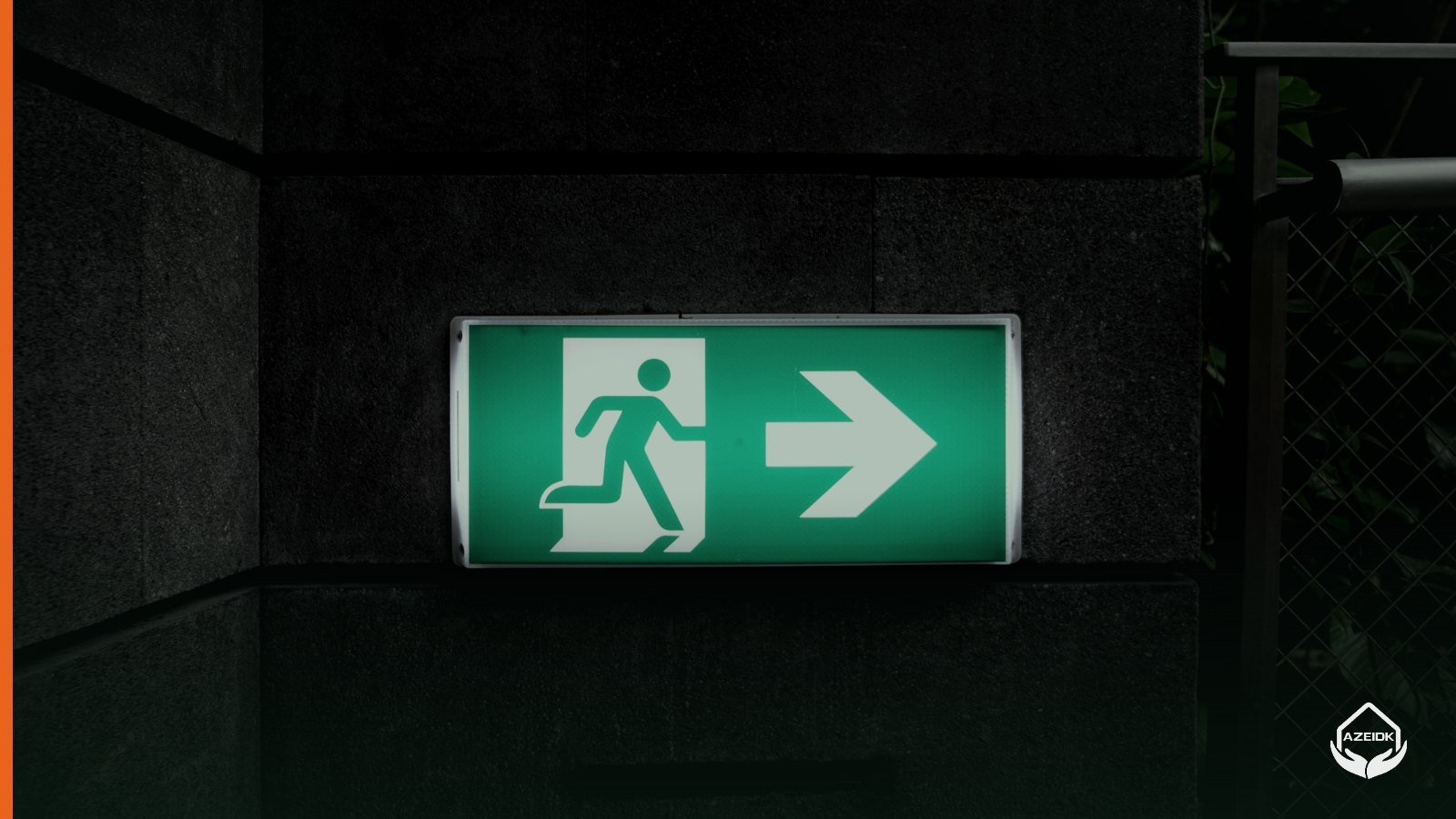
Good practice is to place a sign at every exit and at each change of direction, so the next sign is always visible from the route. Detailed rules on location, size, visibility and power source are in IBC Section 1013 and NFPA 101 Section 7.10 of the adopted edition. Use photoluminescent signs only where the code and listing allow, with enough normal lighting to charge them, and re-check sign locations after partitions or ceilings change. Our fire-rated doors and emergency exits guide covers the doors themselves.
Step-by-step: designing and commissioning emergency lighting
- Agree the governing code and edition with the consultant and Civil Defense.
- Mark escape routes, open areas, high-risk areas, exits, stairs and key points on the drawings.
- Choose the system type: self-contained, central battery, generator-fed or a mix.
- Run photometric calculations for illuminance and uniformity at the start and end of the rated duration.
- Specify listed or certified luminaires and signs, and confirm battery type and rated duration.
- Arrange circuits so one fault does not leave a route dark, and coordinate with smoke control and stair pressurization, fire alarm and door release.
- At commissioning, run a full-duration discharge test and measure illuminance along the routes.
- Hand over as-built drawings, test records and the logbook, and train the facility team.
Inspection, testing and maintenance
NFPA 101 (2021 edition) requires battery-powered emergency lighting to receive a functional test of at least 30 seconds monthly and a 1.5-hour test annually, with written records available to the authority having jurisdiction (AHJ); the 2018 edition followed the same pattern. BS EN 50172:2024 adds logbook requirements and sets periodic inspection and testing for systems designed to European standards.
Good practice is to run full-duration tests when the building is empty or at low risk, since batteries need time to recharge, to replace batteries as the manufacturer recommends, to repair failed units at once, and to keep records ready for Civil Defense inspections; safety licenses are handled on the Salamah platform. Include these tests in the facility’s periodic maintenance program.
Common mistakes and what drives cost
Common site mistakes
- Luminaires placed by count instead of calculated illuminance.
- Non-maintained exit signs that stay dark in normal operation.
- Batteries never discharge-tested, so units fail at the first real outage.
- Central battery circuits run unprotected through the area they serve.
What drives cost
- Number of luminaires and signs, set by layout and required illuminance.
- System type: self-contained, central battery or generator-fed.
- Rated duration, which sets battery size.
- Self-test or addressable monitoring.
- Cable type and routes for central systems.
- Testing, battery replacement and record keeping over the system life.
How AZEIDK helps
Emergency lighting is one part of escape route safety. AZEIDK’s related fire-rated doors and emergency exit solutions cover emergency exit doors and suitable exit hardware coordinated with other fire and life safety systems, and our fire alarm systems solutions include integration with other systems when required, such as fire suppression, smoke extraction or evacuation systems.
For existing buildings, our assessment of existing systems reviews documentation, inspects the site, identifies technical gaps and prepares a preliminary scope of work for fire protection and safety systems. Our Civil Defense approval support helps prepare drawings and technical reports, without guaranteeing a particular outcome. See also our news on fire-rated doors and emergency exits and our guide to Civil Defense fire safety approval.
FAQ
How long must emergency lighting last?
The 2021 IBC requires at least 90 minutes, and NFPA 101 (2018 edition) also requires 1.5 hours. Projects designed to British and European standards take the duration from BS 5266-1 and BS EN 1838. In Saudi projects, agree the governing code and edition with the consultant and Civil Defense before selecting batteries.
What is the difference between maintained and non-maintained emergency lighting?
A maintained luminaire is lit at all times and continues on battery when normal power fails; a non-maintained luminaire stays off until normal lighting fails. Maintained luminaires suit exit signs and areas that need to stay visible whenever occupied, while non-maintained luminaires are often used where normal lighting already covers the area.
How often should emergency lights be tested?
NFPA 101 (2021 edition) requires battery-powered emergency lighting to be tested for at least 30 seconds monthly and for 1.5 hours once a year, with written records. Self-testing units can replace the manual monthly test, but not the annual test. European-style projects follow BS EN 50172:2024.
Should I choose self-contained units or a central battery system?
Self-contained units are simpler to install and suit small and medium buildings or retrofits, but every luminaire has a battery to test and replace. Central battery systems keep batteries in one room and suit large buildings with many luminaires, but need protected circuits, a ventilated battery room and careful circuit design.
Which applies in Saudi Arabia: NFPA 101, the IBC or BS 5266?
Saudi projects follow the Saudi Building Code, including SBC 201 for means of egress and SBC 801 for fire protection, and Civil Defense requirements. SBC 201 is based on the IBC, and specifications may also cite NFPA 101 or British standards. Use one consistent reference agreed with the consultant and Civil Defense, and state its edition.
Planning safe escape routes and emergency exits? Send your drawings, and our team will help with exit doors, fire alarm integration and the scope of an existing systems assessment. Contact the AZEIDK team