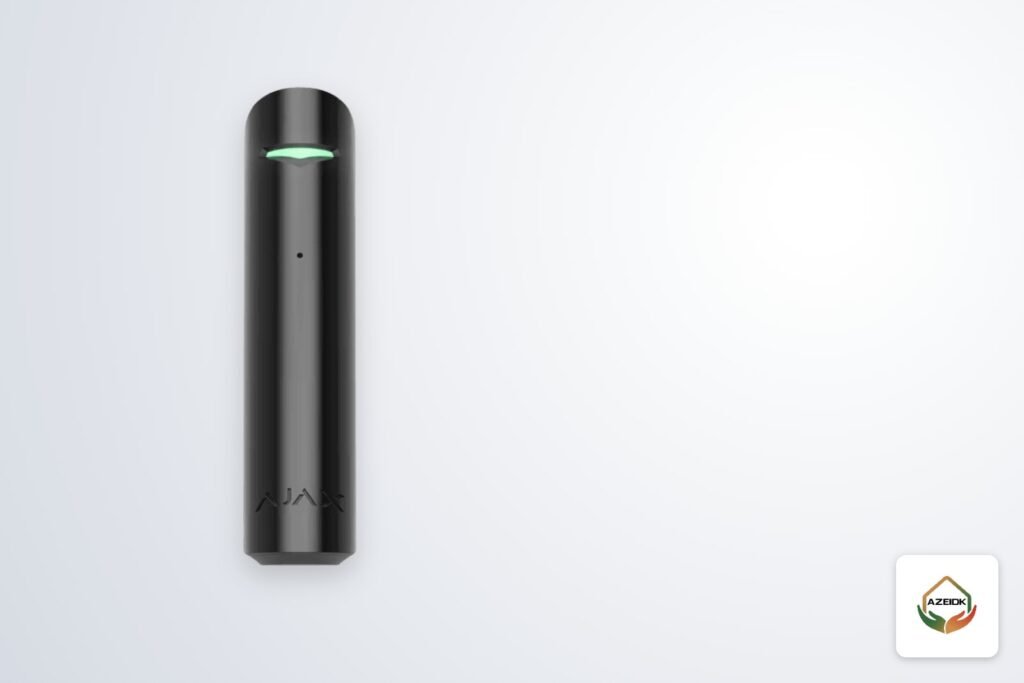
A glass break detector is an alarm sensor that hears glass shattering through a built-in microphone and raises the alarm the moment a shopfront or window is broken, before the intruder is inside. It is used in glass-fronted shops, villas and offices alongside opening contacts and motion detectors in a burglar alarm system.
This guide explains how the detector works, where it should and should not be installed, and how it differs from a shock sensor, using the Ajax GlassProtect Jeweller that AZEIDK supplies within its intrusion alarm systems range.
Key points
- A glass break detector protects the perimeter: it detects entry at the glass, while a motion detector detects it after entry.
- Ajax GlassProtect detects breakage from 0.3 to 9 m across 180° horizontally, with 3 sensitivity levels.
- Its DualTone algorithm requires a low-frequency impact sound followed by a high-frequency ringing sound within 1.5 seconds, to limit false alarms.
- It does not respond to glass covered with protective, sun-control or decorative film; use a shock sensor there.
- Curtains and blinds weaken the sound, so check them when choosing the position.
In this article
- How does a glass break detector work?
- Ajax GlassProtect Jeweller specifications
- Where should a glass break detector be installed?
- When is a glass break detector not enough?
- Glass break, shock or motion detector?
- Connecting to the Ajax hub and the external input
- Setting sensitivity and testing
- Uses by type of premises
- Common installation mistakes
- FAQ
- Summary
How does a glass break detector work?
Breaking glass has a clear acoustic signature: a low-frequency thud at impact, then high-frequency ringing as the glass shatters. Older detectors listened to one frequency and could trigger on dropped keys or a glass. Modern detectors analyse both sounds.
GlassProtect uses an electret microphone and the DualTone algorithm, and raises an alarm only when it hears the low-frequency impact and the high-frequency ringing within 1.5 seconds. Ajax says the aim is to avoid false alarms from sounds such as barking or traffic.
Ajax GlassProtect Jeweller specifications
| Item | Value |
|---|---|
| Sensor | Electret microphone |
| Detection distance | 0.3 to 9 m |
| Detection angle | 180° horizontal |
| Sensitivity | 3 levels, set in the Ajax app |
| False alarm prevention | DualTone two-factor algorithm |
| External input | Wired NC input for a third-party detector |
| Radio | Jeweller, up to 20 mW; range up to 1,000 m in open space |
| Battery | 1 x CR123A, replaceable |
| Dimensions | 90 x 20 x 20 mm |
| Protection | IP50 (indoor use) |
Source: the AZEIDK product page and the official Ajax product page, which adds that users and the monitoring company get a low-battery warning months in advance. Battery life depends on the sensitivity setting and mounting position, so we do not quote a fixed figure.
Where should a glass break detector be installed?
- On a solid wall that does not vibrate: Ajax recommends a wall or load-bearing structure, at a height of up to 2 m.
- Facing the glass or on an adjacent wall so the glass sits inside the 180° field; one detector can cover a shopfront or several windows in the same room.
- Not at maximum range: Ajax notes that at the rated limit the detector works at full sensitivity and uses more energy. Keep a margin inside 9 m.
- Away from heavy curtains: curtains, blinds and films muffle or distort the sound.
- Indoors: IP50 means indoor use only.
When is a glass break detector not enough?
Ajax states that GlassProtect does not respond to breaking glass covered with shockproof, sun-control or decorative film, which is common on Saudi shopfronts and offices because of tinting. In that case use a sensor that reacts to shock or vibration on the frame or glass, such as the Hikvision DS-PDMCK-EG-2-WB wireless magnet and shock detector for Hikvision AX PRO systems.
The detector also does not cover entry through a door opened without breaking glass, so pair it with an opening contact such as the Ajax Superior DoorProtect and an indoor motion detector as a second layer.
Glass break, shock or motion detector?
| Sensor | Detects | Alarm timing | Best for |
|---|---|---|---|
| Glass break detector | Sound of shattering glass | At the moment of breakage | Unfilmed shopfronts and windows in one room |
| Shock / vibration sensor | Blows or vibration on frame or glass | During the attempt | Filmed glass, doors, safes |
| Magnetic opening contact | Door or window opening | At opening | Doors and opening windows |
| Motion detector | A person moving inside | After entry | Corridors and halls as a second layer |
Good design combines perimeter and interior protection. For detector layout and hub selection see Ajax alarm design for villas and shops.
Connecting to the Ajax hub and the external input
GlassProtect works wirelessly with an Ajax hub such as the Ajax Hub 2 Plus Jeweller. Ajax provides an online checker to confirm device and hub compatibility before buying.
Its wired NC input accepts a third-party wired detector, such as an opening or shock sensor, whose signal is then sent wirelessly. Ajax notes that GlassProtect does not power that detector, so it needs its own supply.
Setting sensitivity and testing
After mounting, set one of the three sensitivity levels in the Ajax app and use the detector’s test mode to confirm it hears the glass from its position. Start with the lowest level that covers the glass and raise it only if needed; unnecessary sensitivity is a common cause of burglar alarm false alarms.
Uses by type of premises
- Glass-fronted shops: the front is the easiest way in after closing. One detector on a side or rear wall within range covers it, with an opening contact on the door. For jewellery shops see jewellery store security systems.
- Villas: large windows in majlis and living areas and glass doors to the garden; one detector per room with exposed glass, allowing for curtains.
- Offices and car showrooms: large fronts and glass partitions, watching for tint film.
- Warehouses: rarely needed except in front offices or low windows.
Common installation mistakes
- Mounting on the glass or a vibrating frame instead of a solid wall.
- Placing it behind a heavy curtain or in a different room from the glass.
- Relying on it for filmed glass.
- Maximum sensitivity without need, which raises false alarms and drains the battery.
- Using it alone without door contacts and an indoor motion detector.
FAQ
What is a glass break detector?
An alarm sensor that hears glass shattering through a microphone and triggers the moment a window or shopfront is broken.
What is the range of Ajax GlassProtect?
0.3 to 9 m across 180° horizontally; avoid mounting at the maximum distance.
Does it work on tinted or filmed glass?
No. Ajax states GlassProtect does not respond to film-covered glass; use a shock sensor instead.
Will loud noises trigger it?
DualTone requires both impact and ringing sounds within 1.5 seconds, which limits false alarms when sensitivity is set correctly.
How long does the battery last?
It runs on a single CR123A cell, and its life depends on the sensitivity setting and mounting position. The app sends a low-battery warning months in advance, so the cell can be swapped during routine maintenance.
Do I need one if I already have a motion detector?
A motion detector catches the intruder after entry; a glass break detector catches them at the glass. Together they give earlier warning.
Summary
A glass break detector buys an alarm system valuable seconds by detecting entry at the glass itself. It works when mounted on a solid wall within a comfortable distance of unfilmed glass. Where the glass is tinted with film, a shock sensor is the right alternative.
Protecting a glass-fronted shop or a villa with large windows? Send us the layout and photos of the fronts, and the AZEIDK team will propose glass break, shock, opening and motion detectors with the right hub. Contact AZEIDK
To request a fire alarm system for your facility, see AZEIDK fire alarm systems.
Related guides
- Industrial Fire Alarm Systems for Noisy Factories: Sounder Levels, Strobes and Hazardous Areas
- NFPA 75: Fire Protection Standard for IT Equipment and What It Requires for Server Rooms in Saudi Arabia
- UPS Online vs Offline vs Line-Interactive: Which One for Network and CCTV Rooms
- KD Industries (KDI) in Saudi Arabia: Fire Sprinkler Pipes