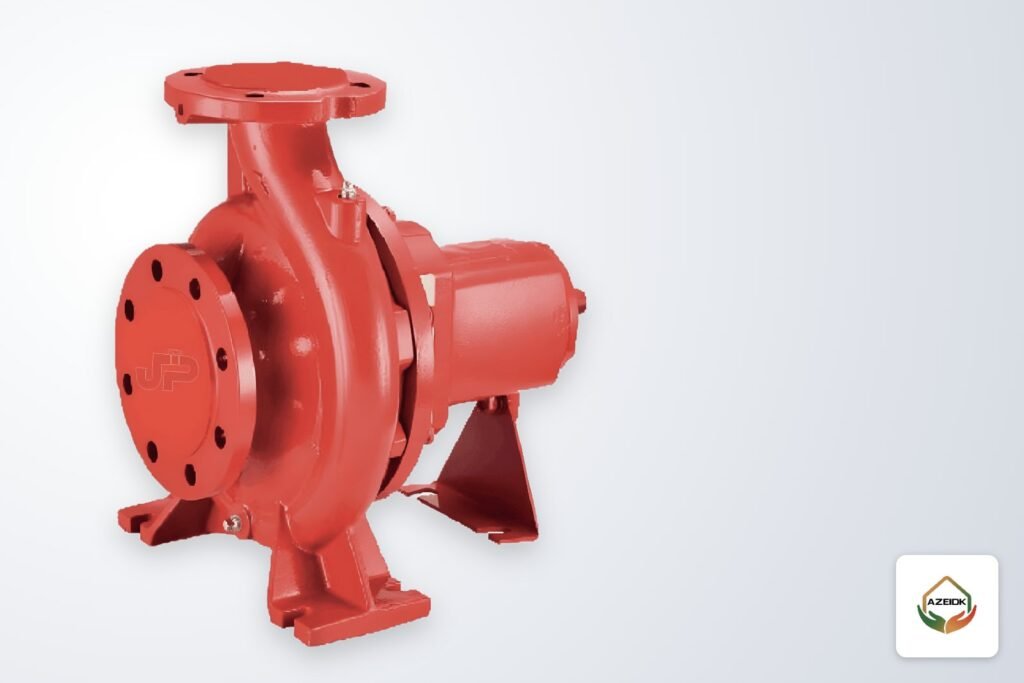
Fire pump replacement usually comes up after a weak annual test, repeated failures, spare parts that are no longer available, or a building change that raised water demand. Not every drop in performance means a new pump, though. Sometimes repairing the impeller, the wear rings or the suction piping is enough. The difference is settled by a documented technical assessment, which AZEIDK provides through its existing systems assessment and scope definition service, followed by technical supply of the replacement from our fire pumps range and testing, commissioning and handover.
For a comparison of fire pump types (electric, diesel, jockey, end suction, split case and vertical turbine), see our full guide.
This article explains when repair is enough and when you need a new pump, and how to replace a pump in an occupied building without leaving it unprotected.
Key points
- Performance is judged by the NFPA 25 annual test at three points: churn, 100% and 150% of rated flow.
- Per the NFPA 25 text quoted by QRFS, results are acceptable at no less than 95% at each point against the reference curve (original acceptance curve, manufacturer curve or nameplate).
- Raising diesel engine speed above the pump’s rated speed to make up for a weak pump is not permitted.
- If the building’s hydraulic demand has changed, even a healthy pump may no longer be enough.
- The replacement pump needs a field acceptance test, which becomes the baseline for future tests.
When should you consider fire pump replacement?
Four common reasons lead an owner or facility manager to this question:
- A weak annual test: flow or pressure falls below the acceptable limit against the original acceptance curve.
- Repeated failures: persistent seal leakage, vibration, hot bearings or driver trips despite earlier repairs.
- No spare parts: a discontinued model or a brand with no local agent, so every fault becomes a long outage.
- A changed building: an extension, a change of use from offices to storage, or a higher hazard class that raises demand on the existing pump.
Sometimes the reason is contractual: a new owner or insurer requires a UL listed or FM approved pump instead of a non-listed one. In that case repair does not help, whatever the pump’s condition.
What does the annual test say about the pump?
The annual test is the most important document in a replacement decision. The pump runs at three points and results are compared with the original acceptance test curve or the nameplate curve. QRFS quotes NFPA 25 (2017 edition, 8.3.7.2.3): results are acceptable at no less than 95% of flow and pressure at each point. In the 2023 wording quoted by QRFS, the pump must deliver 100% of rated flow and net pressure at each flow point must be at least 95% of the original manufacturer curve, the original unadjusted field test curve or the nameplate curve. InspectPoint, referring to the 2023 edition, notes that a pressure drop of more than 5% from the acceptance curve must be investigated.
One point for diesel pumps: QRFS quotes the 2017 edition that increasing engine speed beyond the pump’s rated speed to reach rated performance is not permitted. The fix is not to adjust the engine but to find why the pump is weak.
Test instruments must be calibrated for the reading to mean anything. Our article on fire pump acceptance testing and commissioning explains how the baseline curve is built.
Repair or replace: how to decide
| Situation | Repair is usually enough | Replacement is closer |
|---|---|---|
| Limited performance loss | Once the cause is confirmed as wear rings, impeller or a suction blockage | If the loss continues after repair |
| Seal leakage | Adjust packing or replace the mechanical seal | If shaft or casing is corroded |
| Spare parts | Available from the manufacturer or agent | Discontinued model with no parts source |
| Hydraulic demand | Unchanged and covered by the pump | Increased after an extension or change of use |
| Required listing | Specification unchanged | Insurer or owner now requires UL or FM |
To diagnose faults before deciding, see fire pump faults and troubleshooting. Many cases of weak performance start outside the pump: a half-closed suction valve, a blocked strainer or a low tank level.
Steps to replace a fire pump in an existing building
1. Assessment and scope
Review test and maintenance records, the condition of pump, driver, controller and suction and discharge piping, and compare pump capacity with current building demand. The output is a written scope: pump only, pump and driver, or the complete set with controllers.
2. Re-check the duty point
Do not order a pump from the old nameplate without review. If the building or water source has changed, recalculate through engineering design and calculations; required flow or pressure may change.
3. Choose a model that fits the existing room
Replacement adds the question of space: base dimensions, suction and discharge flange positions, rotation direction and available electrical capacity. The Jack Pump MSC product page notes that its split case rotation can be reversed, which sometimes helps match existing piping. Verify the replacement model’s listing as described in fire pump UL and FM approval.
AZEIDK supplies fire pumps from SFFECO, WATEX and Jack Pump. When a project specification calls for another brand, AZEIDK’s supply team works on sourcing it to the required specification and approvals.
4. Protection during the outage
A pump out of service leaves the facility without full protection. Plan the shutdown to be as short as possible, have the new pump and materials on site before dismantling, notify the owner, safety officer and insurer as the facility’s program requires, and put temporary alternative measures in place during the impairment. Civil Defense requirements and the Saudi Fire Protection Code SBC 801 govern; the NFPA values here are references.
5. Installation, testing and handover
After installation, field acceptance tests are carried out on the new pump and controller. Those results become the reference for future annual tests, in line with InspectPoint’s note that annual results are compared with the original acceptance test curve. The owner then receives the datasheet, curve and test report, and the annual maintenance contract is updated with the new equipment.
What to ask for in a replacement quotation
For a fair comparison, ask every offer to state the same items clearly:
- Pump model, rated flow and pressure, and the curve at the actual driver speed.
- Listing or approval status of that exact model, with the certificate or listing number.
- Whether driver and controller are included, or the pump only.
- Dismantling, installation, piping and electrical modifications, and who covers them.
- The field acceptance test and its report, and the documents handed to the owner.
- Delivery time, since it decides when the shutdown can start.
Common mistakes
- Ordering a pump to the old nameplate without checking that demand has not changed.
- Replacing the pump and keeping an old controller that does not suit the new driver.
- Ignoring existing suction piping, which is sometimes the real cause of poor performance.
- Handing over without a documented acceptance test, leaving no baseline for future years.
Frequently asked questions
When should a fire pump be replaced?
When poor performance continues after repair, parts are unavailable, building demand has increased, or the specification or insurer requires a listing the current pump does not carry.
What performance loss is acceptable?
Per NFPA 25 as quoted by QRFS, results should be no less than 95% at each point against the reference curve (acceptance curve, manufacturer curve or nameplate), and the 2023 edition also requires 100% of rated flow.
Can I raise diesel engine speed to make up for a weak pump?
No. NFPA 25 (2017 edition, as quoted by QRFS) does not permit increasing engine speed beyond the pump’s rated speed to reach rated performance.
Should the controller be replaced with the pump?
The assessment decides. If driver power or type changes, the old controller usually does not suit and must be reviewed before supply.
Does the replacement pump need an acceptance test?
Yes. A field acceptance test is carried out after installation, and its results become the baseline for future annual tests.
How long does fire pump replacement take?
It depends on model availability and the extent of piping and electrical changes. What matters most is having everything ready before the old pump is removed, so the impairment is as short as possible.
Summary
A fire pump replacement decision rests on a documented test and an assessment of both pump and building, not on pump age alone. When replacement is the right call, success depends on re-checking the duty point, choosing a model that fits the existing room, protecting the facility during the outage and running an acceptance test that sets a new baseline. After handover, regular tests against that new curve show any decline early, before it turns into another replacement decision.
Related reading: Fire Pressure Reducing Valve (PRV), End Suction Fire Pump and Vertical Turbine Fire Pump.
Is your fire pump not what it used to be? Send the latest annual test report and the pump nameplate data, and we will assess with you whether repair is enough or a new pump is needed. Contact the AZEIDK team
Related guides
- SIP Trunk in Saudi Arabia: Connecting Your IP PBX to stc, Mobily, Zain and 9200
- Salamah Technical Report (Civil Defense Technical Report): When a Facility Needs It, What It Covers and Who Issues It
- Fire Pump Controllers: Types and Selection Criteria
- Manual Call Points and Audible and Visual Notification Appliances in Fire Alarm Systems