


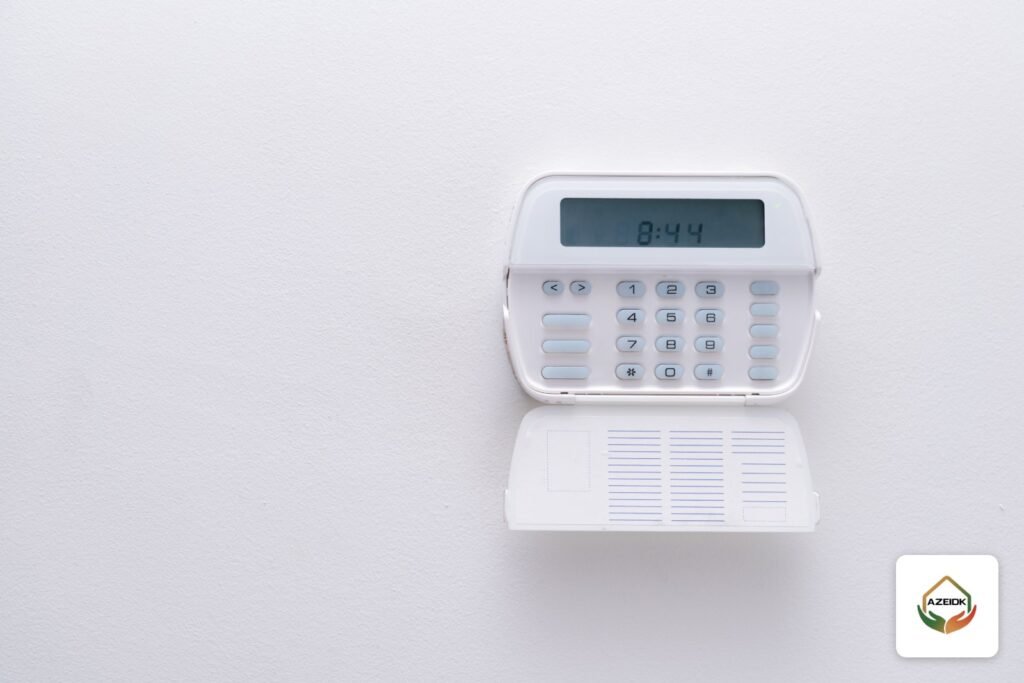
When you buy a burglar alarm, the datasheet often says Grade 2 or Grade 3 to EN 50131. That number is the security grade. It describes the kind of intruder the system is built to resist, from an opportunist with no tools at Grade 1 to an organised group planning ahead at Grade 4. The grade of the whole system is the grade of its weakest device.
This article explains the four grades, what actually changes between Grade 2 and Grade 3, how to read the certificate before you buy, and when a shop, jewellery store, bank or warehouse needs a higher grade. AZEIDK GROUP supplies Ajax and Hikvision intrusion equipment under security and surveillance systems and designs each system around the site and its risk.
Key points
- EN 50131 is the European series for intrusion and hold-up alarm systems; Part 1, EN 50131-1, sets the system requirements.
- There are four grades, from 1 (lowest risk) to 4 (highest), based on the skill and tools of the expected intruder.
- The system grade equals the grade of its lowest-graded component, including the power supply.
- Grade 3 typically adds anti-masking, tamper protection on every device and faster supervision of communication paths.
- The standard also defines four environmental classes for indoor and outdoor use, separate from the security grade.
In this article
- What is EN 50131 for burglar alarm systems?
- Grade 1, Grade 2, Grade 3 and Grade 4 explained
- Grade 2 vs Grade 3 burglar alarm: what changes
- Why the system grade equals the weakest device
- How to read the grade on a datasheet
- When does a shop, bank or warehouse in Saudi Arabia need Grade 3?
- How AZEIDK GROUP helps you choose the grade
- Frequently asked questions
What is EN 50131 for burglar alarm systems?
EN 50131 is a CENELEC series covering wired and wire-free intrusion and hold-up alarm systems installed in buildings. Part 1, “System requirements”, is currently consolidated as EN 50131-1:2006 with amendments A1:2009, A2:2017 and A3:2020. It covers the performance of the installed system and building-mounted components such as control panels and warning devices. It does not cover exterior perimeter systems, or design, installation and maintenance work itself.
Other parts deal with individual devices: control and indicating equipment (Part 3), warning devices (Part 4), detectors (Part 2), wire-free interconnections (Part 5-3) and power supplies (Part 6). That is why a datasheet lists EN 50131-1, EN 50131-2-2, EN 50131-5-3 and so on. Note that a new edition of the control panel part, EN 50131-3:2026, was published on 31 March 2026 and supersedes the 2009 edition, so certificates may refer to either.
Alarm transmission to a monitoring centre has its own series, EN 50136 (alarm transmission systems, ATS). The official Ajax Hub 2 Plus specification page, for example, lists EN 50136-1 and EN 50136-2 alongside the EN 50131 parts.
Grade 1, Grade 2, Grade 3 and Grade 4 explained
A grade is not a general quality score. It states the level of attacker the system resists. The table combines the definitions published by Ajax and Gallagher:
| Grade | Expected intruder | Example sites named by the sources |
|---|---|---|
| Grade 1 | Opportunist with no alarm knowledge or tools | Homes and very low-risk commercial premises |
| Grade 2 | Intruder with basic alarm knowledge and simple tools | Apartments, villas, offices, small and medium commercial premises |
| Grade 3 | Professional intruder with system knowledge and portable electronic equipment | Large shopping centres, warehouses, data centres, healthcare facilities, jewellery stores, armouries, banks |
| Grade 4 | Organised group planning in advance with sophisticated equipment | Government, critical infrastructure, some financial sites |
These examples are a guide. The right grade comes from a risk assessment of the actual site: what is inside, how easy it is to reach, response time, and what the insurer or project specification requires.
Grade 2 vs Grade 3 burglar alarm: what changes
The difference is not the number of detectors. It is how well each device detects attempts to defeat it. The main points from official sources:
- Anti-masking: in Ajax’s wireless Grade 3 line, motion detectors detect attempts to block their view with fabric, paper, metal or spray, even when the system is disarmed. The official spec page of the Grade 3 motion detector lists anti-masking; the page for the Grade 2 Superior MotionProtect Jeweller does not.
- Tamper: Gallagher states that Grade 3 requires tamper protection on all devices, encrypted communication paths and supervision of all circuit paths.
- Supervision: in Ajax’s Grade 3 line, devices can send data packets as often as every 12 seconds and the hub detects communication loss within 36 seconds; if jamming is detected, the hub switches frequencies and sends an alert.
- Opening detectors: the same line uses a magnetometer to detect strong-magnet tampering.
- Keypads: in Ajax’s Grade 3 line, keypads lock for a set time after three wrong code attempts and report the event.
- Power: Gallagher says the whole system, including the power supply, must meet the required grade.
One practical point buyers often miss: motion detectors in Ajax’s wireless Grade 3 line do not support pet immunity, according to the official solution page. If animals are on site, detector type and placement need rethinking.
Why the system grade equals the weakest device
Ajax states that a system’s grade is set by its lowest-graded device. Gallagher adds that one downgraded component invalidates the grade of the whole installation. This often happens on extensions: a Grade 3 panel plus an old Grade 2 detector in the store room gives a Grade 2 system.
An example with Ajax equipment AZEIDK GROUP supplies: the official specification page of the Ajax Superior Hub Hybrid 4G lists Security Grade 3 to EN 50131, certified by TREZOR TEST, while the Superior MotionProtect Jeweller, the Superior DoorProtect Jeweller and the Superior KeyPad Plus Jeweller are Grade 2. Combine them and the system is Grade 2, even though the panel is Grade 3. For a Grade 3 system, every device must be Grade 3.
| Ajax device (supplied by AZEIDK GROUP) | Grade on official spec page |
|---|---|
| Hub 2 Plus Jeweller | Grade 2 |
| Hub BP Jeweller | Grade 2 |
| Superior Hub Hybrid 4G | Grade 3 |
| Superior MotionProtect Jeweller | Grade 2 |
| Superior DoorProtect Jeweller | Grade 2 |
| Superior KeyPad Plus Jeweller | Grade 2 |
| GlassProtect Jeweller | Grade 2 |
On 2 March 2026 Ajax announced a complete wireless Grade 3 line (hub, detectors, keypads and sirens), describing it as the world’s first wireless system certified to EN 50131 Grade 3; the release does not name the certification body. Most of the Grade 3 devices Ajax listed in 2023 came from its wired Fibra line, alongside the Superior Hub Hybrid. Neither the new wireless G3 line nor the Fibra devices are among the Ajax products currently listed on the AZEIDK GROUP site; the listed ones are those in the table above. If your project specification calls for a complete Grade 3 system, review that requirement with the consultant and the AZEIDK GROUP team before the design is approved.
For Hikvision AX PRO devices we do not state a grade here, because we could not find it on the official datasheets of the models listed. Ask for the EN 50131 certificate of the exact model before using it on a project that specifies a grade.
How to read the grade on a datasheet
- Look for “Security Grade” stated explicitly with the standard number. “EN 50131 compliant” without a grade is not enough.
- Check the certification body. The Ajax devices above name TREZOR TEST s.r.o. as issuer of the grade and environmental class certificates. Ajax says the certificates are available to its accredited partners.
- Check the environmental class. The standard defines four environmental classes for indoor and outdoor locations, separate from the grade. The motion detector in Ajax’s Grade 3 line, for instance, is Environmental Class II. An indoor device is not mounted outdoors whatever its grade.
- Check the temperature range. The Superior DoorProtect Jeweller spec page gives -10 to 40 °C operating temperature, which matters in non-air-conditioned warehouses in summer.
- Ask about alarm transmission. If signals go to a monitoring centre, review the communication paths (Ethernet, Wi-Fi, SIM) and how they meet EN 50136.
- Check backup time. Ajax gives up to 15 hours on backup for Hub 2 Plus (SIM only) and up to 60 hours for Superior Hub Hybrid 4G with a 7 Ah battery and 30 wired devices.
When does a shop, bank or warehouse in Saudi Arabia need Grade 3?
In the official sources we reviewed we found no Saudi text that sets a specific EN 50131 grade for each type of business. The grade therefore usually comes from the consultant’s project specification, the insurer’s conditions, or the owner’s or operator’s security requirements. Within that frame:
- Villas, apartments, offices and ordinary shops: Grade 2 is common, and Gallagher notes it is the minimum most insurers ask for in small and medium commercial premises. For layout, see Ajax burglar alarm design for villas, shops and warehouses.
- Gold and jewellery stores: Ajax lists them among Grade 3 sites. Panic buttons, CCTV and access control complete the picture, as in jewellery store security systems.
- Banks and ATMs: follow the bank’s own requirements and those of its regulator first; see bank and ATM CCTV and intrusion alarms.
- Warehouses: Gallagher lists warehousing as a Grade 3 example, but a building-materials store differs from an electronics or pharmaceutical warehouse. Stock value and site isolation decide.
- Government and critical infrastructure: may reach Grade 4 depending on the risk assessment.
In every case, grade does not fix poor layout: a Grade 3 detector in the wrong place is weaker than a Grade 2 detector in the right one. For components and CCTV integration see intrusion alarm systems: components, design and integration.
How AZEIDK GROUP helps you choose the grade
The AZEIDK GROUP team surveys the site, maps entry points and protected contents, proposes a suitable grade and devices from its range, and checks the grade of every device on the list against its official spec page before supply. This is part of technical selection of systems and equipment and engineering design and calculations, followed by installation, programming and handover.
Frequently asked questions
What does Grade 2 mean on an alarm?
The device passed EN 50131 tests for resisting an intruder with basic alarm knowledge and simple tools. It is the common grade for homes, offices and shops.
What is the difference between Grade 2 and Grade 3 alarms?
Grade 3 resists a professional intruder and typically adds anti-masking, tamper protection on all devices and faster communication supervision.
Does a Grade 3 panel make the whole system Grade 3?
No. The system grade is that of its weakest device, so a Grade 3 panel with Grade 2 detectors is a Grade 2 system.
Are Ajax devices EN 50131 certified?
Yes. Official spec pages state the grade per device: for example Hub 2 Plus and Superior MotionProtect Jeweller are Grade 2, and Superior Hub Hybrid 4G is Grade 3.
Does Saudi Arabia require a specific EN 50131 grade?
We found no general official text setting a grade per business type. The grade usually comes from the project specification, the insurer or the owner.
What is an environmental class on an alarm device?
A separate EN 50131 classification of the environment the device works in, indoor or outdoor. There are four classes.
Does your project specification call for a burglar alarm of a specific grade? Send us the site type and required grade, and the AZEIDK GROUP team will check the devices and their certificates before supply. Contact AZEIDK GROUP





