


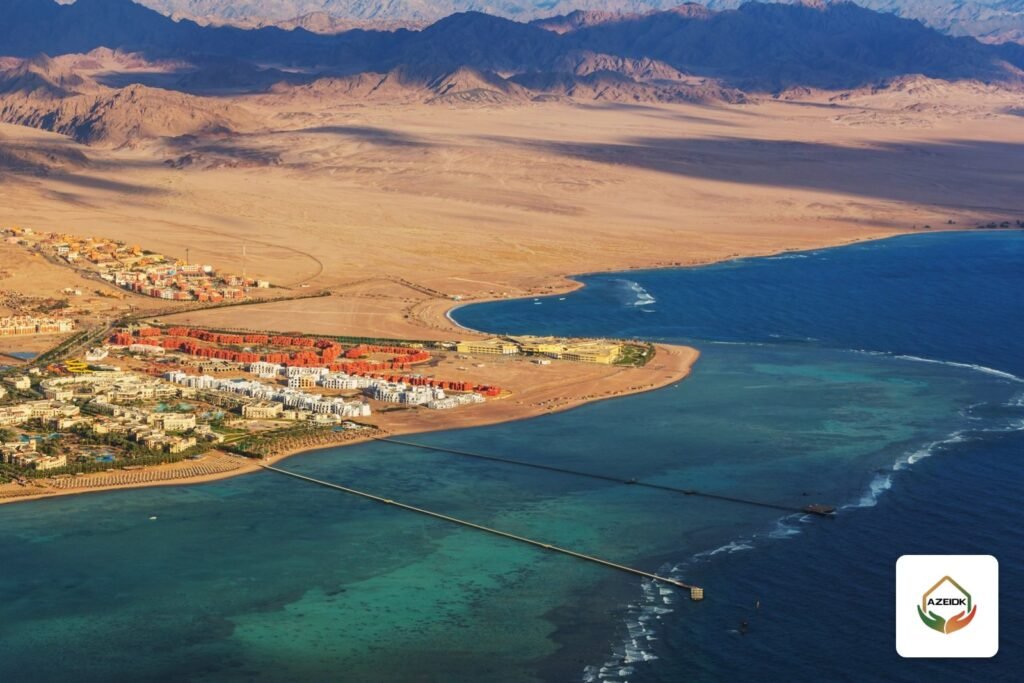
Fire protection for resort villages on the North Coast and the Red Sea is a different design job from a single building or a city compound. The village runs along a long strip of coast, with hundreds of scattered chalets, beach restaurants, service buildings, and an occupancy that peaks for a few summer weeks and drops for the rest of the year.
This guide shows how to build the fire fighting system for that pattern, from water demand to beach restaurant kitchens.
Key takeaways
- Size fire water demand on the largest single risk in the village, not on the chalet count or occupancy.
- Network length is the key variable: friction loss and level differences set the pressure at the last hydrant, and so the pump duty point.
- An electric main pump, diesel standby pump and jockey pump suit sites with a weak power supply. The jockey keeps the network pressurized through quiet months.
- Each chalet is its own unit: a visible extinguisher and suitable detection.
- A beach restaurant kitchen needs hood suppression and a gas shut-off, not extinguishers alone.
- The binding reference is the 2026 Egyptian fire code and Civil Protection. NFPA standards are design references.
In this article
- Why coastal resort villages need a different design
- Fire water demand and the tank: design for the largest risk
- The long fire main: pressure at the last hydrant
- The pump room: duty point and power source
- Protecting scattered chalets
- Beach restaurants and their kitchens
- Zoning the village for protection
- Common mistakes in fire protection design for resort villages
- Frequently asked questions
- Conclusion
Why coastal resort villages need a different design
Three features drive the design. Spread: the external fire main and hydrants become the backbone of the system. Seasonal occupancy: the system must be ready on the busiest day and stay sound through quiet months. Mixed uses: housing, commercial kitchens, service buildings and electrical rooms.
Egyptian Building Law No. 119 of 2008 and its executive regulations require the permit applicant to apply fire protection requirements per the Egyptian code. The code in force is the Egyptian Code for the Design and Implementation of Fire Protection for Buildings, 2026 edition (Ministerial Decree No. 355 of 2026); its second part covers mechanical firefighting systems. The General Directorate of Civil Protection (Ministry of Interior) reviews drawings and inspects systems. NFPA standards cited here are technical references, not a substitute for the code.
Fire water demand and the tank: design for the largest risk
Do not link the system size to the number of units. Assume one fire at the largest risk or hardest location, then calculate the flow it needs and how long that flow must last, as set by the code and the approved design.
Fire storage is flow multiplied by duration. A design flow of 1,000 GPM for 60 minutes, for example, means 60,000 US gallons, about 227 cubic meters reserved for fire use only. The figures only illustrate the arithmetic.
Many coastal villages draw water from a desalination plant or a supply line with limited capacity, so daily use must never eat into the fire reserve. Good practice is a dedicated fire tank, or a shared tank with the domestic suction outlets above the fire reserve level. NFPA 22 covers the design, construction, installation and maintenance of such tanks.
The long fire main: pressure at the last hydrant
In a long village the last hydrant can be far from the pump room, and every meter of pipe uses up pressure. The hydraulic calculation starts at the most remote point: the residual pressure needed there, plus friction loss along the route, plus any level difference if the site slopes toward the sea. For a worked example, see friction loss calculation with Hazen-Williams.
- Several loops, not one long loop: shorter water paths and less area lost to a break.
- Main line diameter: a larger diameter on long runs cuts friction loss sharply and may allow a lower-pressure pump.
- Numbered sectional valves: isolate part of the network without shutting the whole village, recorded on the as-built drawings.
- Future phase connections: leave tie-in points on the main so later phases connect without cutting the live network.
Ring main basics and hydrant locations are in our compound fire hydrant network guide. AZEIDK Egypt fire fighting systems include buried and exposed fire mains, HDPE pipes, AFC FW-9000 wet barrel hydrants and OS&Y gate valves. NFPA 24 covers restraining buried mains with thrust blocks or restraint systems, and it requires metal restraint hardware to be cleaned and coated with a corrosion-retarding material after installation, which matters more in saline soil. For salt air and seasonal shutdown, see fire system maintenance on the North Coast and Ain Sokhna.
The pump room: duty point and power source
With the required flow and discharge pressure known, you choose the rated duty point. NFPA 20 requires a fire pump to deliver 150% of rated flow at no less than 65% of rated pressure, with churn (zero-flow) pressure between 101% and 140% of rated pressure. Oversizing adds cost and raises churn pressure.
AZEIDK Egypt supplies complete 3PUMP fire pump sets: electric main pump, diesel standby pump, jockey pump and controllers on one base. Duty points available in Egypt (Non-UL / Non-Listed): 500 GPM at 8 bar, 750 GPM at 9 bar, 1000 GPM at 10 bar and 1500 GPM at 10 bar, each with its own datasheet. UL/FM-listed sets are manufactured and supplied on request.
On a coastal site the diesel pump matters because it runs when power fails or the supply is weak. Its fuel tank is sized on engine rating and the required run time. The jockey pump makes up small leaks and keeps the network pressurized through the quiet months, so the main pump does not start without reason.
Protecting scattered chalets
A chalet stays closed for months, then hosts guests who do not know where the equipment is. Keep protection simple and obvious:
- ABC dry powder extinguisher: PYRAMID stored-pressure extinguishers come in 1, 3, 6, 9 and 12 kg and conform to EN3 and Egyptian standard ES 8442/2021. Mount one in plain view near the entrance or kitchen, not in a cupboard.
- Detection: smoke detectors in the living area and bedroom corridor, and a heat detector in the kitchen to reduce false alarms. Larger villas suit a small conventional alarm panel.
- Outside access: every chalet group should be within hose reach of a hydrant or hose cabinet, per the approved design.
For comparison only, US OSHA 1910.157 sets a 75 ft (about 23 m) travel distance to an extinguisher for Class A hazards and 50 ft for Class B. In Egypt, the code and Civil Protection decide.
Beach restaurants and their kitchens
A beach restaurant combines fryers and grills running long hours, gas cylinders or a temporary gas line, and sometimes timber roofs or natural shades. An extinguisher alone cannot handle an oil fire inside the hood and exhaust duct.
The HoodSafer kitchen fire suppression system is built for this hazard. The HS series is fully mechanical and needs no pressurized components to actuate; the HSP series uses pneumatic detection. It operates automatically on heat or manually from a pull station and cuts the gas through a shut-off valve. Models HS-4, HS-8 and HS-16 are chosen by the number of flow points. It conforms to EN 17446:2021, holds BSI Kitemark KM 767382 and is approved by the General Directorate of Civil Protection. To pick a model by hood length and appliances, see sizing HoodSafer for restaurants and cafés.
For seasonal kitchens, test the system before opening and review nozzle positions if a new tenant changed the cooking line.
Zoning the village for protection
A design framework, not a replacement for the Egyptian code:
| Zone | Main hazard | Typical protection |
|---|---|---|
| Chalet rows | Kitchen or electrical fire in a closed or lightly occupied unit | ABC extinguisher, smoke and heat detection, coverage from external hydrants |
| Beach restaurants and cafés | Cooking oil, gas, light materials in roofs and shades | HoodSafer hood suppression with gas shut-off, extinguishers for the dining area, a nearby hydrant |
| Service building and clubhouse | Large gatherings, electrical rooms, stores | Fire alarm (conventional or addressable by size), hose cabinets, CO2 extinguishers for electrical rooms |
| Pump room and tank | Loss of water or pressure during a fire | Electric, diesel and jockey pumps, reserved fire water, supervised valves |
| Entrances and internal roads | Delayed fire engine arrival | Fire department connection (Siamese) in an accessible spot, roads wide enough for access |
For large service buildings, AZEIDK Egypt supplies Context Plus conventional and addressable panels and Series 65A detectors, and the TANDA TX7130 beam detector suits high halls. Alarm and fault signals should reach the staffed security room.
Common mistakes in fire protection design for resort villages
- Sizing water demand on the chalet count instead of the largest single risk.
- A shared tank with domestic suction at the bottom, so the fire reserve is used up in peak summer.
- Selecting the pump on a hydrant near the pump room, then finding too little pressure at the far end of the beach.
- One long loop with no sectional valves, so any break takes out a large part of the village.
- No tie-in points for future phases, so the live network must be cut later.
- A beach restaurant with extinguishers only and no hood system or gas shut-off.
Frequently asked questions
Does every chalet need its own fire alarm system?
The Egyptian code and the approved design decide. As a practical minimum: smoke detection in the living area and corridor, a heat detector in the kitchen and a visible extinguisher. Villas and multi-unit buildings may need a panel.
Is the village water tank enough for fire use?
Only if the calculated fire volume is reserved so daily use cannot reach it. A dedicated tank is better, or a shared tank with the domestic suction outlets above the fire reserve level.
Why a diesel pump if electricity is available?
Power cuts or a weak supply are likely on remote sites, and a diesel pump does not depend on the grid. That is why a 3PUMP set combines an electric main pump, a diesel standby pump and a jockey pump on one base.
How do I know the pressure is enough at the last hydrant on the beach?
Through the hydraulic calculation from the most remote point back to the pump, then a test at handover. The calculation adds the required residual pressure, friction loss and level difference, and the pump duty point is chosen on that basis.
Are extinguishers enough for a beach restaurant?
Not on their own for the hood and duct. A kitchen suppression system operates automatically on heat and shuts off the gas; extinguishers cover the dining area and the first moments of a fire.
Conclusion
Fire protection for resort villages starts with two questions: what is the largest single risk, and what pressure is available at the most remote point? The answers set the fire storage volume, the main diameter and the pump duty point. Then comes protection for each chalet, restaurant and service building. The village runs full for only a few weeks, and the network must be ready on every one of them.
Planning a new village or an extension phase? Send us the master plan, network lengths and restaurant locations, and we will help you choose the pump set, network equipment, kitchen systems and extinguishers, with a datasheet for each product. Talk to the AZEIDK Egypt team
Related guides
- Fire Alarm Maintenance in Egypt: Testing Detectors, Call Points, Sounders, Panel Batteries and the Fault Log
- Fire Pump Rooms in Egypt: Equipment and Key Installation Requirements
- Fire Safety in Sports Clubs and Gyms in Egypt: Halls, Kitchens and Stores
- Addressable Fire Alarm Loop Design: Capacity, Isolators and Layout





