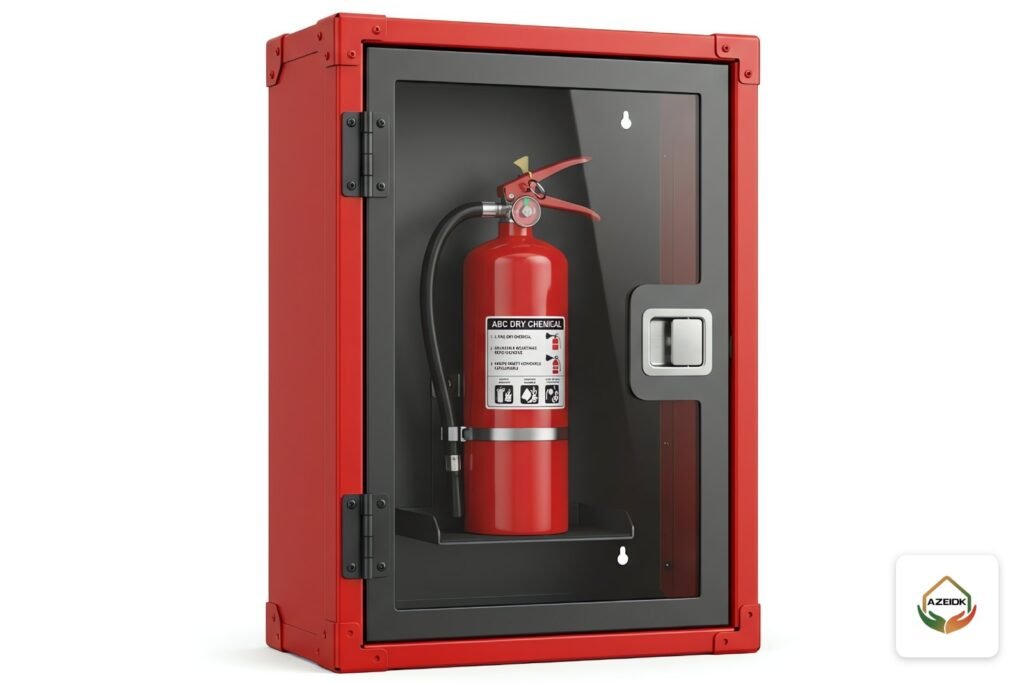
A radiology center differs from an ordinary clinic in two ways: large machines with heavy electrical loads in closed rooms, and an MRI room that no magnetic metal object may enter, firefighters with their gear included. That is why fire protection in radiology centers needs a design that meets accreditation and civil protection requirements on one side and MRI safety rules on the other.
This article sets out what the accreditation handbook for diagnostic and therapeutic radiology centers from Egypt’s General Authority for Healthcare Accreditation and Regulation (GAHAR) requires, what the American College of Radiology manual says about fire in the MR area, and how to choose the fire detection and alarm systems and extinguishers supplied by AZEIDK Egypt for each room.
Key takeaways
- The GAHAR radiology centers handbook (first edition, 2022, with a stated validity of October 2022 to October 2026; we found no newer edition as of November 2026) requires a certificate of conformity with civil protection requirements for governmental and non-governmental centers.
- Standard EFS.02 calls for 24/7 detection with a central control panel and a risk assessment of high-risk areas such as oxygen storage and electrical panels.
- Fire alarm, firefighting and smoke containment systems must work and meet civil protection requirements, with recorded inspection and maintenance.
- The ACR Manual on MR Safety limits firefighting equipment stored in Zones III and IV to items labelled MR Conditional or MR Safe.
- Control rooms, electrical panels and server rooms are protected with CO2 extinguishers, corridors with ABC dry powder.
What the GAHAR handbook asks of radiology centers
The handbook covers standalone radiology centers offering diagnostic, interventional and therapeutic services. Among the licensing requirements it lists a certificate of conformity with civil protection requirements for governmental and non-governmental centers, and it refers to Ministry of Health Decree No. 513 of 2016 on licensing and control of MRI devices. Fire is covered by standard EFS.02 in the Environment and Facility Safety chapter:
| What EFS.02 includes | What it means on site |
|---|---|
| Ongoing risk assessment covering civil protection compliance and high-risk areas such as oxygen storage and electrical panels | A list of high-risk rooms with the detector and extinguisher type for each |
| 24/7 detection with a central control panel | An alarm panel at reception or the security room |
| Smoking prevention and safe storage of flammable materials | An operating policy and a set storage place away from equipment rooms |
| Suppression such as water systems or automatic or manual extinguishers, with maintenance schedules | Extinguishers by hazard, with an inspection and maintenance log |
| Exit signage, annual staff training on RACE and PASS, and recorded evacuation drills | Manual call points at exits and signs beside extinguishers |
Evidence of compliance includes working fire alarm, firefighting and smoke containment systems that meet civil protection requirements, recorded inspection, testing and maintenance, an annual review of the plan with data analysis, and a safe evacuation process for everyone in the building.
The MRI room: different rules for fire
The ACR Manual on MR Safety divides an MR facility into zones, the most hazardous being Zone IV, which holds the scanner itself. The points below come from the 2020 edition; ACR has since released a 2024 update, and its published list of changes shows no change to the fire guidance. On fire, the manual makes several practical points:
- Firefighting equipment stored in Zones III and IV must be MR Conditional or MR Safe.
- Conventional extinguishers and firefighting equipment not verified as MR safe are restricted from Zone III.
- Fire alarms and emergency calls from the MR facility go to a designated member of the MR team, ideally on site before responders arrive, so responders do not have free access to Zones III and IV.
- The magnetic field may remain active during a fire, so nobody should assume it is off.
- If firefighters need to enter Zone IV, the manual says a quench of a superconducting magnet should be seriously considered, and the field must be verified as gone or sufficiently reduced before they enter with their equipment.
Standard extinguishers, PYRAMID included, are not labelled MR Conditional. They belong in corridors and the control room outside Zone III, while firefighting equipment inside the MR area follows the center’s MR safety policy and the scanner manufacturer’s instructions. The ACR manual also recommends educating fire services about MR hazards in advance, which in Egypt means contacting the local civil protection department.
Fire protection in radiology centers, room by room
| Location | Detection | Extinguisher |
|---|---|---|
| Reception, waiting areas and corridors | Smoke detector | PYRAMID ABC dry powder |
| Control room next to CT and MRI | Smoke detector | PYRAMID CO2, outside Zone III |
| X-ray, mammography and CT rooms | Smoke detector, coordinated with the equipment supplier | CO2 near the door |
| Electrical panels, UPS room and server room | Smoke detector | CO2, a Fire Search automatic CO2 unit, or a gaseous system as designed |
| Oxygen and consumables store | Detector suited to the space | ABC powder or CO2 depending on contents |
NFPA 10 says dry chemical extinguishers should not be relied on to protect delicate electronic equipment, because the residue can damage it, which is why CO2 is the extinguisher closest to equipment and control rooms. PYRAMID CO2 units comply with EN3 and Egyptian standard ES 735, dry powder units comply with ES 8442/2021, and the approved products carry the Egyptian quality mark.
In server rooms that hold patient images and the radiology archive, the design may call for a clean agent system such as AFC-227 from American Fire Control, part of our special fire suppression solutions. We described its components in our article on the AFC-227 system.
Alarm system and control panel
A small single-floor center is usually served by a conventional Context Plus system with a CFP or FP panel and Series 65A detectors. Larger multi-floor centers, or those with CT, MRI and therapeutic radiology, are better served by an addressable system with a ZFP panel that pinpoints the room. The panel must sit where it is watched around the clock, and any alarm from the MR area should reach the MR team on duty, as the ACR manual recommends. Our article on choosing smoke and heat detectors explains detector choice per room.
Standard EFS.05 in the same handbook asks for a utilities plan covering normal and emergency power and medical gases, with regular inspection and maintenance and backup for critical systems. Check with the panel supplier that the standby battery is sized for the required standby and alarm time; our article on fire alarm battery calculation shows the method.
Inspection and maintenance before the accreditation visit
Surveyors review the plan and the inspection and maintenance records, observe the alarm and suppression systems in place, and review drill and training plans. The center therefore needs a file holding the as-built detector and extinguisher layout, a periodic test log for the panel, detectors and sounders, an inspection tag on every extinguisher, and the datasheet for every device. AZEIDK Egypt provides testing, commissioning and maintenance through its technical services.
Common mistakes
- Hanging a standard extinguisher inside the MRI room or just inside its door.
- Powder extinguishers in control rooms and equipment rooms.
- An alarm panel in a closed room nobody watches.
- Not telling fire services that there is an MRI room and whom to contact on arrival.
- A radiology archive server room with no detector and no suitable means of suppression.
Frequently asked questions
Does a radiology center need a civil protection certificate?
Yes. The GAHAR radiology centers handbook lists a certificate of conformity with civil protection requirements among the licensing requirements for governmental and non-governmental centers.
Can a standard extinguisher be placed inside the MRI room?
No. The ACR manual limits firefighting equipment in Zones III and IV to items labelled MR Conditional or MR Safe and restricts conventional extinguishers from Zone III.
Which extinguisher suits the control room?
A CO2 extinguisher, because it leaves no residue on equipment, placed outside Zone III if the room serves an MRI scanner.
Does the server room need a gaseous system?
The design decides, based on the value of the equipment and data. Often CO2 extinguishers are enough; in other cases a clean agent system such as AFC-227 is chosen.
Where should the alarm panel go in a radiology center?
At reception or the security room, because EFS.02 calls for 24/7 detection with a central control panel.
Conclusion
A radiology center needs what any healthcare facility needs, a monitored alarm, extinguishers and an evacuation plan, plus one special rule: no standard firefighting equipment in the MR area, and no responders entering with their gear until the field is verified. When the system is designed with that in mind, the accreditation visit and the civil protection inspection go through without the two requirements clashing.
Fitting out a new radiology center or reviewing an existing system? Send us the layout with the equipment and MRI room locations, and we will propose the alarm system and the right extinguishers outside the MR area. Talk to the AZEIDK Egypt team
Related guides
- Electrical Fires in Commercial and Office Buildings in Egypt: Panels, Meters and the Right Extinguisher
- 750 GPM Fire Pump at 9 bar (3PUMP Set): Reading the Datasheet, 150% Point, Churn and Jockey
- Manual Call Points and Sounders in Fire Alarm Systems
- Hospital Fire System Maintenance in Egypt: Testing While Operational