In many fires, a person sees smoke or flame before any detector does. That is why manual call points remain an essential part of every fire alarm system, however good the automatic detection is. At the other end of the system are the sounders and visual alarm devices. Early detection is worth little if occupants cannot hear or see the alarm.
This article covers both ends of the system: call point types and positions, sounders and visual alarm devices, the levels set by the standards, circuits, testing and common mistakes.
Key takeaways
- Manual call points go on escape routes and next to exits, so people can operate them on their way out.
- BS 5839-1:2025 sets a maximum travel distance of 45 m to the nearest call point and a mounting height of about 1.4 m.
- In public mode, NFPA 72 (2025 edition) requires the alarm to be at least 15 dBA above the average ambient sound level, without exceeding 110 dBA.
- EN 54-23 visual alarm devices carry a mounting category and coverage rating. Not every red flashing light is a compliant visual alarm device.
- Calculating sounder loads on circuits and batteries is part of the design, not a task to leave to site.
In this article
- The Egyptian framework and the technical references
- Types of manual call points
- Where to install manual call points, and at what height
- Sounders
- Visual alarm devices (VADs)
- Circuits, power and load calculations
- Testing and maintenance
- Common mistakes with call points and sounders
- Context Plus products from AZEIDK Egypt
- Frequently asked questions
- Conclusion
The Egyptian framework and the technical references
The binding reference is the Egyptian Code for the Design and Implementation of Fire Protection for Buildings — 2026 edition (Ministerial Decree No. 355 of 2026). Its third part covers electrical requirements and fire detection and alarm. The General Directorate of Civil Protection (Ministry of Interior) approves system drawings before installation and inspects the building before occupancy.
For design details, projects use technical references named in the specification: BS 5839-1:2025 for system design in the British approach, with the product standards EN 54-11 for manual call points, EN 54-3 for sounders and EN 54-23 for visual alarm devices; or NFPA 72 (2025 edition) in the American approach. The figures in this article are guidance from these references, not Egyptian legal requirements.
Types of manual call points
A manual call point (MCP, often called a “break glass” on Egyptian sites) sends a fire signal to the panel when someone presses it. Types differ by operation, operating element and connection to the panel:
- Single action: one press on the front raises the alarm. This is the common type in commercial and office buildings.
- Dual action: two steps are needed, such as lifting a cover and then pressing. Used where false operation or tampering is common, such as schools, care homes and busy public areas.
- Glass or resettable element: modern call points usually have a plastic element reset with a key, instead of glass that breaks and must be replaced.
- Conventional or addressable: an addressable call point shows its own address and exact location on the panel; a conventional one shows only its zone.
- Indoor or weatherproof: outdoor and wet locations need the IP rating given on the datasheet.
A protective cover can be added to reduce accidental operation, and BS 5839-1:2025 recommends that these covers are transparent. Manual call points are red in both approaches.
Where to install manual call points, and at what height
The shared rule is to place call points where people pass during evacuation: at final exit doors, at stair entrances and along escape routes. The details differ between the two references:
| Item | BS 5839-1:2025 | US approach (NFPA 72 and IBC) |
|---|---|---|
| Distance to nearest call point | Maximum 45 m actual travel distance, 30 m in a straight line | Horizontal travel distance not over 61 m (200 ft) on the same floor |
| Position relative to exits | At final exits and stair entrances on escape routes | Within 1.5 m (5 ft) of the entrance to each exit |
| Mounting height | 1.4 m, with a tolerance of 200 mm above and 300 mm below | Operable part between 1.07 and 1.22 m (42 to 48 in) |
The British figures come from the FIA guide to the 2025 changes. In the US column, the mounting height and the 61 m travel distance are as Electrical Contractor reports them from the 2022 edition of NFPA 72, and the 1.5 m rule is from IBC Section 907.4.2. Check the edition adopted on your project.
Under BS 5839-1:2025, call points on stair landings belong to the zone serving the adjacent floor, except at the final exit level. Many designers miss this when they set out zones.
Sounders
A sounder turns the alarm signal into an audible warning throughout the building. The European product standard is EN 54-3. What matters is the sound level where people are, not the output figure printed in the catalogue.
Sound levels in NFPA 72
Electrical Contractor magazine summarizes the 2025 edition as follows:
- In public mode, the signal must be at least 15 dBA above the average ambient sound level in all occupied areas.
- Ambient sound plus all appliances must not exceed 110 dBA at the minimum hearing distance.
- Where average ambient sound exceeds 105 dBA, visual notification appliances are required.
- The evacuation signal uses the dedicated three-pulse temporal pattern (Temporal-3).
Sound levels in BS 5839-1:2025
According to Apollo’s guide to the 2025 edition, the minimum is 65 dB(A) in general, or 5 dB(A) above background noise where that noise exceeds 60 dB(A) for more than 30 seconds. 60 dB(A) is acceptable in stairways and small enclosed spaces, and 75 dB(A) is needed at the bedhead, with doors shut, where people sleep.
Doors and walls cut sound sharply, so one corridor sounder may not reach the closed rooms beside it. In plant rooms and production halls, measure real noise during operation before choosing sounders.
Visual alarm devices (VADs)
A building needs visual warning where sound is not enough: for people with hearing loss, and in high-noise areas where workers wear ear defenders. EN 54-23 defines visual alarm devices in three categories:
- Ceiling category (C): written C-x-y, where x is the maximum mounting height and y the diameter of the coverage cylinder in metres. Example: C-3-8.5.
- Wall category (W): written W-x-y, where x is the mounting height and y the width of the covered square in metres. The minimum mounting height for this category is 2.4 m. Example: W-2.5-7.
- Open category (O): coverage is set by the manufacturer, and application relies on the manufacturer’s data.
The standard requires at least 0.4 lux across the whole covered volume, a flash rate between 0.5 and 2 Hz, and a red or white light. A status beacon, or a flashing light on top of a sounder used only for identification, is not a visual alarm device unless it complies with EN 54-23 and is installed to its category.
Circuits, power and load calculations
In a conventional system, sounders sit on dedicated sounder circuits from the panel, each ending in an end-of-line resistor so the circuit can be monitored. In an addressable system, sounders may be powered from the loop itself or from separate circuits via output modules. For the difference between the two, see our comparison of conventional and addressable fire alarm systems.
- Add up the alarm current of all devices and check it is within the circuit or loop capacity on the datasheet.
- Calculate voltage drop to the last device, especially on long loops with many devices.
- Size the batteries for the required standby period and then the alarm period, per the chosen standard and the project specification.
- Use fire-resistant cable for sounder circuits, because they must keep working during the fire.
Testing and maintenance
At handover, test every call point individually to confirm the signal reaches the panel with the correct address or zone. Measure sound levels in representative areas, and check that each visual alarm device can be seen across its coverage area. Record the results in the system log.
In service, BS 5839-1:2025 sets a periodic service visit about every six months, with a tolerance of one month. The maintenance plan sets which call points and devices are tested at each visit, following the chosen standard, the manufacturer’s instructions and the authority’s requirements. AZEIDK Egypt services can help you set up the maintenance programme.
Common mistakes with call points and sounders
- Installing the call point inside the room, away from the door, instead of on the way out.
- Hiding the call point behind an open door, furniture or signage.
- Choosing the number of sounders from floor area alone, without allowing for doors and real noise levels.
- Fitting an ordinary indicator beacon where an EN 54-23 visual alarm device is needed.
- Mounting a wall-category VAD below the height its category allows.
- Adding sounders during later alterations without recalculating batteries and circuit loads.
- Using different alarm tones within the same building, which confuses occupants.
Context Plus products from AZEIDK Egypt
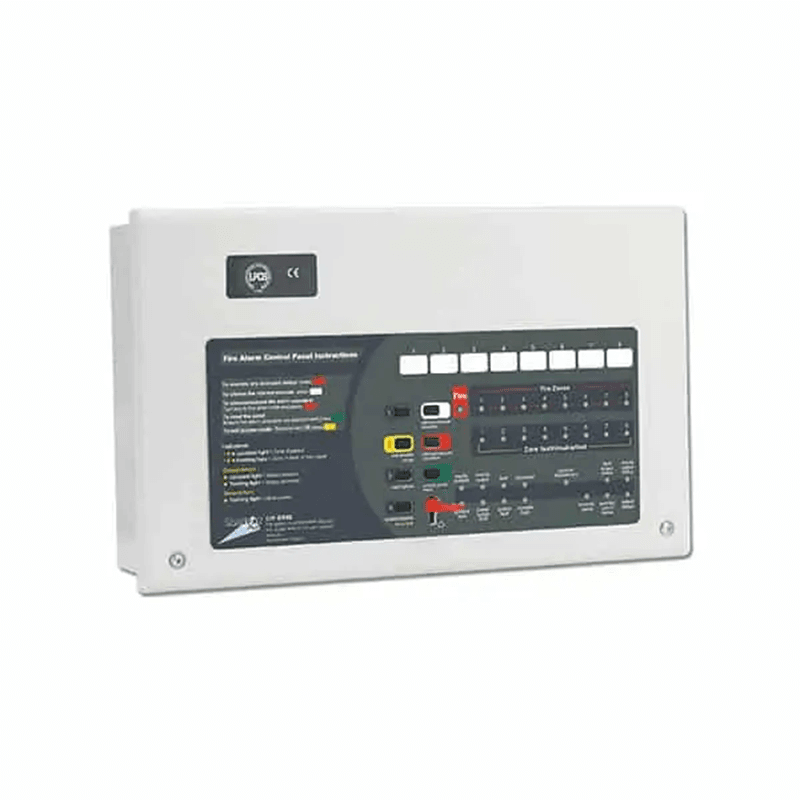
Within our fire alarm system solutions, AZEIDK Egypt supplies manual call points, sounders and beacons, and I/O modules from British manufacturer Context Plus, together with ZFP addressable panels and CFP and FP conventional panels. Approvals vary by model, from EN 54 conformity to UL listing for specific models. Check each model’s datasheet before approval. To choose the detectors that complete the system, see our guide to choosing smoke and heat detectors.
Frequently asked questions
Is a “break glass” the same as a manual call point?
Yes, it is the same device. The name comes from older call points with breakable glass. Modern call points usually use a resettable element.
How many call points does one floor need?
Exit positions and travel distance decide. Under BS 5839-1:2025, the actual travel distance to the nearest call point must not exceed 45 m, with a call point at each final exit and stair entrance, alongside the code and authority requirements.
Is the loudest sounder always the best choice?
No. Too much sound can exceed the maximum level, harm hearing and make communication during evacuation harder. The aim is enough level above ambient noise everywhere, with sounders spread evenly.
When do I need visual alarm devices?
Where there are people with hearing loss, in noisy areas or where ear defenders are worn, and wherever the project specification or the authority requires them.
Can a cover be fitted over a call point?
Yes, where accidental operation or tampering is likely, provided it does not stop use in an emergency. BS 5839-1:2025 recommends transparent covers.
Conclusion
Manual call points and sounders are the parts of the system occupants actually touch and hear. Put call points on escape routes, next to exits and at the right height. Check sound levels in every space, choose VADs whose category matches their mounting, and confirm that circuits and batteries carry the full load.
Need a review of call point and sounder layouts on your project? Send us the drawings and the use of each space, and we will propose suitable models with datasheets and the approval status of each. Talk to the AZEIDK Egypt team