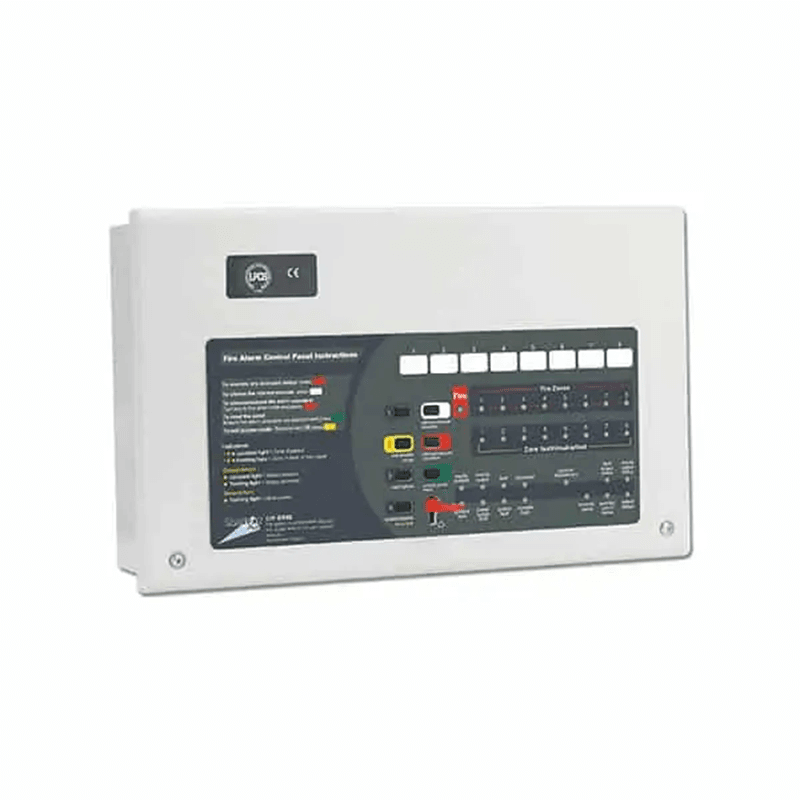
A fire protection system spends most of its life on standby, so faults usually show only when it is needed. A valve left closed after old alteration works, a panel battery that has lost capacity, a diesel fire pump that has not run for months: these silent faults are found only by a regular programme of fire fighting and fire alarm system maintenance.
This guide explains inspection, testing and maintenance, why records matter, and common causes of failure, with a table of typical intervals from the American standards NFPA 25 and NFPA 72, kept separate from manufacturer instructions and Egyptian legal requirements.
Key takeaways
- Inspection is visual, testing is operational and measures performance, and maintenance means repair, replacement and resetting. Together they form one programme.
- NFPA 25 is the reference for water-based systems (sprinklers, pumps, hoses) and NFPA 72 for fire alarm systems. Their latest editions are 2026 and 2025 respectively.
- Common causes of failure include closed control valves, out-of-service pumps, dirty detectors, weak batteries, and painted or blocked sprinklers.
- The intervals in the table are NFPA guidance, not Egyptian legal periods, and are supplemented by the manufacturer’s instructions.
- Documented records are essential to prove system readiness to the owner, the insurer and the authorities.
In this article
- Inspection, testing and maintenance: three different activities
- Three levels of reference to keep separate
- Typical intervals under NFPA 25 and NFPA 72
- Main causes of failure in fire fighting and fire alarm systems
- Records and impairment management
- How to build a fire fighting system maintenance programme
- Common maintenance mistakes
- Frequently asked questions
- Conclusion
Inspection, testing and maintenance: three different activities
American standards use the abbreviation ITM (Inspection, Testing and Maintenance) for an integrated programme of three activities, each with its own purpose:
- Inspection: a visual check that a component is in good condition, correctly positioned and undamaged: valve positions, gauge readings, sprinkler condition, unobstructed detectors.
- Testing: operating a component or system and measuring performance, such as running the pump to measure pressure and flow, or activating a detector and confirming the signal reaches the panel.
- Maintenance: work that keeps or restores proper working order, such as changing diesel engine oil and filters, replacing batteries, cleaning detectors and repairing leaks.
These are often confused. A walk-round does not prove the pump delivers its rated pressure, and a good run test does not replace a component at the end of its service life.
Three levels of reference to keep separate
- Legal requirements in Egypt: Egyptian Building Law No. 119 of 2008 and its executive regulations oblige the permit applicant to apply fire protection requirements according to the Egyptian code. The General Directorate of Civil Protection (Ministry of Interior) reviews drawings and systems and carries out site inspections. The Egyptian Code for the Design and Implementation of Fire Protection for Buildings — 2026 edition is now in force. Any mandatory maintenance intervals come from the code, the regulations and the facility’s licence conditions, not from this article. For more, see our article on fire protection requirements in Egypt.
- Technical reference standards: NFPA 25, NFPA 72 and similar. They are internationally recognised and used in many specifications and by insurers, but are not legally binding in Egypt on their own.
- Manufacturer’s instructions: the operation and maintenance manual for each pump, panel or detector, which may add items or shorten intervals.
Where they conflict, the stricter of the legal requirement and the manufacturer’s instructions usually applies, after consulting the responsible engineer and the authority.
Typical intervals under NFPA 25 and NFPA 72
The table summarises selected intervals from NFPA 25 (2023 edition; the 2026 edition has since been issued) and NFPA 72. They are American guidance, not Egyptian legal periods; the final reference is the project’s adopted edition and the manufacturer’s instructions.
| Item | Activity | Interval per NFPA | Reference |
|---|---|---|---|
| Diesel-driven fire pump | No-flow (churn) run test for at least 30 minutes | Weekly | NFPA 25 |
| Electric-driven fire pump | No-flow run test for at least 10 minutes | Monthly; weekly in specific cases, including high-rise buildings | NFPA 25 |
| Pump room | Visual inspection of pumps, valves, temperature and ventilation | Weekly | NFPA 25 |
| Fire pump set | Flow test at 0%, 100% and 150% of rated flow, with a controller test | Annual | NFPA 25 |
| Control valves | Check position (open) and condition of seal or lock | Weekly for sealed valves; monthly for locked or electrically supervised valves | NFPA 25 |
| Pressure gauges | Check reading; replace or calibrate | Monthly on wet systems; replace or calibrate every 5 years | NFPA 25 |
| Sprinklers | Visual inspection from floor level | Annual | NFPA 25 |
| Main drain test | Measure static and residual pressure and compare with previous readings | Annual | NFPA 25 |
| Waterflow alarm devices | Operational test | Semi-annual for vane and pressure switches; quarterly for mechanical water motor gongs | NFPA 25 |
| Internal condition of piping | Internal assessment for deposits and foreign material | Every 5 years | NFPA 25 |
| Smoke detectors | Functional test of alarm response | Annual | NFPA 72 |
| Smoke detector sensitivity | Sensitivity measurement | Within the first year after installation, then every two years | NFPA 72 |
| Fire alarm panel batteries | Inspect and test charger and load | Semi-annual and annual, depending on battery type and test | NFPA 72 |
| Control panel | Test functions, trouble signals and power supply | Annual | NFPA 72 |
Visual inspection intervals for other alarm components in NFPA 72 Table 14.3.1 range from semi-annual to annual, depending on the component and whether it is supervised. The standard also allows the sensitivity test interval to be extended in specific cases where readings have proven stable.
Main causes of failure in fire fighting and fire alarm systems
Water-based systems
- Control valves closed or partly open: often left that way after maintenance or alterations. This is one of the most serious faults: it takes the whole system out of service with no visible sign if the valve is unsupervised.
- Pumps out of service or left in manual: a controller left in the off position, weak diesel starting batteries, a low fuel tank, or a jockey pump (the small pump that maintains system pressure) running constantly because of a leak in the network.
- Painted, covered or damaged sprinklers: paint on the heat-sensitive element, or items hung from it, delays response; stock stored too close blocks the spray pattern.
- Pipe corrosion and deposits: these cause leaks, reduce flow area and can block sprinklers when they operate.
- Freezing or obstructions in the piping: the 2026 edition of NFPA 25 treats ice in the piping between the water supply and the discharge points as an impairment. This is less common in Egypt’s climate but possible in cold rooms.
- Insufficient water supply: a fire water tank that was not refilled, or a closed supply valve.
Fire alarm systems
- Dirty detectors: dust build-up changes detector sensitivity, causing false alarms or delayed response.
- Expired standby batteries: the panel looks healthy until the mains fails.
- Repeated false alarms: these push users to disable zones or silence the panel, leaving the system effectively out of service.
- Cable and circuit faults: open circuits, earth faults or moisture in junction boxes.
- Change of use: turning a store into a kitchen, or adding partitions, without reviewing detector type and layout.
Records and impairment management
A fire fighting system maintenance programme is incomplete without documentation. Each record should include the date, component, actual readings (pressure, flow, battery voltage), remarks, corrective action and who did the work. Comparing readings between visits reveals gradual deterioration before it becomes a failure.
NFPA 25 gives special attention to impairments, whether planned for maintenance or caused by an emergency. It calls for clear notification procedures, alternative protection measures during the impairment, and returning the system to service as soon as possible. Good practice is to tag any closed valve, inform building management, and confirm the valve is open before leaving site. The 2026 edition also stresses that work must be carried out by people qualified for the specific tasks.
How to build a fire fighting system maintenance programme
- List the components of each system: pumps, control valves, sprinklers, fire alarm panels, detectors and extinguishers.
- Collect the manufacturer’s instructions and datasheet for each component, and identify the reference edition of the standards used in the project design.
- Review the requirements in the Egyptian code and the facility’s licence conditions.
- Prepare a schedule that combines the shortest required intervals, with standard record forms.
- Assign responsibilities between the facility team (visual rounds) and the specialist contractor (testing and maintenance).
- Review the records regularly and close out findings by set deadlines.
AZEIDK Egypt provides periodic inspection and maintenance services for fire fighting systems, fire alarm systems and fire pumps. See also our solution pages for fire pump systems, fire fighting systems and fire alarm systems.
Common maintenance mistakes
- Doing a visual walk-round and recording it as a test.
- Running the diesel pump for only a few minutes, short of the run time the standard sets, and without recording temperature and pressure.
- Silencing the fire alarm panel or disabling a whole zone because of one faulty detector, without repairing it.
- Cleaning detectors with materials or methods the manufacturer does not recommend.
- Confusing NFPA intervals with local legal requirements, or assuming one replaces the other.
- Replacing sprinklers with types that have a different response or temperature rating without checking the design.
Frequently asked questions
Are the NFPA 25 and NFPA 72 intervals legally binding in Egypt?
Not on their own. The legal reference is the Egyptian code, civil protection requirements and the facility’s licence conditions. NFPA standards are used as technical references in specifications, design and maintenance programmes.
Why is the diesel fire pump tested every week?
The engine depends on batteries, fuel and cooling, and any of these can deteriorate when idle. NFPA 25 sets a weekly no-flow test of at least 30 minutes to confirm the engine starts and runs steadily.
What is the difference between the weekly run test and the annual flow test?
The weekly test runs without actual flow and checks that the engine starts and runs. The annual test measures pump performance at several flow points and compares the results with the pump’s rated performance curve.
How can we reduce false alarms?
Clean the detectors and test their sensitivity in line with the standard and the manufacturer’s instructions, check that each detector type suits how the space is used, and inspect cables and junction boxes for moisture.
Who is allowed to carry out testing and maintenance?
NFPA 25 requires the people doing the work to be qualified for the specific tasks. In Egypt, refer to the authorities’ requirements on which parties are approved to carry out this work.
Conclusion
Fire fighting and fire alarm system maintenance is an ongoing programme of visual inspection, operational testing and hands-on maintenance, documented in clear records. NFPA 25 and NFPA 72 give a detailed framework for intervals and items, applied within Egyptian requirements and manufacturers’ instructions. Most serious failures have simple causes, such as a closed valve or a weak battery, and a regular programme finds them before a fire does.
Read also: fire protection valves guide and automatic sprinkler systems in Egypt.
When was the fire pump in your facility last tested? Our team will review your systems and set up a documented, periodic inspection and maintenance programme. Talk to the AZEIDK Egypt team