NFPA 30 is the National Fire Protection Association code for storing, handling and using flammable and combustible liquids. It classifies each liquid by flash point, and that class then drives tank spacing, dike capacity, when foam protection is required and which fire extinguisher rating you need. In Saudi Arabia, designers use it as a technical reference alongside the Saudi Fire Code SBC 801 and Civil Defense requirements.
Key takeaways
- In NFPA 30, a flammable liquid is Class I (closed-cup flash point below 100°F / 37.8°C). Class II and Class III liquids are combustible.
- Shell-to-shell spacing between aboveground tanks is a fraction of the sum of adjacent tank diameters, never less than 3 ft (0.9 m) for tanks up to 150 ft in diameter (Table 22.4.2.1).
- A diked area must hold at least the largest amount of liquid that can be released from the largest tank inside it, assuming a full tank (22.11.2.2).
- Section 22.8.1 requires an extinguishing or exposure protection system per NFPA 11 (foam) or NFPA 15 when four specific conditions all apply.
- Portable extinguishers in liquid storage areas follow NFPA 10, with a minimum 40:B rating at the locations set out in 9.10.2.2.
In this article
- What is NFPA 30 and what does it cover?
- How does NFPA 30 classify flammable and combustible liquids?
- Where does NFPA 30 sit next to the Saudi code and Civil Defense?
- NFPA 30 tank spacing: distance between tanks and to property lines
- When does NFPA 30 require foam protection for tanks?
- Fire extinguisher for flammable liquids under NFPA 30
- Quick NFPA 30 project review table
- Common mistakes on liquid storage projects
- Frequently asked questions
- Conclusion
What is NFPA 30 and what does it cover?
The full title is NFPA 30, Flammable and Combustible Liquids Code. The 2024 edition was issued by the NFPA Standards Council on 23 April 2023 with an effective date of 13 May 2023, as stated on its front page. A 2027 edition has since been published (TIA 27-1 to the 2027 edition was issued on 15 April 2026). Section numbers in this article come from the 2024 text, so check the edition named in your project specification, because numbering and details can change. The code applies to any liquid with a measurable closed-cup flash point, which it calls an ignitible liquid.
The main parts are liquid classification (Chapter 4), fire and explosion prevention and risk control (Chapter 6), container and warehouse storage (Chapters 9 to 16), and tank storage (Chapters 21 to 24). Motor fuel dispensing stations have their own code, NFPA 30A, so do not mix the two in a specification.
In Saudi projects, NFPA 30 comes up in paint and solvent stores, chemical and plastics plants, diesel day tanks for generators and fire pumps, lube oil stores and hazardous materials warehouses in industrial cities.
How does NFPA 30 classify flammable and combustible liquids?
Every decision in the code starts with the liquid class. Ask the supplier for the datasheet or Safety Data Sheet (SDS) and read the flash point and boiling point before you design anything. The classification below is from Chapter 4 of the 2024 edition:
| Class | NFPA 30 term | Flash point (closed cup) | Additional condition |
|---|---|---|---|
| IA | Flammable liquid | Below 73°F (22.8°C) | Boiling point below 100°F (37.8°C) |
| IB | Flammable liquid | Below 73°F (22.8°C) | Boiling point at or above 100°F (37.8°C) |
| IC | Flammable liquid | 73°F up to below 100°F | None |
| II | Combustible liquid | 100°F (37.8°C) up to below 140°F (60°C) | None |
| IIIA | Combustible liquid | 140°F (60°C) up to below 200°F (93°C) | None |
| IIIB | Combustible liquid | 200°F (93°C) or higher | None |
Chapter 3 defines a flammable liquid as Class I only, and a combustible liquid as Class II or Class III. Boiling point is taken at an absolute pressure of 14.7 psi (101.4 kPa) under 4.3.1.
Where does NFPA 30 sit next to the Saudi code and Civil Defense?
The Saudi Fire Code SBC 801 has a full chapter on these materials. In the 2018 edition, as listed in the ICC study companion table of contents, Chapter 57 is Flammable and Combustible Liquids, Chapter 23 covers motor fuel-dispensing facilities and repair garages, and Chapter 9 covers fire protection systems. Always check the edition of SBC 801 in force when you design.
NFPA 30 is a technical reference that the designer or consultant adopts in the specification for detail the local code does not give. It is not binding on its own unless the contract names it or the authority asks for it. Final approval of a facility goes through Civil Defense and the Salamah platform, depending on the activity. AZEIDK’s Civil Defense approval support team can review the file before submission.
NFPA 30 tank spacing: distance between tanks and to property lines
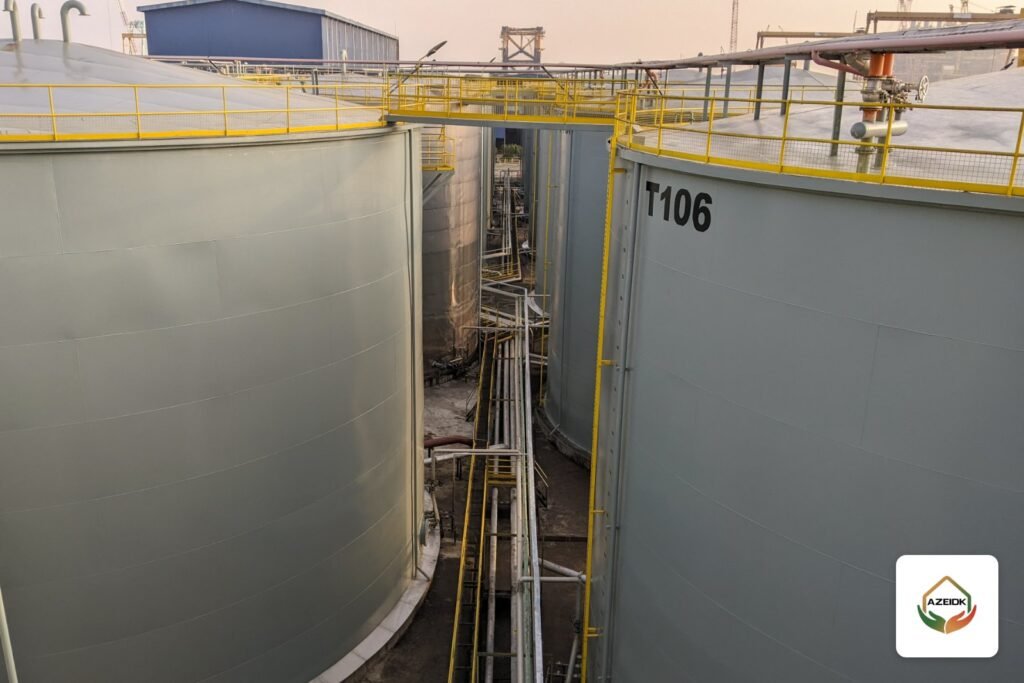
Chapter 22 covers aboveground tanks and sets two kinds of distance:
- Distance to property lines, public ways and important buildings: set by Tables 22.4.1.1(a), 22.4.1.3, 22.4.1.5 and others. The figure changes with tank type (floating roof, weak roof-to-shell seam, emergency relief venting or protected tank), whether there is protection for exposures or a foam or inerting system, tank capacity, and whether you measure to a property line, a public way or an important building on the same site.
- Shell-to-shell spacing: Table 22.4.2.1 sets it as a fraction of the sum of the adjacent tank diameters, with a minimum of 3 ft (0.9 m) for all tanks not over 150 ft (45 m) in diameter. Larger tanks have separate rows tied to the spill control method.
Spill control comes next. For a diked area, the volumetric capacity must be at least the largest amount of liquid that can be released from the largest tank, assuming it is full, after deducting the volume taken up by the other tanks in the dike. For remote impounding, the drainage route must slope at least 1 percent away from the tank for at least 50 ft, and the impounding area must hold at least the volume of the largest tank that drains into it.
Section 21.7.1 requires overfill prevention for aboveground tanks over 1320 gal storing Class I or Class II liquids, and 21.7.2.1 requires hazard identification signs per NFPA 704 or an equivalent system.
When does NFPA 30 require foam protection for tanks?
Section 22.8.1 requires a fire-extinguishing or exposure protection system per NFPA 11 (foam) or NFPA 15 (water spray) to be provided or made available for a tank when all four of these conditions apply:
- The tank is a vertical atmospheric tank of 50,000 gal (190 m³) or more.
- It contains a Class I liquid.
- It sits in a congested area with an unusual exposure hazard from or to adjacent property.
- It has a fixed roof, or a combined fixed and floating roof that does not qualify as a floating roof tank.
If the conditions are not all met, foam is still allowed. Many projects choose foam protection as a design decision or because the owner or insurer asks for it, especially in solvent stores and loading areas.
A fixed foam system has three parts: the foam concentrate, the proportioning device and the discharge device. Under special fire suppression systems, AZEIDK supplies each part:
- Safe Guard AFFF concentrate at 3% or 6%, for example the Safe Guard 3% AFFF 200 L drum.
- The WATEX UL-listed foam bladder tank with ratio controller.
- SFFECO foam monitors, fixed or portable, which the product page lists for tank farms, fuel depots and loading areas.
One point on selection: standard AFFF is meant for hydrocarbons such as diesel and gasoline. Polar solvents such as alcohols and some other solvents need an alcohol-resistant concentrate, so read the concentrate datasheet and its listing before you approve it.
Fire extinguisher for flammable liquids under NFPA 30
Section 9.10.2.1 requires portable fire extinguishers in accordance with NFPA 10 and this code. Section 9.10.2.2 sets a minimum 40:B rating near liquid storage room doors and within set distances of Class I or Class II liquids outside those rooms. Section 10.10.3 requires extinguishers per NFPA 10 where these liquids are stored in mercantile occupancies.
The letter B stands for flammable liquid fires, and the number in front of it reflects the extinguisher’s test performance. Foam and dry powder extinguishers are the usual choices for this hazard, and the actual rating is what is printed on the label and certificate, not the size of the cylinder. One option is the Falcon Gold 25 L foam extinguisher. For placement and travel distance, see our NFPA 10 portable fire extinguishers guide and the dry powder extinguisher guide.
For protected container storage with hose connections, 9.10.2.5 requires a water supply for the fixed system demand plus at least 500 gpm for 2 hours, unless Chapter 16 states otherwise. Chapter 16 itself covers automatic sprinkler and foam-water sprinkler protection for liquid storage rooms and liquid warehouses.
Quick NFPA 30 project review table
| Item | NFPA 30 (2024) reference | What to check on the project |
|---|---|---|
| Liquid class | Chapter 4 | Flash point and boiling point from the SDS or datasheet |
| Distance to property lines | 22.4.1 and its tables | Tank type, exposure protection, capacity |
| Tank-to-tank spacing | Table 22.4.2.1 | Adjacent tank diameters and the 3 ft minimum |
| Dike capacity | 22.11.2.2 | Largest full tank, less displacement of other tanks |
| Foam protection | 22.8.1 with NFPA 11 | The four conditions, concentrate type, proportioner, monitors |
| Overfill prevention | 21.7.1 | Tanks over 1320 gal with Class I or II liquids |
| Fire extinguishers | 9.10.2 with NFPA 10 | At least 40:B at the listed locations |
Common mistakes on liquid storage projects
- Setting distances before the liquid class is known, then changing the stored product after handover without a review.
- Sizing the dike on nominal tank volume without deducting the displacement of other tanks.
- Supplying standard AFFF for an alcohol or polar solvent store.
- Choosing extinguishers by size instead of checking the B rating on the label.
- Forgetting the diesel tank for the fire pump or generator, which is also a combustible liquid tank.
AZEIDK’s engineering design and calculations team can review spacing, dike capacity and foam calculations, and the industrial facilities page shows AZEIDK’s scope in this sector.
Frequently asked questions
What is NFPA 30?
The NFPA code for storing, handling and using flammable and combustible liquids. The 2024 edition took effect on 13 May 2023, and a 2027 edition has followed. The edition that applies is the one named in your project specification.
What is the difference between a flammable and a combustible liquid?
A flammable liquid is Class I, with a flash point below 100°F (37.8°C). A combustible liquid is Class II (100°F up to below 140°F) or Class III (140°F and above).
What is the NFPA 30 tank spacing between fuel tanks?
For tanks up to 150 ft in diameter, shell-to-shell spacing is a fraction of the sum of the two diameters and not less than 3 ft (0.9 m), per Table 22.4.2.1. Distances to property lines come from other tables.
Does every flammable liquid tank need a foam system?
No. Section 22.8.1 requires it when four conditions apply together: a vertical atmospheric tank of 50,000 gal or more, a Class I liquid, a congested location with an unusual exposure hazard, and a fixed roof that does not qualify as floating. The design or the owner may still call for it in other cases.
Which fire extinguisher is used for flammable liquids?
An extinguisher rated for Class B fires, such as foam or dry powder. NFPA 30 sets a minimum of 40:B near liquid storage room doors and at the other locations listed in 9.10.2.2.
Is NFPA 30 mandatory in Saudi Arabia?
The regulatory reference is SBC 801 and Civil Defense requirements. NFPA 30 becomes binding on a project when the contract or specification names it, or when the authority asks for it.
Do fuel stations follow NFPA 30?
Motor fuel dispensing stations have their own code, NFPA 30A, and SBC 801 has a separate chapter for them (Chapter 23 in the 2018 edition).
Conclusion
Start with the liquid class from the SDS, then apply the Chapter 22 distances and dike capacity, check the 22.8.1 foam conditions and place extinguishers with the right B rating. Treat SBC 801 and Civil Defense as the regulatory frame, and NFPA 30 as the technical reference for detail.
Have a liquid store or fuel tanks that need a protection review? AZEIDK reviews liquid classes, spacing and foam calculations, and supplies the system components and extinguishers to match. Talk to the AZEIDK team