Fail safe vs fail secure comes down to one thing: what an electric lock does when power to it is cut. A fail-safe lock releases when it loses power. A fail-secure lock stays locked. A magnetic lock (maglock) is fail-safe by nature, but an access-controlled door does not open automatically in a fire unless the access control system is wired to the fire alarm panel so that the alarm cuts power to the lock. This article explains the difference, where each type belongs, and how the fire alarm interface is built on a real project.
Key takeaways
- Fail-safe: the lock needs power to stay locked. Cut the power and it opens. Maglocks work this way.
- Fail-secure: the lock needs power to open. Cut the power and it stays locked from the outside. Common with electric strikes and electric cylinders.
- A standby battery in the lock power supply keeps a maglock locked during a building power cut, so “it opens on power loss” is not a fire strategy on its own.
- The usual solution is a relay output from the fire alarm panel that cuts power to the egress door locks when the alarm operates.
- An exit door must always open from the inside with one obvious action, whatever the lock type.
In this article
- What do fail safe and fail secure mean for electric locks?
- Fail safe vs fail secure: comparison table
- Do electronic doors open during a fire?
- Does a magnetic lock open in a power cut?
- How is access control interfaced with the fire alarm?
- Where to use fail-safe and where to use fail-secure
- How access control works on a door
- Common site mistakes
- Frequently asked questions
- Conclusion
What do fail safe and fail secure mean for electric locks?
Both terms describe the lock’s state when power to it is removed. They say nothing about quality or security level. “Safe” refers to the safety of people, meaning the door lets them through. “Secure” refers to protecting the space, meaning the door stays closed to entry.
Fail-safe locks
The lock uses power to stay locked. The clearest example is the magnetic lock: an electromagnet fixed to the door frame and a steel armature plate on the door. With current flowing, the magnet holds the plate. With current removed, the magnetic field collapses and the door is free at once. A maglock has no latch or bolt.
Fail-secure locks
The lock needs a pulse of power to release and otherwise stays mechanically locked. A typical example is an electric strike in the frame working with a standard latching lockset. On power loss the door stays locked from the entry side, while the inside lever still opens it mechanically if the door is installed correctly.
Many electric strikes can be field-set to either mode, so the required mode should be stated clearly on the drawings and in the submittal, and checked at handover.
Fail safe vs fail secure: comparison table
| Item | Fail-safe | Fail-secure |
|---|---|---|
| Door state when lock power is cut | Opens | Stays locked from outside |
| Common examples | Magnetic locks, some electric strikes | Electric strikes set to fail-secure, electric cylinders |
| Power use | Continuous while locked | Momentary, only when releasing, on most models |
| Exit from inside | Exit button, sensor or power cut | Mechanical lever, directly |
| Typical use | Office, corridor and glass entrance doors on escape routes | Server rooms, stores and doors that must stay closed to entry |
| On rated fire doors | Needs special review, since a maglock has no latch | Common, because the latch stays engaged during a fire |
Do electronic doors open during a fire?
That depends on design and installation, not only on the lock type. A door with a maglock opens when power to the lock is removed. On most projects, though, the lock power supply has a standby battery, and the supply circuit may itself be on a generator. In that case the lock stays locked even when the building loses power, which is intentional for security.
So door release in a fire is not left to a power failure. In normal engineering practice the fire alarm panel sends a signal when the alarm operates, cuts power to the locks on escape-route doors, and the doors stay free until the alarm panel is reset.
The 2021 International Building Code (IBC) states this directly for sensor-release electrically locked egress doors (Section 1010.2.12): activation of the building fire alarm system, where provided, must automatically unlock the electric lock, as must activation of the sprinkler or fire detection system, and the lock stays unlocked until the fire alarm system is reset. The same section requires the lock to release on loss of power. Section numbers change between editions, and the binding reference on your project is the code adopted in the building permit together with Civil Defense requirements.
Does a magnetic lock open in a power cut?
Yes, if power to the lock itself is lost. The better question is whether the lock lost power or the building did. There are three cases:
- Power supply without battery: a building power cut removes lock power and the door opens. The space is unsecured for the whole outage.
- Power supply with standby battery: the lock stays locked until the battery runs down. People leave through the exit button or sensor, and through the fire alarm release in a fire.
- Supply from a generator or UPS-backed board: a general outage does not affect the lock, and emergency release depends entirely on the alarm signal and the emergency release button.
A fail-secure lock stays locked from the outside in every case, while exit from the inside remains available through the lever.
How is access control interfaced with the fire alarm?
The interface is mainly a hard-wired power cut to the locks, not a software link. The usual steps on site are:
1. Identify escape-route doors
Mark on the drawings every escape-route door that carries an electric lock: office entrances, corridor doors, stair doors and glass doors at reception. These are the doors that must release on alarm.
2. Output from the fire alarm panel
Use a control relay module on the loop of the addressable panel, such as the FCM-1 and FRM-1 control and relay modules, or a relay output on a conventional panel. Program it to operate on alarm in the relevant zone or the whole building, according to the evacuation strategy.
3. Cut power to the locks
Route the lock supply through the relay contacts so that an alarm removes power from the maglocks and they release. Some access control power supplies have a dedicated fire alarm input that drops all outputs. Check this in the datasheet of the model supplied.
4. Emergency release button wired directly
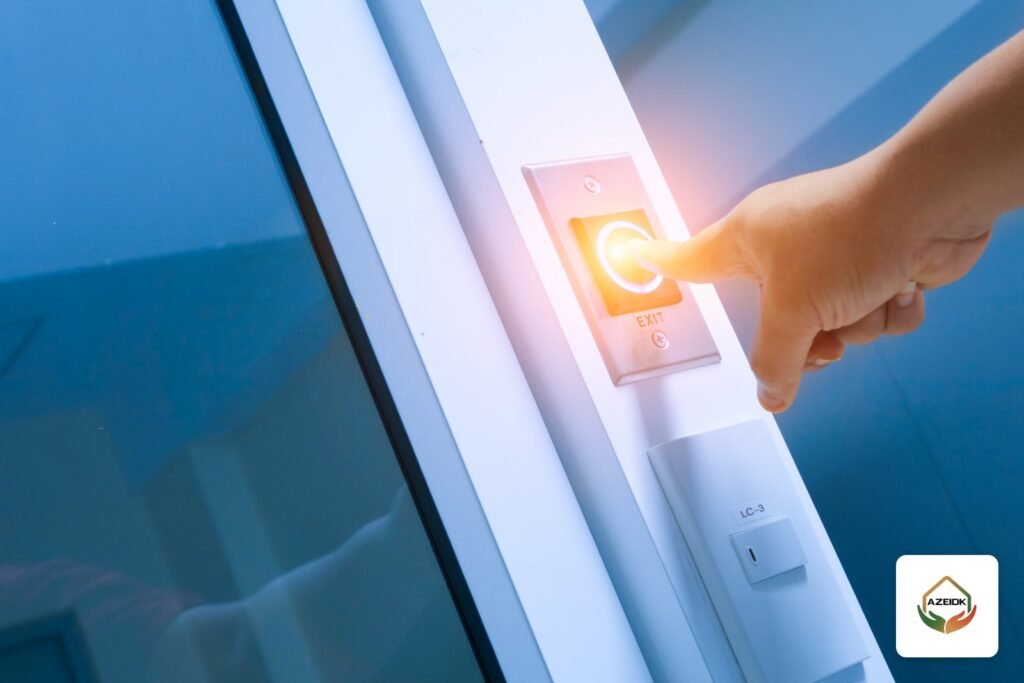
Next to the normal exit button, a covered break-glass emergency release is usually fitted. It cuts lock power electrically without passing through the controller, so the door opens even if the controller or software fails.
5. Functional testing
At testing and commissioning, operate the alarm and confirm that each door releases, one by one. Then reset the panel and confirm the locks re-engage. Repeat with mains power off to see how the standby battery behaves.
This interface sits between low current systems and fire alarm systems, and is part of AZEIDK’s programming and systems integration service.
Where to use fail-safe and where to use fail-secure
Escape-route doors: people come first. A maglock with an exit button, a request-to-exit sensor and a fire alarm release is the common solution in offices and commercial buildings.
Rated fire doors: a fire door normally needs a latch that stays engaged in the frame so smoke and fire pressure cannot push it open. That is why a latching lock with a fail-secure electric strike is often used: the door stays closed with the latch engaged and opens from the inside by the lever. Any change to a rated fire door must stay within the door’s certification. See fire-rated doors and emergency exits.
Server rooms and sensitive stores: if the door is not on an escape route, security comes first and fail-secure is usually preferred so the door does not open in a power cut.
Do not confuse a magnetic lock with a magnetic door holder. A door holder keeps a fire door open in normal use and releases it on alarm so the closer shuts it. The first opens a door for escape, the second closes one to stop smoke spread.
How access control works on a door
A basic single-door system has a reader (card, fingerprint or face), a controller that decides whether to grant access, an electric lock, an exit button, a door position sensor and a power supply. When a valid credential is read, the controller signals the lock to release for a few seconds and then relock.
Examples available from AZEIDK include the Hikvision DS-K2801 controller and the Dahua ASI1212F standalone terminal, plus ZKTeco devices and the InBio and C3 networked access panels. What decides door behaviour in an emergency is the lock, the power supply and the fire alarm interface, not the reader.
IBC 2021 also requires the locking system units on these doors to be listed to UL 294, the standard for access control system units. It is worth checking in the submittal when the consultant asks for it.
Common site mistakes
- A maglock on a battery-backed power supply with no fire alarm interface at all.
- The alarm signal taken only as a software input to the controller, so release fails if the controller fails.
- An electric strike set to fail-safe on a fire door that needs a positive latch.
- A lock that prevents exit from the inside without an obvious button or lever.
- Testing one door on alarm instead of every door.
- No door schedule showing lock type, mode and exit method for each door.
Frequently asked questions
What is the difference between fail-safe and fail-secure?
Fail-safe releases when lock power is cut, fail-secure stays locked. The first puts people’s exit first, the second puts protection of the space first.
Will a fingerprint door open in a fire?
Yes, if the lock is wired to the fire alarm panel so the alarm cuts its power. The fingerprint reader itself does not know there is a fire unless that interface exists.
Does a magnetic lock open in a power cut?
It opens if power to the lock itself is lost. If the power supply has a standby battery, the lock stays locked until the battery runs down.
Are magnetic locks allowed on exit doors?
They are widely used on egress doors under conditions, including release on alarm and on power loss and an exit button and sensor. The detailed conditions come from the adopted code and Civil Defense on your project.
Can I fit a magnetic lock on a fire door?
A fire door normally needs a positive latch to stay closed in a fire, and a maglock has no latch. Check the door certification and the consultant before any change.
What is the difference between a magnetic lock and a magnetic door holder?
The lock keeps a door closed and releases it on alarm. The holder keeps a fire door open and releases it on alarm so it closes.
Is a software link between the alarm and the controller enough?
A direct hard-wired cut through a relay on the lock supply is better, so the door opens even if the controller or software fails.
Conclusion
Fail-safe and fail-secure describe the lock’s state on power loss. Real safety comes from design: the right lock for each door, a power supply whose behaviour is known, a fire alarm relay that cuts power to escape-route locks, an independent emergency release, and a test of every door before handover.
Planning access-controlled doors on your project? Send the door layout, the lock types you need and the existing fire alarm system, and our team will review the interface and the lock type for each door. Talk to the AZEIDK team