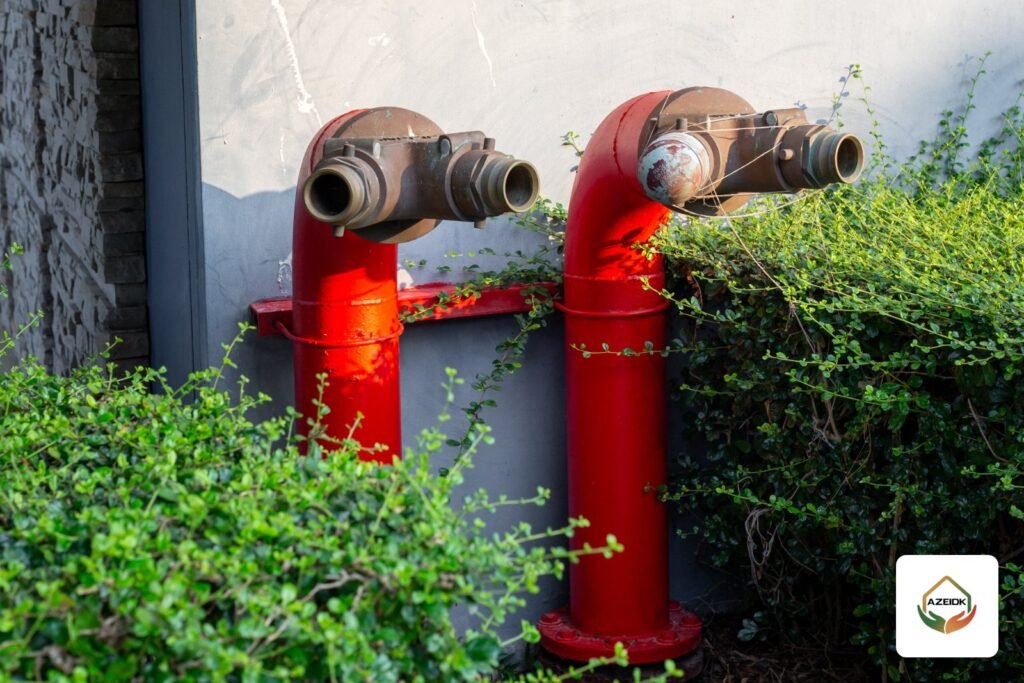
A Siamese connection, or fire department connection (FDC), is the inlet on the outside of a building where the fire truck couples its hoses and pumps water straight into the fire network. In the Egyptian market it is usually called the civil protection connection (the Siamese). To find out whether your building has a wet or dry riser and how to inspect it, see wet and dry risers in Egyptian buildings. It matters most when the building pump cannot keep up or the standpipe is dry.
This article covers its location, height, inlets, check valve, automatic drip, sign and use by the fire crew. It is part of the fire fighting systems that AZEIDK Egypt designs, supplies and installs, from risers and OS&Y gate valves to check valves.
Key takeaways
- The Siamese connection is an inlet for the fire truck, not an outlet for drawing water from the building.
- NFPA 14 (2019 edition) places the inlet centerline 18 to 48 in. above the adjoining grade, within 100 ft of a fire hydrant.
- Its line carries a listed check valve and no shutoff valve.
- It needs a sign with letters at least 1 in. high, stating the required pressure when system demand exceeds 150 psi.
- In Egypt the legal reference is the 2026 Egyptian fire code and the civil protection review; NFPA is a technical design reference.
In this article
- What is a Siamese connection and where does it sit in the fire network?
- Location on the facade: height, distance and access
- Inlet size, number of inlets and pipe size
- Check valve and automatic drip on the FDC line
- Sign and inlet caps
- How the fire truck uses the Siamese connection
- Inspection and maintenance
- Common mistakes
- The FDC under Egyptian requirements and before civil protection inspection
- Frequently asked questions
- Conclusion
What is a Siamese connection and where does it sit in the fire network?
The connection is a metal body with two or more 2.5 in. inlets, which is where the name “Siamese” (twin) comes from. The body feeds a pipe that enters the building and joins the main or the base of the riser. A check valve on that pipe lets truck water in and stops backflow.
- Sprinkler systems: the truck boosts sprinkler pressure and flow when the water supply is weak or the fire pump fails. The FDC normally connects on the system side of the water supply check valve.
- Standpipes and hose outlets to NFPA 14: the truck feeds the riser so firefighters can use the 2.5 in. hose valves on each floor. A dry standpipe has no permanent water supply, so the FDC is its only source.
The FDC must not connect to the suction side of the fire pump, which NFPA 13 (2022 edition) prohibits outright; truck water has to enter on the discharge side. For the full network layout from pump to hose cabinets, see fire fighting network installation in buildings.
Location on the facade: height, distance and access
The aim is simple: the truck driver should spot the connection at once and reach it with a short hose lay.
| Item | Value or condition | Reference |
|---|---|---|
| Inlet centerline height | 18 in. (457 mm) to 48 in. (1.2 m) above adjoining grade | NFPA 14, 2019 edition, 6.4.6 |
| Distance to fire hydrant | Not more than 100 ft (about 30 m) | NFPA 14, 2019 edition, 6.4.5.4 |
| Facade | Street side or facing the fire access road, visible from the road | Fire department practice, authority approval |
| Clearance | No trees, fences or parked cars blocking it | Fire department practice |
| Inlet orientation | So hoses connect without kinking | Good practice |
The current NFPA 14 is the 2024 edition, which was completely rewritten and reorganized, so check clause numbers against the edition your consultant specifies. On compounds and large sites the FDC location ties into the hydrant layout on the ring main.
Inlet size, number of inlets and pipe size
The standard NFPA inlet is 2.5 in. The number of inlets depends on the system:
- Sprinklers only (NFPA 13): a riser larger than 3 in. needs a two-inlet (2 x 2.5 in.) FDC; a riser of 3 in. or less may use a single inlet.
- Standpipe (NFPA 14): one 2.5 in. inlet per 250 gpm of system demand, with a minimum of two inlets per building.
- Combined system: sized on the larger of sprinkler demand with hose allowance or standpipe demand; the standpipe usually governs.
Under NFPA 13 (2022 edition, 16.12.4) the FDC pipe is in principle not smaller than 4 in. The inlet thread must match the civil protection hose couplings used in the governorate; a connection with a different thread is useless to the truck. Confirm it with the consultant before ordering.
High-rise buildings are split into pressure zones, each with its own FDC where the truck can supply it. Under NFPA 14 (2024 edition), zones above the reach of the fire department pumper are not required to have an FDC. See high-rise office fire protection.
Check valve and automatic drip on the FDC line
The check valve is the key component on the FDC line. NFPA 13 requires a listed, accessible check valve in each connection. It keeps network water from escaping outward and opens when truck pressure exceeds network pressure.
NFPA 13 (2022 edition) prohibits a shutoff valve in the FDC piping; a valve closed by mistake leaves the truck pumping into a dead end.
Between the check valve and the outside inlets there is normally a dry section of pipe, and an automatic drip (ball drip) is often fitted at its low point. It drains residual water after use and reveals check valve leakage. The consultant decides whether it is needed in the project specification; where fitted, it is part of the NFPA 25 routine inspection.
AZEIDK Egypt supplies check valves from American Fire Control, including these two models per their datasheets:
| Model | Ends | Sizes | Max working pressure |
|---|---|---|---|
| AFC A-3150 | Flanged | 2 to 12 in. | 300 psi (21 bar) |
| AFC A-3500 | Grooved | 2 to 12 in. | 350 psi (24 bar) |
Both models are UL listed and FM approved per the datasheet; the approval belongs to the product. The A-3500 installs horizontally or vertically per its datasheet. For details and flow direction, see AFC A-3150 and A-3500 check valves.
Sign and inlet caps
Under NFPA 13 and NFPA 14 the sign has:
- Letters at least 1 in. (25 mm) high on the plate or ring.
- The service: AUTOSPKR for sprinklers, STANDPIPE for standpipes, or both for a combined system. A manual standpipe also states wet or dry.
- When system demand exceeds 150 psi, the sign states the pressure required at the inlets.
- Under NFPA 14, when the FDC serves more than one building or location, the sign lists the locations served.
A clear Arabic label naming the area served helps. Inlets stay closed with caps or plugs on chains. If locking caps are used, NFSA’s review of the NFPA 14 2024 edition notes that their locks are keyed alike with the standpipe hose valve cap locks.
How the fire truck uses the Siamese connection
- The truck parks near the FDC and draws water from the nearest hydrant or its own tank.
- The crew removes the caps and couples the hoses with matching threads.
- The pump operator reads the sign for the system and required pressure. Where the sign gives no pressure, US references note that FDCs are normally supplied at about 150 psi.
- Pressure rises until the check valve opens and water enters the network.
- After the fire the pumping stops and the automatic drip drains the outside pipe.
Inspection and maintenance
NFPA 25 (2023 edition, 13.8, as quoted in the QRFS guide) calls for quarterly FDC inspection, covering:
- The connection is visible and accessible.
- Couplings and swivels are undamaged and rotate freely; caps and gaskets are in place.
- The sign is in place.
- The check valve is not leaking, the automatic drain is in place and working, and the clappers work.
- The inlets are free of obstructions.
The piping from the inlets to the check valve is hydrostatically tested at 150 psi for 2 hours at least every 5 years. For hydrostatic testing of the whole network, see fire network hydrostatic pressure testing. These intervals are NFPA guidance, not Egyptian law; the project follows the consultant and the maintenance and technical support contract.
Common mistakes
- Placing the FDC on a rear facade or inside a locked fence the truck cannot reach.
- Fitting a shutoff valve in the FDC pipe, or connecting it to the pump suction.
- Installing the check valve backwards, or leaving it out.
- Inlet threads that do not match local civil protection couplings.
- Leaving out the automatic drip when the specification calls for it, so water stays in the outside pipe and check valve leakage goes unseen.
- A sign that does not state the system or the area served.
The FDC under Egyptian requirements and before civil protection inspection
Article 49 of Egyptian Building Law No. 119 of 2008 and its executive regulations requires the permit applicant to apply fire protection requirements per the Egyptian code. The current code is the Egyptian Code for the Design and Implementation of Fire Protection for Buildings, 2026 edition (Ministerial Decree No. 355 of 2026), prepared by the Housing and Building National Research Center (HBRC). The General Directorate of Civil Protection (Ministry of Interior) reviews fire system drawings and inspects before occupancy.
Clause numbers for the FDC in the Egyptian code should be checked against the official code text with the consultant. The drawings should show its location, size, check valve and sign, and before inspection the contractor should confirm:
- The truck can reach the FDC without obstruction and see it from the road.
- Caps and sign are fitted and couplings are sound.
- The check valve faces the right way and the drip works.
- The pressure test result for the FDC pipe is recorded.
Frequently asked questions
What is a Siamese connection in a fire network?
An outside inlet with two or more connections where the fire truck couples its hoses to pump water into the sprinkler system or standpipe.
How high should a Siamese connection be installed?
NFPA 14 (2019 edition) places the inlet centerline 18 to 48 in. above the adjoining grade, roughly 457 mm to 1.2 m.
What size is a Siamese connection inlet?
The standard inlet is 2.5 in. The number of inlets follows system demand, with at least two per building for standpipes.
Why is there a check valve on the FDC line?
It stops pressurized network water escaping to the outside pipe, and lets truck water in when truck pressure exceeds network pressure.
Can a shutoff valve be fitted on the FDC pipe?
No. NFPA 13 prohibits a shutoff valve in the fire department connection piping, because closing it by mistake cuts off the truck supply.
How often is a Siamese connection inspected?
Quarterly under NFPA 25 (2023 edition), with a 150 psi, 2-hour hydrostatic test of the FDC pipe at least every 5 years.
Conclusion
The Siamese connection is a small fitting, but it is the only way truck water gets into the network. Keep it visible, near a hydrant and at a usable height, with a listed check valve, an automatic drip where the specification calls for it, and a clear sign, and keep it clear after handover.
Reviewing fire network drawings before civil protection submission? Send us the drawings and the system type, and our team will check the FDC location and the right check valve. Talk to the AZEIDK Egypt team