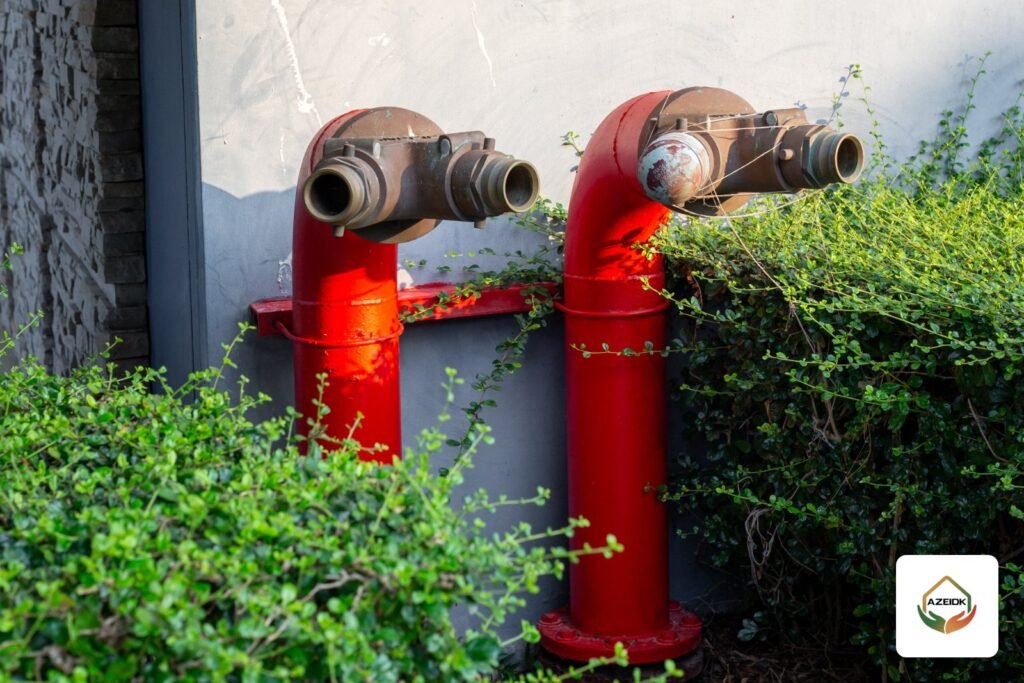
When a data center owner or plant manager asks which fire extinguishing gas to use, the choice is usually between two agents: HFC-227ea, known by the trade name FM-200, and carbon dioxide (CO2). Both put out fire without water and leave no residue. The difference in people safety, however, is large, and it decides where each gas belongs.
This article compares the two gases by extinguishing mechanism, safety and typical use. It explains when an AFC-227 clean agent system from American Fire Control is the right choice, and when PYRAMID CO2 extinguishers are enough, within the special fire suppression systems supplied by AZEIDK Egypt.
Key takeaways
- FM-200 (HFC-227ea) is a clean agent that works mainly by absorbing heat. Its design concentration is checked against human safety limits under NFPA 2001.
- CO2 works by lowering oxygen. The minimum design concentration in total flooding is 34%, which is lethal to people.
- According to a US EPA review, most CO2 deaths happened during maintenance and testing, not during fires.
- Occupied server and control rooms, or rooms that staff enter often, suit clean agent systems.
- PYRAMID portable and automatic CO2 extinguishers give local protection for panels and equipment. They do not replace a total flooding system.
In this article
- How a gas puts out fire without water
- Fire extinguishing gas compared: FM-200 vs CO2
- Why CO2 needs special care
- When to choose an AFC-227 clean agent system
- Where PYRAMID CO2 extinguishers are enough
- What comes before discharge: detection, alarm and control
- Common mistakes when choosing an extinguishing gas
- Frequently asked questions
- Conclusion
How a gas puts out fire without water
Gas systems work by total flooding. The agent is stored in cylinders. When fire is detected, it is released within seconds through pipes and nozzles to fill the room at a calculated concentration. The aim is to protect equipment that cannot take water: servers, control panels, archives and sensitive equipment.
- FM-200 (HFC-227ea): works mainly by absorbing heat from the flame and interrupting the reaction. At design concentration, oxygen in the room stays at a breathable level.
- Carbon dioxide: works by smothering. It lowers oxygen to a level where burning cannot continue, and at that level people cannot breathe either.
This difference in mechanism is the root of the difference in safety.
Fire extinguishing gas compared: FM-200 vs CO2
| Item | FM-200 (HFC-227ea) | Carbon dioxide (CO2) |
|---|---|---|
| Mechanism | Heat absorption and reaction interruption | Oxygen reduction (smothering) |
| Reference standard | NFPA 2001 | NFPA 12 |
| Design concentration | Relatively low, checked against the NOAEL for occupied spaces | Minimum 34% in total flooding |
| People safety | Suitable for occupied spaces within design limits | Lethal at extinguishing concentration, needs strict evacuation and lock-out |
| Residue | None | None |
| Typical use | Server, control, telecom and archive rooms | Unoccupied rooms, industrial equipment, panel extinguishers |
The EPA list of acceptable substitutes states that HFC-227ea should be used under the safety guidelines of the latest NFPA 2001, and that CO2 system design must follow NFPA 12. These are technical design references. The binding requirement in Egypt is the 2026 Egyptian fire code and Civil Protection approval.
Why CO2 needs special care
The EPA review of CO2 system risks notes that the minimum total flooding design concentration is 34% by volume, while concentrations above 17% can cause unconsciousness and death within a minute. The review recorded 62 incidents with 119 deaths and 152 injuries. All deaths were from asphyxiation, and most happened during maintenance or testing rather than an actual fire.
The recommended measures include:
- Supervised lock-out to prevent discharge when people unfamiliar with the space are present, as NFPA 12 notes.
- Pre-discharge alarms, a time delay that allows escape, and warning signs at entrances.
- Mandatory evacuation before any test or maintenance, and training for staff and contractors.
- Fast ventilation after discharge, and no rescue entry without breathing apparatus.
US OSHA rule 1910.162 also requires a distinctive pre-discharge alarm where the CO2 design concentration is 4 percent or more. Together, these points make CO2 a fit for unoccupied spaces or local protection, with strict operating procedures.
When to choose an AFC-227 clean agent system
The AFC-227 system from American Fire Control uses HFC-227ea. It suits rooms that meet three conditions:
- High-value or critical equipment that cannot take water or powder, such as servers, control panels and telecom equipment.
- A room that can be sealed well enough to hold the concentration, which is confirmed by a room integrity test.
- Staff presence or frequent entry, so a lethal agent such as CO2 is not acceptable.
The agent quantity depends on room volume, the lowest expected temperature and the design concentration. EPA explains that the design concentration is the extinguishing concentration multiplied by a safety factor of 1.2 or 1.3, depending on hazard and system type under NFPA 2001, and is then compared with the NOAEL for occupied spaces. A worked example is in FM-200 quantity calculation.
Where PYRAMID CO2 extinguishers are enough
Not every panel or small room needs total flooding. In many cases a combination is enough:
- Portable CO2 extinguishers from PYRAMID in 2, 3, 6, 10, 20 and 30 kg, made to EN3 and Egyptian standard ES 735, for trained staff to use next to panels and equipment.
- Automatic PYRAMID CO2 extinguishers in 3, 6 and 10 kg, using a linear detection tube inside the panel or cabinet, so the fire is put out where it starts without anyone present.
An automatic extinguisher inside a closed panel protects one item. A clean agent system protects the whole room, including raised floor and ceiling voids. Sizes are covered in PYRAMID CO2 extinguishers.
What comes before discharge: detection, alarm and control
Whichever gas is used, the suppression system does not work alone. Before discharge there is a chain of steps that the consultant’s design should define clearly:
- Detection: smoke detectors in the room, below the raised floor and above the false ceiling where these exist. Confirmation from two detectors is often required before the countdown starts, to reduce false discharge.
- Pre-discharge alarm: a sounder and beacon inside the room and at the door, with a time delay that lets occupants leave.
- Abort switch and manual release: outside the door, with a sign explaining their use.
- Linked actions: air-conditioning shutdown and power isolation to equipment where the design calls for it, and a signal to the building fire alarm panel.
These steps are part of the approval and handover file. Missing them is a frequent reason for a system being rejected at review, or discharging when it should not.
Common mistakes when choosing an extinguishing gas
- Choosing CO2 for a staffed server room because it looks cheaper, without counting people risk and lock-out procedures.
- Installing a clean agent system in a room with large unsealed openings, so the agent leaks out before it works.
- Not interlocking the system with air-conditioning shutdown and power isolation as the consultant’s design requires.
- Testing or servicing a CO2 system without evacuating the room and securing the system.
- Relying on one automatic extinguisher to protect a room with many panels.
Frequently asked questions
Which fire extinguishing gas is used in server rooms?
Most often the clean agent HFC-227ea, known as FM-200, because it leaves no residue and is designed at a concentration suitable for occupied spaces.
Is FM-200 safe for people?
When the design concentration follows NFPA 2001 and stays within the NOAEL, it is considered suitable for occupied spaces. The room is still evacuated when the alarm sounds.
Why is CO2 dangerous in occupied spaces?
It works by lowering oxygen. Total flooding design concentration is at least 34%, while above 17% can cause death within a minute.
Is a CO2 extinguisher enough to protect an electrical panel?
A portable unit covers manual use, and an automatic unit protects a closed panel locally. A whole critical room needs a flooding system.
What is the difference between FM-200 and AFC-227?
FM-200 is a trade name for HFC-227ea gas. AFC-227 is a suppression system from American Fire Control that uses the same agent.
What happens after a gas system discharges?
The room is ventilated and the cause investigated. The cylinders are then recharged and the system tested before it returns to service.
Conclusion
Choosing between FM-200 and CO2 is not only about price. HFC-227ea is the natural choice for critical rooms that people enter. CO2 fits unoccupied spaces and local protection, with strict safety procedures. Start with the nature of the room, who goes in, and how well it seals, then ask for an approved design under the Egyptian code and Civil Protection requirements.
Need to decide which gas suits the server or control room in your project? Send us the room size and equipment and we will suggest the right solution. Talk to the AZEIDK Egypt team