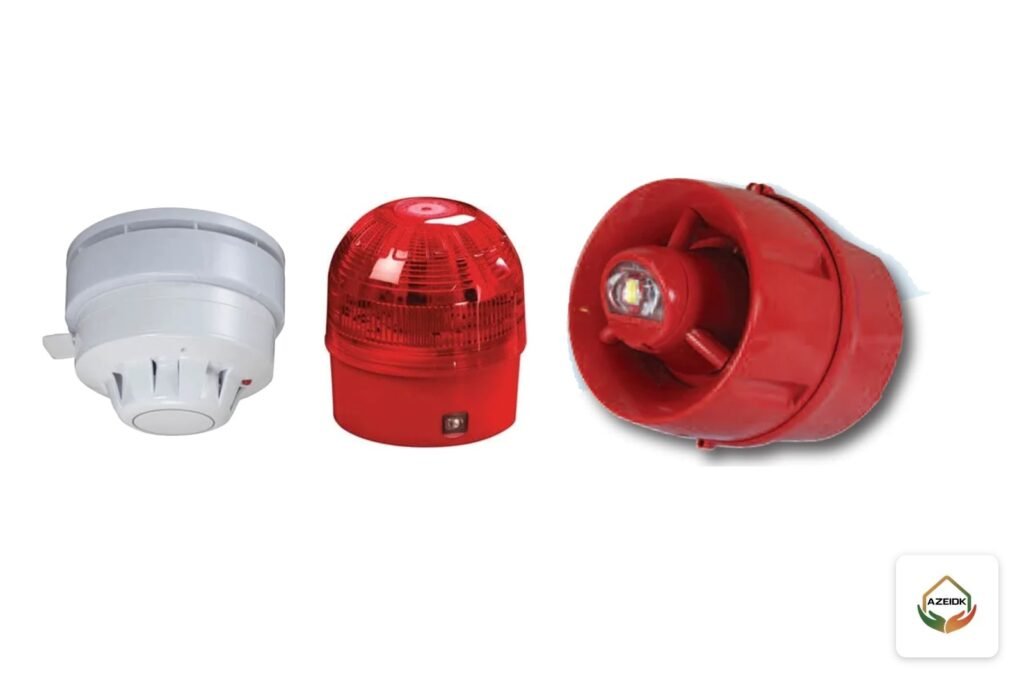
An EN 54-23 visual alarm device (VAD, called a beacon or flasher on Saudi sites) is rated by a coverage code such as C-3-8 or W-2.4-8.2. The code tells you the maximum mounting height and the volume in which the device delivers at least 0.4 lux, and that is what you use to count beacons per room. It cannot be compared directly with an NFPA 72 candela rating, because the two systems measure performance differently.
Below we read the code and apply it to models from the official Context Plus datasheet, such as the CON456A/CX/W addressable sounder-beacon base.
Key takeaways
- EN 54-23 covers fixed visual alarm devices; the current edition is BS EN 54-23:2010.
- Category C is for ceiling mounting, category W for wall mounting, and category O lets the manufacturer declare its own coverage volume.
- C-3-8 means a maximum mounting height of 3 m and a coverage cylinder 8 m in diameter. W-2.4-8.2 means wall mounting up to 2.4 m high and a cuboid coverage volume with an 8.2 × 8.2 m square base.
- In the Context Plus catalogue, CON456A, CON451A, CON458A and CON433A/CX/DR carry EN 54-23, while the open-area beacons 55000-009 and 55000-010 list EN 54-3 only.
- NFPA 72 rates strobes in candela from room tables, with devices listed to UL 1971. Do not mix the two systems.
In this article
- What is a fire alarm beacon and why specify EN 54-23?
- How to read EN 54-23 coverage codes (C, W and O)
- Context Plus addressable beacons: what the datasheet says
- How many beacons does a room need? Counting from the coverage code
- EN 54-23 vs NFPA 72 candela: do not mix the two systems
- Where are visual alarms required on Saudi projects?
- What goes into the submittal for EN 54-23 beacons?
- Common mistakes
- Frequently asked questions
- Summary
What is a fire alarm beacon and why specify EN 54-23?
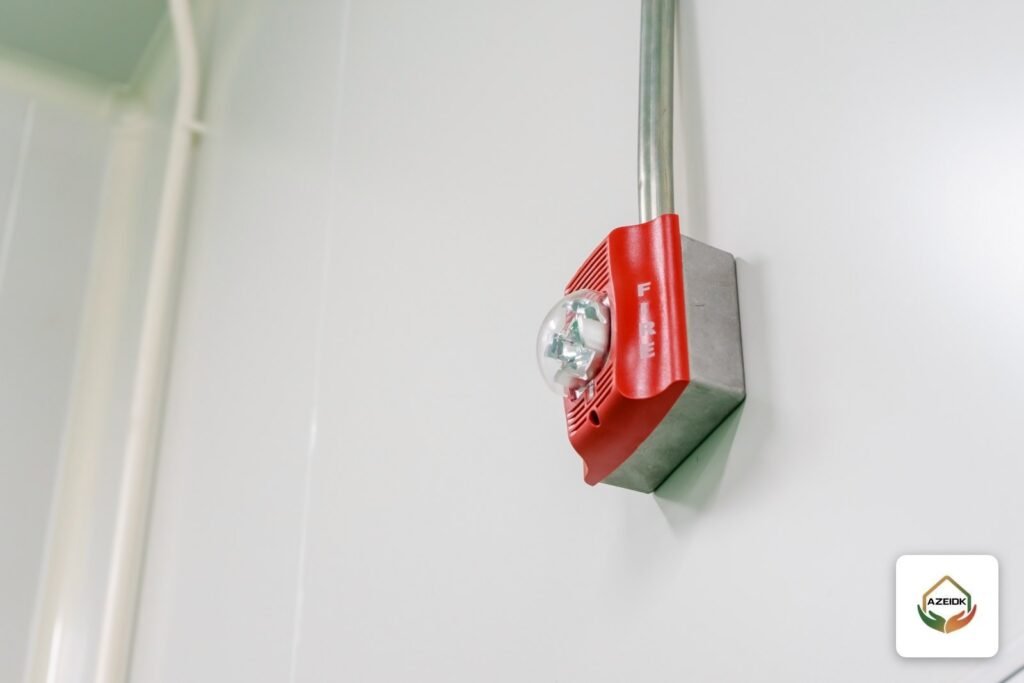
A sounder warns with sound, a beacon with flashing light. Beacons are needed where the alarm may not be heard: noisy plant, rooms used by people with hearing impairments and areas where staff wear ear protection. This article covers reading a European beacon’s rating and designing with it. For the wider system, see our fire alarm systems page.
According to BSI, BS EN 54-23:2010 sets the requirements, test methods and performance criteria for visual alarm devices in fixed installations that warn building occupants. It covers flashing devices powered from an external source such as the panel, not detector or panel indicator lamps.
Pfannenberg’s summary adds that the light must be white or red, the flash rate must be between 0.5 and 2 Hz, and an illuminance of at least 0.4 lux (lm/m²) must be reached throughout the declared coverage volume.
How to read EN 54-23 coverage codes (C, W and O)
Each EN 54-23 device falls into one of three categories, written “category-x-y” in the datasheet:
| Category | Mounting | Meaning of x | Meaning of y and coverage shape |
|---|---|---|---|
| C (Ceiling) | Ceiling only | Maximum mounting height in metres (3, 6 or 9) | Diameter of the coverage cylinder in metres |
| W (Wall) | Wall only | Maximum wall mounting height, minimum 2.4 m | Side of the square base of the cuboid coverage volume |
| O (Open) | As the manufacturer instructs | Set by the manufacturer | Coverage volume with dimensions declared by the manufacturer |
Example: C-3-8 is a ceiling device mounted no higher than 3 m that guarantees 0.4 lux inside a cylinder 8 m in diameter. W-2.4-8.2 is a wall device mounted up to 2.4 m high that covers a space with an 8.2 × 8.2 m base. The first number is an upper limit: a C-3 device must not go on a 4 m ceiling.
Context Plus addressable beacons: what the datasheet says
Figures below are from the Context Plus addressable sounders and beacons catalogue (pages 23–24), currents at 24 V DC. All four models draw 550 µA quiescent and are certified to EN 54-17 (loop isolator).
| Model | Type | Coverage code | Sound at 1 m | Alarm current | EN 54 parts per datasheet |
|---|---|---|---|---|---|
| CON456A/CX/W | Sounder-beacon base under a detector | C-3-8 | 96 dB(A) | 14 mA | 3, 17 and 23 |
| CON451A/CX/SR | Compact wall/ceiling sounder-beacon | C-3-8 on ceiling, W-3-2.1 on wall | 91 dB(A) | 14 mA | 3, 17 and 23 |
| CON458A/CX/SR | Beacon only | C-3-8 on ceiling, W-3-2.1 on wall | No sounder | 10 mA | 17 and 23 |
| CON433A/CX/DR | Hi-output wall beacon with sounder, deep base | W-2.4-8.2 | 103 dB(A) | 14 mA | 3, 17 and 23, certified by LPCB |
Other datasheet points:
- CON456A/CX/W mounts under Context Plus detectors in corridors, stairwells and open spaces; the base is 112 mm × 46 mm deep, IP21C (Type A). One detector point then gives both sound and light.
- CON451A/CX/SR and CON458A/CX/SR are 102 mm in diameter, 63 mm deep and rated IP21C (Type A). Their wall code, W-3-2.1, is far smaller than the ceiling code, so ceiling mounting gives the large coverage.
- CON433A/CX/DR is rated IP33C (Type B) with 7 volume levels and up to 15 tone pairs. The datasheet states its EN 54-3, 23 and 17 certification is by the LPCB, with 0.4 lux over a 2.4 m × 8.2 m cuboid.
- The outdoor CON433A/CX/DR/65 is IP65 with the same W-2.4-8.2 code and 14 mA alarm current, but the datasheet lists no EN 54 parts or certifying body for it, so ask for its own certificate before submitting it.
Product pages: CON433A/CX/DR hi-output wall beacon and CON451A/CX/SR and CON458A/CX/SR compact sounder-beacon and beacon.
How many beacons does a room need? Counting from the coverage code
Turn the coverage shape into a square that tiles across the plan, then divide the room dimensions by its side. A category C cylinder does not fit rectangular rooms, so designers use the largest square inside the circle: side = diameter ÷ 1.41.
Example 1: 10 × 10 m office, 2.8 m ceiling
The C-3-8 CON456A base suits a ceiling below 3 m. Square side: 8 ÷ 1.41 ≈ 5.66 m; 10 ÷ 5.66 ≈ 1.8, so two each way: four bases on a roughly 5 × 5 m grid.
Example 2: 16 × 8 m plant room, 4.5 m ceiling
C-3-8 is ruled out because the ceiling exceeds 3 m. The W-2.4-8.2 CON433A/CX/DR wall beacon, mounted at 2.4 m, covers 8.2 × 8.2 m per unit, so two units on the long wall about 8 m apart are enough. Its 103 dB(A) sounder also helps in noisy plant, subject to a site sound check.
Example 3: 2 × 2 m accessible toilet
A CON458A/CX/SR beacon on the wall gives W-3-2.1, a 2.1 × 2.1 m volume, which is enough for this small space. In a larger room, ceiling mounting gives the same device C-3-8.
These are first-pass estimates. Partitions, tall furniture and sloping ceilings change coverage; the consultant approves the final design.
EN 54-23 vs NFPA 72 candela: do not mix the two systems
In the US approach, visible appliances are listed to UL 1971 (Signaling Devices for the Deaf and Hard of Hearing), which covers public-mode visible appliances used under NFPA 72. The designer picks the candela (cd) rating from the room tables in NFPA 72 Chapter 18. According to EC&M’s review of the 2025 edition, wall-mounted strobes go between 80 and 96 in (2.03–2.44 m) above the finished floor, and in sleeping rooms the strobe must be within 16 ft (4.9 m) of the pillow, at 177 cd if it is less than 24 in from the ceiling and 110 cd if it is further down.
| Item | EN 54-23 | NFPA 72 with UL 1971 |
|---|---|---|
| Performance measure | Coverage volume achieving 0.4 lux | Candela rating from room tables |
| Catalogue format | Code such as C-3-8 or W-2.4-8.2 | Value such as 15, 110 or 177 cd |
| Wall mounting height | Per x in the code (at least 2.4 m) | 80–96 in above floor |
| How it is verified | Certificate of conformity from a body such as LPCB | UL listing of the model |
There is no official formula that converts an EN 54-23 code into candela or the reverse. Swapping UL strobes on an NFPA 72 design for EN 54-23 beacons needs a redesign and consultant approval. See UL or EN 54 for fire alarm devices and our EN 54 fire alarm standard guide.
Where are visual alarms required on Saudi projects?
The mandatory reference is the Saudi Fire Code, SBC 801, which deals with fire alarm and detection systems in Section 907. Locations follow the adopted code text and each building’s specification. In NFPA 72-2025, Section 18.4.1.1 states that an average ambient sound level above 105 dBA requires visible notification appliances, as reported by EC&M. That applies directly to generator halls, compressor rooms and production lines.
What goes into the submittal for EN 54-23 beacons?
- The model datasheet, marking the coverage code and mounting position used.
- The EN 54-23 certificate of conformity (and EN 54-3 if the unit includes a sounder) in the name of that exact model.
- A layout showing each beacon’s coverage and mounting height.
- A loop load calculation: alarm current per device (10 or 14 mA for the models above) and quiescent current, with battery capacity.
- Confirmation of compatibility with the addressable panel.
Common mistakes
- Submitting a beacon marked EN 54-3 only as an EN 54-23 device. In the same catalogue, the open-area beacons 55000-009 and 55000-010 list EN54-3 (2001) only.
- Fitting a C-3 device to a ceiling higher than 3 m.
- Using the ceiling code after mounting the device on a wall, as with CON451A, which drops from C-3-8 to W-3-2.1.
- Mixing UL candela-rated strobes with EN 54-23 beacons in one system without a redesign.
- Assuming an LPCB approval stated for one model covers its variants.
Frequently asked questions
Is a flasher the same as a beacon in a fire alarm system?
Yes. On Saudi sites both mean a visual alarm device (VAD in EN 54-23, visible notification appliance in NFPA 72).
What does C-3-8 mean on a datasheet?
A ceiling device mounted up to 3 m high that covers a cylinder 8 m in diameter with at least 0.4 lux.
What does W-2.4-8.2 mean?
A wall device mounted up to 2.4 m high that covers a space with an 8.2 × 8.2 m square base.
Can an EN 54-23 code be converted to candela?
No. Each system has its own design method; switching needs a redesign and consultant approval.
Which Context Plus beacon is LPCB certified according to the datasheet?
The datasheet names LPCB for CON433A/CX/DR only. For the others it lists EN 54-23 without a certifying body, so request their certificates.
When is a beacon mandatory rather than optional?
That depends on SBC 801 and the consultant’s specification for each building. In NFPA 72-2025, average ambient noise above 105 dBA requires visible notification appliances.
Summary
Choosing an EN 54-23 beacon starts with the code: the category sets where it mounts, the first number sets the maximum height, and the second sets the coverage you count from. Then check the exact model’s datasheet for EN 54 parts, certifying body and alarm current. On an NFPA 72 project, stay with candela and UL-listed devices.
Have a fire alarm layout and need the right beacon count? Send the drawings, ceiling heights and project standard, and we will prepare a model schedule with datasheets and certificates. Talk to the AZEIDK GROUP team