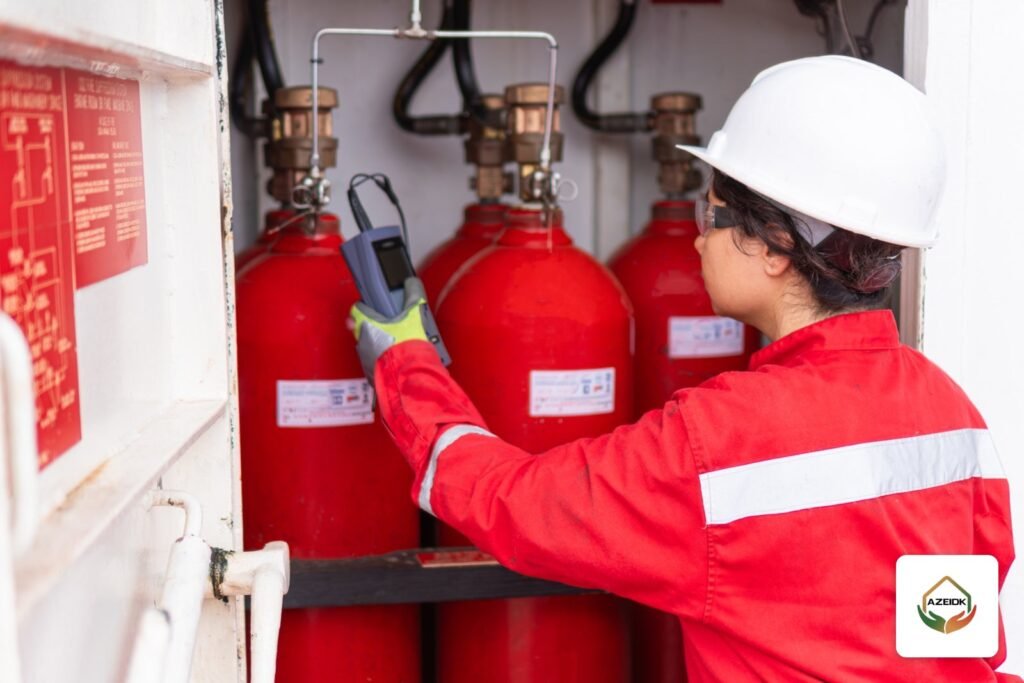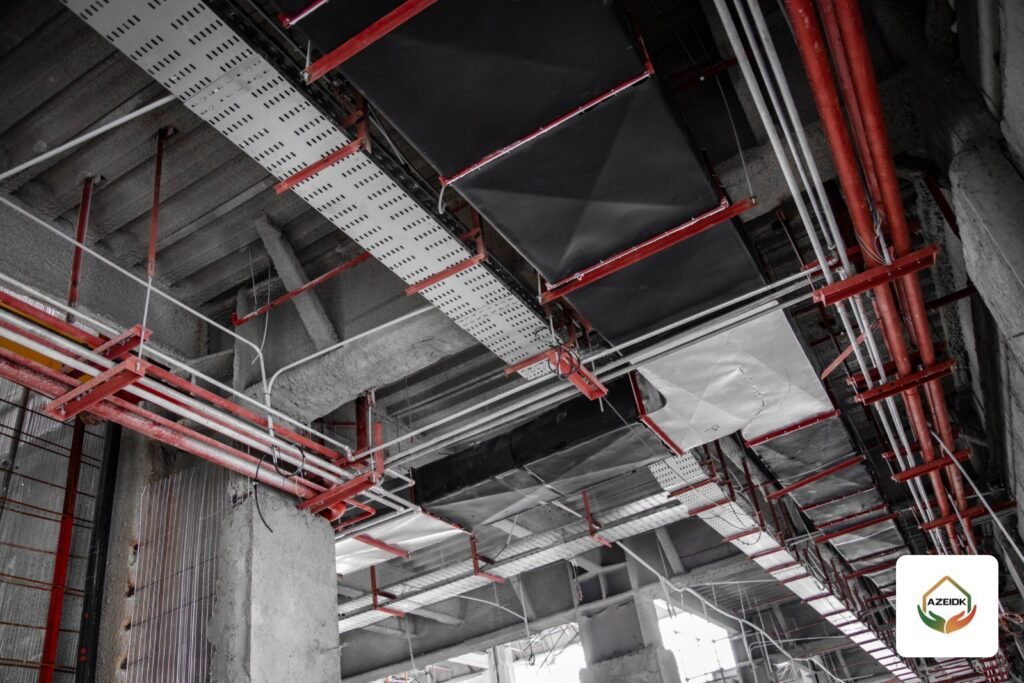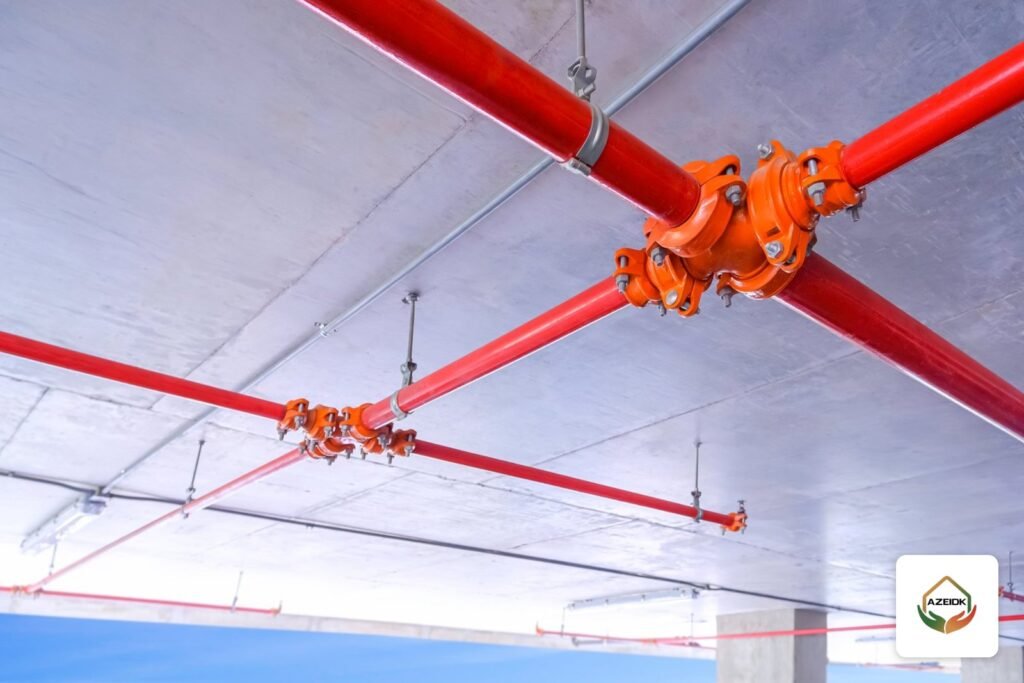
A foam sprinkler system is a sprinkler or spray network fed with both water and foam concentrate, so it discharges foam solution instead of plain water, mainly where flammable liquid fires are the hazard. Its requirements used to sit in NFPA 16, but NFPA withdrew that standard in the 2020 revision cycle and moved its content into NFPA 11, so designers now work from NFPA 11 together with the Saudi code and Civil Defense approval. This article explains the types of foam-water sprinkler system, including the deluge type, where they are used, their main components and how they are tested, with links to components AZEIDK supplies under special fire suppression systems.
Key takeaways
- A foam sprinkler system mixes foam concentrate into water at a set ratio (for example 3% or 6%) and distributes the solution through sprinklers or spray nozzles.
- Main types: deluge with open heads, closed-head systems (wet, dry, preaction), preprimed systems filled with solution, and foam-water spray systems.
- NFPA 16 was withdrawn in the 2020 cycle; its requirements now form part of NFPA 11 (low-, medium- and high-expansion foam).
- The heart of the system is the proportioner, such as a bladder tank with a ratio controller.
- Testing includes sampling the foam solution during the operational test and checking the concentration, plus periodic checks on the concentrate.
In this article
- What is a foam sprinkler system?
- Types of foam-water sprinkler system
- Is NFPA 16 still current, and where are its requirements now?
- Where is a foam sprinkler system used?
- Components of a deluge foam water sprinkler system
- How is a foam sprinkler system tested and maintained?
- What do the consultant and Civil Defense ask for before approval?
- Common mistakes with foam-water sprinkler systems
- Frequently asked questions
- Conclusion
What is a foam sprinkler system?
In a standard sprinkler network only water reaches the heads. In a foam-water sprinkler system, the water passes through a proportioner that draws concentrate from its tank and injects it at the required ratio, so the heads receive foam solution. As it leaves the head it mixes with air and forms low-expansion foam that spreads over the burning liquid, seals off the vapours and cools the surface.
In the NFPA 11 chapter that took over the NFPA 16 requirements, NFPA describes the system as a piping network that employs automatic or open sprinklers, nozzles or other discharge devices, supplied from a foam concentrate source and a water supply. The foam it produces is low-expansion foam, which matters when comparing it with high-expansion foam systems that fill a space and are designed and used differently.
On Saudi sites many contractors simply call it “foam sprinkler” or “deluge foam”. The correct name depends on the type of heads and how the system is actuated, as the next section shows.
Types of foam-water sprinkler system
The types differ by discharge device (closed heads, open heads or spray nozzles) and by actuation. The table summarises the common types used on projects:
| Type | Discharge devices | Actuation | Typical choice |
|---|---|---|---|
| Foam-water deluge | Open heads | Detection in the same area opens the deluge valve and all heads discharge together | Areas that must be covered at once, such as loading racks and fuel spill zones |
| Closed-head foam-water sprinklers (wet / dry / preaction) | Closed sprinklers with a heat-responsive element | Each head opens on its own when it reaches its rated temperature | Stores with flammable liquids where full-area discharge is not needed |
| Preprimed | Closed sprinklers | A wet pipe system whose piping already holds foam solution | Where foam must be delivered from the first second, without waiting for concentrate to arrive from the proportioner |
| Foam-water spray | Spray nozzles | Usually detection plus a deluge valve | Directed protection of specific equipment or surfaces |
For the basic difference between wet, dry, preaction and deluge water systems, see our article on wet, dry, preaction and deluge sprinkler systems. The same logic applies here, with concentrate and a proportioner added.
Is NFPA 16 still current, and where are its requirements now?
Many people search for “NFPA 16 pdf” to find design rules. In fact NFPA issued a withdrawal notice for NFPA 16 in the Fall 2020 revision cycle, stating that its material moves into the next edition of NFPA 11, Standard for Low-, Medium-, and High-Expansion Foam. NFPA 11 revision reports published by NFPA show that foam-water sprinkler design criteria are now referred to the dedicated chapter inside NFPA 11.
What this means for projects in Saudi Arabia:
- Do not design from an old NFPA 16 PDF found online. Unofficial copies can be incomplete or outdated, and every design value should come from the edition adopted for the project.
- The applicable edition is set by the Saudi Fire Protection Code (SBC 801), the project specification and Civil Defense approval. NFPA is a technical reference the designer adopts, not automatically binding in every edition.
- Discharge density, foam discharge duration and design area come from NFPA 11 and the occupancy standard, then are proven by hydraulic calculations submitted with the drawings.
If your project needs these calculations, AZEIDK’s engineering design and calculations team prepares them as part of the design file.
Where is a foam sprinkler system used?
Low-expansion foam suits flammable liquid and fuel fires because it floats on the liquid and forms a blanket that stops vapours rising. Foam-water systems therefore appear in facilities with that hazard, including:
- Warehouses storing flammable liquids, oils and solvents.
- Tanker loading and unloading racks.
- Aircraft hangars and fuel depots.
- Plants that use flammable liquids on production lines.
Whether to use foam instead of water is the designer’s decision once the liquid, quantity and storage method are known. Some stores can be protected with a higher-density water system; others are better served by a foam monitor or a local foam system. That is why AZEIDK starts with a hazard review before proposing a system.
Components of a deluge foam water sprinkler system
1. Water supply and fire pump
The system needs a water supply that meets the calculated flow and pressure for the full discharge time, usually through a fire pump set and a water tank.
2. Deluge valve
With open heads, the valve stays closed until it receives a signal from detection or manual release. AZEIDK supplies the Cla-Val 134-05 solenoid-operated deluge valve, an on-off control valve that opens or closes on an electrical signal from the detection or releasing panel. It comes in 3 to 12 inch sizes, its main valves are UL/ULC listed according to the product page, and its listed applications include deluge and preaction systems and foam systems.
3. Concentrate tank and proportioner
This is what sets the system apart from a water network. The most common choice on projects is a bladder tank: a pressure vessel with a bladder holding the concentrate. Water entering the tank squeezes the bladder and pushes concentrate to the ratio controller without an extra pump. AZEIDK supplies:
- The WATEX UL foam bladder tank, UL listed (UL certificate EX29807 to UL 162), vertical 200 to 7,500 L and horizontal 1,000 to 15,000 L, rated at 175 psi.
- The SFFECO foam bladder tank in vertical and horizontal models, used with the SFFECO ratio controller proportioner.
NFPA 11 inspection requirements also cover other proportioning types, such as standard balanced pressure with a concentrate pump, in-line balanced pressure and orifice plate proportioning. The choice depends on system size, the number of zones and the flow range.
4. Foam concentrate
The concentrate is chosen for the liquid being protected. For example, Safe Guard AFFF 3% is mixed 3 parts concentrate to 97 parts water and is intended for non-polar hydrocarbon fires such as petrol, diesel and kerosene. According to the product page it is UL listed to UL 162 and approved to EN 1568-3, and works with fresh water or seawater. Polar solvents such as alcohols need an alcohol-resistant concentrate, so confirm the liquid before choosing the concentrate.
5. Foam sprinkler nozzle
Discharge devices can be air-aspirating foam sprinklers or non-aspirating sprinklers and nozzles. What matters is that the head is listed for use with the selected concentrate at the same ratio, because the listing ties the concentrate to the discharge device. Do not combine heads from one source with a concentrate from another without confirming compatibility in the datasheets.
6. Detection and control
A deluge system needs fire detection in the protected area and a releasing panel that signals the valve, plus a manual release. In wide open areas, SFFECO foam monitors can complete coverage where heads do not reach.
How is a foam sprinkler system tested and maintained?
Testing goes further than on a water network, because the system only works if the mixing ratio is right. NFPA 11 revision reports published by NFPA include, among other points:
- Taking a foam sample during the operational test.
- Running a refractometer test or equivalent after the proportioner is adjusted, repaired or replaced, to confirm the concentration.
- Reading the pressure at the most hydraulically demanding discharge device and comparing it with the design pressures.
- Sending concentrate samples to the manufacturer or a qualified laboratory at the frequency the manufacturer recommends.
- Testing manual actuation devices annually.
These tasks need a team that knows foam systems, not only water networks. They can be included in an annual maintenance contract with AZEIDK, with each result recorded in a report kept by the facility.
What do the consultant and Civil Defense ask for before approval?
A technical file is usually required: drawings, hydraulic calculations, concentrate type and ratio, tank capacity and discharge time, with the datasheet and listing documents for each component (concentrate, tank, proportioner, heads and deluge valve). Changing one component after approval may require a new compatibility review. AZEIDK supports this stage through its Civil Defense approval support service.
Common mistakes with foam-water sprinkler systems
- Choosing a concentrate that does not suit the liquid, such as standard AFFF for an alcohol store.
- Combining heads, concentrate and proportioner that are not listed to work together.
- Sizing the concentrate tank without the full discharge time and the largest area operating at once.
- Skipping the concentration test after installation, so the system discharges a solution that is too weak or too strong.
- Designing from an old copy of NFPA 16 instead of the NFPA 11 edition adopted for the project.
Frequently asked questions
What is the difference between a foam sprinkler system and a foam monitor?
A sprinkler system discharges solution from fixed heads over a defined area. A foam monitor throws foam over a distance at a target and is mostly used in wide open areas. Some projects use both.
Can an existing water sprinkler network be converted to foam?
It needs an engineering review of the heads, hydraulic calculations, water supply and the location of the proportioner and tank. Adding a concentrate tank to the existing network is not enough.
Is there an updated official NFPA 16 PDF?
No new edition of NFPA 16 exists. It was withdrawn in the 2020 revision cycle and its content moved into NFPA 11. Get NFPA 11 from NFPA and use the edition your project specification adopts.
What mixing ratio does a foam sprinkler use?
The concentrate sets the ratio: a 3% concentrate is mixed 3 parts to 97 parts water, a 6% concentrate 6 parts to 94. The proportioner and heads must be listed for the same ratio.
When is a foam-water deluge system chosen over closed-head foam sprinklers?
Deluge is chosen when the whole area must be covered as soon as fire is detected, as at loading racks and fuel spill zones. Closed heads suit areas where only the heads near the fire need to open. The final choice belongs to the designer under the adopted standard.
Does AZEIDK supply foam sprinkler system components in Saudi Arabia?
Yes. AZEIDK supplies Safe Guard AFFF concentrate, WATEX and SFFECO bladder tanks, the SFFECO ratio controller and the Cla-Val 134-05 deluge valve, with design, supply, installation and maintenance.
Conclusion
A foam sprinkler system is a targeted answer to flammable liquid hazards, and it only works when its parts match: a concentrate suited to the liquid, an accurate proportioner, heads listed with the concentrate, and a deluge valve with detection where open heads are used. Its requirements now sit in NFPA 11 after NFPA 16 was withdrawn, alongside the Saudi code and Civil Defense approval. Start with the hazard review, then the calculations, then component selection and documentation.
Planning a foam-water sprinkler system for your facility? Send the drawings and the liquids you store, and we will review them and propose the system and components. Talk to the AZEIDK team
Related guides
- Kitchen Fire Extinguisher (Wet Chemical Class K): Why Dry Powder Falls Short on Oil Fires, Where to Place It and How It Works With the Hood System
- How Does a Fire Sprinkler System Work? Smoke, Broken Heads and Hanging Loads
- Fire Hose Cabinet Types, Sizes and Components (Class I, II and III)
- Fire Pump Brands in Saudi Arabia: Local and Imported Brands, Listings and SABER