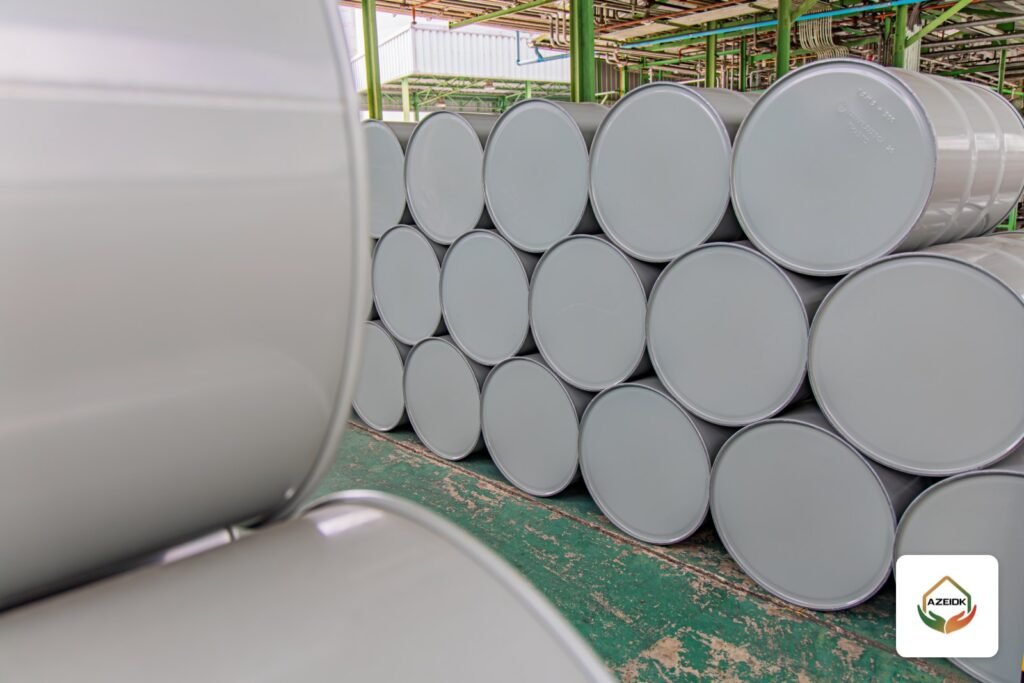
A hazardous materials storage license from Civil Defense is the safety license that proves a chemical warehouse meets fire prevention and protection requirements, and the Executive Regulation of the Chemical Materials Management Law asks for a valid copy of it with every import permit application. Approval depends on what you store and how much, and on whether the warehouse fire alarm, suppression, ventilation and containment are ready under the Saudi Fire Code, SBC 801. This article explains what gets checked on site and how to prepare your file before you apply.
Key takeaways
- The Executive Regulation of the Chemical Materials Management Law (published in the Umm Al-Qura gazette) requires a copy of a valid Civil Defense license confirming that chemical warehouses meet prevention requirements.
- The regulation names two licensing bodies for chemical warehouses: the High Commission for Industrial Security and Civil Defense, depending on the facility.
- SBC 801 gives Chapter 50 to general provisions for hazardous materials and Chapters 51 to 67 to individual material classes.
- Detection and suppression are chosen by material class: water does not suit every material, and flammable liquids usually need foam.
- Prepare the chemical inventory and Safety Data Sheets (SDS) before design, because every technical decision depends on them.
In this article
- What is a hazardous materials storage license from Civil Defense?
- Who licenses a chemical warehouse: Civil Defense or Industrial Security?
- Chemical storage requirements in the Saudi Fire Code SBC 801
- Fire detection and alarm in a hazardous materials warehouse
- Which suppression does a hazardous materials warehouse need: water, foam or gas?
- Hazardous materials warehouse: preparing the file before you apply
- Common mistakes that delay a chemical warehouse license
- Frequently asked questions
- Conclusion
What is a hazardous materials storage license from Civil Defense?
Warehouse owners use several names for it: Civil Defense license, Salamah certificate, or hazardous materials permit. In every case it means the safety license issued to a facility once its premises and systems are confirmed to meet fire prevention and protection requirements. Civil Defense licenses for facilities are handled online through the Salamah platform, and we cover its steps and account types in our Salamah certificate guide.
A chemical warehouse differs from an ordinary warehouse because its license is tied to a second law. The Executive Regulation of the Chemical Materials Management Law requires in item (2-1-1/c) of Article Two a copy of a valid Civil Defense license stating that the chemical warehouses meet prevention requirements. The same condition is repeated for export and re-export. In practice, the warehouse Civil Defense license is an operating condition for importing the materials themselves, not a separate piece of paper.
According to the regulation text published in Umm Al-Qura, it also requires the person responsible for the chemical warehouse to be a Saudi national holding a bachelor’s degree and employed by the same entity that applies for the import permit. These are administrative conditions for the owner, but they affect whether the whole file is ready, so do not leave them to the last step.
Who licenses a chemical warehouse: Civil Defense or Industrial Security?
Article Eight of the regulation (item 8-2) refers to “the licensing bodies for chemical warehouses” and names the High Commission for Industrial Security and Civil Defense among them. The responsible body depends on the facility type and activity, and government entities obtain Civil Defense approval instead of a commercial license. So the first question to settle with the licensing body is who has jurisdiction over your facility. The answer changes the technical references that will apply to the design.
Article Eleven (item 11-2) also requires importers to notify Civil Defense before moving the materials from one region to another. That obligation covers transport, not storage, but it belongs to the same picture: Civil Defense follows the material from import to the warehouse.
Chemical storage requirements in the Saudi Fire Code SBC 801
The Saudi Fire Code, SBC 801, follows the chapter layout of the International Fire Code (IFC). In the 2018 edition, as shown in the table of contents of the study companion published by the International Code Council (ICC), the following chapters cover hazardous materials. Always check the edition currently in force before you design, because figures and tables can change between editions.
| SBC 801 chapter (2018 edition) | Material class |
|---|---|
| 50 | Hazardous materials, general provisions |
| 51 to 55 | Aerosols, combustible fibers, compressed gases, corrosive materials, cryogenic fluids |
| 56 | Explosives and fireworks |
| 57 | Flammable and combustible liquids |
| 58 | Flammable gases and flammable cryogenic fluids |
| 59 | Flammable solids |
| 60 | Highly toxic and toxic materials |
| 61 | Liquefied petroleum gases |
| 62 and 63 | Organic peroxides; oxidizers |
| 64 to 67 | Pyrophoric materials, pyroxylin plastics, unstable (reactive) materials, water-reactive solids and liquids |
In the 2018 IFC, whose structure SBC 801 follows, Chapter 50 rests on a few ideas the designer checks in any hazardous materials warehouse:
- Maximum allowable quantity (MAQ) per control area: each material class has a limit inside a control area, and control areas are separated by fire barriers. Going beyond these limits moves the building into a higher hazard occupancy with stricter requirements.
- Hazardous Materials Inventory Statement and Management Plan (HMIS and HMMP): the authority may ask for them with the permit application. They list each product, its hazard class, quantity and location.
- Hazard identification signs: at entrances to hazardous material areas and on tanks, following NFPA 704 (the familiar colored diamond).
- Spill control and secondary containment: for hazardous liquids and solids in storage rooms and buildings.
- Ventilation: mechanical or natural ventilation for indoor storage areas, linked where needed to smoke extraction and emergency ventilation systems.
- Separation of incompatible materials: by distance, noncombustible partitions or cabinets. Two incompatible materials are never stored in the same cabinet.
Fire detection and alarm in a hazardous materials warehouse
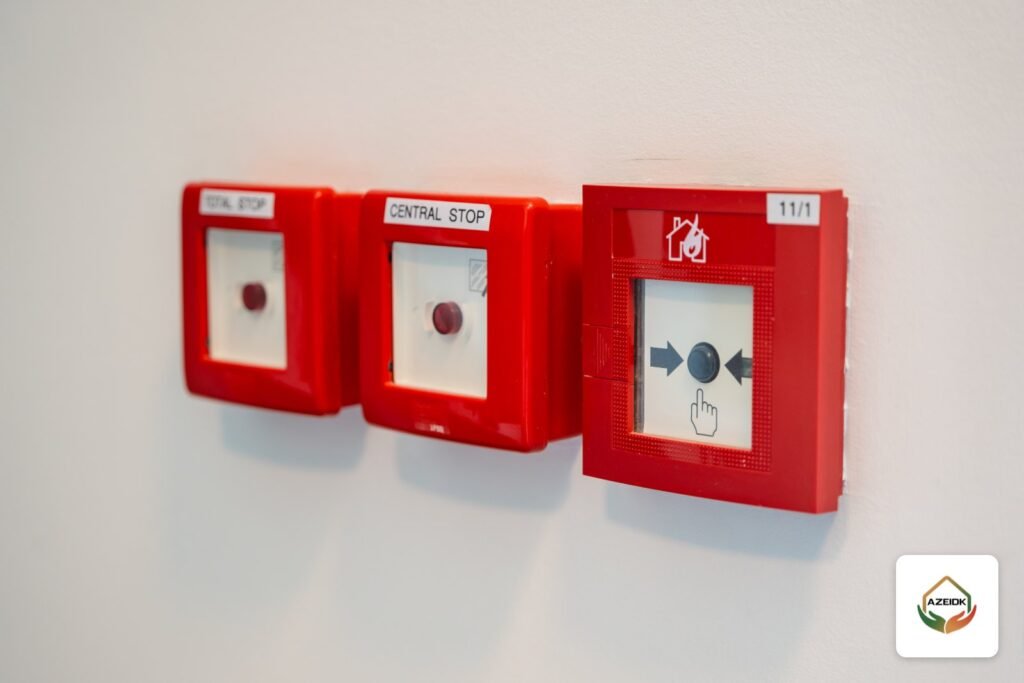
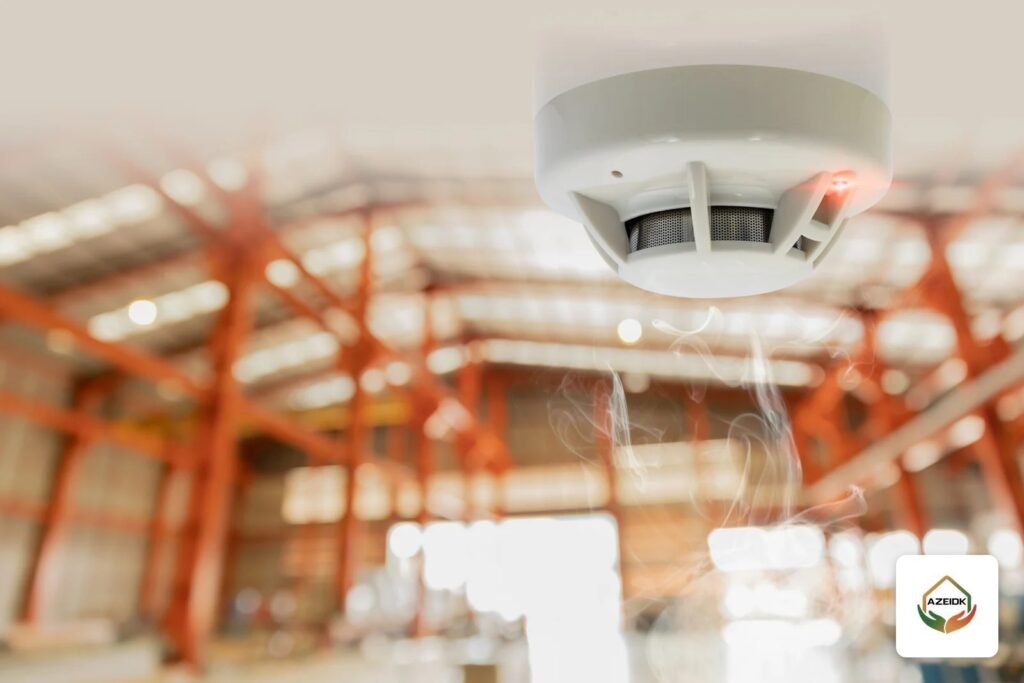
A fire alarm system for a hazardous materials warehouse is not designed the same way as one for dry goods storage. The detector type follows the environment: smoke detectors suit clean areas, while heat detectors are used where dust or vapors would cause false alarms. In high-bay warehouses the designer also has to check ceiling height against the detector type. All of this must appear on the drawings and in the cause and effect matrix that links the alarm to ventilation shutdown or suppression release.
With some materials, such as flammable or toxic gases, gas detection becomes an important part of the safety package, because it warns before a leak turns into a fire. The designer sets the sensor type and position from the density of the stored gas and the likely leak points. Full details of addressable and conventional systems are on our fire alarm systems page.
Which suppression does a hazardous materials warehouse need: water, foam or gas?
The 2018 IFC (Section 5004.5) sets Ordinary Hazard Group 2 as the minimum design for automatic sprinklers in indoor hazardous materials storage areas and buildings, and that is only a minimum. The material-specific chapters, and standards such as NFPA 30 for flammable liquids and NFPA 400 for hazardous materials, can raise the density or change the type of system. The table below summarizes the selection logic. The final decision belongs to the designer after reviewing the actual materials.
| Material or area | Solution usually studied | Technical note |
|---|---|---|
| General combustibles and hazardous materials that do not react with water | Automatic sprinklers and a fire fighting network | Density and design area depend on class, storage arrangement and height |
| Flammable liquids (solvents, paints, fuels) | Foam with sprinklers or as local application | NFPA 11 is the foam reference; proportioning follows the concentrate type, 3% or 6% |
| Water-reactive materials (Chapter 67) | Special review of the extinguishing agent | Water itself may be the hazard, so water spray is not used without a study |
| Electrical and control rooms inside the warehouse | Clean agent or condensed aerosol | Protects equipment without water; needs a sealed room |
| First response in aisles and loading bays | Portable extinguishers suited to the fire class | Type and quantity selected per NFPA 10 |
For flammable liquids, foam is usually the practical answer because it blankets the liquid surface and cuts off oxygen. AZEIDK supplies UL-listed WATEX foam bladder tanks with ratio controllers, as well as AFFF foam concentrates, as part of our fire fighting systems. For electrical and control rooms inside the warehouse, see special fire suppression systems and our clean agent comparison. Extinguisher selection is covered in our NFPA 10 guide.
Hazardous materials warehouse: preparing the file before you apply
Doing things in the right order saves a lot of time, because most comments come from designs based on assumptions about the materials instead of their actual data. These are the steps we recommend:
- Chemical inventory: each product, its maximum quantity and storage location, with a Safety Data Sheet (SDS) for each one.
- Classification: the class of each material and its code chapter, and a check of quantities against the limits per control area.
- Layout: materials spread across separated areas, with incompatibles, containment and ventilation in mind.
- Design and calculations: selection of the suppression and alarm systems, hydraulic calculations and foam calculations.
- Installation and testing: installing and testing the systems, and handing over as-built drawings and installation certificates.
- Maintenance: a periodic maintenance contract and an up-to-date safety log. High-risk activities usually need a contract with a safety company and a Civil Defense inspection before the license is issued.
AZEIDK can support you through these stages under our Civil Defense approval support service, from design review to inspection readiness. For AZEIDK solutions for the warehouse sector, see warehouses and logistics.
Common mistakes that delay a chemical warehouse license
- Designing the sprinklers as for ordinary goods storage without reviewing the classes actually stored.
- Storing incompatible materials side by side, such as oxidizers next to flammable liquids.
- Missing hazard identification signs at entrances and on tanks.
- No spill containment around drums and liquid tanks.
- Changing materials or increasing quantities after licensing without a design review.
- Leaving the maintenance contract and safety log until after the inspection.
Frequently asked questions
Does a chemical warehouse need its own Civil Defense license?
The warehouse needs a valid Civil Defense license confirming it meets prevention requirements, and the Executive Regulation of the Chemical Materials Management Law asks for a copy with import and export permit applications. The licensing body may be Civil Defense or the High Commission for Industrial Security, depending on the facility.
What are the chemical storage requirements in the Saudi Fire Code?
SBC 801 gives Chapter 50 to general provisions and Chapters 51 to 67 to individual classes. The main checks are maximum quantities per control area, separation of incompatibles, containment, ventilation, hazard signs and the automatic sprinkler system.
Are standard sprinklers enough for a hazardous materials warehouse?
Not always. The 2018 IFC sets Ordinary Hazard Group 2 as the minimum design for indoor hazardous materials storage, and material chapters or standards such as NFPA 30 can require more. Flammable liquids usually need foam, and water-reactive materials need a special study.
Do I need gas detection in the warehouse?
It depends on what you store. With flammable or toxic gases, gas detection is an important part of the design because it warns before ignition. The designer sets the sensor type and position from the gas properties.
Which technical documents should I prepare before applying?
The chemical inventory and quantities, Safety Data Sheets, approved drawings for the alarm and suppression systems, installation and test certificates, and the periodic maintenance contract. The authority may also ask for a hazardous materials inventory statement or management plan.
What if I change the stored materials after licensing?
Any change in material class or quantity can change suppression, ventilation and separation needs. Review the design with a specialist engineer before bringing in new materials, and check with the licensing body whether the change requires a license update.
Conclusion
A hazardous materials storage license from Civil Defense starts with the chemical inventory, not with the online form. Know the class and quantity of each material, place them in separated areas, then select the suppression and alarm systems that fit them. In that order, your file reaches inspection ready, with fewer comments holding up operation.
Preparing a chemical warehouse for licensing? The AZEIDK team reviews alarm, suppression and foam system design and prepares the Civil Defense requirements with you. Talk to the AZEIDK team
Related guides
- Network Cabling Installation Cost for Offices and Villas: What Drives Structured Cabling Prices
- Fire Alarm Cause and Effect Matrix: How to Build, Program and Test It
- Fire Extinguisher Bracket (Stand / Holder): Wall, Floor and Vehicle Types and How to Choose by Extinguisher Size
- NAQUA Saudi Arabia: Seafood Plant and Warehouse Fire Safety