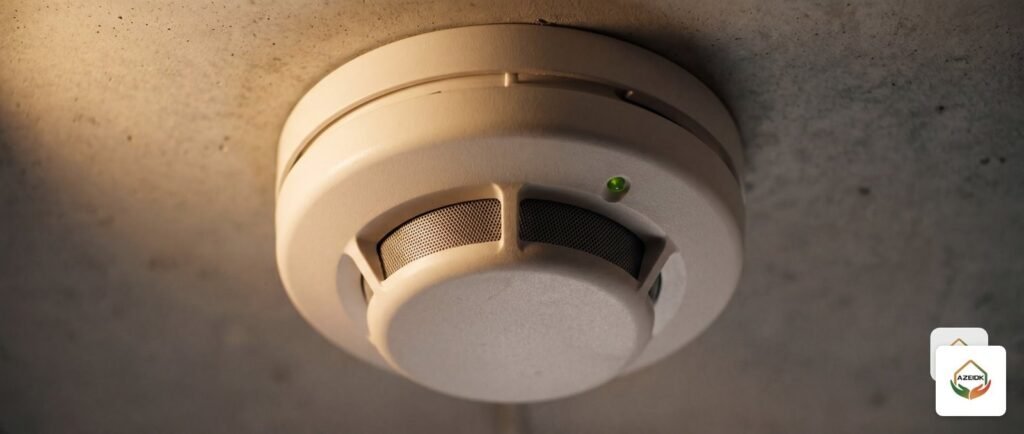
A heat detector is a fire alarm initiating device that signals when the air at the ceiling reaches a set temperature or rises abnormally fast. It replaces a smoke detector where steam, dust or exhaust fumes would cause false alarms, such as kitchens, car parks and generator rooms, but it responds later than a smoke detector.
This guide covers heat detector types, when to choose one over a smoke detector, how to pick the temperature rating, installation basics, and conventional versus addressable devices.
Key takeaways
- Fixed-temperature detectors operate at a set point; rate-of-rise detectors respond to a fast temperature rise; many combine both.
- Heat detectors protect property where smoke detection is unsuitable. They are not a substitute for smoke detectors in sleeping areas and escape routes.
- NFPA 72 calls for a rating at least 20°F (11°C) above the maximum expected ceiling temperature.
- Spacing is based on each model’s listed spacing and is reduced for ceilings above 10 ft (3.05 m).
- EN 54-5 classes (A1 to G) match the detector to ambient temperature; suffixes S and R distinguish fixed from rate-of-rise.
In this article
- What is a heat detector and how does it work?
- Fixed temperature vs rate of rise: what is the difference?
- When should you use a heat detector instead of a smoke detector?
- How do you choose the temperature rating?
- What are the NFPA 72 installation basics?
- Conventional or addressable?
- Context Plus heat detectors at AZEIDK
- What to check on a heat detector datasheet
- How is a heat detector tested and maintained?
- Common heat detector mistakes
- Frequently asked questions
- Summary
What is a heat detector and how does it work?
A spot-type heat detector has a heat-sensitive element that reads the hot gases rising from a fire and collecting under the ceiling. When the alarm condition is met, it signals the fire alarm panel. Linear heat detection is a cable that senses heat along its length, typically for applications such as tunnels, conveyors and cable trays.
Fixed temperature vs rate of rise: what is the difference?
A fixed-temperature detector waits until its element reaches the rated point, for example 57°C (135°F); because of thermal lag the ceiling air is hotter than the element at the moment of alarm. A rate-of-rise detector responds to a rapid increase, typically quoted as about 15°F (8.3°C) per minute regardless of starting temperature, so it catches fast-growing fires earlier. Rate-compensated detectors offset thermal lag and respond faster than fixed types.
| Type | Alarms when | Suits | Avoid |
|---|---|---|---|
| Fixed temperature | A set point is reached | Spaces with rapid normal temperature swings, e.g. near ovens, boiler rooms | Where early warning is needed |
| Rate of rise | Temperature rises quickly | Warehouses, car parks, plant rooms with stable temperatures | Near HVAC vents, oven doors, process heat surges |
| Combined | Either condition | General use where the environment allows | Same limits as rate of rise unless set to fixed only |
| Linear (cable) | Heat at any point on the cable | Tunnels, conveyors, cable trays | Per manufacturer instructions |
When should you use a heat detector instead of a smoke detector?
Smoke detection first, because it is faster; switch to heat detection where the environment makes smoke detectors a source of repeated false alarms: commercial and residential kitchens, car parks and garages (depending on ventilation and design), generator, boiler and pump rooms, dusty areas such as joinery workshops and bulk stores, laundries, and unconditioned voids. Heat detectors do not give enough early warning for occupant escape, so they are not used in place of smoke detectors in bedrooms and escape routes. For a full comparison of smoke, heat, beam and flame detectors see choosing fire detectors.
How do you choose the temperature rating?
NFPA 72 calls for the detector’s rating to be at least 20°F (11°C) above the maximum expected ceiling temperature. A 57°C detector is wrong under an uninsulated metal roof that reaches 45°C in summer.
| EN 54-5 class | Typical application | Max application | Static response |
|---|---|---|---|
| A1 | 25°C | 50°C | 54–65°C |
| A2 | 25°C | 50°C | 54–70°C |
| B | 40°C | 65°C | 69–85°C |
| C | 55°C | 80°C | 84–100°C |
| D | 70°C | 95°C | 99–115°C |
| E–G | 85–115°C | 110–140°C | 114–160°C |
Suffix S (e.g. CS) means static response only; suffix R (e.g. A1R) adds rate-of-rise response. For addressable models see Context Plus addressable heat detectors.
What are the NFPA 72 installation basics?
- On smooth ceilings, the distance from a wall to the nearest detector is no more than half the listed spacing.
- Every point on the ceiling is within 0.7 times the listed spacing of a detector, used for irregular rooms.
- Full listed spacing applies up to 10 ft (3.05 m); from there to 30 ft (9.14 m) it is multiplied by a reduction factor from the standard’s table, e.g. 0.77 at 15 ft (4.6 m).
- Spacing perpendicular to joists is halved, and perpendicular to beams reduced to two-thirds.
- Detectors are not recessed unless listed for it, and rate-of-rise detectors are kept out of direct HVAC airflow.
These are basics only. The figures come from earlier NFPA 72 editions as summarised by the technical references cited, so treat them as approximate and check the NFPA 72 edition adopted for the project. For full calculations see smoke and heat detector spacing. In Saudi Arabia this sits within SBC 801 and the Civil Defense approved design.
Conventional or addressable?
| Item | Conventional | Addressable |
|---|---|---|
| Alarm location | Zone level | Individual detector |
| Wiring | Zone circuits | One loop for many devices |
| Settings | Fixed by model | Some models offer selectable response modes |
| Suits | Shops, villas, small sites | Large and multi-storey buildings |
The detector must match the panel type and protocol.
Context Plus heat detectors at AZEIDK
- Conventional Series 65E (EN 54): 55000-121IMC (A1R), 55000-126IMC (BR) and 55000-131IMC (CR) rate-of-rise, and 55000-136IMC (CS) fixed; 9–33 V DC per the product page.
- Conventional Series 65A (UL): 55000-139IMC (135°F) and 55000-145IMC (200°F), both fixed and rate-of-rise.
- Addressable: A2S 55000-485IMC, CS 55000-495IMC, Xpert 55000-400IMC and 55000-401IMC, and Context UL-Plus 58000-450IMC.
Check each model’s approval on its datasheet. They are available within AZEIDK’s fire alarm solutions.
What to check on a heat detector datasheet
- Response type and whether the mode can be changed.
- Rating or EN 54-5 class against the maximum ceiling temperature.
- Listed spacing for UL-listed detectors.
- Approval of the exact model (UL, EN 54 or LPCB).
- Compatible base, voltage and standby/alarm current.
- Operating temperature, humidity and IP rating.
- Panel and protocol compatibility.
How is a heat detector tested and maintained?
Restorable detectors are tested with a suitable heat source per the manufacturer, never an open flame. NFPA 72 reviews note that non-restorable spot-type heat detectors are replaced after 15 years or sampled for laboratory testing. Record results in maintenance logs, which can be covered by preventive maintenance contracts.
Common heat detector mistakes
- Fitting a heat detector in a bedroom or escape corridor instead of a smoke detector.
- Choosing class A1 under a metal roof that runs hot in summer, causing repeated alarms.
- A rate-of-rise detector next to an oven door or an AC outlet.
- Copying smoke detector spacing to heat detectors instead of using the model’s listed spacing.
- Ignoring the spacing reduction for high warehouse ceilings.
- An addressable detector on a panel with an incompatible protocol.
Frequently asked questions
Heat detector or smoke detector?
Smoke detectors warn earlier; heat detectors respond later but tolerate steam and dust.
Where are heat detectors installed?
Kitchens, car parks, generator and boiler rooms, and dusty areas where smoke detectors false alarm.
What is a typical rating?
Many standard detectors operate around 57°C (135°F); choose higher where the ceiling runs hot, keeping at least 11°C margin per NFPA 72.
Is rate of rise better than fixed?
Faster for fast-growing fires, but unsuitable where temperatures jump in normal operation.
How far apart are heat detectors?
Per the model’s listed spacing, reduced for ceilings above 3.05 m and for beams and joists.
Summary
A heat detector is the right answer in the right place: where the environment defeats a smoke detector, not where occupants need early warning. Choose the type (fixed or rate of rise) by how temperature behaves in the space, the class by the highest ceiling temperature, and the spacing from the datasheet with height reductions, and confirm compatibility with the panel.
Specifying heat detectors? Send us the drawings, panel type, ceiling heights and use of each space, and we will recommend models and classes with datasheets. Contact the AZEIDK team