


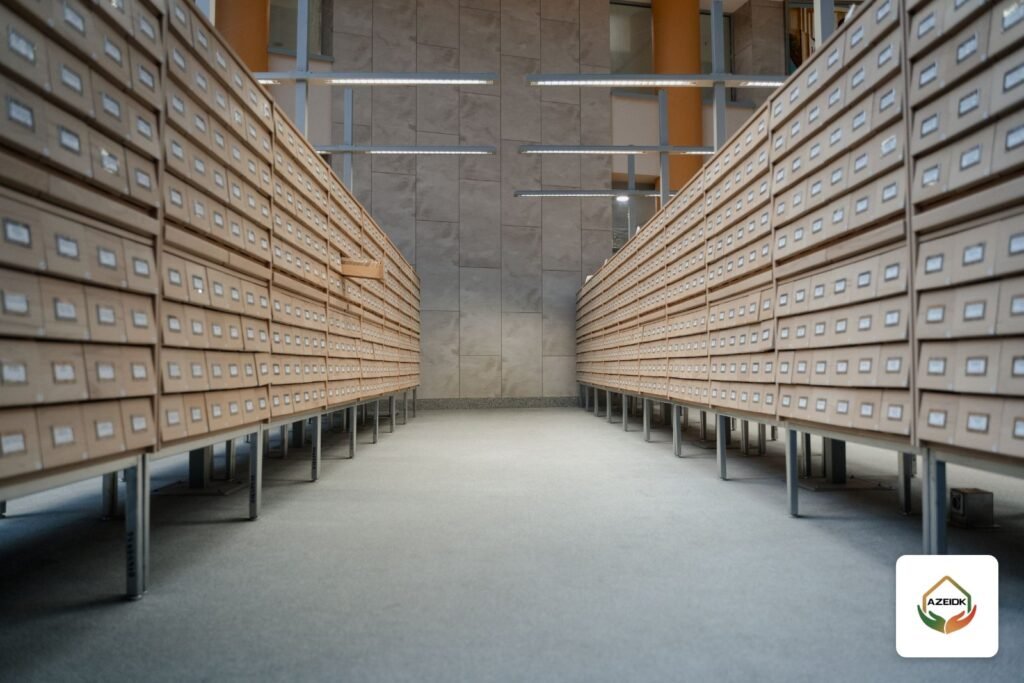
A government building in Egypt is not an ordinary office block. Under one roof you may find a crowded public service hall, archive rooms full of paper files, a server room holding citizens’ records, and offices that close in the afternoon and leave the building empty until morning. That is why government building fire protection starts by splitting the building into spaces with different risks, then choosing the right detection and suppression for each one.
This article explains how to plan that in practice for public authorities, directorates and service centers, using the fire detection and alarm solutions supplied by AZEIDK Egypt, together with extinguishers and special suppression systems for sensitive rooms.
Key takeaways
- A government building mixes spaces with different risks: public halls, paper archives, server and electrical rooms, and offices.
- An addressable system such as the Context Plus ZFP panels shows the exact room where a fire started, which matters in a large building that is empty at night.
- Paper archives need early smoke detection and storage that does not block detectors or aisles. NFPA 232 is the technical reference for records protection.
- Sealed server rooms are usually protected with AFC-227 clean agent, plus PYRAMID CO2 extinguishers for electrical equipment.
- The binding reference is the Egyptian fire code, 2026 edition, and the approval of the General Directorate of Civil Protection.
In this article
- Why a government building is different from a private office
- Government building fire protection by type of space
- Addressable alarm: know the room before you get there
- The paper archive: the largest fire load in the building
- Server and telecom rooms
- Extinguishers in public halls and offices
- The legal reference in Egypt
- Common mistakes in government buildings
- Frequently asked questions
- Conclusion
Why a government building is different from a private office
In a private company, every employee knows the building and its exits. In a public service office, most people inside during working hours are visitors who do not know the layout. They stand in queues at service counters, and some are elderly or have a disability. Clear, audible alarms and easy evacuation matter more than usual.
The second difference is the contents. Paper files in the archive may be the only record of citizens’ rights, and the server room may run a service that a whole branch depends on. Losing them is hard to recover from, even when nobody is hurt. The third difference is age. Many of these buildings are old, and offices, store rooms and electrical loads were added over the years without a full review of the fire systems.
Government building fire protection by type of space
The table below sums up the usual design logic. It does not replace the approved design, but it helps the owner and consultant check that every space has been covered.
| Space | Nature of the risk | Typical detection | First-aid firefighting |
|---|---|---|---|
| Public service hall | Many visitors, furniture and desks | Smoke detectors, manual call points at exits, sounders audible across the hall | ABC dry powder extinguishers, CO2 near electrical panels |
| Offices | Paper and office equipment | Optical smoke detectors | ABC dry powder extinguishers spaced by travel distance |
| Paper archive | Heavy fire load from paper and shelving | Early smoke detection, a beam detector where the ceiling is high and the room is large | ABC powder extinguishers at the entrance; fixed suppression studied in the design |
| Server and telecom room | Sensitive electronics and cables | Smoke detectors in the room and hidden voids, as designed | AFC-227 clean agent system, CO2 extinguishers |
| Electrical and generator room | Electrical faults and fuel | Smoke or heat detectors to suit the space | CO2 for panels, powder or AFFF foam near fuel |
Addressable alarm: know the room before you get there
In a large government building, a conventional alarm that says “zone 3, second floor” can leave a security guard searching twenty locked rooms. An addressable system identifies the detector itself, so the panel shows “archive room” or “server room” by name. That is why the addressable ZFP panels from Context Plus suit multi-storey buildings with many rooms, while CFP conventional panels are enough for small single-floor branches.
When designing the system, check these points:
- Label every address with the room name staff actually use, not just a number. See programming an addressable fire alarm panel.
- Put the panel, or a repeater panel, where security staff sit at night, because the building is empty after hours.
- Provide manual call points at every exit and stair, and sounders loud enough over hall noise. Context Plus offers addressable sounders at 91, 96 and 103 dB depending on the model.
- Link the alarm to shut down central air conditioning and release controlled exit doors where they exist, following the approved cause and effect matrix.
The paper archive: the largest fire load in the building
An archive room full of steel shelving and files is often the biggest fuel source in a government building. NFPA 232 is the US standard for protecting records in all media against fire and its effects. It is used as a technical reference when designing records rooms, while the Egyptian code remains binding.
In practice, the best protection for an archive is early detection, before smoke turns into flames that nobody can approach. Place detectors where tall shelving does not block them, and keep clear aisles between rows so someone can reach a fire with an extinguisher. In large archive rooms with high ceilings, a beam detector such as the TANDA TX7130 can cover a wide area with one device.
Fixed suppression for an archive is a design decision for the consultant, based on the value of the contents, the room size and the code. Water protects the building but can damage paper. Clean agent needs a sealed room. There is no single answer for every archive; what matters is that the decision is made deliberately and the archive is not left unprotected.
Server and telecom rooms
With public services going digital, the server room is now the most important room in many government offices. The usual protection is a clean agent system such as AFC-227 from American Fire Control, which uses HFC-227ea, known in the market as FM-200, because it puts out the fire without leaving residue on equipment. It only works if the room is sealed, which is checked with a room integrity test before handover.
Next to the fixed system, place a PYRAMID CO2 extinguisher at the room door; CO2 suits electrical equipment and leaves no residue. For small enclosed electrical or network cabinets, PYRAMID automatic CO2 extinguishers in 3, 6 and 10 kg sizes can be used.
Extinguishers in public halls and offices
NFPA 10 classes offices and assembly halls as light hazard. For light hazard it calls for extinguishers rated at least 2-A, with a maximum travel distance of 22.9 m (75 ft) to the nearest unit. Service areas and workshops attached to the building are ordinary hazard. These are design reference figures; the Egyptian code and Civil Protection are binding.
In government buildings, 6 kg PYRAMID ABC powder extinguishers are a common choice for corridors and halls, with CO2 units next to electrical panels and large printers. Mount them in visible places near exits, not behind service counters or inside locked offices. To work out the number, see how many fire extinguishers a space needs.
The legal reference in Egypt
Egyptian Building Law No. 119 of 2008 and its executive regulations oblige the permit applicant to apply fire protection requirements in line with the Egyptian code. The current code is the Egyptian Code for the Design and Implementation of Fire Protection for Buildings, 2026 edition (Ministerial Decree No. 355 of 2026). The General Directorate of Civil Protection (Ministry of Interior) reviews drawings and systems and inspects before occupancy. For what the new code means for owners, see the Egyptian fire code 2026 edition.
Common mistakes in government buildings
- Turning an ordinary room into an archive or server room without changing its detection and suppression.
- Stacking files up to the ceiling so detectors are blocked and aisles are closed.
- Placing the alarm panel in an office that is locked in the afternoon, so nobody sees a night alarm.
- Using dry powder extinguishers inside the server room, leaving residue that harms undamaged equipment.
- Skipping routine maintenance after handover, so a failed detector or battery goes unnoticed.
Frequently asked questions
Is a conventional fire alarm enough for a government building?
It is enough for small single-floor buildings. For multi-storey buildings with many rooms, an addressable system is better because it shows the exact room.
What is the best extinguisher for a server room?
A CO2 extinguisher, because it leaves no residue on equipment, plus a fixed clean agent system if the room is critical and sealed.
Can a paper archive be protected with clean agent?
Yes, if the room is sealed and of a suitable size. The consultant decides based on the value of the contents and the Egyptian code.
Where should the fire alarm panel go in a government building?
Where security staff are present around the clock, such as the guard room at the main entrance, or a repeater panel can be placed there.
Is NFPA mandatory for government buildings in Egypt?
No. NFPA is a technical design reference. The binding rules are the Egyptian code, 2026 edition, and Civil Protection requirements.
What should we do in an old building with many added rooms?
Start with a full survey of the current spaces and how they are really used, then update detection and suppression to match.
Conclusion
Government building fire protection means treating each space according to its risk: a clear addressable alarm for public halls and offices, early detection and orderly storage for archives, clean agent and CO2 extinguishers for server rooms, and the right extinguishers in every area. With regular maintenance and the Egyptian code as the reference, the building is safer for visitors and better protected for its records and services.
Reviewing an existing government building or fitting out a new one? Send us the drawings and the use of each floor, and we will propose the alarm, extinguishers and suppression systems that fit. Talk to the AZEIDK Egypt team
Related guides
- Fire Safety in Nurseries and Kindergartens in Egypt: Detectors, Extinguishers, Evacuation
- Factory Fire Protection in Egypt’s Industrial Zones: From Pump Room to Electrical Rooms
- Warehouse Fire Protection in Egypt: Sprinklers, Detection and Codes
- Fire Network Rehabilitation for Old Egyptian Buildings: Assessment, Valves, Cabinets and Pumps





