


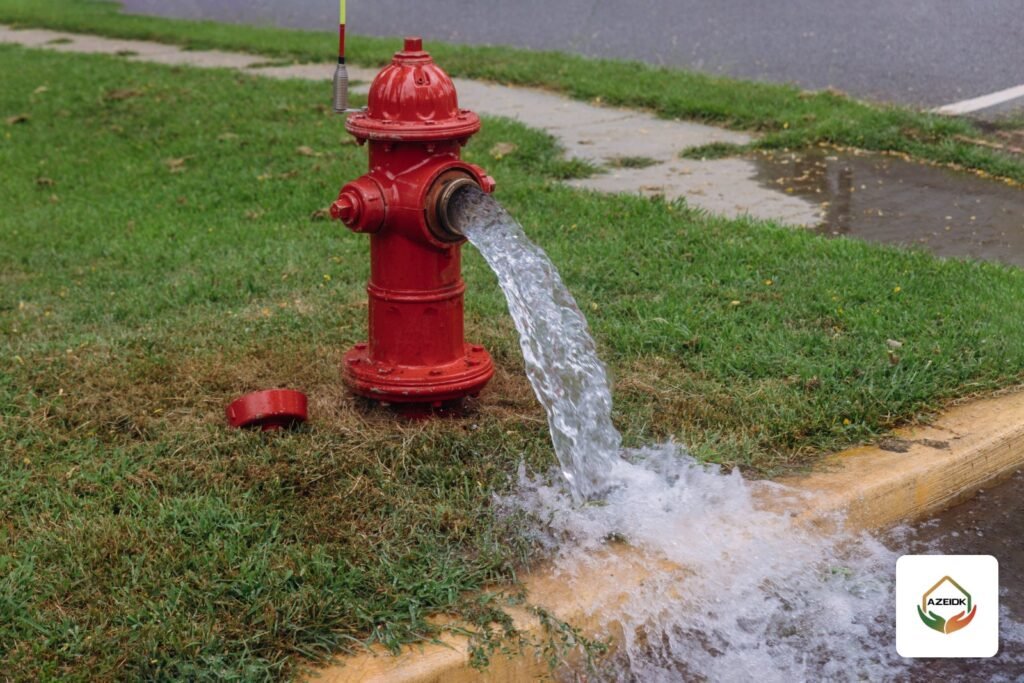
Fire network flushing means running water at high velocity through the underground main and the fire pump suction piping to push out the sand, gravel, weld slag, rags and plastic bags that construction leaves inside the pipe. A pressure test does not find this debris. A network can hold pressure while full of gravel; the problem shows on start-up day as a blocked sprinkler, a weak hose reel or a check valve that will not seat.
This article covers the flushing velocity set by NFPA 24, NFPA 13 and NFPA 20, how to work out the flow for each pipe size, where to put the discharge outlets and how to record the result. Flushing is part of the testing, commissioning and handover service from AZEIDK Egypt for fire fighting networks and 3PUMP fire pump sets.
Key takeaways
- Flush the underground main and its lead-ins before connecting them to risers and aboveground piping, not after.
- The flushing table in NFPA 13 (2019 edition) and NFPA 24 gives the flow needed for 10 ft/s (about 3 m/s): for example 390 gpm for 4 in pipe and 880 gpm for 6 in.
- Under NFPA 20 (2019 edition), fire pump suction piping is flushed at a higher velocity, around 15 ft/s, so debris never reaches the impeller.
- Flushing continues until the water runs clear, not for a fixed time.
- Record the result on the underground piping test certificate, with the measured flow and duration.
In this article
- Why a pressure test alone is not enough
- Required velocity for fire network flushing
- Flushing suction piping before connecting the fire pump
- Discharge outlets and flushing order on a looped main
- When to stop flushing and how to record it
- What debris does to equipment after start-up
- Common fire network flushing mistakes
- The regulatory frame in Egypt
- Frequently asked questions
- Conclusion
Why a pressure test alone is not enough
The hydrostatic test checks that joints are tight and nothing leaks. We cover it in detail in fire network hydrostatic testing. But it is a static test: the water inside the network hardly moves, so no debris is carried out.
On Egyptian sites, whether a residential compound or a factory in 6th of October or 10th of Ramadan, underground pipes often sit open in the trench for days before backfill. Dust, rainwater and sometimes small animals get in, and workers leave gloves, burlap and plastic bags behind. Steel lines also hold weld slag and scale. All of this moves at the first real pump run and heads for the narrowest point in the system.
Technical articles on underground flushing published by PHCP Pros explain that this debris can damage the fire pump impeller if it sits in the suction line, and can cut flow if it lodges in valves, piping and sprinkler orifices downstream of the pump.
Required velocity for fire network flushing
Water must move fast enough to carry gravel and sand to the outlet. NFPA 24, the standard for private fire service mains, sets a minimum flushing flow based on 10 ft/s (about 3.0 m/s), and NFPA 13 carries the same table for the underground lead-in that feeds a sprinkler riser. The table below shows these values as given in NFPA 13 (2019 edition), with the third column from the NFPA 20 (2019 edition) suction flushing table, as reported by PHCP Pros and US authority documents.
| Nominal pipe size | Flushing flow for 10 ft/s, main (NFPA 13-2019 and NFPA 24) | Flushing flow for 15 ft/s, pump suction (NFPA 20-2019) |
|---|---|---|
| 4 in (DN100) | 390 gpm (about 89 m³/h) | 590 gpm (about 134 m³/h) |
| 6 in (DN150) | 880 gpm (about 200 m³/h) | 1,320 gpm (about 300 m³/h) |
| 8 in (DN200) | 1,560 gpm (about 354 m³/h) | 2,350 gpm (about 534 m³/h) |
| 10 in (DN250) | 2,440 gpm (about 554 m³/h) | 3,670 gpm (about 834 m³/h) |
| 12 in (DN300) | 3,520 gpm (about 799 m³/h) | 5,290 gpm (about 1,201 m³/h) |
The current edition of NFPA 24 is 2025, so check which edition the project specification adopts before using these figures. If the water supply cannot deliver the table flow, NFPA 24 accepts the maximum flow available to the system. The final decision rests with the consultant and the project specification.
To check actual velocity on site, use: velocity (ft/s) = 0.4085 × flow (gpm) ÷ internal diameter squared (in). A pipe with a 6.065 in bore carrying 880 gpm gives about 9.8 ft/s, because the actual bore is slightly larger than the nominal size.
Flushing suction piping before connecting the fire pump
The suction line is the most critical point, because any stone in it goes straight into the impeller. NFPA 20 therefore asks for suction piping to be flushed at a higher velocity, around 15 ft/s, before the pump is connected. As PHCP Pros reports for NFPA 20 (2019 edition), if the supply cannot reach that velocity, a flow of at least 150% of the pump rated flow is accepted; if that is not possible either, the greater of 100% of rated flow or the maximum system demand applies.
A worked example: a 3PUMP fire pump set rated 1000 GPM at 10 bar. 150% of its rated flow is 1500 gpm. If the suction line is 6 in, the 15 ft/s table value is 1,320 gpm, so reaching 150% of pump flow would exceed the table value in this case. Work the figure out before flushing day and confirm the tank or public main can supply it.
In practice, the suction line is disconnected at the pump flange and a temporary, well restrained outlet is fitted in its place. The pump itself is not used to push flushing water through its own unflushed suction line. Running the pump on a dirty suction line is exactly what flushing is meant to prevent.
Discharge outlets and flushing order on a looped main
880 gpm will not come out of a single 2.5 in outlet easily, so some authorities set the number of hoses or outlets by pipe size, such as one 4 in hose or four 2.5 in hoses for 6 in pipe, as in the City of Rocklin requirements in the US. As a site safety rule, the discharge line is tied down and never hand held, and the discharge area must take that volume without flooding the site.
In compounds and large factories the main is usually a loop, as described in compound fire hydrant networks. PHCP Pros recommends this order:
- Flush the pump suction section first, before connecting the pump.
- Choose a path starting at the pump that covers more than half the loop, closing sectional valves so water moves in one direction.
- Flush the other half of the loop in the opposite direction, with a small overlap between the two passes.
- Flush each branch on its own: building lead-ins, fire hydrants and the fire department connection (FDC, the Siamese connection).
A remote FDC needs attention, because its check valve stops water leaving from that side. Plan in advance how its line will be flushed: either rotate or remove the check valve temporarily where it is accessible, or flush the FDC line from the connection into the loop before flushing the loop.
When to stop flushing and how to record it
NFPA 24 sets no fixed duration. The requirement is to keep flushing until the water runs clear of debris. Because that judgement is visual, PHCP Pros suggests calculating the transit time of water through the line at the required velocity and doubling it as a minimum. A 3,000 ft (about 915 m) line at 10 ft/s has a 5 minute transit time, so at least 10 minutes of flushing, continuing longer if debris is still coming out.
A net or burlap bag on the outlet catches what comes out and gives physical evidence that the line is clean. The result goes on the Contractor’s Material and Test Certificate for Underground Piping referenced by NFPA 24, including:
- Pipe size, length flushed, start point and outlet.
- Measured flow, residual pressure and measuring method.
- Flushing time and a note on water condition at the end.
- Names of those present from the contractor, consultant and owner.
This record goes into the handover file described in fire system commissioning and acceptance.
What debris does to equipment after start-up
| Component | Likely effect of debris |
|---|---|
| Fire pump impeller | Scored or broken vanes, flow and pressure below the datasheet curve |
| Check valves and alarm check valve | A stone or rag stops the clapper seating, the network loses pressure and the jockey pump cycles often |
| Sprinklers | Blocked orifice or distorted spray pattern |
| Hose reels and hose cabinets | Weak flow at the nozzle or a blocked internal valve |
| Fire hydrants | Debris trapped in the hydrant base, preventing full opening or closing |
So flush before fitting sprinklers and nozzles where possible, and before connecting hose cabinets and hose reels. Fixing these faults after handover is harder and costs more than an extra hour of flushing.
Common fire network flushing mistakes
- Flushing through a small hose: opening a 2.5 in valve on an 8 in line gives very low velocity, so water moves without carrying gravel.
- Connecting aboveground piping before flushing: the debris then moves from the underground main into risers and branches.
- Flushing the suction line with the pump itself: the stones pass through the impeller first.
- Skipping the FDC branch and remote hydrants: dead ends remain where water never moved fast enough.
- Not measuring flow: looking at the stream does not prove velocity. Measurement needs a calibrated gauge or flow meter.
- Stopping on time, not on result: the criterion is clear water.
For more site errors, see fire protection installation and testing mistakes in Egypt.
The regulatory frame in Egypt
Egyptian Building Law No. 119 of 2008 and its executive regulations require the permit applicant to apply fire protection requirements under the Egyptian code. The current edition is the Egyptian Code for the Design and Implementation of Fire Protection for Buildings, 2026 edition (Ministerial Decree No. 355 of 2026). The General Directorate of Civil Protection (Ministry of Interior) reviews fire protection drawings and inspects the building before occupancy.
Flushing procedures and velocities usually come from the consultant’s project specification, which often refers to NFPA 24, NFPA 20 and NFPA 13 as reference standards. These standards are not legally binding in Egypt on their own, so agree the standard, the accepted values and the recording method with the consultant before flushing.
After start-up, NFPA 25 (current edition 2026) deals with debris in existing systems under its internal assessment and obstruction investigation chapter. As NFSA explains that chapter, the conditions that trigger an investigation include finding enough foreign material to obstruct water flow. Good flushing before handover makes it less likely a system ever reaches that stage.
Frequently asked questions
What is fire network flushing?
Running water at high velocity through the underground main and suction lines to push out construction debris before aboveground piping and pumps are connected.
What velocity is required to flush the main?
NFPA 24 is based on 10 ft/s, about 3 m/s, and the NFPA 13 (2019 edition) table gives the flow for each pipe size, such as 880 gpm for 6 in pipe.
Is flushing done before or after the pressure test?
The fixed rule is that flushing happens before the underground main is connected to aboveground piping. Its order relative to the pressure test is set by the project specification and the consultant, and authorities differ on it.
How long should a fire network be flushed?
NFPA 24 sets no fixed time. Flushing continues until the water runs clear, and a minimum can be estimated by doubling the transit time of water through the line.
Why is the fire pump suction line flushed at a higher velocity?
Any debris in it goes straight into the impeller, so NFPA 20 (2019 edition) asks for around 15 ft/s before the pump is connected.
What if the water supply cannot reach the flushing flow?
NFPA 24 accepts the maximum flow available to the system. Record the flow actually achieved and agree this with the consultant before flushing.
Conclusion
Fire network flushing is short compared with weeks of installation, but it protects the pump, valves and sprinklers from faults that are hard to trace after handover. Calculate the flow for each pipe size, confirm the supply, restrain the outlets, flush the suction line, then the loop, then the branches, stop only when the water runs clear, and record it on the test certificate.
Getting ready to hand over a new fire network? Send us the main layout and pump data, and the AZEIDK team will review the flushing and test plan with you before start-up. Talk to the AZEIDK Egypt team
Related guides
- Fire Alarm Elevator Interface: Lift Recall, AHU Shutdown, Door Release and Gas Shut-off with Context Plus Outputs
- Fire Protection in Medical Laboratories in Egypt: GAHAR, Alarm and Extinguishers
- AFC-227 / P227 Clean Agent System: Components and Electrical Room Use
- PYRAMID Dry Powder Extinguishers: 1 to 12 kg Sizes and Where to Use Each





