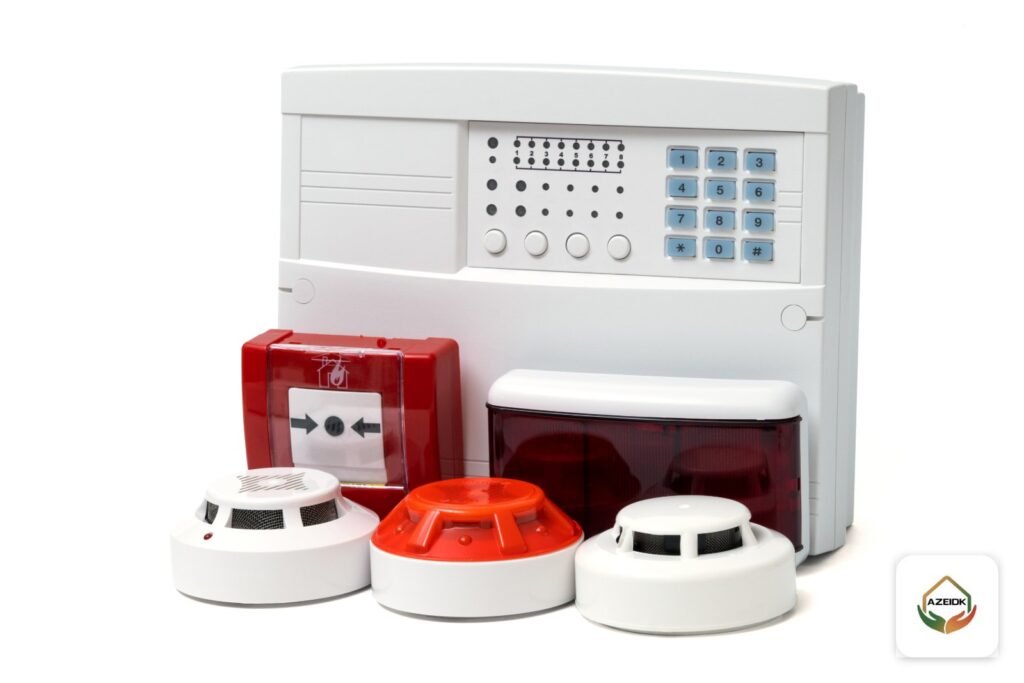
Fire alarm panel faults usually show up as an intermittent buzzer, a yellow LED and a short message on the display, such as Earth Fault or Open Circuit. It does not mean there is a fire. It means part of the system may not work if a fire does happen.
This article explains common trouble messages, what facility staff can safely check, when to call a technician, and what NFPA 72 says about testing trouble signals. If your panel shows a fault now, AZEIDK Egypt corrective maintenance and fault repair is the service built for this situation.
Key takeaways
- NFPA 72 separates three conditions: alarm (immediate threat), supervisory (an off-normal condition in monitored equipment, such as a closed valve) and trouble (a fault in the fire alarm system itself).
- Earth Fault, Open Circuit, Short Circuit and Device Missing point to wiring, device or power problems.
- Staff record the message, check visually and report it. They do not open the panel, disconnect batteries or isolate circuits.
- Silencing the trouble buzzer fixes nothing. The fault stays until its cause is repaired.
- Locating, repairing and retesting is specialist work done to the manufacturer’s instructions.
In this article
- Alarm, supervisory or trouble?
- Common fire alarm panel faults and what they mean
- The main messages in more detail
- Safe first checks for facility staff
- When you need a specialist technician, and what they do
- The reference in Egypt: code, then standards, then the manufacturer
- Common mistakes when handling panel faults
- Corrective maintenance with AZEIDK Egypt
- Frequently asked questions
- Conclusion
Alarm, supervisory or trouble?
A panel shows three kinds of signal, each needing a different response. NFPA 72 defines an alarm condition as an abnormal condition posing an immediate threat to life or property. A supervisory condition is an abnormal condition linked to the supervision of other systems or equipment, such as a sprinkler valve tamper switch. A trouble condition is an abnormal condition in the system caused by a fault; a ground fault is a typical example.
That is why a panel usually gives a trouble buzzer that sounds different from the alarm, heard at the panel or where the people responsible for the system are, rather than sounding the building sounders. False alarms, where sounders operate with no fire, are a different problem, covered in our article on fire alarm false alarms.
Common fire alarm panel faults and what they mean
Wording varies by manufacturer and model, but most messages fall into these groups. The final word is the manual for the installed panel model. The table summarises frequent causes as described in technical guidance from fire alarm service providers such as ORR Protection and the Fire Protection Technicians Network.
| Typical message | General meaning | Frequent causes | Who acts |
|---|---|---|---|
| Earth Fault / Ground Fault | A conductor is touching earth or metal | Damaged cable in a metal box, water ingress, wrong termination | Specialist technician |
| Open Circuit / Zone Fault | A break in a zone, loop or sounder circuit | Loose wire, detector head removed, faulty end-of-line resistor, cable cut during works | Staff check visually; technician repairs |
| Short Circuit | The two circuit conductors are touching | Damaged insulation, a screw through the cable, wrong wiring in a base | Specialist technician |
| Device Missing / No Reply | An addressable device is not answering the panel | Device removed or failed, wrong address after replacement, loop cut | Staff confirm the device is fitted; technician does the rest |
| Mains Fail / AC Fail | Primary power is lost and the panel is running on batteries | Power cut, panel breaker off, power supply failure | Staff check power and breaker; technician does the rest |
| Battery / Charger Fault | Batteries weak or disconnected, or charger failed | Old batteries, blown fuse, loose terminal, failed charger | Specialist technician |
| Sounder / NAC Fault | A problem on a notification (sounder) circuit | Open or short on the sounder cable, damaged sounder | Specialist technician |
| Disablement / Disabled Zone | A zone or device has been switched off at the panel | Isolated for maintenance and not re-enabled | System owner, with the technician |
The main messages in more detail
Earth fault
A conductor is now connected to earth or a metal structure, usually through a cable pinched against a metal box or conduit, water in a ceiling detector or junction box, or a wiring mistake. A single earth fault may not stop the system, but it weakens its ability to cope with a second fault, so it should not be left.
Open circuit
The panel monitors each circuit with a small current to the end of the line; a break gives an open-circuit fault. On conventional systems the cause is often a detector head removed during painting or cleaning, or the end-of-line resistor. On addressable systems a broken loop can produce several “no reply” messages at once. NFPA 72 Chapter 12 (Circuits and Pathways) classes pathways by how they behave under faults. A Class A pathway keeps working through a single open or a single ground fault, and both conditions are annunciated as trouble.
Short circuit
A direct contact between the two conductors of a circuit. On an addressable loop a short can take out many devices, so isolators are fitted to confine it to one section (see addressable fire alarm loop design). On a sounder circuit, the sounders may not operate.
Device missing
Every addressable device has an address that the panel polls continuously. If one does not reply, the message shows its loop and address. Typical causes: a device removed and not refitted, a failed device, or a replacement whose address or type does not match the programming.
Power and battery faults
A mains failure means the panel is on batteries, designed to carry it for a limited time only. A battery or charger fault means that backup cannot be relied on. Often a panel looks healthy until a power cut exposes weak batteries.
Safe first checks for facility staff
Steps a building manager or security team can take without tools or opening the panel:
- Read the full message and write it down: the text, the zone or loop number and address, and the date and time.
- Silence the trouble buzzer only, following the site procedure. Do not press Reset again and again; the fault will come back as long as its cause is there.
- Ask what changed recently in that area: painting, ceiling or electrical work, a leak or a power cut.
- Look at the area: a detector off its base, a damaged cover or signs of water.
- For a mains failure, check the building supply and the dedicated panel breaker in the distribution board. If it is off, call the site electrician. Do not touch anything inside the panel.
- Report the exact message to the system owner and maintenance provider, and log it.
Staff should not open the panel, disconnect batteries, remove detectors or isolate a whole zone to stop the buzzer. Taking part of the system out of service is a decision for the responsible person, recorded and communicated, with a temporary watch until the repair.
When you need a specialist technician, and what they do
Earth faults, short circuits, battery or charger faults, and open circuits with no visible cause need a fire alarm specialist, who will typically:
- Read the event log to see when the fault started and whether it repeats.
- Identify the affected circuit, then split it into sections and test each one until the fault is found.
- Take measurements after disconnecting electronic devices as the manufacturer instructs.
- Repair the cable or replace the faulty device, and set the address and type of any replacement to match the panel programming.
- Restore the circuit, confirm the fault has cleared and devices work, and document it.
The test methods table in NFPA 72 Chapter 14 (inspection, testing and maintenance) includes items that bear directly on this topic. They include verifying control unit trouble signals, a ground-fault indication when any conductor is grounded, a trouble indication for a fault on any circuit monitored for integrity, and a trouble indication on loss of primary power. So the panel’s ability to detect faults is itself tested periodically. We set out the test intervals in our article on fire system maintenance and routine testing.
The reference in Egypt: code, then standards, then the manufacturer
The legally binding reference in Egypt is the Egyptian Code for the Design and Implementation of Fire Protection for Buildings, 2026 edition (Ministerial Decree No. 355 of 2026). Its third part covers electrical requirements and detection and alarm, and systems are reviewed and approved by the General Directorate of Civil Protection (Ministry of Interior). NFPA 72 is a technical reference used where the designer or contract adopts it; it is not binding in Egypt on its own.
For daily diagnosis the manufacturer’s manual is the basis, since messages and isolation and reset procedures differ between models. AZEIDK Egypt supplies Context Plus addressable (ZFP) and conventional (CFP/FP) panels, together with detectors, manual call points, sounders and input/output modules. Each model’s messages are explained in its own manual.
Common mistakes when handling panel faults
- Silencing the buzzer and forgetting the fault for weeks.
- Pressing Reset repeatedly before recording the message.
- Isolating a whole zone for one device, leaving an area unprotected unnoticed.
- Disconnecting the batteries to stop a battery fault message, which removes the panel’s backup power.
- Removing detectors during fit-out and refitting them wrongly or not at all.
- Fitting a replacement device of a different type or address without reprogramming.
- Ignoring an intermittent earth fault because it sometimes clears by itself.
Corrective maintenance with AZEIDK Egypt
AZEIDK Egypt maintenance covers preventive and periodic maintenance, corrective maintenance and fault repair, and technical support and spare parts. For a live fault, send the exact message, panel model, zone or loop and address, when it appeared and any recent building work. This shortens diagnosis on site.
Frequently asked questions
Does a fault on the fire alarm panel mean there is a fire?
No. It means a problem in the system, such as a broken cable or weak battery, which may stop it detecting or warning of a fire in that area. Fix it quickly.
Can an earth fault be left if the system still works?
Not advisable. It leaves the circuit more likely to fail on a second fault, and may signal water ingress or cable damage that worsens.
Why does the fault come back after a reset?
A reset does not fix the cause. The panel monitors continuously, so the message returns while the cause remains.
What is the difference between Open Circuit and Device Missing?
Open circuit concerns the cable; device missing means a specific addressable device is not replying. A broken loop can show both.
Can a general electrician fix panel faults?
An electrician can check the supply and panel breaker. Tracing circuit faults, setting up addressable devices and retesting need a fire alarm specialist.
Conclusion
Dealing with fire alarm panel faults starts with reading the message accurately. Staff record it, check visually and confirm power, then hand over to a specialist who locates, repairs and retests. Every day a fault stays open, part of the building may be unprotected.
Is your fire alarm panel showing a fault? Send us the message text, the panel model and the affected zone, and we will arrange inspection and repair with you. Talk to the AZEIDK Egypt team