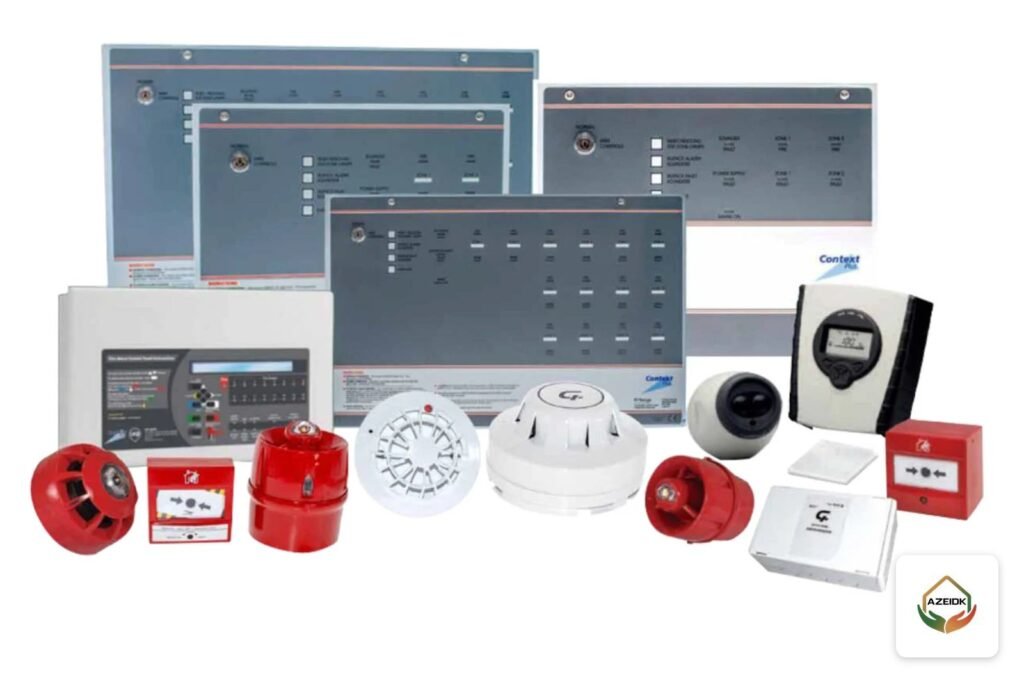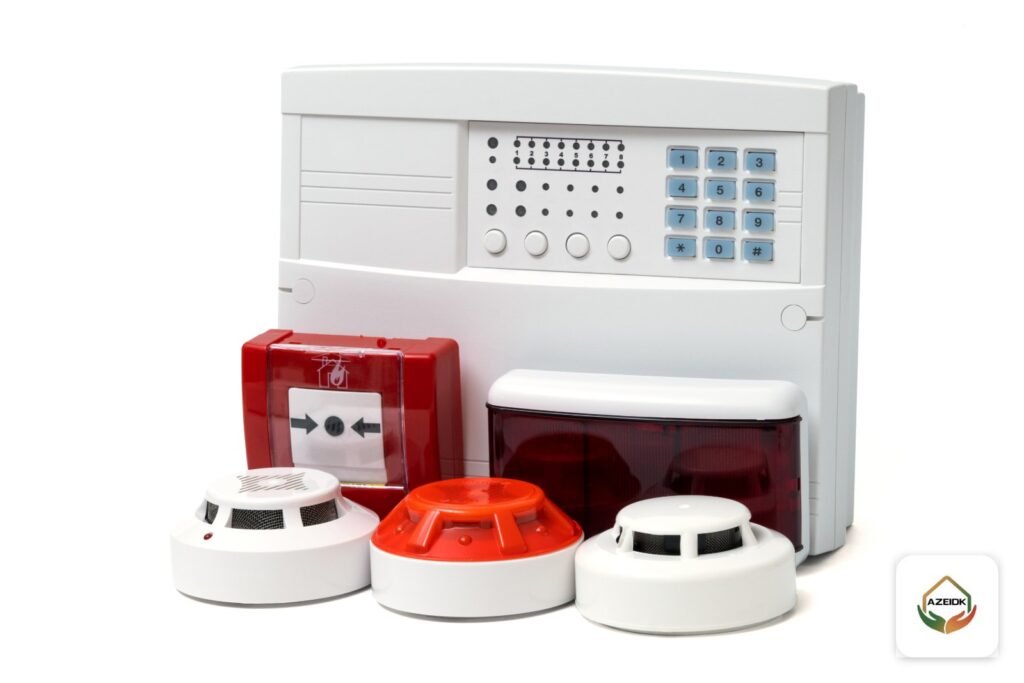
Many villa owners in compounds across New Cairo, Sheikh Zayed, 6th of October and the North Coast ask for a villa fire alarm system run from a central panel, not a few stand-alone battery smoke alarms. A small conventional panel with a few zones, and detectors chosen room by room, usually does the job.
This guide covers zoning, detector choice room by room, and the supply request, based on the Context Plus conventional panels and Series 65A detectors listed under AZEIDK Egypt fire detection and alarm solutions.
Key takeaways
- A residential villa is normally served by a Context Plus conventional panel from the CFP or FP families, with at least one zone per floor; confirm the zone count of the offered model on its datasheet.
- Use the 55000-326IMC photoelectric smoke detector in bedrooms, corridors, living areas and stairs, and the 55000-139IMC heat detector (135°F) in the kitchen, garage and laundry.
- NFPA 72 sets out alarm locations in dwellings: inside every bedroom, outside each sleeping area and on every level, basement included. It is a technical reference, not a legal requirement in Egypt.
- The Series 65A datasheet gives an ambient operating range of about 0 to 38°C, so unconditioned roof rooms and stores need a check.
- Add manual call points, sounders audible in bedrooms, a standby battery and periodic maintenance.
In this article
- Why a conventional panel and not addressable?
- Zoning the villa: how many zones do you need?
- Detector locations, from kitchen to bedrooms
- The rest of a villa fire alarm system
- What does the Egyptian code say about villas?
- Common mistakes in villa systems
- What to include in your supply request
- Frequently asked questions
- Conclusion
Why a conventional panel and not addressable?
In a conventional system, detectors are wired on two-wire circuits called zones. The panel shows which zone is in alarm, not which detector. In a two or three storey villa, knowing the floor is enough to reach the source in seconds, so a conventional panel is the sensible, economical choice. The full comparison is in our article on conventional vs addressable fire alarm systems.
The main difference from stand-alone battery alarms is that the alarm reaches the whole house. A detector in the ground floor kitchen sounds the sounders on the bedroom floor too. The panel also reports faults, such as a cut cable or a detector pulled off its base.
On the Context Plus brand page, AZEIDK Egypt lists conventional panels from the CFP and FP families; the zone count of each model is confirmed from its datasheet when you order. Context Plus is a British manufacturer founded in 1984; approvals vary by model, so check each datasheet.
Zoning the villa: how many zones do you need?
The practical rule is at least one zone per floor, so the panel tells you where the fire started. Separate areas such as the garage or a roof annex can take their own zone.
Example: a detached villa in a compound
A villa with a basement, ground floor, first floor and roof room, a common layout in New Cairo and West Cairo compounds:
- Zone 1: basement (multi-purpose hall, staff room, laundry).
- Zone 2: ground floor (reception, kitchen, dining, stairs).
- Zone 3: first floor (bedrooms and internal corridor).
- Zone 4: garage and roof room, or each in its own zone if panel capacity allows.
This layout fits a 4 zone panel. Keep one or two spare zones if the owner plans to finish the basement or add an annex later. Two storey North Coast chalets and townhouses usually need fewer zones, typically two or three.
The number of detectors allowed per zone is set by the panel manual, and each zone ends with the end-of-line device specified by the panel. Take it from the datasheet, not from a generic figure online.
Detector locations, from kitchen to bedrooms
The best-known technical guidance on detection in homes is the household chapter of NFPA 72, current edition 2025. It calls for alarms inside every bedroom, outside each sleeping area near the bedroom doors, and on every level including the basement. According to a Fine Homebuilding summary of US dwelling rules (the International Residential Code and NFPA 72), smoke alarms are kept about 3 m horizontally from fixed cooking appliances, and about 1 m from bathroom doors and air supply grilles. These are US technical guidance figures for the designer, not Egyptian legal text.
Detector choice per space, from the Series 65A models listed by AZEIDK Egypt:
| Villa space | Detector type | Model | Note |
|---|---|---|---|
| Bedrooms | Photoelectric smoke | 55000-326IMC | One in every bedroom, including staff and guest rooms. |
| Corridor outside bedrooms | Photoelectric smoke | 55000-326IMC | Near the bedroom doors, away from AC outlets. |
| Reception, living and dining | Photoelectric smoke | 55000-326IMC | Quantity depends on area, ceiling height and the approved layout. |
| Stairwell and double-height voids | Photoelectric smoke | 55000-326IMC | One at the top of the stairwell; high voids are reviewed at design stage. |
| Kitchen | Heat 135°F | 55000-139IMC | A smoke detector in the kitchen is a constant source of false alarms. |
| Garage | Heat 135°F | 55000-139IMC | Exhaust fumes and dust do not suit a smoke detector. |
| Laundry and store | Heat 135°F | 55000-139IMC | Steam and lint trigger smoke detectors. |
| Central water heater or generator room | Heat 200°F | 55000-145IMC | Only after checking the actual room temperature against the datasheet limits. |
Kitchen: heat, not smoke
Daily frying and steam make a kitchen smoke detector a source of repeated false alarms, which usually ends with the zone disabled. The 55000-139IMC heat detector combines a fixed temperature point of 135°F (about 57°C) with a rate-of-rise element. In an open kitchen, the smoke detector goes in the living area, well away from the hob.
Bedrooms and corridors: photoelectric smoke
The 55000-326IMC photoelectric detector sees the visible smoke from slow, smouldering fires, such as a mattress, a sofa or an overloaded extension lead. Such fires can smoulder for a long time, and are most dangerous at night.
Roof rooms and hot spaces
The Series 65A datasheet gives an ambient operating range of 32 to 100°F, about 0 to 38°C. An unconditioned roof room in August, or a store under a sun-exposed slab, can exceed this. Do not just switch to the 200°F model; send us a description of the space for review.
Detector spacing and coverage are covered in our smoke detector spacing guide, and the full electrical data of each model in Context Plus Series 65A detectors.
The rest of a villa fire alarm system
A typical villa also needs:
- Panel: in a place the family passes daily, such as the entrance or next to the kitchen door, not in the basement or a locked electrical room.
- Manual call points (MCPs): at the main door, at the back or garden exit, and on the stair landing on each floor.
- Sounders: at least one per floor, sized so the sound is heard inside bedrooms with the doors closed.
- 45681-245 relay base: where a signal from a specific detector must start or stop another piece of equipment.
- BF318 remote indicator: for a detector inside a room that stays locked, such as a store or roof room, so the alarm LED shows outside the door.
A standby battery is essential in Egypt, where power cuts can happen. Sizing method: see our article on fire alarm battery calculation.
What does the Egyptian code say about villas?
The legal reference in Egypt is the Egyptian Code for the Design and Implementation of Fire Protection for Buildings, 2026 edition (Ministerial Decree No. 355 of 2026). Its third part covers electrical requirements and detection and alarm systems. The General Directorate of Civil Protection (Ministry of Interior) reviews and approves fire system drawings where required.
We have not verified any provision that obliges every single-family villa to have a central alarm system. Whether one is required depends on the building’s classification, size and use, and on the developer’s requirements in the compound. Check with the design engineer or compound management for your case.
Common mistakes in villa systems
- Smoke detector in the kitchen or garage: false alarms, then the whole zone is disabled and a full floor loses protection.
- One zone for the whole villa: time is lost searching three floors for the source.
- A single ground floor sounder: poorly heard in upstairs bedrooms.
- Fitting detectors before finishing works end: plaster and paint dust gets into the detector chamber. Fit heads after final cleaning, or keep them covered until handover.
- Ignoring roof room temperatures: the 0 to 38°C datasheet range does not cover every unconditioned room in summer.
- North Coast villas closed in winter: the panel sits for months unattended, and a flat battery or a fault can go unnoticed. Book a check visit before summer.
What to include in your supply request
| Item | What to specify |
|---|---|
| Conventional fire alarm panel | Number of zones needed plus a spare, and mounting location. |
| Photoelectric smoke detectors | Quantity for bedrooms, corridors, living areas and stairs. |
| Heat detectors | Quantity and rating (135°F or 200°F) for each space. |
| Bases | A standard base per detector, and relay bases where needed. |
| MCPs and sounders | Quantity on each floor and their locations. |
| Cables | Fire alarm cable type and approximate lengths per route. |
| Scope | Supply only, or supply, installation and testing, with or without a maintenance contract. |
Send a floor plan for each level showing room use. AZEIDK Egypt provides supply, installation, testing and maintenance through its technical services, and provides the datasheet of each product before approval. A suitable extinguisher in the kitchen and garage completes the setup, as explained in our guide to choosing a home fire extinguisher.
Frequently asked questions
Is a 2 zone panel enough for a three storey villa?
Not in practice. One zone per floor lets the panel point straight to the alarm location, so a three storey villa needs at least three zones, and four is better with a spare.
Why not put a smoke detector in the kitchen?
Cooking smoke and steam will set it off again and again. A 135°F heat detector picks up a real kitchen fire without daily nuisance, and the smoke detector stays in the adjacent living area at a proper distance from the hob.
Does the system work during a power cut?
Yes, if the standby battery is correctly sized and in good condition.
Is a fire alarm system mandatory in villas?
We have not verified a provision that imposes it on every single villa. It depends on building classification and authority and developer requirements.
Can detectors be added after finishing?
Yes, as long as the zone has spare capacity and a cable can be run to the new point. Running cables after finishing costs more, so plan before gypsum and paint works.
Conclusion
A villa fire alarm system in Egypt is simple in its parts: a conventional panel with one zone per floor and a spare, photoelectric smoke detectors in bedrooms, corridors and living areas, heat detectors in the kitchen, garage and service rooms, and MCPs and sounders heard in every bedroom. Plan it before finishing works, check hot spaces against the datasheet, and keep it maintained even when the villa is closed most of the year.
Fitting out a compound villa and need a quote for a complete alarm system? Send us the floor plans and room uses, and we will propose zones, detectors and sounders with the datasheet for each product. Talk to the AZEIDK Egypt team