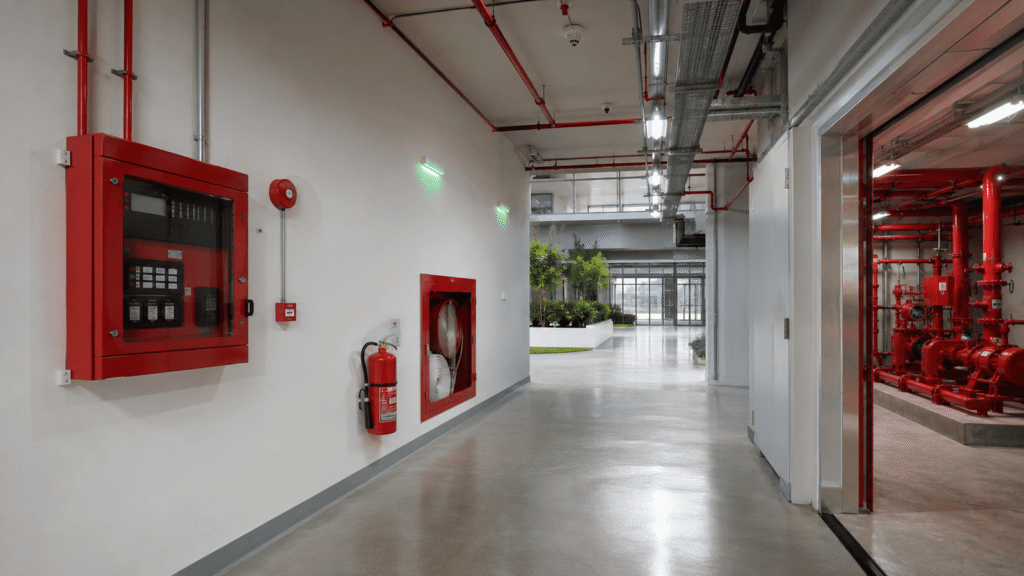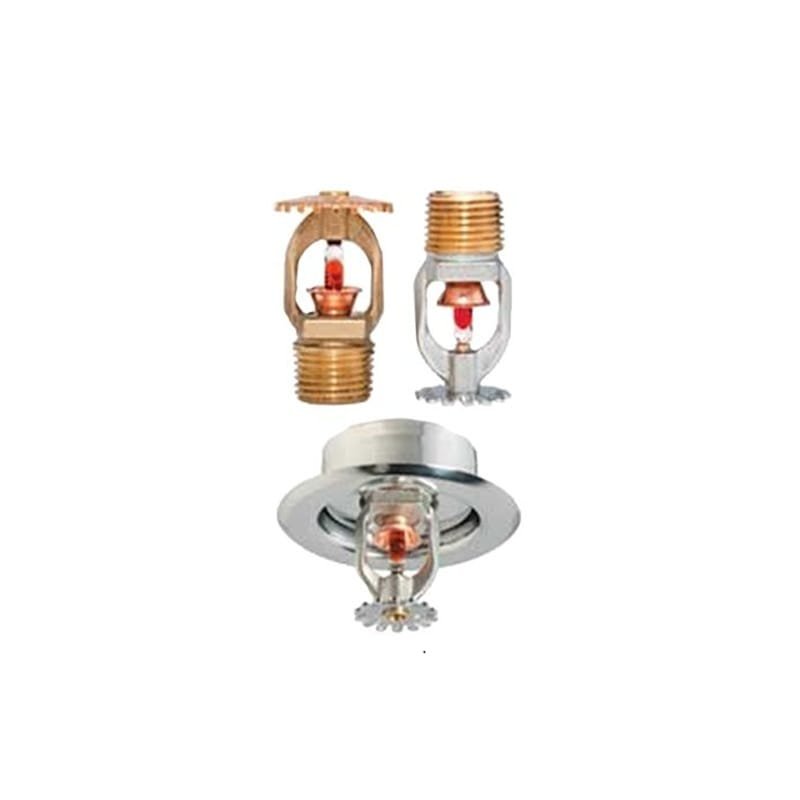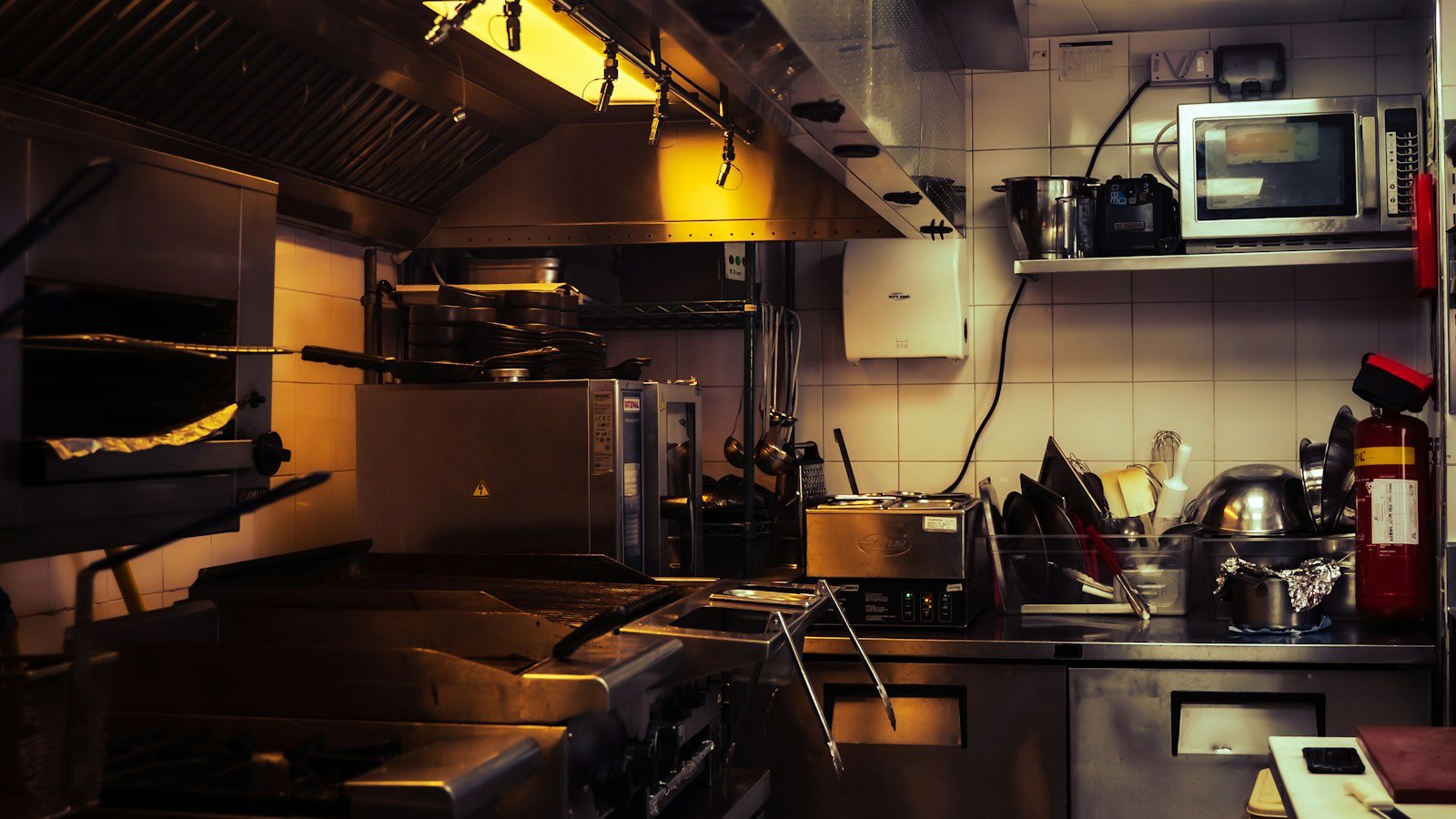
A commercial kitchen fire suppression system is a pre-engineered wet chemical system fixed above the cooking line. It detects fire in the hood, plenum, exhaust duct or appliances, discharges agent through nozzles aimed at each hazard, and shuts off gas or electric power to the protected equipment. NFPA 96, the National Fire Protection Association (NFPA) standard for commercial cooking operations, makes such automatic systems the primary protection, with portable extinguishers as backup.
Key takeaways
- NFPA 96 requires automatic extinguishing systems as primary protection for commercial cooking, with portable extinguishers as secondary backup.
- NFPA 96 calls for UL 300 (in effect since November 1994) or an equivalent standard, and the 2027 edition of NFPA 17A requires listing to both UL 300 and UL 1254.
- The International Fire Code (IFC) model requires discharge to shut off fuel or power automatically, and NFPA 96 requires it to actuate any building fire alarm.
- A Class K extinguisher within 30 ft (9.1 m) of the cooking hazard is a backup, never a substitute.
- Semiannual service, fusible link replacement and exhaust cleaning by cooking volume keep the system ready.
In this article
- How a kitchen suppression system works
- Why UL 300 matters
- Standards that apply to a commercial kitchen
- Interlocks: gas, power, exhaust and fire alarm
- Step-by-step: design, installation and acceptance
- Class K extinguishers and staff training
- Inspection, maintenance and hood cleaning
- Common mistakes and what drives cost
- How AZEIDK helps
- FAQ
How a kitchen suppression system works
The system has an agent cylinder, piping with nozzles aimed at the hood, plenum, duct and each appliance, a detection line of fusible links or heat detectors, a mechanical or electrical release, a remote manual pull station, and shut-off devices for gas and power.
When detection operates, agent discharges onto the cooking surfaces and into the plenum and duct while fuel and power shut off. The alkaline agent reacts with hot fat to form a soapy blanket that cuts off oxygen, a process called saponification. NFPA 17A requires every protected appliance, hood and branch duct to be covered by systems designed to operate together. Heat detectors suit the kitchen space itself, as our fire detector selection guide explains.
Why UL 300 matters
Older dry chemical agents formed the soapy layer with animal fats, but kitchens changed. Most commercial kitchens now fry in vegetable oils, which have less fat and burn hotter, so that layer breaks down, and insulated fryers hold heat longer. UL 300, the fire test standard for systems protecting commercial cooking equipment, took effect on 21 November 1994.
NFPA 96 (2027 edition) requires automatic systems to be listed to UL 1254 and UL 300 or equivalent standards and installed per their listing, and the 2027 edition of NFPA 17A requires wet chemical cooking systems to be listed and to meet both UL 1254 and UL 300. Where an old dry chemical system remains, or appliances or oils change, consider a UL 300 system.
Standards that apply to a commercial kitchen
| Standard | What it covers | Key points for owners |
|---|---|---|
| NFPA 96 (current edition 2027) | Ventilation control and fire protection of commercial cooking operations | Automatic system as primary protection; alarm connection; actuation tests; exhaust inspection and cleaning |
| NFPA 17A (current edition 2027) | Pre-engineered wet chemical extinguishing systems | Listing to UL 1254 and UL 300; installation by trained persons; inspection and maintenance |
| NFPA 10 | Portable fire extinguishers | Class K units within 30 ft (9.1 m) of the hazard |
The NFPA pages for NFPA 96 and NFPA 17A list 2027 as the current edition of both; in Saudi Arabia, the Saudi Fire Protection Code (SBC 801) and Civil Defense set the requirements and editions. As model-code text, the 2018 IFC, as published on ICC Digital Codes, places the manual actuation device near a means of egress, 10 to 20 ft (3 to 6 m) from the exhaust system and 42 to 48 in. (1,067 to 1,200 mm) above the floor, and requires automatic fuel or power shut-off with manual reset. For hotel kitchens, see our hotel fire safety guide.
Interlocks: gas, power, exhaust and fire alarm
NFPA 17A defines shut-off devices as devices that operate with the system to cut fuel and power to the protected equipment and other equipment that must stop. Its deficiency table lists inoperable shut-off devices. Gas is usually shut by a mechanical or electrical valve, and electric appliances by an electrical shutdown.
Where a fire alarm system serves the building, NFPA 96 (Section 10.6.2 in the 2024 edition) and NFPA 17A require actuation of the suppression system to actuate it, and the 2027 edition of NFPA 17A has that connection’s signal verified at maintenance.
Exhaust and make-up air need a decision: NFPA 17A’s deficiency table lists an exhaust fan that does not run, unless a listed ventilation component or the system design requires shutdown, and make-up air that does not shut off. Confirm the arrangement in the listed design manual and test it at commissioning.
Step-by-step: design, installation and acceptance
- List every appliance, its size, position and cooking medium, plus the hood, plenum and duct layout.
- Choose a system listed to UL 300 and UL 1254 whose listed manual covers those appliances.
- Use installers trained and qualified for that system; NFPA 17A requires them to certify to the authority having jurisdiction (AHJ) that the installation complies with the listing and the manufacturer’s instructions.
- Use fusible links or heat detectors rated as the manual specifies.
- Place at least one labeled manual actuation device, with instructions, in a means of egress or a location the AHJ accepts, as NFPA 96 requires.
- Interlock the gas valve, electrical shutdown, make-up air and fire alarm.
- Provide a Class K extinguisher with its placard.
- At acceptance, test detection, manual release, shut-off devices and alarm signals per the manufacturer, and keep the records.
Class K extinguishers and staff training
A Class K extinguisher is for fires in cooking oils in commercial cooking equipment and, per NFPA 10, should be no more than 30 ft (9.1 m) from the hazard. It backs up the fixed system: where the cooking hazard has an automatic system, NFPA 10 requires a placard near the extinguisher stating that the fire protection system shall be actuated first, and NFPA 96 repeats this for mobile and temporary cooking. See our NFPA 10 extinguisher guide.
NFPA 17A (2027 edition) adds staff training to its inspection items. As good practice, every shift should know the pull station, the gas valve and the way out.
Inspection, maintenance and hood cleaning
The 2021 editions of NFPA 96 and NFPA 17A set the routine: a monthly check by the owner, inspection and service every six months by a trained and certified person, and replacement of fusible metal-alloy links at least semiannually. NFPA 96 also requires all actuation and control components, including remote pull stations, detectors and actuators, to be tested at that inspection per the manufacturer’s procedures.
The 2027 NFPA 17A inspection list includes unobstructed manual actuators, intact seals, the maintenance tag, gauges in range, intact nozzle caps, and no change in the hazard, such as replaced or relocated appliances. Until a fault that could impair the system is repaired, it is tagged as impaired and the owner and AHJ are notified by the end of the next business day.
| Cooking type (NFPA 96, 2021 edition) | Exhaust inspection for grease buildup |
|---|---|
| Solid fuel cooking | Monthly |
| High-volume cooking (24-hour, charbroiling, wok) | Quarterly |
| Moderate-volume cooking | Semiannually |
| Low-volume cooking, such as seasonal businesses | Annually |
Contaminated hoods, ducts and fans are cleaned to bare metal by a trained, qualified and certified company. NFPA 96 measures with a grease depth gauge comb: 2,000 µm (0.078 in.) calls for cleaning, or 3,175 µm (0.125 in.) in a fan housing.
Common mistakes and what drives cost
- A fryer or griddle added or moved under the hood without re-checking nozzles.
- Nozzles clogged with grease or caps missing.
- A gas valve not interlocked, or the manual reset bypassed.
- Fusible links never replaced, and hood cleaning postponed.
- A dry chemical extinguisher instead of Class K, or a blocked pull station.
Cost follows the number and length of hoods, appliances and duct runs protected, agent capacity, interlocks, the alarm connection, and recurring service and cleaning.
How AZEIDK helps
AZEIDK supplies the kitchen systems listed on its products page through its technical supply service, with Civil Defense approval support and annual maintenance contracts that include periodic inspections and functional tests.
| Brand and system | As AZEIDK’s product page describes it |
|---|---|
| ANSUL R-102 restaurant system | Pre-engineered wet chemical system for hoods, ducts, plenums and appliances; fusible link detection; options for alarm interface, electrical shutdown and gas shut-off |
| Hood Safer system (HS-4, HS-8, HS-16) | Pre-engineered wet chemical system; heat detectors; remote pull station; optional gas shut-off valve |
| American Fire Control (AFC) kitchen system | Wet chemical, fixed nozzles; automatic with manual pull station; energy or gas shut-off by design; 7.5 to 27.5 L |
| Falcon Gold kitchen hood system | Wet chemical cylinder with fixed nozzles; heat detector or manual release; 15 L and 25 L capacities |
Each system follows its manufacturer’s manual, and certifications differ: our Hood Safer page, for example, reports certification to the European standard BS EN 17446, and we found no published UL 300 listing for that system. We recommend verifying each model’s listing or certification and confirming that the project specification accepts it.
FAQ
Do restaurants in Saudi Arabia need a kitchen suppression system?
SBC 801 and Civil Defense set the requirement. NFPA 96 makes the automatic system the primary protection for commercial cooking, so restaurants, hotels, hospitals and food courts with commercial cooking normally need one for each hood. Confirm with your consultant.
What does UL 300 mean?
It is a fire test standard for systems protecting commercial cooking equipment, in effect since 21 November 1994. NFPA 96 requires automatic systems to comply with it or an equivalent standard, and NFPA 17A (2027) adds listing to UL 1254, so ask for proof of listing for the exact model.
Can sprinklers protect a hood instead of wet chemical?
The model fire code accepts other listed types, such as sprinklers, water mist or dry chemical, each to its own standard, and fryer sprinklers must be listed to UL 199E. The design, listing and AHJ decide; such sprinklers have annual maintenance under NFPA 25.
How often must a kitchen suppression system be serviced?
Per the 2021 editions of NFPA 96 and NFPA 17A: a monthly owner check, and inspection and service every six months by a trained and certified person, including fusible link replacement and testing of actuation and control components. The exhaust system is inspected monthly to annually depending on cooking volume.
Do I still need a Class K extinguisher if the hood has a system?
Yes. NFPA 96 makes portable extinguishers the backup to the automatic system, and a Class K unit sits within 30 ft (9.1 m) of the cooking hazard with a placard reminding staff to activate the system first. Class K units, not dry chemical ones, are specified for cooking oil fires.
Fitting out a commercial kitchen or reviewing an existing system? Send us the kitchen layout and appliance list, and our engineers will review the right system and its gas, power and alarm interlocks. Contact the AZEIDK team