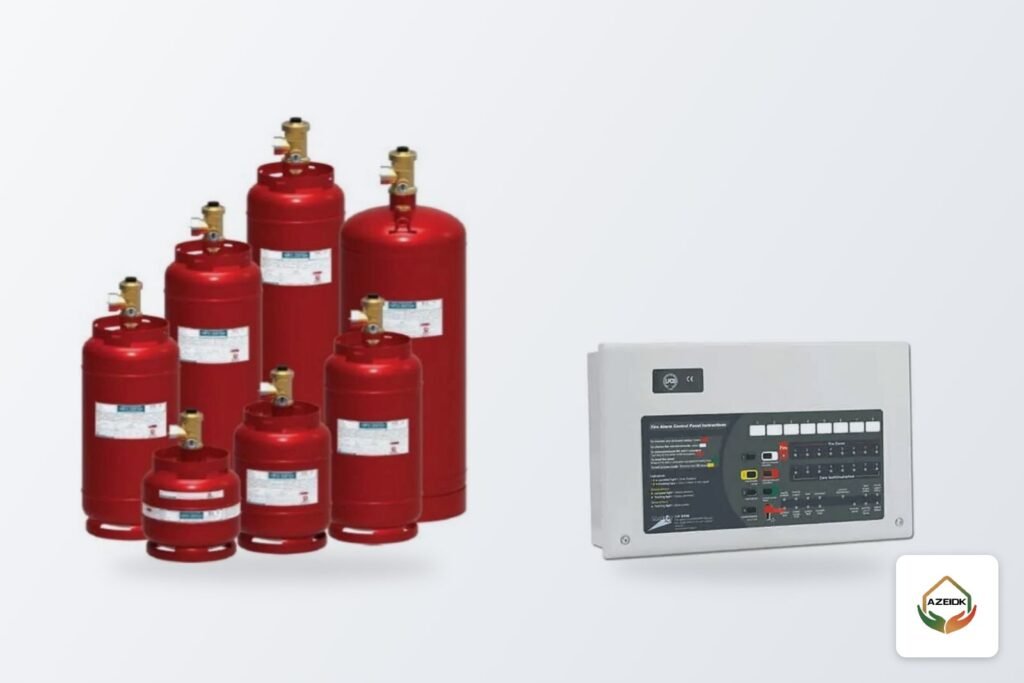
Many people ask for the price of an FM-200 system for an electrical or server room before the room has been measured. A clean agent system is not priced per square metre: the cost is built from the volume of each protected space, the design concentration, the number of cylinders, the detection and release method, room tightness, and then maintenance and recharge over the system life. This guide explains those factors without price figures, and how to request a quotation you can compare.
AZEIDK Egypt supplies the AFC-227 system from American Fire Control under special fire suppression, with submittals, supply, installation, testing and maintenance.
Key points
- The first cost driver is agent quantity, calculated from the net volume of each space, the concentration and the lowest temperature, not from floor area.
- Raised floor and ceiling voids are calculated as separate spaces and add agent and nozzles.
- A complete quotation states the model, cylinders, detection, release panel, room integrity test and documents explicitly.
In this article
1. Protected volume and agent quantity
Agent mass in kg equals net volume divided by the specific vapour volume, multiplied by concentration over (100 minus concentration), with the specific volume taken at the lowest expected room temperature. Two rooms with the same area but different heights therefore need different quantities. Details and a worked example are in clean agent quantity calculation.
If the room has a raised floor or a ceiling void carrying cables, each space is calculated by its own volume, the quantities are added and each space needs its own nozzles. Most Egyptian cities are close to sea level, so the altitude factor is about 1.00; elevated sites are corrected.
2. Cylinders, count and system type
AFC-227 cylinders range from 26.8 litres water capacity (AFC-26) to 175 litres (AFC-175); the calculated quantity sets the number and size of cylinders. Where pipe runs are long or complex, the AFC-P227 model with a separate nitrogen pusher cylinder may be needed, starting from AFC-P63, as decided by the hydraulic calculation report. See the AFC-227 / P227 system.
Where several adjacent rooms are protected, they may share the same cylinders through selector valves that direct the agent to the room that sent the release signal. That changes the sum: cylinders sized for the largest room, plus extra valves and pipework.
3. Detection and the release control panel
The system does not work without detection and release: detectors in each space, a release control panel, pre-alarm devices, a manual release button, and signs. The release sequence and its devices are a separate line in the quotation, with the model stated and whether it is linked to the building fire alarm. See clean agent fire suppression.
4. Room tightness and the door fan test
Gas cannot protect a room that leaks air. The room integrity test measures leakage and predicts how long the room holds the concentration without discharging any agent; if the room fails, openings are sealed, doors and dampers adjusted and the test repeated. The test and sealing works may sit with the contractor or the owner, so define this in the quotation. See room integrity testing.
5. Approvals and documents
Most AFC-227 components are UL and FM approved, with exceptions such as the optional discharge pressure switch and the instruction signs, so check each part on its sheet. The submittal for the consultant, the calculation report and the drawings are all part of the scope and should appear in the quotation. See fire equipment technical documents.
6. Cost over the system life
After installation there are recurring costs: cylinder weighing and pressure checks at least every six months under NFPA 2001, release sequence testing without discharge, and refilling a cylinder when agent loss exceeds 5%. After any discharge the cylinders are removed and transported for filling, and a cylinder whose last hydrostatic test is more than 5 years old is not refilled before it is tested. See FM-200 system maintenance and recharge after discharge.
How to request a comparable quotation
- Dimensions of each room and the raised floor and ceiling void heights, plus the lowest expected temperature.
- The number of rooms and whether they should share one system with selector valves.
- The type of protected equipment and whether the room is occupied.
- The condition of doors, openings and dampers, and whether the integrity test is in scope.
- The reference required by the specification and the component approvals.
Then compare quotations line by line: the same calculated quantity, the same number and model of cylinders, and the same scope of detection, release, testing and documents, as in the fire system quotation comparison guide.
Frequently asked questions
Can the price of an FM-200 system be known from room area?
Not accurately. The cost follows the net volume of each space, the concentration and the minimum temperature, then cylinder count, detection and release, and the integrity test.
Is CO2 a cheaper alternative?
Prices may differ, but CO2 concentrations are lethal in occupied spaces, so it is not a like-for-like alternative in a room staff enter. The design decides by hazard and occupancy.
Does AZEIDK Egypt publish a price list for gas systems?
No. Each system is priced after the quantity is calculated for each space and the scope is defined; the AZEIDK Egypt team quotes once it has the room data.
Summary
The cost of an FM-200 or AFC-227 system in Egypt is built from a calculated agent quantity for each space, the number and size of cylinders, the detection and release method, room tightness and its test, and the documents, then maintenance and recharge. Ask for a quotation built on these lines so that you compare like with like.
Want a quotation for a gas suppression system? Send the room dimensions, the raised and suspended voids and the type of equipment, and the AZEIDK Egypt team will calculate the quantity and propose an AFC-227 system with datasheets. Request a quotation from AZEIDK Egypt
Related guides
- Residential Building Fire Protection in Egypt: Common Areas and Upkeep
- Fire Protection Terms in the Egyptian Market and Their English Equivalents in the BOQ and Datasheet
- Context Plus Fire Alarm Systems in Egypt: Panels, Detectors and Sounders
- Fire Protection for Schools and Universities in Egypt: Alarm, Extinguishers, Labs and Maintenance