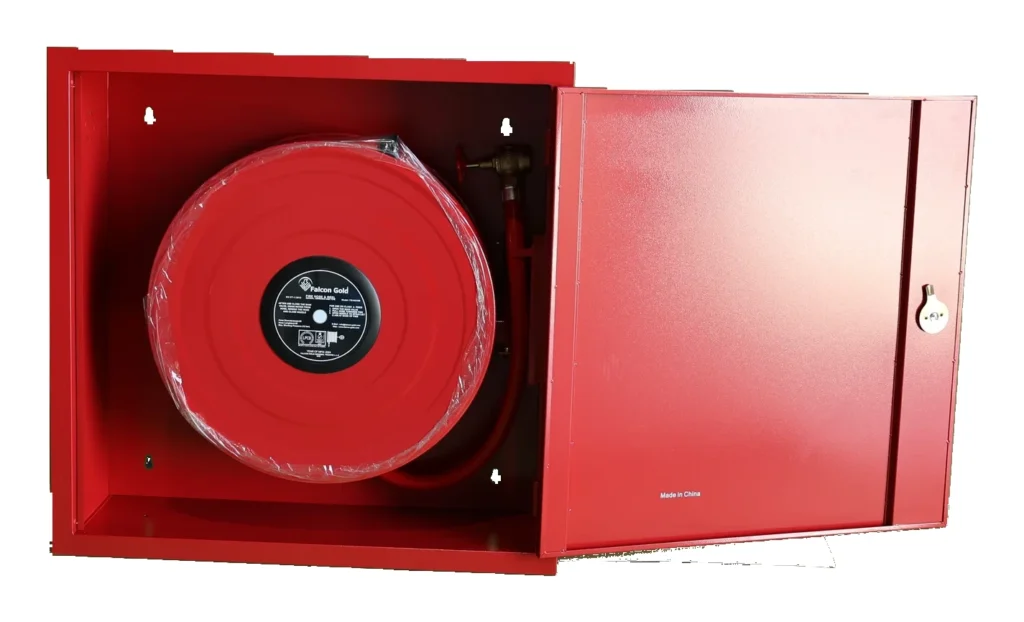
On Egyptian sites, people say fire hose about two different things: the semi-rigid hose wound on the reel inside the fire hose cabinet, and the fabric lay-flat hose that must be fully run out before the water is turned on. The length can be the same: the Falcon Gold reel hose is 30 m, and 30 m is also one of the lay-flat lengths. But who uses them, how they are pulled out and how they are operated are not the same.
Below are the figures from the Falcon Gold component submittal on the AZEIDK Egypt website, plus couplings, nozzle, inspection, storage, replacement and buyer checks.
Key takeaways
- The Falcon Gold semi-rigid reel hose is 25 mm by 30 m, with a maximum working pressure of 12 bar and an average burst pressure of up to 45 bar.
- The same submittal lists lay-flat hose in 1.5 in (38 mm) and 2.5 in (65 mm), in lengths including 15, 23, 30 and 45 m, with an EPDM lining, a woven polyester jacket and aluminium or copper couplings fitted at both ends.
- Reel hose is meant for building occupants and works while still partly wound. Lay-flat hose must be fully run out before the valve is opened, and the submittal notes it is typically used by the fire service.
- Do not add length by joining two hoses. The number and position of cabinets come from the approved design.
- After every use: close the valve, drain the hose, rewind it and close the nozzle.
In this article
- Two products, one name: reel hose and lay-flat hose
- The difference in figures
- 30 m fire hose: why this length, and its limits
- Working pressure: what 12 bar means on site
- Couplings, valve and nozzle
- Fire hose inspection: what to look at
- Storage after use
- When to replace a fire hose
- What buyers in Egypt should check before supply
- Common mistakes
- Frequently asked questions
- Summary
Two products, one name: reel hose and lay-flat hose
Semi-rigid reel hose
Its reinforced wall keeps a round shape even when empty, so water flows while the hose is still partly on the reel. A guard or resident can pull out what they need and start at once. EN 671-1 sets the requirements for hose reels with semi-rigid hose installed in buildings and permanently connected to a water supply, and states that they are for use by the occupants, whether manual or automatic.
Lay-flat hose
It folds flat when empty, and water only flows properly once it is fully run out with no kinks. The Falcon Gold submittal says it is typically used by the fire service to carry large quantities of high-pressure water. Because it pushes hard when the valve opens, it is for trained users, not ordinary occupants. In the same European series, Part 2, EN 671-2:2012, covers hose systems with lay-flat hose.
What AZEIDK Egypt supplies from Falcon Gold is the red single-door fire hose cabinet with its components: the semi-rigid hose reel, hose, nozzle and valve. We cover lay-flat hose here for comparison, because it appears in the same submittal and because the everyday name mixes up the two types. For the cabinet itself and its types, see our fire hose cabinets article; for reel details and installation, see Falcon Gold fire hose reels and hoses. Here we focus on the hose.
The difference in figures
The figures and materials below come from the Falcon Gold component submittal:
| Item | Semi-rigid reel hose | Lay-flat hose |
|---|---|---|
| Size | 25 mm | 1.5 in (38 mm) or 2.5 in (65 mm), other sizes available |
| Length | 30 m | 15, 23, 30 or 45 m, other lengths available |
| Maximum working pressure | 12 bar | Not stated here; take it from the datasheet of the supplied product |
| Burst pressure | Average up to 45 bar | Take it from the datasheet of the supplied product |
| Construction | Anti-ageing, UV-resistant hose | EPDM lining, circular-woven high-tenacity polyester jacket |
| Connection | Full brass waterway, nipples instead of hose clamps | Aluminium or copper couplings (BS 336 or Storz) pre-fitted at both ends |
| How it is used | Works while partly wound | Fully run out before water is turned on |
| User | Occupants, first response | Fire service and trained persons |
30 m fire hose: why this length, and its limits
30 m is the reel hose length in the Falcon Gold submittal, and it is also one of the lay-flat lengths listed. Length alone does not decide coverage. The number and position of fire hose cabinets come from the design under the Egyptian Code for the Design and Implementation of Fire Protection for Buildings, 2026 edition (Ministerial Decree No. 355 of 2026), and the drawings approved by the General Directorate of Civil Protection (Ministry of Interior).
- Measure along the real walking route, not a straight line on the drawing. In a factory in 10th of Ramadan or 6th of October, racks and machines block the way; in a mall, kiosks and partitions added after handover do the same.
- Do not join a second hose or fit a longer one without the designer’s review. Longer hose means more friction loss, and the reel is built for a set length.
In a residential tower the same cabinet layout repeats on every floor. If the flat or corridor layout changes on one floor, check hose reach on that floor specifically.
Working pressure: what 12 bar means on site
12 bar is the maximum working pressure of the reel hose in the submittal. 45 bar is the average burst pressure in testing, a safety margin, not a figure to work to. What matters is the actual pressure at each cabinet:
- In tall buildings, lower floors see higher pressure. The designer checks that no cabinet exceeds the hose, valve and reel rating, and adds pressure reduction where needed.
- If the pre-handover hydrostatic test pressure is above the hose rating, isolate the reels at their valves, as the manufacturer and designer instruct.
- Do not accept lay-flat hose without a written figure. We do not quote lay-flat pressures here, so ask for working and test pressure in writing on the datasheet of the supplied product before approval.
Couplings, valve and nozzle
Angle valve
The reel is fed from a 1.5 x 1 in angle valve (model A-4), as listed in the reel parts list of the submittal.
Hose-to-reel connection
The reel waterway is full brass, and the hose is fixed with nipples and a crimped sleeve rather than hose clamps. So a leak at the reel hub usually points to fitting or tightening, not to the hose itself. For reel tests and dimensions, see our Falcon Gold fire hose reels article.
Lay-flat couplings
Aluminium or copper couplings are pre-fitted at both ends, bound with galvanised steel wire under a hose guard. Before supply, match the coupling type to the valve outlet on the project; a coupling that does not fit the outlet means a hose that cannot be used.
N-04-2 nozzle
The reel nozzle in the submittal adjusts between straight jet and spray, and is closed after every use. A jet reaches further; spray covers a wider area at closer range. Never direct water at live electrical equipment or panels.
Fire hose inspection: what to look at
EN 671-3 covers inspection and maintenance of hose reels with semi-rigid hose and lay-flat hose systems in all types of buildings. Intervals come from the manufacturer, the project standard and Civil Protection requirements, not from a legal frequency we can state here. Practical checks:
- Pull out the full hose and check its whole length for cracks, bulges, surface wear, sun cracking or a kink that does not recover.
- Open the valve with the nozzle closed, and watch the joint at the reel hub and at the nozzle.
- Try every nozzle setting and make sure it shuts off fully.
- Turn and swing the reel. It should move smoothly, without rubbing or noise.
- Open and close the angle valve and check that it moves easily without leaking.
- For lay-flat hose: run it out, check the jacket, the lining visible at the ends, the couplings and the binding wire, then fold or roll it so the folds fall in different places from last time.
- Record the date, findings and technician’s name in the cabinet log.
Storage after use
The submittal gives the steps after use: close the valve, drain the hose, rewind it, then close the nozzle. Good practice also includes:
- Dry lay-flat hose before folding; a wet folded jacket rots.
- Keep hose away from heat and direct sun, especially in cabinets near glass facades or under factory roofs.
- Even though the manufacturer says the reel can also be used for cleaning, daily washing of car parks and floors wears the hose and nozzle and often leaves the hose badly rewound when it is really needed.
- Keep the cabinet door clear and never store anything on top of the hose.
When to replace a fire hose
The Falcon Gold submittal gives no service life for the hose, so replacement depends on condition. Replace the hose if you see any of the following:
- A leak from the hose body, not the coupling.
- A bulge, or a cut that shows the reinforcement.
- Hose slipping off the nipple, a damaged coupling, or a permanent kink in semi-rigid hose that blocks flow.
- Rot or tears in a lay-flat jacket.
- Exposure to fire or chemicals.
The replacement must match size, length and pressure rating, fit the reel connections and come with a datasheet. An unbranded hose from the market may fit the reel and then burst at the first real pressure.
What buyers in Egypt should check before supply
- Datasheet size, length and working pressure (25 mm, 30 m, 12 bar for the fire hose reel) against the expected cabinet pressure.
- Written datasheet pressure figures for lay-flat hose, if it is in the project specification.
- The lay-flat coupling type and its match to the valve outlets.
- Nozzle type and angle valve size.
- The submittal, for the consultant and the Civil Protection file.
AZEIDK Egypt supplies red single-door Falcon Gold fire hose cabinets, manufactured locally with genuine Falcon Gold components supplied from Dubai: reel, hose, nozzle and valve. They are part of our fire fighting systems offering. For the full network installation sequence up to the cabinets, see fire fighting network installation.
Common mistakes
- Opening the water before a lay-flat hose is run out, so it kinks and flow stops.
- Joining two hoses to reach a far spot instead of reviewing the cabinet layout.
- Fitting a replacement hose from the market with a lower rating or no datasheet.
- Leaving the nozzle open after use, so water sprays uncontrolled the next time the valve is opened.
- Rewinding the hose wet or storing it in direct sun.
- Testing the network above the hose rating without isolating the reels.
- Directing water at live electrical wiring or panels.
Frequently asked questions
What is the difference between a fire hose reel and a lay-flat hose?
Reel hose is semi-rigid, works while partly wound and is meant for occupants. Lay-flat hose is fully run out first, carries more water and is typically used by the fire service and trained users.
Is 30 m the only fire hose length?
In the Falcon Gold submittal, the 25 mm reel hose is 30 m long, while lay-flat hose is listed in lengths including 15, 23, 30 and 45 m. The required length comes from the approved design.
What is the working pressure of a fire hose reel hose?
The maximum working pressure of the Falcon Gold reel hose is 12 bar, with an average burst pressure of up to 45 bar.
Can a leaking fire hose be repaired?
If the leak is at the coupling, refitting it correctly may be enough. A leak or bulge in the hose body is a reason to replace it with a hose of the same specification.
How often should a fire hose be inspected?
EN 671-3 covers inspection and maintenance of reels and lay-flat hose. Intervals come from the manufacturer’s instructions, the standard adopted for the project and Civil Protection requirements.
Summary
Choosing a fire hose starts with one question: who will use it? The 25 mm semi-rigid reel hose is for first response by occupants; lay-flat hose is for the fire service and people trained to handle it. Then check length along the walking route, pressure at each cabinet against 12 bar, and coupling type, and keep the hose inspected and properly stored.
Need hoses and reels for a project, or a replacement for a damaged hose? Send us the number of cabinets and the hose type you need, and we will send the Falcon Gold component submittal. Talk to the AZEIDK Egypt team
Related guides
- PYRAMID CO2 Extinguishers: Sizes and Use in Electrical and Server Rooms
- Car Fire Extinguisher in Egypt: Traffic Law Rules by Vehicle Type
- Food Court Kitchen Fire Suppression in Egyptian Malls: Per-Unit Systems, Alarm Link and Gas Shutoff
- Fire Extinguishers for Poultry Farms in Egypt: Brooders, Gas, Feed Stores and Panel Rooms