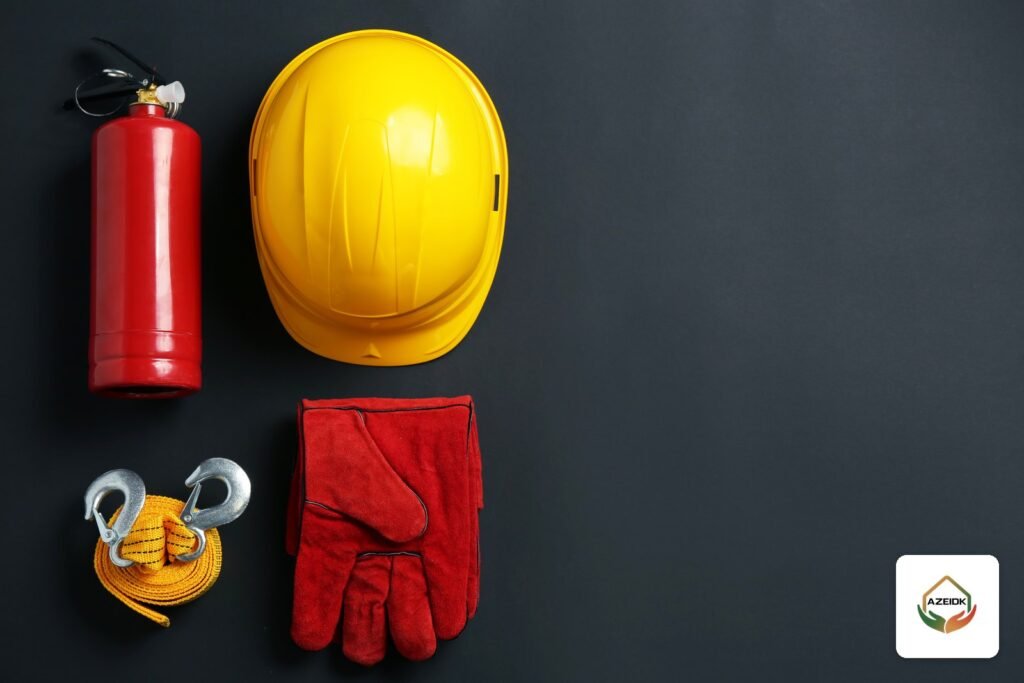
Safety and security tools for a shop, office or warehouse fall into five groups: firefighting tools (extinguishers and hose cabinets), detection and alarm, evacuation (emergency lighting and exit signs), personal protective equipment and first aid boxes, and electrical and gas safety. Which ones you actually need depends on the activity, floor area and hazards, and is checked against Civil Defense requirements on the Salamah platform. The items we stock are in AZEIDK’s safety equipment section.
This guide is written for commercial premises, offices and warehouses, not homes. If you are equipping a house, see home safety tools every house should have. Below, the tools are grouped by category, with when each one is needed and links to the detailed guides.
For the full picture of the fire and security systems malls and retail shops need and the Civil Defense requirements that apply, see our safety systems guide for malls and retail shops.
Key takeaways
- There is no single safety tools list for every facility. The Saudi Fire Protection Code SBC 801 is the binding reference, and each activity’s requirements appear when it is licensed on Salamah.
- The Saudi Labor Law requires employers to take fire precautions, provide suitable personal protective equipment and keep one or more first aid cabinets.
- Extinguisher type follows the hazard: dry powder for general use, CO2 near electrical panels, wet chemical where oil is used for frying.
- Emergency lighting and illuminated exit signs keep the way out visible when the power fails.
In this article
- What are the essential safety and security tools in a facility?
- Who decides which safety tools your facility needs?
- 1. Firefighting tools: extinguishers and hose cabinets
- 2. Detection and alarm
- 3. Evacuation tools: emergency lighting and exit signs
- 4. Personal protective equipment and first aid boxes
- 5. Electrical and gas safety tools
- 6. Security tools: surveillance and intrusion alarms
- When is each tool needed? Start from the hazard in your facility
- Inspecting and maintaining safety tools
- Safety and security tools at AZEIDK
- Frequently asked questions
- Conclusion
What are the essential safety and security tools in a facility?
People call them safety tools, safety and security equipment or “Civil Defense supplies”. The table groups the five categories, plus security, and shows when each is usually needed:
| Category | Typical tools | Usually needed | Details |
|---|---|---|---|
| Firefighting | Extinguishers of each type, extinguisher cabinets, fire hose cabinets | Extinguishers in almost every facility; hose cabinets where the building has a fire water network | Fire extinguishers section |
| Detection and alarm | Detectors, manual call points (break glass), sounders, alarm panel | As set by occupancy and area in the approved design | Fire alarm systems |
| Evacuation | Emergency luminaires, illuminated exit signs, rechargeable portable lights | Exit routes, corridors and stairs | Emergency and exit lighting section |
| PPE and first aid | Safety shoes, high-visibility vest, first aid box | Wherever people are employed, more as work hazards increase | PPE guide |
| Electrical and gas | CO2 extinguishers by panels, automatic ceiling extinguishers, kitchen hood suppression | Electrical and server rooms, commercial kitchens | CO detection section |
| Security | CCTV cameras, intrusion alarms | Depending on the business and the value of contents | Security and surveillance |
For firefighting equipment specifically, with a table by facility type, see the fire safety equipment list for facilities.
Who decides which safety tools your facility needs?
Requirements come from several sources, each with its own angle:
- Saudi Fire Protection Code SBC 801: the binding technical reference for fire protection systems and equipment. The 2024 edition of the Saudi Building Code has been mandatory since 30 June 2025.
- Civil Defense and Salamah: facility licensing runs through the platform, and safety requirements vary with activity, area and hazard level.
- Labor Law: Article 122 requires employers to take the precautions needed to protect workers from work hazards; Article 123 requires suitable personal protective equipment; Article 125 requires fire prevention precautions and technical means to fight fire; Article 142 requires one or more first aid cabinets.
- Municipal requirements per activity: some Ministry of Municipalities and Housing guides name specific items. The requirements for building materials shops, for example, call for a first aid box, safety equipment for workers such as gloves, shoes and helmets, and Civil Defense approval before the licence is issued.
A ready-made “safety kit” is therefore not enough; start from your activity’s requirements. For shops, see retail shop safety requirements.
1. Firefighting tools: extinguishers and hose cabinets
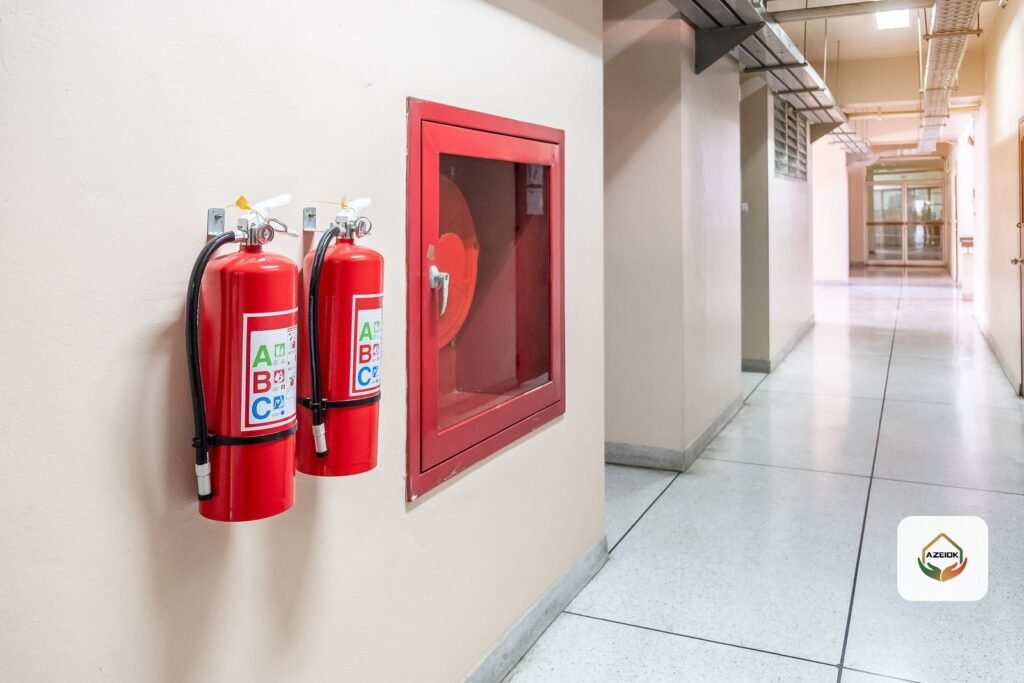
The portable extinguisher is the first safety tool in any facility because it deals with a fire in its first minutes. The wrong one can be useless or dangerous: water and foam must not be used on live electrical equipment.
Extinguisher types available from AZEIDK
- Dry powder: Falcon Gold 1 kg and 6 kg units for general use, and a 50 kg wheeled unit for large warehouses and workshops. An automatic ceiling-mounted powder extinguisher is also available.
- Carbon dioxide (CO2): 2, 6 and 10 kg, suited to electrical panels and equipment because it leaves no residue.
- Foam: Falcon Gold 25 L, for flammable liquids in workshops and stores.
- Wet chemical: 6 kg, for commercial kitchens using cooking oil.
The number and placement of extinguishers are calculated in the design under SBC 801, with NFPA 10 as the technical reference. The full range and sizes are in the fire extinguishers section.
Fire hose cabinets and extinguisher cabinets
A fire hose cabinet holds the hose reel and valve and is installed where there is a fire water network. An extinguisher cabinet protects the extinguisher and keeps it visible. AZEIDK supplies Falcon Gold single and double-door cabinets in mild steel and stainless steel.
2. Detection and alarm
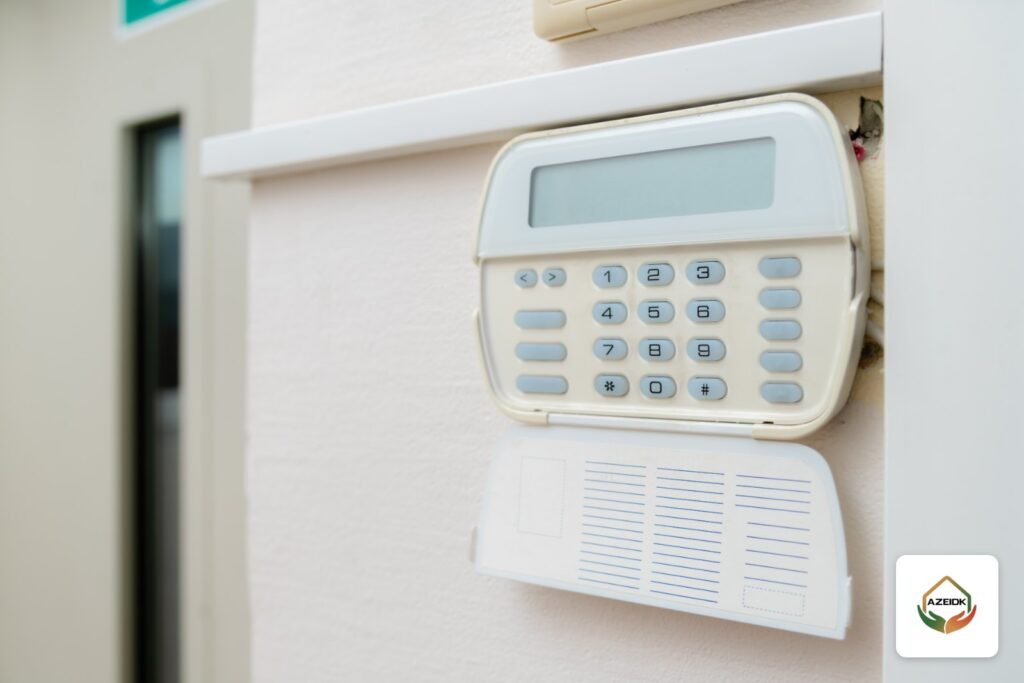
An extinguisher is no help if nobody knows there is a fire. Alarm comes first: a detector senses smoke or heat, a manual call point lets the first person who sees the fire raise the alarm, sounders warn occupants, and a panel collects the signals.
- Shops and small offices: often served by a conventional system with a few zones, such as Context Plus FP panels.
- Larger buildings and long warehouses: designs tend to use addressable systems that show the location of each device on the panel.
- Manual call points and sounders: placed at exits and along escape routes.
If a shop sits inside a mall with a fire alarm system, the detectors in its ceiling belong to the building system and must not be removed or covered during fit-out.
3. Evacuation tools: emergency lighting and exit signs
During a fire the power often fails and corridors fill with smoke. Emergency luminaires then run on their batteries and illuminated exit signs point to the door.
AZEIDK stocks KHIND, Alrouf and LIFECO products: twin-head emergency lights, bulkhead luminaires, illuminated exit signs including a bilingual Arabic and English sign, and rechargeable portable lights. Duration and IP rating vary by model and are listed on each product page in the emergency and exit lighting section.
An evacuation plan is a document prepared for the facility, not a product you buy.
4. Personal protective equipment and first aid boxes
If you employ people in a warehouse, workshop or loading area, the obligations go beyond fire. The Labor Law requires employers to provide PPE suited to the work and to keep one or more first aid cabinets.
AZEIDK supplies in this category:
- Coverguard professional safety shoes and high-visibility vest: for warehouses, loading bays and areas with forklift traffic.
- Coverguard bump cap: protects against light knocks only, such as a low shelf or pipe. It is not a substitute for an industrial helmet where objects can fall.
- Professional workwear for workers.
- Falcon Gold first aid boxes: in three sizes, small H-323, medium H-324 and large H-325.
Contents and which size suits your headcount are covered in the first aid box guide.
5. Electrical and gas safety tools
Many shop and office fires start at an overloaded panel or temporary wiring. Tools here are of two kinds: those that extinguish without damaging equipment, and those that work on their own in rooms nobody enters.
- CO2 extinguishers by electrical panels and server rooms: non-conductive and residue-free. Discharging one in a small closed room lowers the oxygen level, so leave and ventilate afterwards.
- Automatic ceiling extinguishers: heat-activated, suited to small electrical rooms and closed stores, with a limit on the area each unit covers.
- Commercial kitchens: a wet chemical extinguisher by the fryers and a hood suppression system where required.
- Enclosed car parks and basements: carbon monoxide detectors that monitor exhaust fumes and start ventilation, including the Honeywell Farenhyt IDP-CO addressable detector, the Komttech VSO-800 detector and the VCO800 panel.
6. Security tools: surveillance and intrusion alarms
The “security” half of the phrase covers protecting the premises and their contents. Shops and warehouses use CCTV to cover entrances, tills and loading docks, and intrusion alarms to secure the site after hours. AZEIDK supplies Hikvision, Dahua and EZVIZ cameras and Hikvision and Ajax intrusion alarms through its security and surveillance solutions.
When is each tool needed? Start from the hazard in your facility
Ask first what hazard is actually present, then choose the tool:
| Situation | Suitable tool | Reference |
|---|---|---|
| Any shop, office or warehouse | Portable extinguishers matched to the materials present | SBC 801 and the activity’s Salamah requirements, NFPA 10 as technical reference |
| People are employed on site | First aid box and PPE matched to the hazards | Labor Law, Articles 123 and 142 |
| Electrical panels or a server room | CO2 extinguisher, plus an automatic unit in closed rooms where needed | Approved design and manufacturer guidance |
| Frying or cooking with oil | Wet chemical extinguisher, hood suppression where required | Activity requirements and design |
| Large warehouse or workshop | Wheeled extinguisher in addition to portables, alarm system per design | SBC 801 and approved design |
| Corridors, stairs and exit doors | Emergency luminaires and illuminated exit signs | SBC 801 and exit requirements |
Inspecting and maintaining safety tools
A tool on the wall is not necessarily ready. Three simple checks the facility manager can do:
- Extinguishers: a monthly look at the gauge, seal, inspection tag and access, with annual servicing by a qualified provider.
- Emergency lighting: press the test button, confirm the luminaire lights on battery, and note any exit sign that is off.
- First aid box: restock what has been used and discard expired items.
Fire alarm systems and hose cabinets need periodic technical inspection, usually under a periodic maintenance contract.
Safety and security tools at AZEIDK
AZEIDK supplies the safety tools described here in Saudi Arabia to individuals, facilities and projects, listed by category in the safety equipment section and the extinguisher and emergency lighting sections. If your facility is being licensed, our team can help you review the Civil Defense requirements for your activity.
Frequently asked questions
What safety tools does a shop need?
Most shops need an extinguisher suited to the goods, an illuminated exit sign or emergency light, and a first aid box. A fire alarm may be required depending on activity and area; check the requirements on Salamah.
What is the difference between safety tools and Civil Defense equipment?
“Civil Defense equipment” usually means what Civil Defense checks at licensing, such as extinguishers, alarms and emergency lighting. Safety tools are broader and include the PPE and first aid the Labor Law requires.
Is a first aid box mandatory in a workplace?
Article 142 of the Labor Law requires every employer to keep one or more first aid cabinets, and some municipal activity requirements name it explicitly.
Which extinguisher should go next to an electrical panel?
A CO2 extinguisher is the usual choice because it is non-conductive and leaves no residue. Never use water or foam on live electrical equipment.
Can a bump cap replace a hard hat in a warehouse?
No. A bump cap protects against light knocks only. Where objects can fall, an industrial helmet is needed.
How often should safety tools be checked?
Extinguishers monthly by eye with annual servicing, emergency lighting with the test button at regular intervals, and the first aid box after every use. Alarm systems need technical inspection under a maintenance contract.
Conclusion
Equipping a facility with safety and security tools starts from the hazard, not a list: the right extinguisher for each fire type, early warning, lighting that keeps the exit visible, and protection and first aid for staff. Regular inspection then keeps them ready for the day they are needed.
Equipping a shop, office or warehouse? Send us the activity, floor area and number of staff, and we will suggest suitable safety tools from our range with the product pages. Contact the AZEIDK team
Related guides
- Fire Alarm Panel Faults (Fault Messages): What Each Message Means, What the Technician Checks and When to Call Maintenance
- Context Plus Addressable Heat Detectors: Applications and Installation Basics
- Fire Alarm Systems for Villas and Small Residential Buildings
- Automatic Fire Sprinkler Systems in Saudi Arabia: Design and Applications