An extinguisher on the wall looks ready, but whether it works depends on the fire extinguisher maintenance programme behind it: a monthly check by facility staff, annual maintenance, and internal examination, recharging and hydrostatic testing when due, all recorded on tags and logs that can be shown at inspection.
This article covers each service level, who performs it, what gets recorded and what a maintenance contract should include. AZEIDK provides fire extinguisher maintenance through its own maintenance team, as part of its preventive and periodic maintenance service for fire protection and alarm systems, with the exact scope set by contract; this guide helps you define the extinguisher clauses in that contract. For selection and placement, see our NFPA 10 guide to portable extinguishers.
Key takeaways
- Monthly inspection, at intervals not exceeding 31 days, is done by trained staff; NFPA 10 does not require them to be certified.
- Annual maintenance and recharging require a certified person; hydrostatic testing requires people trained and certified for it.
- A rechargeable extinguisher is recharged after any use, however brief, and is replaced immediately with a suitable unit of at least equal rating while out for service.
- Each service level leaves a mark: annual tag, six-year label, verification-of-service collar and hydrostatic test label.
- SBC 801 and Civil Defense determine which NFPA 10 edition applies. A maintenance contract documents the work but does not shift responsibility from the owner.
In this article
- Fire extinguisher maintenance levels: who does what?
- The Saudi framework: what is mandatory and what is a reference
- Annual maintenance: what the technician actually does
- Internal examination and six-year maintenance
- Recharging fire extinguishers after use
- Hydrostatic testing and when a cylinder is condemned
- Tags and records: the extinguisher file at inspection
- What should an extinguisher maintenance contract cover?
- Common mistakes in fire extinguisher maintenance
- Frequently asked questions
- Summary
Fire extinguisher maintenance levels: who does what?
NFPA 10 separates inspection, a quick check that the extinguisher is in place and ready, from maintenance, a full examination of the mechanical parts, agent and expelling means. It also sets periodic internal examination, recharging and hydrostatic testing.
The intervals below have been stable across NFPA 10 editions, but always check the text of the edition your project adopts.
| Level | Interval under NFPA 10 | Performed by | Record left behind |
|---|---|---|---|
| Monthly inspection | When first placed in service, then at intervals of no more than 31 days, or more often where site conditions require it | Trained facility staff (no certification required) | Date and the inspector’s name or initials, on a tag, checklist or electronic record |
| Annual maintenance | At intervals of no more than one year, at the time of hydrostatic testing, or when an inspection shows the need | Certified technician | Tag showing month and year, the technician and the service agency |
| Internal examination | Every 1 to 6 years depending on type; the extinguisher must be emptied | Certified technician | Internal examination label and verification-of-service collar |
| Recharging | After any use, or when inspection or servicing shows the need | Certified technician | Verification-of-service collar and an updated record |
| Hydrostatic test | Every 5 or 12 years depending on type and shell material | A person trained in pressure testing and certified, with suitable equipment | Test label or stamp on the cylinder |
The Saudi framework: what is mandatory and what is a reference
NFPA 10 is a technical reference. The edition that applies is set by the referenced standards in the Saudi Fire Protection Code (SBC 801) and by General Directorate of Civil Defense requirements; a new edition is not automatically mandatory, as our NFPA 10 2026 edition news explains.
For licensing, Elm’s overview of the Salamah platform states that high-risk activities must contract with a safety company and provide maintenance contracts before the Civil Defense inspection, while some low- and medium-risk activities are licensed on a safety tools invoice or technical report from firms approved on the platform.
A replacement extinguisher falls under the SASO Technical Regulation for Fire Control Materials and Equipment, which requires a certificate of conformity for extinguishing equipment before it is placed on the market.
Annual maintenance: what the technician actually does
Annual maintenance follows the manufacturer’s service manual and typically includes:
- all monthly inspection items: location, access, gauge reading, pull pin and tamper seal;
- checking that the nameplate operating instructions are present and legible;
- replacing any gauge that is broken, cracked, illegible, not working or contains water;
- uncoiling and examining the hose on wheeled units;
- the annual conductivity test on CO2 hose assemblies, replacing any hose that fails;
- recording when the next internal examination and hydrostatic test are due.
A tag is then attached showing the month and year, the technician and the service agency. If a unit goes to the workshop, NFPA 10 requires immediate replacement with one suitable for the hazard and of at least equal rating.
Internal examination and six-year maintenance
An internal examination means emptying the extinguisher and examining the cylinder and parts inside. The NFPA 10 interval ranges from 1 year for cartridge-operated dry chemical, to 3 years for foam, 5 years for water, CO2 and wet chemical, and 6 years for stored-pressure dry chemical in mild steel, brazed brass or aluminium shells. The full table is in the NFPA 10 guide.
Six-year maintenance is the most common case, because most installed units are stored-pressure dry chemical. Every six years, stored-pressure units requiring a 12-year hydrostatic test are emptied, examined inside and out, and labelled with the month and year, technician and agency.
Non-rechargeable extinguishers are not internally examined; they are removed from service no later than 12 years after manufacture.
Recharging fire extinguishers after use
NFPA 10 requires every rechargeable extinguisher to be recharged after any use, or when inspection or servicing shows the need. A service provider should:
- use only the agent on the nameplate, or one proven to have the same chemical composition;
- never mix multipurpose (ABC) with alkaline-based dry chemicals, which the standard prohibits;
- pressurise dry chemical and halogenated units with standard industrial-grade nitrogen with a dew point no higher than −51°C (−60°F), since moisture causes powder to cake;
- leak-test stored-pressure and self-expelling units, such as CO2, after recharging;
- fit a verification-of-service collar after recharging or internal examination.
The collar is a ring around the cylinder neck that cannot be removed without taking the valve off, showing the month and year and the agency. It proves the extinguisher was actually opened. Cartridge- and cylinder-operated units are exempt.
Hydrostatic testing and when a cylinder is condemned
A hydrostatic test confirms the cylinder can safely hold its working pressure. NFPA 10 requires it to be done by people trained in pressure-testing procedures and holding the required certification, with suitable equipment and facilities. The interval is 5 years for water, foam, CO2 and wet chemical units and 12 years for most stored-pressure dry chemical units; the full table by type is in our NFPA 10 guide.
Some cylinders are not tested at all: the standard lists conditions under which a cylinder is condemned or destroyed by the owner, including exposure to excessive heat, flame or fire. A unit that has been in a fire should not return to service until a certified technician has decided whether its cylinder is serviceable.
Tags and records: the extinguisher file at inspection
Each service level leaves a mark on the extinguisher or in the records:
| Mark | When it is added | What it shows |
|---|---|---|
| Monthly inspection record | Every month | Date and inspector. Keep enough records to show that at least the last 12 monthly inspections were done |
| Annual maintenance tag | At each annual maintenance | Month and year, the technician and the agency |
| Six-year label | At the internal examination of stored-pressure units | Month and year, the technician, and the agency |
| Verification-of-service collar | After recharging or internal examination | Month and year, and the agency |
| Hydrostatic test label or stamp | After a passed test | Test date and who carried out the test |
Good practice is an inventory listing each extinguisher’s number, location, type, year of manufacture and next due dates, so units falling due in the same year are visible.
What should an extinguisher maintenance contract cover?
Extinguisher maintenance sits within the wider fire system contract but needs its own clauses, because part of the work happens in a workshop. Before signing, check that it covers:
- an inventory of covered extinguishers by number, type, size and location, plus a list of what is excluded;
- who does the monthly inspection and who reviews the records, and who does the annual maintenance;
- how extinguishers are taken to the workshop, and how replacement units of at least equal rating are provided while they are away;
- separate prices for recharging after use, internal examinations and hydrostatic tests in the years they fall due, and replacement parts such as gauges and hoses;
- technician qualifications, and who carries out the hydrostatic tests;
- the report format and delivery date, and confirmation that the records belong to the owner and are handed over when the contract ends.
AZEIDK’s preventive and periodic maintenance service provides an agreed visit schedule, checklists for each system, a report after every visit with findings and recommended corrective actions, and an up-to-date maintenance log for inspection or licence renewal. The contract states whether spare parts are included, and systems installed by others are covered after a site survey. For general contract clauses, see fire system maintenance contracts in Saudi Arabia.
Common mistakes in fire extinguisher maintenance
- A new annual tag on a unit overdue for internal examination or hydrostatic testing; a tag does not mean the unit was opened.
- Rehanging a partly used extinguisher because the gauge is still near green.
- Recharging with an agent not on the nameplate, or mixing ABC with alkaline powder.
- Removing units to the workshop without replacements, leaving areas unprotected for days.
- Records held only by the contractor and lost when the contractor changes.
Frequently asked questions
Is a current maintenance tag enough?
No. The annual tag only proves annual maintenance. Also check the internal examination label or verification-of-service collar, the hydrostatic test date on the cylinder, and the monthly inspection record.
Can facility staff recharge extinguishers?
NFPA 10 requires maintenance and recharging to be done by a certified person following the manufacturer’s instructions. A trained staff member without certification may do the monthly inspection.
When does a dry chemical extinguisher need recharging?
After any use, even a few seconds of discharge; when a monthly inspection or maintenance finds low pressure or weight; and at the six-year internal examination of stored-pressure units in mild steel, brazed brass or aluminium shells.
How long must monthly inspection records be kept?
NFPA 10 requires records showing that at least the last 12 monthly inspections were performed. It is good practice to keep each extinguisher’s history for its whole life, because that history sets the dates for internal examination and testing.
Summary
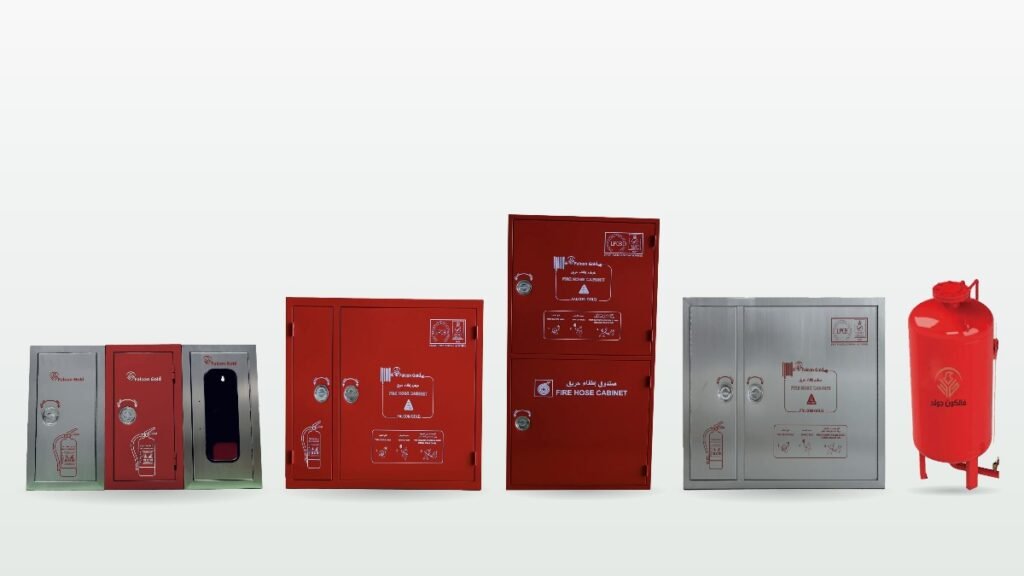
An extinguisher programme is a chain of linked tasks: a monthly check on site, annual maintenance by a certified technician, and internal examination, recharging and hydrostatic testing when due, each leaving a clear mark on the unit and in the records. What convinces a Civil Defense inspector is dates that agree across the unit, the log and the report, not the number of tags. For the extinguisher models AZEIDK supplies, see Falcon Gold fire extinguishers. For selection and placement rules, see the extinguisher selection guide.
Do you know when your extinguishers are due for internal examination and testing? Send us your extinguisher inventory and latest maintenance report, and we will propose a schedule and contract scope for your facility. Contact the AZEIDK team