Fire extinguisher maintenance is more than replacing the tag every year. It covers a monthly check by the building’s own staff, annual maintenance by a qualified technician, and internal examination and hydrostatic testing of the cylinder at intervals that depend on the extinguisher type.
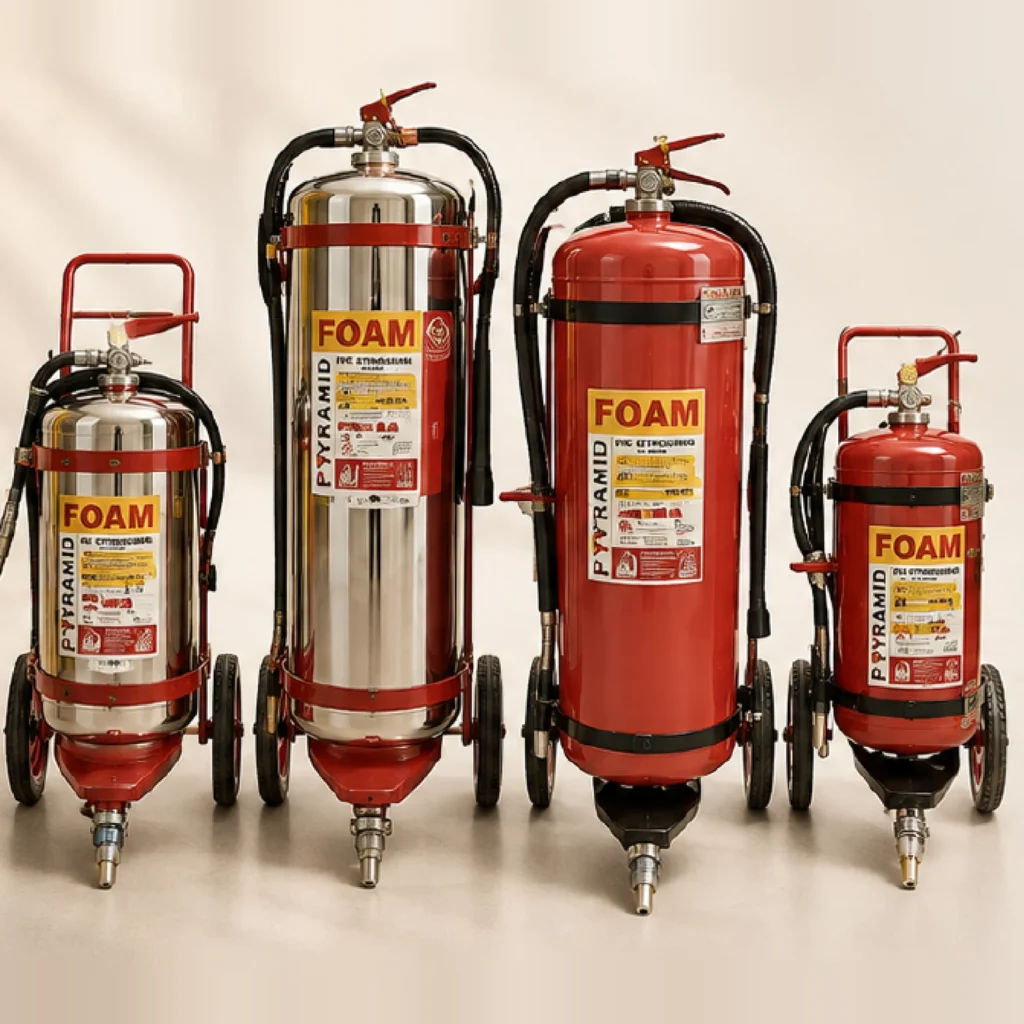
This guide explains each stage and how to read working and test pressures in a datasheet, using the PYRAMID extinguishers supplied by AZEIDK Egypt as examples.
Key takeaways
- NFPA 10 (latest edition 2026) sets a three-layer programme: a monthly visual inspection, annual maintenance, and periodic internal examination and hydrostatic testing. It is a technical reference, not Egyptian law.
- Under the NFPA 10 tables, stored-pressure dry powder extinguishers with steel cylinders get an internal examination every 6 years and a hydrostatic test every 12 years.
- CO2, foam, water, wet chemical and stainless-steel dry powder extinguishers are hydrostatically tested every 5 years.
- Recharge an extinguisher immediately after any use, even a short one, with the agent named on its nameplate.
- The test pressure comes from the manufacturer’s data, and it differs widely between dry powder and CO2 extinguishers.
In this article
- What is mandatory and what is guidance for fire extinguisher maintenance in Egypt
- Monthly inspection: what the building’s staff check
- Annual maintenance and internal examination
- Hydrostatic testing: intervals by extinguisher type
- Reading extinguisher pressures in the datasheet
- Recharging fire extinguishers
- Tags and records
- Common fire extinguisher maintenance mistakes
- PYRAMID extinguishers and maintenance service at AZEIDK Egypt
- Frequently asked questions
- Conclusion
What is mandatory and what is guidance for fire extinguisher maintenance in Egypt
The legal framework in Egypt is Egyptian Building Law No. 119 of 2008, the Egyptian Code for the Design and Implementation of Fire Protection for Buildings — 2026 edition (Ministerial Decree No. 355 of 2026), and the requirements of the General Directorate of Civil Protection (Ministry of Interior) during review and inspection. We do not quote any maintenance interval as an Egyptian legal requirement, because we could not verify one in a published official source.
The intervals below are guidance from NFPA 10, the US standard for portable extinguishers most often cited in project specifications. They apply alongside the manufacturer’s service manual and whatever the authority, insurer or contract requires. For extinguisher types and where each one fits, see our guide to fire extinguisher types and uses.
Monthly inspection: what the building’s staff check
NFPA 10 requires a quick visual inspection at intervals of about 30 days, starting from the day the extinguisher goes into service, unless an alternative inspection programme approved by the authority is in place. A trained member of the building’s team can do it with a fixed checklist:
- The unit is in its place, visible and not blocked.
- The safety pin is in place and the tamper seal is intact.
- The gauge needle is in the green zone, on units fitted with a pressure gauge.
- The unit is full, judged by weight or by lifting it.
- No rust, dents, leaks or visible damage.
- Hose and nozzle are clear; instructions are legible and face outward.
Record the date and initials on the tag or in a log. A unit that fails any check is replaced with one of at least the same rating until it is serviced. According to extinguisher manufacturer Amerex, the 2026 edition allows approved electronic monitoring technologies to supplement or replace some manual monthly inspection items, subject to the authority’s approval.
Annual maintenance and internal examination
Annual maintenance
At least once a year, a qualified technician examines the mechanical parts, agent and expellant, using the manufacturer’s service manual and correct parts. The visit ends with a new tamper seal and an updated maintenance tag showing the month and year, the technician and the service company.
Six-year internal examination
Stored-pressure extinguishers whose cylinder is hydrostatically tested every 12 years, mainly steel-cylinder dry powder units, need internal maintenance every 6 years: the unit is emptied, the cylinder interior and valve are examined, and the unit is recharged and repressurised. A metal or similarly durable label showing the date is then fixed to the extinguisher.
Extinguishers on a 5-year hydrostatic cycle, such as CO2, have their internal examination at the time of the hydrostatic test. Cartridge-operated extinguishers are examined internally at every annual maintenance. After any internal examination or recharge, a verification-of-service collar is fitted around the cylinder neck (cartridge-operated units excepted).
Hydrostatic testing: intervals by extinguisher type
A hydrostatic test fills the cylinder with water and raises it to test pressure to confirm it holds without leaking or permanent deformation. The cylinder is then marked with the test date and the tester’s identity. The intervals below come from the NFPA 10 tables as presented in published references based on the 2010 and 2022 editions; check the edition adopted for your project:
| Extinguisher type | Internal examination | Hydrostatic test |
|---|---|---|
| Stored-pressure dry powder (steel or aluminium cylinder) | Every 6 years | Every 12 years |
| Dry powder, stainless-steel cylinder | With the hydrostatic test | Every 5 years |
| Carbon dioxide (CO2) | Every 5 years | Every 5 years |
| AFFF foam and water (stored pressure) | With the hydrostatic test | Every 5 years |
| Wet chemical (Class K) | Every 5 years | Every 5 years |
| Non-rechargeable extinguishers | Not examined internally | Not tested; removed from service 12 years after manufacture |
When not to wait for the scheduled interval
References based on NFPA 10 list conditions that take a cylinder out of service before its due date: earlier repair by welding, soldering or patching compound; damaged cylinder threads; corrosion that has caused pitting; or exposure to fire, shown by charred or blistered paint, a distorted body or a melted handle. A cylinder that fails the test does not go back into service.
Reading extinguisher pressures in the datasheet
Test pressure is always taken from the manufacturer’s datasheet, never estimated. The PYRAMID datasheets on the AZEIDK website state, for the portable models:
| PYRAMID extinguisher | Working pressure | Test pressure | Burst pressure | Expellant |
|---|---|---|---|---|
| ABC stored-pressure dry powder, 1–12 kg | 17.5 bar | 35 bar | 70 bar | Nitrogen |
| AFFF foam, 6 and 9 L | 17.5 bar | 35 bar | 70 bar or more | CO2 cartridge or stored nitrogen pressure |
| Carbon dioxide (CO2) | 150 bar | 250 bar | 400 bar or more | The agent itself |
A CO2 extinguisher is a high-pressure, weld-free one-piece steel cylinder, and it needs different test and filling equipment from a low-pressure dry powder cylinder. PYRAMID dry powder and foam extinguishers carry a pressure gauge that shows their condition at the monthly check. The CO2 specification table lists no gauge, so CO2 units are checked by weighing them and comparing the result with the nominal weight marked on the unit.
Recharging fire extinguishers
An extinguisher is recharged in three cases: after any use, even for a few seconds; when the monthly inspection or annual maintenance finds low pressure or low weight; and after an internal examination or hydrostatic test. When recharging:
- Use the same extinguishing agent named on the nameplate, in the nominal quantity. Do not fill an ABC unit with a different powder.
- Use the expellant specified in the datasheet (nitrogen for PYRAMID dry powder units) and pressurise to the working pressure, no higher.
- Inspect the valve, O-rings and hose, and replace damaged parts with parts suitable for the model.
- Leak-test after filling, then fit a new seal and a verification collar and update the tag.
- Put a replacement of the same rating in the extinguisher’s place for as long as it is out for service.
Wheeled units (25 and 50 kg powder; 10, 20 and 30 kg CO2) follow the same rules, plus checks on wheels and hose. Automatic ceiling-mounted extinguishers have their own checks for the detection tube and mounting position, covered in our guide to PYRAMID Fire Search automatic extinguishers.
Tags and records
Records prove to an inspector that the programme was carried out. Keep a record for each extinguisher with:
- Extinguisher number, location, type, capacity and rating.
- Cylinder manufacture date as marked on the unit.
- Dates of monthly inspections and annual maintenance.
- Dates of the last internal examination, last recharge and last hydrostatic test.
- Technician and service company, and any parts replaced.
Units installed together usually fall due together, so plan them in batches and keep every area protected.
Common fire extinguisher maintenance mistakes
- Changing the tag without checking weight, pressure and valve.
- Leaving a partly used extinguisher in place because the needle is still near the green zone.
- Filling with an agent other than the one on the nameplate, or pressurising above the working pressure.
- Missing the 6-year internal examination on dry powder units because they look fine from outside.
- Returning a fire-exposed or pitted extinguisher to service without assessing the cylinder.
- Not weighing CO2 extinguishers.
PYRAMID extinguishers and maintenance service at AZEIDK Egypt
The PYRAMID range available from AZEIDK Egypt includes stored-pressure dry powder extinguishers in 1, 3, 6, 9 and 12 kg; wheeled dry powder units in 25 and 50 kg; CO2 extinguishers from 2 to 30 kg; AFFF foam extinguishers in 6 and 9 L and 25 and 45 L; and the Fire Search automatic models. The brand page states that the portable units conform to EN 3 and the relevant Egyptian standards, such as ES 8442/2021 for dry powder, ES 735 for CO2 and ES 711 for foam, with approval from the Egyptian Organization for Standardization and Quality (EOS) for the portable models listed. Check the status of each model in its own datasheet.
The AZEIDK Egypt maintenance and technical support services include periodic maintenance and recharging of extinguishers and suppression systems. For fire fighting and alarm systems, see our guide to fire system maintenance and inspection.
Frequently asked questions
How often does an unused dry powder extinguisher need recharging?
Under NFPA 10, a stored-pressure dry powder extinguisher is emptied, examined internally and recharged every 6 years. It is recharged sooner if its pressure or weight drops or it is used.
What is the difference between annual maintenance and a hydrostatic test?
Annual maintenance checks the unit, parts and agent without pressure-testing the cylinder. A hydrostatic test proves the cylinder holds test pressure, every 5 or 12 years by type.
How do I know a CO2 extinguisher is full?
Weigh it and compare the result with the nominal weight marked on the unit, because CO2 extinguishers do not normally rely on a pressure gauge.
Are NFPA 10 intervals legally binding in Egypt?
No. NFPA 10 is a technical reference used in specifications. The binding references are the Egyptian code and Civil Protection requirements, with the manufacturer’s instructions.
Can I keep using an extinguisher that was close to a fire?
Not before it is assessed. Heat exposure is one of the conditions that can make a cylinder unfit without waiting for its test date, especially if the paint is charred, the body is distorted or the handle has melted.
Conclusion
A fire extinguisher maintenance programme has clear layers: a simple monthly inspection, annual maintenance by a qualified technician, a 6-year internal examination for dry powder units, a hydrostatic test every 5 or 12 years depending on type, and immediate recharging after any use. The practical reference for each unit is the manufacturer’s data, above all its working and test pressures, agent and expellant, backed by a clear record.
Do you have extinguishers coming due for internal examination or testing? Send us their types, capacities and manufacture dates, and we will plan maintenance and recharging with you in batches. Talk to the AZEIDK Egypt team