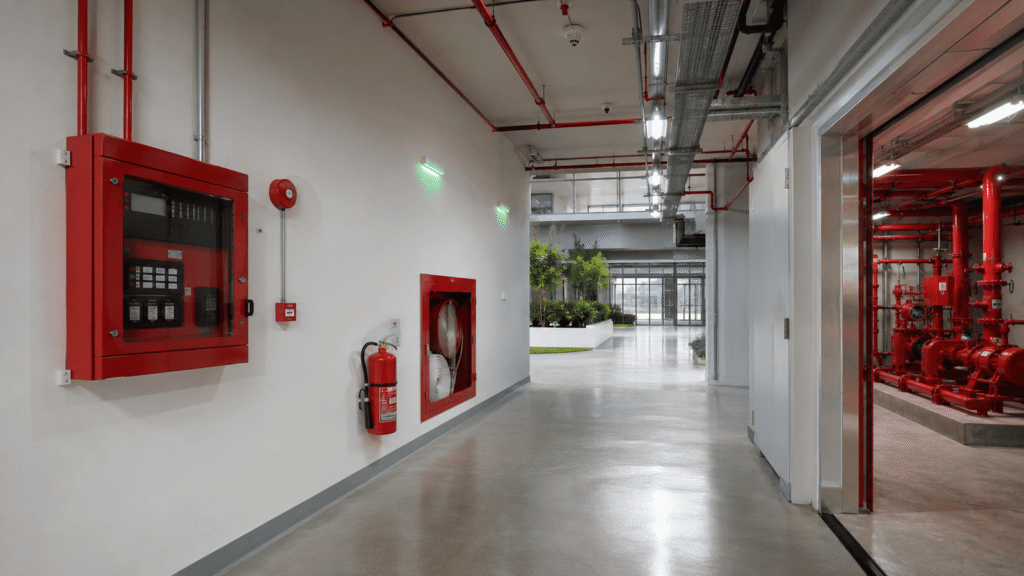
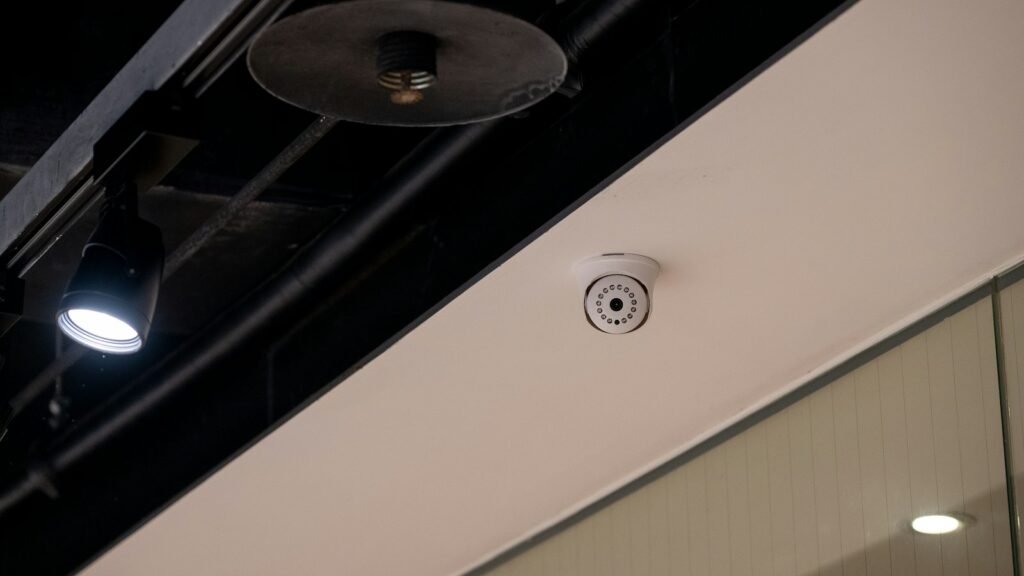
CCTV records what happened, and access control decides who may enter. Intrusion alarm systems have a different job: to detect an unauthorised entry attempt the moment it happens and report it before the damage is done. That is why they remain a separate layer of the security design, even in buildings with the latest cameras.
This guide covers the components, the EN 50131 security grades, detector and zone layout, signalling, integration with CCTV and access control, and common site mistakes.
Key takeaways
- An intrusion alarm system consists of a control panel, detectors, keypads, warning devices, a standby power supply and an alarm communicator.
- EN 50131 classifies systems into four security grades based on the expected intruder, and a system is only as high a grade as its weakest component.
- On US-based projects, UL standards cover components, NFPA 731 covers installation, and ANSI/SIA CP-01 sets false-alarm reduction features for control panels.
- Facilities under the High Commission for Industrial Security follow its security directives; elsewhere, the project specification and the owner’s requirements decide what applies.
- An alarm is only worth as much as the person who receives and verifies it.
In this article
- What an intrusion alarm system does
- Components of intrusion alarm systems
- Reference standards and security grades
- Design basics: from risk assessment to detector layout
- Signalling, monitoring and response
- Integration with CCTV, access control and building systems
- Common mistakes in intrusion alarm systems
- Testing, commissioning and maintenance
- How AZEIDK can help
- Frequently asked questions
- Conclusion
What an intrusion alarm system does
While armed, the system monitors entry points and interior spaces. When a detector senses movement, a door opens or glass breaks, the control panel triggers a local warning and signals a monitoring point. The system works in clear states: fully armed, part armed (for example perimeter only while staff are inside) or disarmed. Some zones stay active around the clock whatever the state, such as tamper circuits and hold-up or panic buttons.
Unlike a camera, which needs someone watching or analytics to draw attention, an intrusion alarm creates a specific event with a time and a location. Design the two together: the alarm detects, and the camera verifies.
Components of intrusion alarm systems
Control panel and keypads
The control panel is the brain of the system. It receives zone signals, applies arming and delay logic, logs events, and drives the warning devices and communicator. In the panel, a site is divided into partitions that can be armed independently, such as a warehouse and its offices. Keypads and card readers are used to arm and disarm, with permissions defined for each user.
Detectors
| Detector | What it detects | Typical use | Design note |
|---|---|---|---|
| Passive infrared (PIR) | A warm body moving across detection zones | Corridors, rooms, offices | Affected by changing heat sources, AC outlets and direct sunlight |
| Dual technology (PIR + microwave) | Movement confirmed by both technologies | Warehouses and spaces with unstable conditions | Fewer false alarms; microwave can see through light partitions |
| Magnetic door and window contact | A door or window opening | Entrances and entry points | Detects at the perimeter, before the intruder is inside |
| Glass-break detector | The sound or shock of breaking glass | Glazed façades, showrooms | Check range and glass type in the datasheet |
| Seismic (vibration) detector | Drilling or cutting attempts | Safes, cash rooms, sensitive walls | Mounted directly on the protected surface |
| Beams and fence detectors | Crossing a line or tampering with a fence | External perimeter | Affected by dust, wind and vegetation; needs specific design |
Warning devices, power and signalling
Warning devices include internal sounders and external sounders with a strobe; external units should be tamper-protected and have their own battery. The system needs a standby power supply sized for the period set by the specification and the system grade, and a communicator that sends events to the monitoring point over the network, the cellular network or both.
Reference standards and security grades
The most widely used design reference is the EN 50131 series. Part 1 (EN 50131-1:2006, consolidated with amendments up to A3:2020) sets performance requirements for intrusion and hold-up alarm systems installed in buildings, including components mounted on the building’s external structure, and excludes exterior systems. It classifies the environment into four environmental classes and defines four security grades:
| Grade | Assumed intruder | Typical applications |
|---|---|---|
| Grade 1 | Opportunistic, no tools, no knowledge of the system | Very low risk |
| Grade 2 | Limited knowledge of alarm systems, simple tools | Small and medium offices and shops |
| Grade 3 | Familiar with the system, with tools and portable equipment | Warehouses and sites holding valuable stock |
| Grade 4 | Organised, with planning and advanced means to defeat the system | Critical and high-risk sites |
The practical rule is that a system cannot exceed the grade of its weakest component. One Grade 2 detector in a Grade 3 design downgrades the whole system. Grade 3 detectors must also be able to report masking attempts (anti-masking). Other parts of the series cover components, including EN 50131-2-6 for magnetic opening contacts, EN 50131-4 for warning devices and EN 50131-6 for power supplies. The international counterpart of Part 1 is IEC 62642-1:2010.
On projects that follow the US route, components are listed to UL standards such as UL 639 for intrusion-detection units and UL 634 for connectors and switches, and NFPA 731 (2026 edition) covers the installation, testing and maintenance of electronic premises security systems. ANSI/SIA CP-01-2019 sets design features for control panels and arming devices that reduce false alarms.
In Saudi Arabia, the High Commission for Industrial Security (HCIS) reviews security projects at facilities under its oversight against its security directives (SEC). For other buildings, the grade and standard are set by the project specification, the owner and, where relevant, the insurer, and any sector-specific requirement should be checked before design starts.
Design basics: from risk assessment to detector layout
Design starts with three questions: what are we protecting, whom do we expect, and how many minutes will it take a responder to arrive? The answers define the grade and the layers:
- Perimeter: fences and gates, where needed, designed for outdoor conditions.
- Building envelope: door and window contacts and glass-break detectors, to detect the attempt before entry.
- Interior spaces: motion detectors on the routes an intruder must pass through.
- The target itself: seismic detectors on safes, or contacts on server rooms and high-value stores.
Zones are then arranged so that an alarm points to a specific location. An entry and exit route is defined with enough delay to arm and disarm, and zone wiring is supervised with end-of-line resistors as the manufacturer specifies, so that cuts, shorts and tampering are detected. Detectors are positioned to the datasheet’s height and range, away from AC outlets, sun-exposed surfaces and moving signs. When wireless devices are used, signal strength is tested on site before final fixing.
Signalling, monitoring and response
A siren alone is rarely enough. Someone has to receive the alarm: an on-site security room, a monitoring centre, or a mobile app for named managers. The EN 50136 series covers alarm transmission systems: general requirements, the transmitter at the premises and the receiver at the monitoring centre. For important sites, a dual-path communicator, such as wired network plus cellular, is preferred so that cutting one path does not stop the alarm getting through.
Write a response procedure: who is notified first, how the alarm is verified on camera, and when security or the authorities are called. Repeated false alarms push users to ignore the system.
Integration with CCTV, access control and building systems
- CCTV: an alarm event can call up the nearest camera in the control room and bookmark the recording around the event. For camera selection, see our IP vs analogue CCTV comparison.
- Access control: an authorised user’s card can arm and disarm a partition, with a record of who disarmed and when, as covered in our guide to access control technologies.
- Building management system: displaying arming status and alarms is usually enough; no other system should control the alarm logic.
- Fire alarm: no security interface may prevent escape doors from opening during a fire. The fire alarm system always takes priority.
Common mistakes in intrusion alarm systems
- Specifying a security grade, then supplying a detector or power supply of a lower grade.
- Placing motion detectors facing AC outlets or sun-exposed glazing.
- Putting a whole building on one zone, so responders cannot tell where the alarm is.
- Leaving zone wiring without tamper supervision, or mounting the panel in an exposed location.
- Relying on a local siren with no one to receive the alarm and no response procedure.
- Skipping user training on arming and disarming, which leads to false alarms and a neglected system.
- Not reassessing coverage after racking or partitions change.
Testing, commissioning and maintenance
Acceptance should include a walk test of every detector, tamper tests including opening the panel cover, a mains failure test with the system running on battery, and a signalling test to the monitoring point over each path. The handover should include the zone schedule, a device location drawing and a record of panel settings. Maintenance intervals follow the contract, the manufacturer’s instructions and the project standard, and visits should cover battery tests, lens cleaning and a review of the false-alarm log.
How AZEIDK can help
AZEIDK’s low current solutions include intrusion and burglar alarm systems, and the brands we supply include wireless intruder alarm devices from Hikvision. Through our programming and systems integration service we configure zones and partitions and link the alarm to CCTV and access control, and we keep the system in service under our annual maintenance contracts.
Frequently asked questions
Can CCTV replace an intrusion alarm system?
No. Cameras record and help verify, while an intrusion alarm creates an immediate event with a precise location. The best results come from linking the two.
Which grade suits a commercial warehouse?
That depends on the value of the stock, the risk assessment and the owner’s or insurer’s requirements. Grade 3 is often requested for valuable stock, provided every component is the same grade.
Are wireless systems reliable?
Yes, for many sites, if designed for the required grade, signal-tested on site and supervised by the panel.
How can false alarms be reduced?
Choose detectors for the environment, avoid heat and air movement, set sensible delays, train users and review the event log.
Is there a general Saudi code that mandates an intrusion alarm standard?
Facilities under the High Commission for Industrial Security have their own security directives. For other buildings, the project specification and the owner’s requirements set the standard, and any sector-specific requirement should be checked before design.
Conclusion
Effective intrusion alarm systems start with a realistic risk assessment, a security grade applied to every component, a detector layout that catches intruders early without false alarms, and signalling that reaches someone who will respond. Linked to CCTV and access control without compromising escape routes, they complete the security design.
Planning protection for a warehouse, office or sensitive facility? Send us the drawings and the type of activity, and we will propose the security grade, detector layout and signalling method that fit. Talk to the AZEIDK team