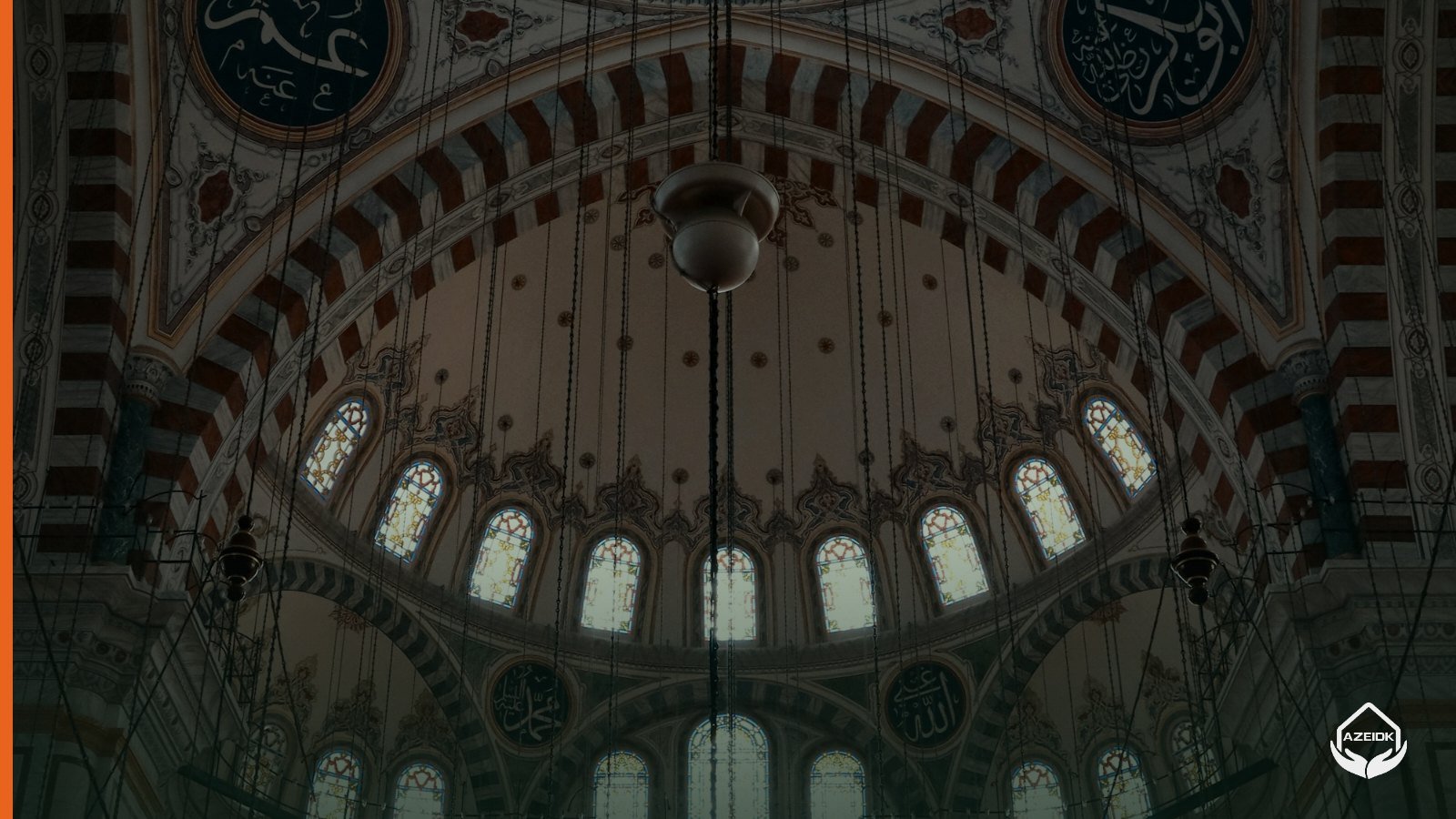
Mosque fire safety requirements in Saudi Arabia follow from the mosque’s classification as an assembly building under the Saudi Building Code, then from peak attendance, prayer hall area and floor level. The Ministry of Islamic Affairs, Dawah and Guidance sets them out in its technical guides for mosques, including a fire protection guide, with the Saudi Building Code prevailing in any conflict.
Key takeaways
- Mosques are assembly group A-3 under the Saudi Building Code, according to the ministry’s Technical Guides for Building and Developing Mosques.
- Where the guides conflict with the code, the code applies, including the Saudi Fire Protection Code (SBC 801).
- Domes and high ceilings need detection that works at height and can be maintained, such as beam or aspirating detection.
- The ministry’s fire protection guide requires inspection, testing and maintenance records to be kept at the mosque for at least three years.
- Key practical hazards: temporary wiring, neglected air conditioning, carpets and curtains, and iftar areas using gas.
In this article
- The Saudi references: the building code and the ministry’s mosque guides
- Why requirements differ from one mosque to another
- Detection and alarm under domes and high ceilings
- Emergency exits, emergency lighting and escape routes
- Common hazards in mosques and how to address them
- Practical checklist for mosque administrators
- Inspection, maintenance and what drives cost
- How AZEIDK helps
- FAQ
The Saudi references: the building code and the ministry’s mosque guides
The ministry has issued the first edition of its Technical Guides for Building and Developing Mosques, prepared with support from bodies including the National Committee for the Saudi Building Code. The guides are aligned with the Saudi Building Code and cover religious, administrative, engineering, health and operational requirements.
Guide 1 (administrative requirements) classifies mosques as assembly group A-3, buildings where 50 or more people gather for purposes that include worship, places separate imam and muezzin housing under the Saudi Residential Building Code (SBC 1101), and states that the code prevails in any conflict. Guide 10 covers fire protection and draws on SBC 801 and the Saudi General Building Code (SBC 201).
| Guide 10 topic | Examples of what it covers |
|---|---|
| Administration and records | Records kept at the mosque for at least three years; written, certified inspection reports |
| General fire safety | No smoking in the mosque; control of ignition sources and combustibles |
| Fire department access | Access roads, access to openings and roofs, mosque identification |
| Interior finishes | Ceiling and wall finishes, decorative materials |
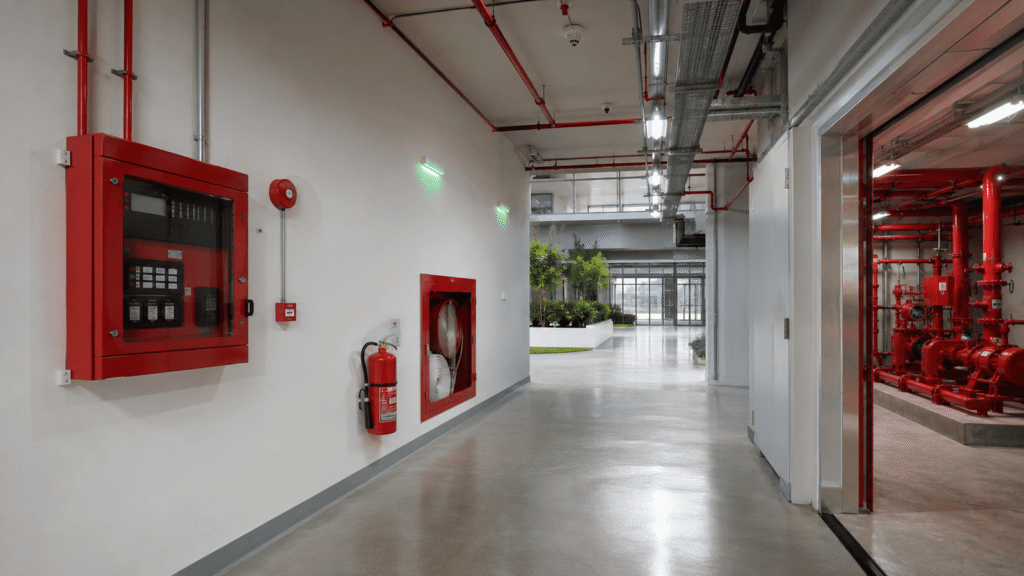
| Fire protection systems | Sprinklers, standpipes, extinguishers, fire alarm and detection, fire pumps |
| Means of egress | Occupant load, exit width, number and arrangement, exit lighting and signs, travel distance |
The guide applies to new mosques and to existing ones in defined cases, such as a clear hazard to life or property, and bars a change to another occupancy group unless the mosque complies with SBC 801 and SBC 201. Historic mosques classified by the relevant authorities need an approved fire protection plan.
The numeric thresholds that trigger a fire alarm or sprinklers come from the adopted edition of SBC 801 and SBC 201, applied by the designer, not from comparing mosques; see our SBC 801 guide.
Why requirements differ from one mosque to another
Requirements depend on factors calculated for each project:
| Factor | Why it matters | What to check |
|---|---|---|
| Occupant load | Calculated from net prayer area with the code load factor; exits and alarm needs follow | Main hall, women’s area, mezzanines and courtyards used at peak |
| Fire area | Larger undivided areas bring more requirements | Fire-rated walls and doors |
| Prayer hall location | Upper floors and basements change exit and protection needs | Upper women’s areas, basements and their stairs |
| Ceiling and dome | Decide which detection works and how it is maintained | Beam or aspirating detection, access equipment |
| Ancillary areas | Kitchens, generator rooms and Quran classrooms add hazards | Protection matched to each area |
Detection and alarm under domes and high ceilings
Under a high ceiling or dome, smoke cools and spreads before reaching the top, and a trapped warm air layer can keep it from a spot detector at the crown. A crown detector also needs scaffolding for every test or cleaning, so in practice it often goes unmaintained.
- Beam detectors send a light beam across the hall and sense smoke along it, mounted on walls at a more accessible height. The Context Plus range AZEIDK supplies includes a self-aligning beam detector suited to these spaces.
- Aspirating detection draws air through small pipes to a detector unit in an accessible place, which suits decorated domes.
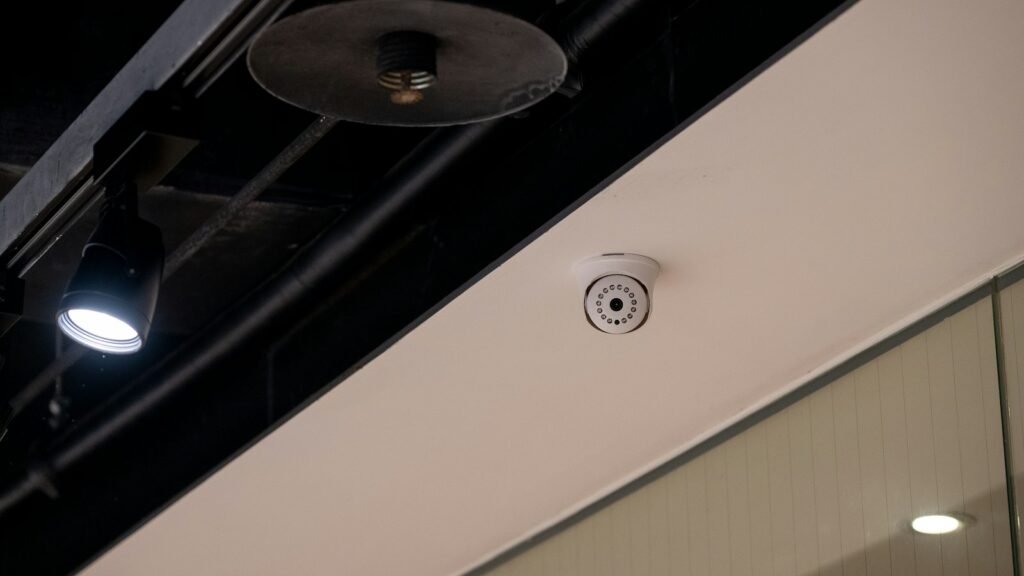
- Spot detectors stay right for offices, libraries, Quran classrooms, electrical rooms and stores, with heat detectors in kitchens. See our fire detector selection guide.
Incense, false alarms and the sound system
Incense is a known cause of false alarms, since smoke detectors cannot tell it from fire smoke. Rather than disconnecting or covering detectors, set fixed incense spots away from them, choose type and position carefully, and use alarm verification where the approved design allows.
The mosque sound system is not a fire alarm: its circuits are usually unsupervised and it may lack a calculated standby supply. Program the fire alarm panel to mute the speakers on alarm, and in large mosques consider a voice evacuation system with clear Arabic messages, plus visual alarms for people with hearing loss.
Emergency exits, emergency lighting and escape routes
The critical moment is the end of Friday prayer or Taraweeh, when everyone leaves at once, so exits are sized on peak occupant load. On site:
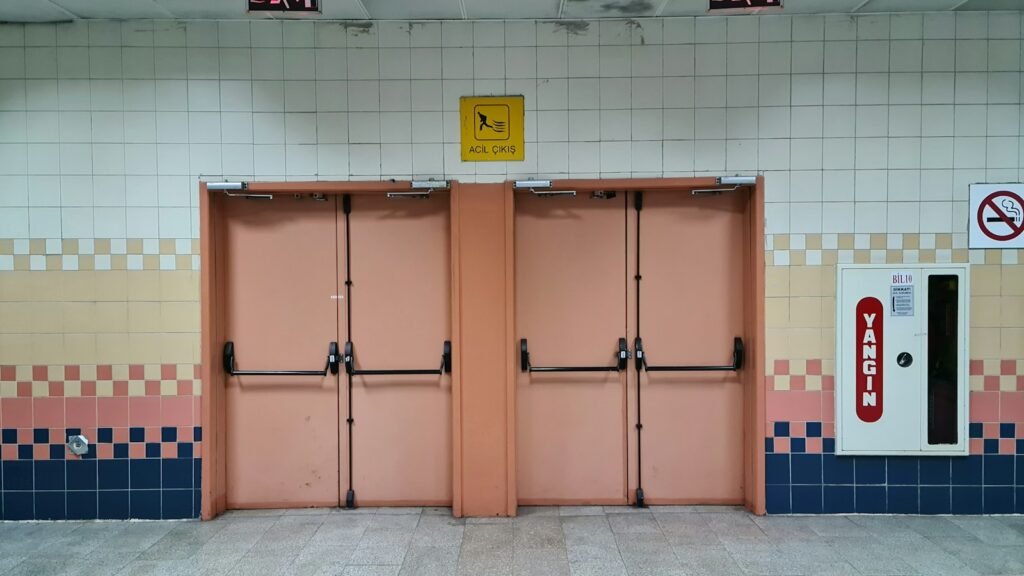
- Never lock or chain exit doors while worshippers are inside; fit panic hardware where the code or approved design requires it.
- Provide enough exits for the women’s area, especially on an upper floor served by one stair.
- Keep shoe racks, Quran shelves and water coolers out of corridors and doorways.
- Emergency lighting and exit signs matter at Fajr, Isha and Taraweeh, because a power cut in a full hall causes panic before any smoke.
- Set an outdoor assembly point away from car entrances and the Civil Defense route, with a plan for elderly and wheelchair users.
Common hazards in mosques and how to address them
Air conditioning units run for long hours in summer, and dirty filters and loose connections make them a potential ignition source, as do temporary Ramadan lighting, overloaded extension leads and amplifiers in unventilated cabinets. Check distribution boards regularly, allow temporary wiring only by a qualified electrician, and place suitable extinguishers near electrical rooms and sound equipment.
Carpet, curtains and wooden partitions form a continuous fire load. Guide 10 has a part on interior finishes and decorative materials, so ask suppliers for flame spread evidence when renovating, and do not store spare carpets in corridors or under stairs.
In instructions announced in January 2026 ahead of Ramadan 1447 AH, the ministry placed iftar in prepared areas in mosque courtyards under the imam’s and muezzin’s responsibility. Keep cooking and gas cylinders away from the hall and iftar areas, with extinguishers and clear exits. Permanent kitchens need approved kitchen fire suppression systems, and generator rooms need separation and ventilation.
Practical checklist for mosque administrators
- Get an occupant load calculation for the main hall, women’s area and any courtyard used at peak.
- Review alarm, sprinkler and emergency lighting needs with a licensed engineering office.
- Keep exit doors openable without a key whenever worshippers are present.
- Check extinguishers visually: gauge, seal and clear access.
- Test emergency lighting by cutting its supply, and replace weak batteries.
- Set incense spots away from detectors, and never allow a detector to be covered.
- Ban unqualified temporary wiring, and service air conditioning before summer.
- Train the muezzin or caretaker to read the panel and call Civil Defense and the maintenance contractor.
- Keep inspection and maintenance records for at least three years, as the ministry’s guide requires.
Inspection, maintenance and what drives cost
Maintain systems to National Fire Protection Association (NFPA) standards, NFPA 10 for extinguishers, NFPA 72 for fire alarm and NFPA 25 for sprinklers, pumps and standpipes, at the intervals in the adopted editions and Civil Defense requirements. Guide 10’s three-year record rule applies, with written, certified inspection reports. An annual maintenance contract with a written visit schedule keeps maintenance from slipping. Cost depends on:
- Occupant load, area and floor level, which decide whether an alarm and sprinklers are needed.
- Ceiling height and dome shape, and the detection and lifting equipment they require.
- Decorative finishes needing concealed sprinklers and planned cable routes.
- Working around prayer times in an operating mosque.
How AZEIDK helps
AZEIDK has worked in the Saudi market for more than 16 years with more than 300 technical and administrative staff. On mosque projects we usually start with an assessment of existing systems and scope definition, then provide engineering design and calculations, technical supply, installation, testing and commissioning, and Civil Defense approval support.
Brands we supply include Context Plus fire alarm panels and detectors and Falcon Gold fire hose and extinguisher cabinets. Among high-occupancy facilities, we supplied, installed, tested and commissioned fire protection, alarm and security systems at the Hajj Terminal of King Abdulaziz International Airport (KAIA) in Jeddah.
FAQ
Does every mosque need a fire alarm system?
Not necessarily. Mosques are assembly group A-3, and alarm requirements depend on occupant load, area and the floor the prayer hall is on, under the adopted Saudi Fire Protection Code and Civil Defense requirements. The licensed designer decides for each project.
What is the best smoke detector for a mosque dome?
Under domes and high ceilings, a wall-mounted beam detector, or an aspirating system with an accessible detector unit, is usually preferred. A spot detector at the top of a dome may respond late and is hard to test. The designer decides based on ceiling height, shape and manufacturer instructions.
Does incense cause false fire alarms?
Yes. Smoke detectors respond to incense smoke just as they do to fire smoke. The answer is fixed incense spots away from detectors, and careful choice of detector type and position. Never disconnect or cover detectors, because that removes protection exactly when worshippers need early warning.
Which fire extinguishers suit a mosque?
The prayer hall usually needs extinguishers for fires in solid materials such as carpets and wood, while carbon dioxide extinguishers, which leave no residue, suit electrical rooms and sound equipment. Dry powder works but is hard to clean from carpets. Number and placement follow NFPA 10 and the approved design.
What is the official reference for mosque fire safety requirements?
The top reference is the Saudi Building Code, including the Saudi Fire Protection Code and the Saudi General Building Code. The ministry details requirements in its Technical Guides for Building and Developing Mosques, including Guide 10 on fire protection, which defer to the code in any conflict.
How long should a mosque keep fire system maintenance records?
The ministry’s fire protection guide requires inspection, testing and maintenance records to be kept at the mosque for at least three years, unless the code or referenced standards set a different period. Include contractor reports, faults and how they were fixed, as a record of system readiness.
Planning to build, extend or upgrade the safety systems of a mosque? Send the drawings or book an assessment visit, and our team will review the requirements that apply before work starts. Contact the AZEIDK team