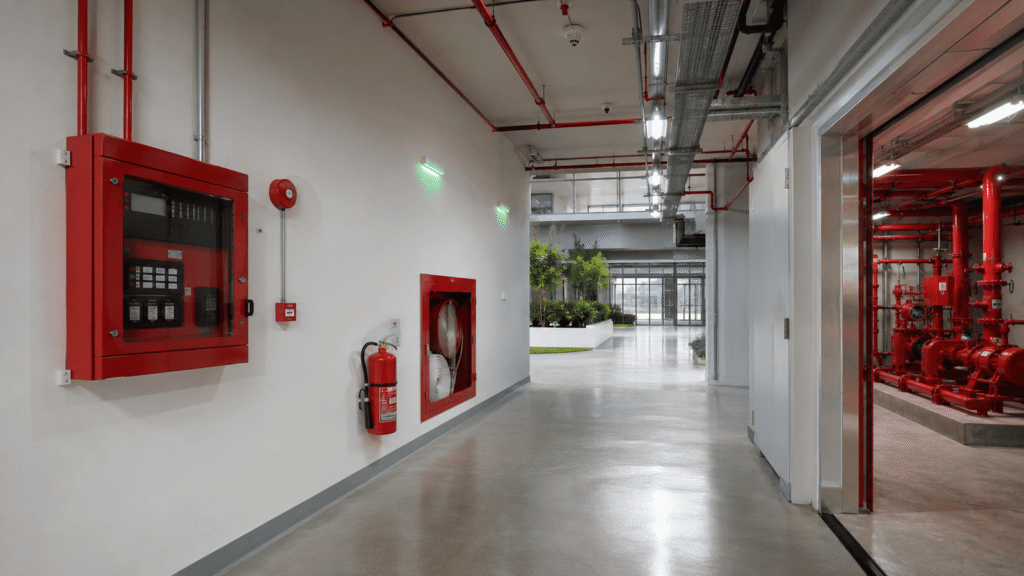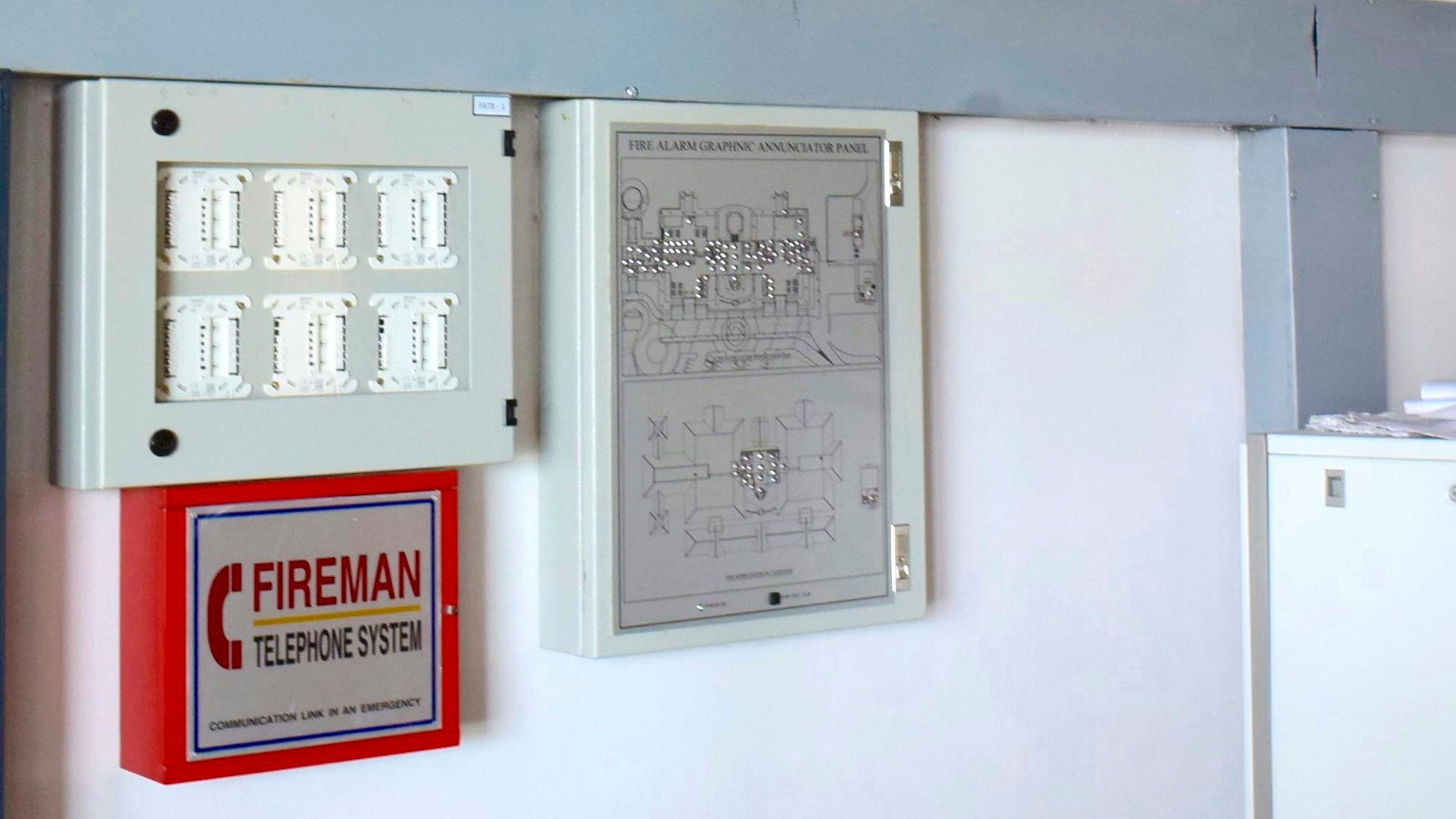
A fire telephone system is a dedicated two-way voice network that links stations in stairs, lobbies, equipment rooms and areas of refuge to a master control unit in the control room or fire command center. It lets firefighters coordinate and lets people who cannot use the stairs call for help. Whether your project needs one is set by the adopted code, Civil Defense and the consultant.
Key takeaways
- Fire telephones and refuge call points are both two-way emergency communication systems: Chapter 24 of NFPA 72 covers them, and BS 5839-9 covers emergency voice communication (EVC) systems on British-specified projects.
- In the International Building Code (IBC), the model behind the Saudi Building Code, areas of refuge and certain elevator landings need two-way communication to the fire command center or an approved control point, with audible and visible signals.
- Handset fire telephones and hands-free refuge units serve different users, so choose the outstation for the person who will use it.
- Recent NFPA 72 editions apply pathway survivability requirements to firefighters’ telephone circuits and area of refuge communication.
- Test every outstation with a live call; testing only the master unit hides dead stations.
In this article
- What is a fire telephone system and how does it work?
- Areas of refuge: why they need two-way communication
- When do Saudi projects need fire telephones?
- Design and selection criteria
- Delivering a fire telephone system: step by step
- Common site mistakes
- Inspection, testing, maintenance and cost
- How AZEIDK helps
- FAQ
What is a fire telephone system and how does it work?
In a real fire, building phones can lose power, mobile signal drops in concrete stairs and basements, and noise defeats shouting. A fire telephone system gives emergency teams a separate, monitored voice network that does not depend on the telecom system.
When a firefighter lifts a handset at a floor station, or a wheelchair user presses the call button at a refuge, the master unit gives an audible and visual alert and shows the caller’s location. The operator answers and, on larger systems, can link stations so crews on different floors can talk.
Type A and Type B outstations
Manufacturers describe two BS 5839-9 outstation types: Type A, telephone-style handsets for firefighter telephones and stadium marshal systems, and Type B, hands-free intercom-style units common at disabled refuges. A person at a refuge may not be able to hold a handset, yet guidance written to the 2011 edition prefers Type A in most locations and limits Type B to quiet areas where a handset is impractical, so confirm the type and background noise at each refuge.
Areas of refuge: why they need two-way communication
An area of refuge is a protected space, usually within or beside a protected stair, where people who cannot use the stairs wait for assisted evacuation. It relies on fire separation and on keeping smoke out, which is why it is tied to smoke control and stair pressurization.
Construction alone is not enough: the person waiting needs to report their presence and receive instructions, so the IBC requires a two-way communication system in areas of refuge and at the landing serving each elevator or bank of elevators on accessible floors one or more stories above or below the level of exit discharge, subject to the code’s exceptions. The system must connect each location to the fire command center or a central control point approved by the fire department, include audible and visible signals, and dial out automatically to a monitoring location where the control point is not constantly attended. Directions for use and the location must be posted beside each unit.
The Saudi Building Code is based on the International Codes of the International Code Council (ICC), but what applies to your building is the adopted Saudi text as interpreted by the consultant and Civil Defense.
When do Saudi projects need fire telephones?
The requirement follows occupancy, height, size and the people using the building under the Saudi Fire Protection Code (SBC 801) and the Saudi Building Code (SBC 201), whose 2024 edition came into effect on 30 June 2025, together with Civil Defense review during drawing approval.
Chapter 24 of the NFPA 72 fire alarm code groups the two-way systems: in-building wired emergency services communication systems (firefighters’ telephones), radio communications enhancement systems, area of refuge systems, and stairway and elevator landing communication systems. The edition that applies in Saudi Arabia is set by SBC 801 and Civil Defense. British-specified projects use BS 5839-9, whose 2021 edition covers wired and wireless systems serving refuges, firefighting lobbies and sports venues; it does not decide whether a system is needed.
As one US example, Seattle Fire Department guidance (updated January 2025) covers wired systems, which Seattle allows in existing buildings instead of radio enhancement: with a fire command center, the system must link it with elevators and their lobbies, emergency and standby power rooms, fire pump rooms, areas of refuge and enclosed exit stairways, with a device on every floor of those stairways.
In practice they are common in high-rise towers, hospitals and care facilities, hotels, large malls, airports, stadiums and busy public buildings.
Design and selection criteria
Agree the reference standard first
Settle with the consultant at the outset whether the system follows NFPA 72 or BS 5839-9. The choice changes outstation types, cabling and test procedures, and mixing the two invites rejected submittals.
Survivability and monitoring
NFPA 72 applies the same pathway survivability requirements to firefighters’ telephone systems as to voice systems that use partial evacuation or relocation, and recent editions extended them to area of refuge communication. Circuits are monitored for faults, and the cable must suit the required survivability level, as our guide to fire alarm cables and circuit integrity explains.
Locations and interfaces
Place handsets in protected stair lobbies and at the fire service entry point, and hands-free units inside the actual refuge within reach of a wheelchair user. It is good practice to report master unit faults to the fire alarm panel and to coordinate refuges with emergency and exit lighting and the voice evacuation system, so broadcasts do not drown out calls.
| Element | Typical location | Used by | What to check |
|---|---|---|---|
| Handset fire telephone (Type A) | Protected stair lobbies, fire service entry point | Firefighters and marshals | Easy-open cabinet, monitored line, clear audio in noise |
| Hands-free refuge unit (Type B) | Inside the protected refuge | People who cannot use the stairs | Reachable height, call-received indicator, posted instructions |
| Elevator landing unit | Elevator landings on affected floors | People waiting for the elevator or rescue | Link to the control point, audible and visible signals |
| Master control unit | Control room or fire command center | Building operator and fire officer | Caller location display, fault log, secondary power |
Delivering a fire telephone system: step by step
- Review occupancy, height and egress drawings to confirm the requirement.
- Agree the reference standard, outstation types and cable specification with the consultant.
- Mark station and refuge unit locations with the architect, inside the actual protected refuges.
- Calculate line capacity, circuit lengths and secondary power from manufacturer data.
- Submit shop drawings and the fire alarm interface for Civil Defense approval.
- Install on protected routes and fix instruction signs at every unit.
- Test every station with a live two-way call, simulate faults, and train staff to answer.
Common site mistakes
- Refuge unit outside the refuge, installed in an unprotected corridor because cabling was easier.
- Ordinary cable on survivable circuits, a small saving that silences the system when it is needed.
- Master unit in an unattended room with no dial-out or transfer to a staffed location.
- No posted instructions, so a frightened caller does not know what to press or expect.
- Testing only the master unit at handover, so dead outstations surface during the first drill.
Inspection, testing, maintenance and cost
Chapter 14 of NFPA 72 or BS 5839-9 sets inspection and testing, the manufacturer adds model procedures, and the frequency follows the adopted edition and the maintenance contract. Each visit should include a live call from every station and refuge unit, checking audio and the caller location; a simulated line fault checked at the master unit and fire alarm panel; and battery and charger checks.
What drives the cost?
The number of stations and refuge units, master line capacity, cable type and route lengths, the reference standard and survivability level, interfaces with the alarm panel, special cabinets, and the scope of testing and training at handover.
How AZEIDK helps
AZEIDK delivers fire telephone and refuge systems within its fire alarm system solutions: egress drawing review, engineering design and calculations, technical supply, installation and commissioning, Civil Defense approval support and annual maintenance contracts, with the AZEIDK Care Center for complaints and technical issues.
The Context Plus range that AZEIDK supplies includes the SigTEL fire telephone system alongside fire alarm panels and detectors, with a compliance review for each project. AZEIDK supports projects with more than 16 years in the Saudi market and 17+ branches and service regions.
FAQ
What is the difference between a fire telephone and a normal building phone?
A normal phone depends on the telecom network or exchange and can fail when power or cables are lost. A fire telephone is a separate network for emergency teams: its circuits are monitored for faults, it runs on secondary power, and the master unit shows exactly which floor or refuge is calling.
Is a fire telephone system mandatory in every building?
No. It depends on occupancy, height, size and the people using the building, and on the adopted Saudi code text, Civil Defense and the consultant’s specification. It is common in towers, hospitals and large hotels and malls. Confirm it at design stage, because stations and cable routes are costly to add later.
What is an area of refuge?
It is a space protected from fire and smoke, usually within or beside a protected stair, where someone who cannot use the stairs waits for assisted evacuation. The IBC requires it to have a two-way communication system linked to the fire command center or an approved control point, with posted instructions and the location identified.
Who answers refuge calls during a fire?
The designated operator in the control room or fire command center answers first, and the fire officer takes over on arrival. Where the control point is not constantly attended, the IBC requires automatic dial-out to a monitoring location. The emergency plan should name who answers and who briefs the rescue team.
Can two-way radios replace a fire telephone?
Not necessarily. Radio coverage can be weak in concrete stairs and basements, so NFPA 72 treats radio enhancement as a separate system, and a person at a refuge will not carry a radio. The adopted code, the consultant and Civil Defense decide whether one solution or both are needed.
How do BS 5839-9 and NFPA 72 differ for fire telephones?
Both cover two-way emergency communication. NFPA 72 groups firefighters’ telephones, refuge, stairway and elevator landing systems in its emergency communications chapter, with survivability rules. BS 5839-9 is a British code of practice for emergency voice communication using Type A handset and Type B hands-free outstations. The project specification decides which applies.
Does your project need a fire telephone or refuge system that will pass approval? Send your egress drawings and we will review locations, survivability and the fire alarm interface. Contact the AZEIDK team