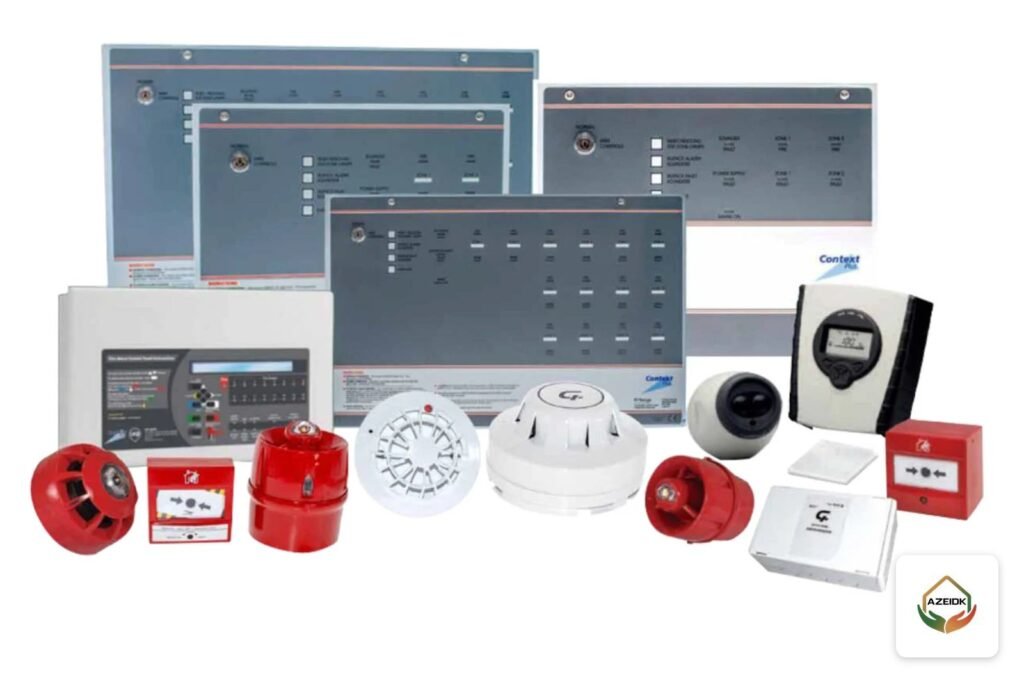
Choosing a Context Plus fire alarm panel starts with the building, not the model number: how many zones and devices, which systems must react to an alarm, and whether the project will grow. Context Plus has been a British fire alarm specialist since 1984; AZEIDK Egypt supplies its ZFP addressable and CFP and FP conventional panels, with detectors, sounders and beacons.
This guide uses only what the datasheets on the AZEIDK website state. For the full solution see Fire Detection and Alarm Systems, and for products and documents see the Context Plus brand page.
Key takeaways
- ZFP panels are addressable, with a full colour touchscreen, third-party certified by Intertek to EN 54-2 and EN 54-4 according to the datasheet, and available from 1 to 8 loops.
- CFP and FP panels are conventional and suit small and medium buildings; confirm zones in the model datasheet.
- Selection criteria: number of zones and devices, interfacing and cause and effect, repeaters, future expansion, and total system budget.
- Approvals differ by model: Series 65A conventional detectors are UL listed per the datasheet, while the CON series addressable sounders are certified to EN 54-3 and EN 54-17, and the models with a beacon also to EN 54-23.
In this article
- What Context Plus panels and devices are available in Egypt?
- ZFP addressable panels: what the datasheet says
- CFP and FP conventional panels: when are they enough?
- How to choose a Context Plus fire alarm panel: five criteria
- Quick selection table by project
- Field devices: detectors, beam detectors and sounders
- Batteries and panel location
- Regulatory framework: the Egyptian code, EN 54 and NFPA 72
- Common mistakes when selecting a panel
- Frequently asked questions
- Conclusion
What Context Plus panels and devices are available in Egypt?
The range covers conventional and addressable panels and repeaters, smoke, heat, flame and beam detectors, manual call points (MCPs), sounders, beacons and I/O modules. The main families:
| Family | Type | What the datasheet or product page states | Typical place in a project |
|---|---|---|---|
| ZFP | Addressable fire alarm panel | Touchscreen, 1 to 8 loops, certified to EN 54-2 and EN 54-4 by Intertek | Large buildings with many zones |
| CFP / FP | Conventional fire alarm panel | Request the datasheet for the offered model | Small and medium buildings |
| Series 65A | Conventional smoke and heat detectors | Optical smoke detector and heat detectors, UL listed, 9 to 33 V supply | Conventional zone circuits |
| 55000-268 | Intelligent reflective beam detector | Transmitter and receiver in one unit, 5 to 50 m with a single reflector | Warehouses, halls and high ceilings |
| Addressable sounders and beacons | Loop-powered notification devices | CON models certified to EN 54-3 and EN 54-17; those with a beacon also to EN 54-23 | Corridors, stairs and outdoor locations |
ZFP addressable panels: what the datasheet says
The datasheet on the AZEIDK products page describes ZFP as networkable addressable panels certified by Intertek to EN 54 parts 2 and 4. Part 2 covers control and indicating equipment; part 4 covers power supply equipment. Key points:
- Three cabinet sizes: standard with 1, 2 or 4 loops; medium and large with 2, 4, 6 or 8 loops.
- Loop capacity: up to 127 addressable devices per loop, 500 mA output per loop, and up to 1 km of fire resistant screened cable per loop.
- Zones and indication: 10,000 programmable detection zones and up to 200 zonal LEDs per panel (100 in standard cabinets) through switch and indicator modules.
- User interface: 4.3 inch full colour touchscreen with an on-screen keyboard, up to 38 characters of text per device, and a filterable log of more than 20,000 events.
- Programming: isolated USB port, PC tools and a Micro SD card for off-site configuration.
CFP and FP conventional panels: when are they enough?
A conventional panel reports the zone, not the device. The AZEIDK Egypt solution page positions conventional systems for small and medium buildings, so CFP or FP suits a shop, clinic or small office with few zones.
No CFP or FP datasheet is published on the website yet, so no capacities are given here. Ask for the datasheet and check the number of zones, sounder circuits, outputs for interfacing, battery size and the stated approval. For the general differences between the two technologies, read Conventional and Addressable Fire Alarm Systems.
How to choose a Context Plus fire alarm panel: five criteria
1. Building size, zones and devices
Start with a rough device count and zone layout from the drawings. With few zones, a conventional panel is usually enough. Otherwise ZFP capacity is set by loops: up to 127 devices per loop, with spare capacity left. Device distribution and isolator positions are covered in Addressable Fire Alarm Loop Design.
2. Cause and effect and interfacing
What must happen on alarm? HVAC shutdown, lift recall, door holder release, sprinkler flow switch signals. Each needs an input or output. The datasheet lists two programmable auxiliary inputs, two programmable relays and a fault relay on the ZFP, plus an A-Bus that takes up to 15 expansion cards, including 4 and 8 relay cards, 8 and 16 input/output cards and a card with 4 conventional sounder circuits. Building the matrix is covered in Addressable Fire Alarm Panel Programming.
3. Repeaters
Hospitals and hotels need remote alarm display. The datasheet lists the ZREP1S compact repeater and a fault tolerant RS485 ring network of up to 128 nodes: up to 64 panels and 64 repeaters or compact controllers, up to 1 km between nodes. Each networked main panel needs a ZHN network card.
4. Future expansion
If there is a second phase, select the panel on the final capacity. A Z02LOOP card extends a 2 loop ZFP to 4 loops, medium and large cabinets reach 8 loops, and more panels can join the network. The datasheet also lists the Z16 card, which adds 4 conventional detection zones and 2 sounder circuits, useful when bringing part of an existing conventional system onto the panel. For conversions, read Upgrading a Conventional Fire Alarm to Addressable.
5. Budget
Compare whole system cost, not the panel alone: devices, cables, modules, batteries, programming and testing. A conventional system is usually simpler in a small building; in a large one an addressable system can save circuits, cabling and fault-finding time. The final answer comes from a quotation based on a real quantity take-off.
Quick selection table by project
| Project | Closest family | Check before approval |
|---|---|---|
| Shop, clinic or small office with few zones | CFP / FP conventional | Zones, sounder circuits and Series 65A compatibility |
| Multi-storey office or commercial building with interfaces | ZFP in a standard cabinet (1 to 4 loops) | Devices per loop, number of relays and I/O cards |
| Hospital, hotel or mall needing repeaters | ZFP with ZREP1S and ZHN card | Network cable routes and repeater locations |
| Factory or warehouse with high ceilings | ZFP with 55000-268 beam detector | Detector to reflector distance and stable mounting |
| Phased compound or several buildings | Medium or large ZFP, or several networked panels | Final capacity, not phase one capacity |
Field devices: detectors, beam detectors and sounders
Series 65A conventional detectors
The datasheet lists an optical smoke detector (55000-326IMC) and fixed temperature plus rate of rise heat detectors at 135 °F and 200 °F (55000-139IMC and 55000-145IMC), all UL listed, with a 9 to 33 V supply.
55000-268 intelligent reflective beam detector
A loop-powered addressable detector with transmitter and receiver in one unit, a short-circuit isolator and automatic drift compensation. The 55000-268 covers 5 to 50 m between detector and reflector, with a single reflector. For other spaces, see Smoke and Heat Detectors: Choosing the Right Detector.
Addressable sounders and beacons
They are loop powered, with a built-in short-circuit isolator and group addressing. Examples: the CON431A/CX/W base sounder at 96 dB(A) at 1 m, the CON456A/CX/W combined sounder and beacon also certified to EN 54-23, and high output 103 dB(A) wall sounders with IP65 versions for exposed locations. Each sounder adds to the loop load and battery calculation.
Batteries and panel location
The datasheet states that the standard ZFP cabinet takes two 12 V batteries up to 18 Ah, the medium and large cabinets up to 38 Ah, and that standard cabinets give 72 hours standby plus 30 minutes alarm. That is a panel capability, not your project result; standby and load are calculated per project, as in Fire Alarm Battery Calculation.
The stated operating range is -5 °C to +40 °C with up to 95% relative humidity, non-condensing. An unventilated electrical room in an Egyptian summer can exceed that, so choose a cooled or ventilated location. To read trouble messages, see Fire Alarm Panel Faults.
Regulatory framework: the Egyptian code, EN 54 and NFPA 72
The binding reference in Egypt is the Egyptian Code for the Design and Implementation of Fire Protection for Buildings, 2026 edition (Ministerial Decree No. 355 of 2026). Its third part covers electrical requirements and detection and alarm. The General Directorate of Civil Protection (Ministry of Interior) reviews drawings and inspects before occupancy. EN 54 is a series of product standards. NFPA 72 (2025 edition) is a design reference used when the contract calls for it, not a product certificate.
Common mistakes when selecting a panel
- Sizing the panel for phase one only.
- Loading an addressable loop to the last address with no spare for additions and changes.
- Leaving the inputs and outputs needed for interfacing until commissioning.
- Assuming any detector or sounder works with any panel.
- Confusing a UL listing on one model with EN 54 certification on another.
- Installing the panel in a hot, unventilated room.
Frequently asked questions
What is the difference between Context Plus ZFP and CFP or FP panels?
ZFP is addressable and identifies the device that raised the alarm, from 1 to 8 loops. CFP and FP are conventional, identify the zone only, and suit small and medium buildings.
How many devices can go on one ZFP loop?
The datasheet states a maximum of 127 addressable devices per loop. Leave spare capacity and check loop current and cable length.
What approval do ZFP panels carry?
According to the datasheet on the AZEIDK website, ZFP panels are third-party certified by Intertek to EN 54-2 and EN 54-4. Field devices are checked in their own datasheets.
Can a repeater be added later?
Yes. ZFP panels are networkable, and the datasheet lists the ZREP1S repeater and the ZHN network card. It is better to plan the network cable route from the start.
When does the 55000-268 beam detector make sense?
In warehouses, halls and high ceilings, at 5 to 50 m detector to reflector distance.
Conclusion
CFP and FP conventional panels cover small projects; ZFP addressable panels cover large and multi-building ones. The decision rests on zones and devices, interfacing, repeaters, expansion and total system cost. Then check the datasheet of each model before a fire alarm panel is supplied, not after.
Deciding between a conventional panel and a ZFP for your project? Send drawings or a device count and the systems to interface, and we will propose the model and loops with datasheets. Talk to the AZEIDK Egypt team
Related guides
- Electric Fire Pump Maintenance in Egypt: Routine Runs, Annual Flow Test, Controller and Jockey Pump
- Fire Safety in Wedding Halls in Egypt: Alarms, Extinguishers, Exits and Decor
- Wheeled Fire Extinguishers: When You Need One, Capacity and Agent
- Fire Protection for Schools and Universities in Egypt: Alarm, Extinguishers, Labs and Maintenance