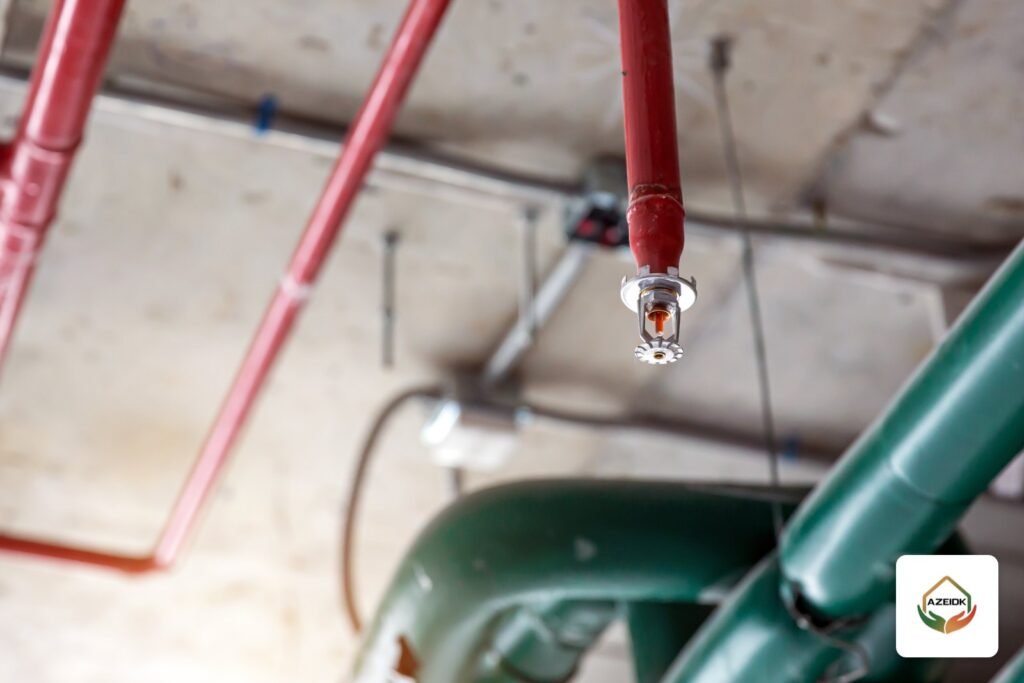
When you find a fire sprinkler leak or a sprinkler that has gone off by accident, first make sure there is no fire, smoke or unusual heat. If there is any, do not close a valve: evacuate and call Civil Defense (998 or 911). Once you are sure it is a false discharge, the authorised person closes the control valve for that zone and drains the water, then a qualified fire technician replaces the head with a new matching sprinkler, restores the system and records what happened.
Key takeaways
- Never close a sprinkler valve until you are certain there is no fire.
- Keep people away from the water and from wet electrical equipment, and inform the building safety officer at once.
- A sprinkler that has operated or leaks is replaced, not repaired. The new head must match the old one in model, K-factor, temperature rating and response type.
- A closed valve means an unprotected area. Restore the system quickly and log the shutdown and restoration in the fire safety log book.
In this article
- What to do immediately about a fire sprinkler leak
- How to close a sprinkler control valve safely
- Why does a sprinkler go off by accident or leak?
- Who replaces the sprinkler head, and what must it match?
- How is the sprinkler system put back in service?
- What if the system stays out of service for a while?
- Frequently asked questions
- Conclusion
What to do immediately about a fire sprinkler leak
The first minutes decide how much damage you get. Follow this order and do not skip a step:
- Check there is no fire. Look around the sprinkler and the space near it for smoke, a burning smell or heat. If in any doubt, the sprinkler is doing its job: do not close the valve, raise the alarm if it has not sounded, evacuate and call Civil Defense.
- Move people away from the water. Water near sockets, panels or equipment is a shock hazard. Nobody should approach wet electrical equipment. Ask a qualified electrician to isolate it if that can be done safely.
- Inform the safety officer or building management. They decide on shutting the system down and should know where the valves are. TYCO’s care and maintenance instructions say to obtain permission from the proper authorities before closing a main control valve and to notify everyone who may be affected.
- Close the zone valve, not the whole building. Most buildings have a control valve for each floor or zone. Closing it stops water to the affected part only and keeps the rest of the building protected.
- Drain the remaining water. Water stays in the pipes after the valve is closed and keeps running from the head. The technician opens the test and drain valve on the control assembly to empty that section.
- Do not try to plug or retighten the head. Wrapping it in cloth or forcing it with an ordinary wrench can break the joint or make the leak worse.
- Take photos and notes. Photograph the head, the ceiling and any damage, and note the time and zone. You will need them for insurance and to find the cause.
How to close a sprinkler control valve safely
Two valve types are common on Saudi sprinkler networks:
- OS&Y gate valve: a stem rises above the handwheel. A visible stem means the valve is open, and the stem moves back in as the valve closes. See AFC OS&Y gate valves.
- Butterfly valve: operated by a handwheel or lever, with an indicator showing open or closed.
Turn the valve in the closing direction marked on it until it stops. Two things are normal at this point: a supervisory signal on the fire alarm panel from the valve tamper switch, and a waterflow alarm from the flow switch before the valve was closed. The wiring is explained in connecting sprinklers to the fire alarm panel.
If the building has a fire pump, it may start automatically when pressure drops. Do not stop it yourself. Stopping it and returning it to automatic mode is a job for the fire technician, after confirming there is no fire.
Why does a sprinkler go off by accident or leak?
Most cases have a cause that can be avoided. The table sums up the causes named in manufacturer data and what to do about each:
| What you see | Likely cause | Action |
|---|---|---|
| Discharge after a ladder, forklift or stock hit the head | Mechanical damage to the frame or bulb | Replace the head and review clearances and guards in the store |
| Steady drip at the base after installation | Over- or under-torque distorted the inlet, or the wrong thread sealant | Replace the head and install it with the wrench and torque in the datasheet |
| Cracked bulb or bulb that has lost its liquid | Impact or high heat | Replace at once |
| Visible corrosion or deposits | Humidity or chemical vapours | Replace, and specify a corrosion-resistant finish where needed |
| Paint on the head or objects hung from it | Head altered after leaving the factory, or used as a hanger | Replace painted heads and stop all hanging |
The TYCO TFP151 data sheet for Series TY-B sprinklers is a clear example. It says any sprinkler that leaks or shows visible corrosion must be replaced, as must any sprinkler with a cracked bulb or a bulb that has lost liquid. It warns that torque above the stated range can distort the inlet and cause leakage, and that hanging objects on sprinklers can lead to inadvertent operation. AZEIDK supplies these as TYCO Series TY-B sprinklers.
Who replaces the sprinkler head, and what must it match?
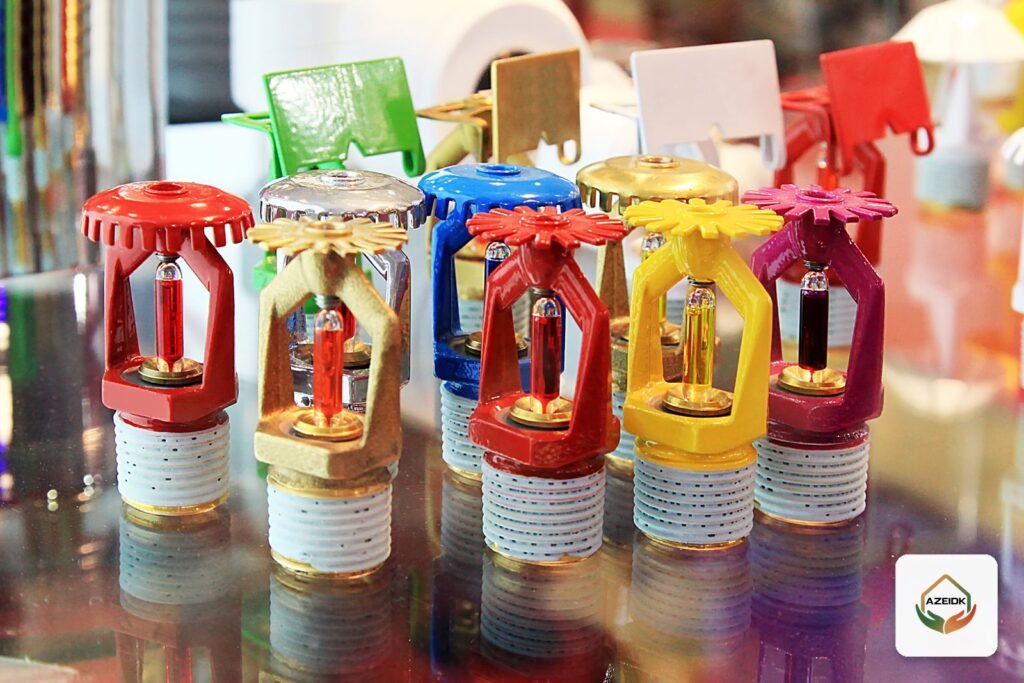
Replacement is a job for a qualified fire technician, because the wrong head can look right and still fail to protect the space. The new head must match the old one in:
- Model and sprinkler identification number (SIN), or an approved equivalent.
- K-factor and thread size.
- Temperature rating and bulb colour.
- Response type (quick or standard) and orientation (upright, pendent or sidewall).
- Finish, where a corrosion-resistant coating was used.
The reference is the as-built drawings and the approved datasheet. NFPA explains that NFPA 13 requires a spare sprinkler cabinet on site with the special sprinkler wrench: at least 6 spares for fewer than 300 sprinklers, 12 for 300 to 1,000, and 24 above 1,000. Having that cabinet cuts the time the system stays out of service.
A sprinkler that has operated is never reinstalled, and the new head is tightened with its own wrench. For TY-B upright and pendent sprinklers, for example, the data sheet gives 7 to 14 lb-ft for 1/2 in. NPT and 10 to 20 lb-ft for 3/4 in. NPT, using the W-Type 6 wrench.
How is the sprinkler system put back in service?
- Fit the new matching head and check the joint for leaks.
- Close the drain valve, then open the control valve fully and slowly.
- Check the pressure gauges on the control assembly and inspect the new head and those next to it.
- Reset the fire alarm panel once the valve and flow signals clear.
- Confirm the fire pump and jockey pump are back in automatic mode.
- Record the event, the shutdown and the restoration in the fire safety log book.
AZEIDK provides this work through its corrective maintenance and technical support service: logging the call and setting priority, a site visit to find the cause, replacement after you approve the action and cost, then testing the system and handing over a report of the work.
What if the system stays out of service for a while?
NFPA 25 (2020 edition, Chapter 15) treats any shutdown as an impairment with set procedures:
- The owner assigns an impairment coordinator. If nobody is assigned, the owner or their representative is the coordinator.
- A tag system is applied to the impaired system.
- Where the system is out of service for more than 10 hours in a 24-hour period, measures such as a fire watch are taken.
- On restoration, the coordinator verifies the needed checks were made, advises those concerned that protection is restored and removes the tag.
In Saudi Arabia, follow Civil Defense instructions and the conditions of your facility licence. If incidents repeat, the lasting fix is a preventive maintenance contract that finds corroded and painted heads before they leak, as described in inspection, testing and maintenance of water-based systems under NFPA 25.
Frequently asked questions
A fire sprinkler burst and is spraying water. What should I do?
First make sure there is no fire. If there is any smoke or heat, evacuate and call Civil Defense and do not close the valve. If it is a false discharge, tell the safety officer so the zone valve can be closed and the water drained.
Can a leaking fire sprinkler be repaired?
No. Manufacturer data says a sprinkler that leaks or shows visible corrosion must be replaced with a new matching head.
Where is the sprinkler shut-off valve in a building?
Usually on the control assembly for each floor or zone, near stairs or corridors, with the main valve in the pump room. The safety officer should know these locations in advance.
Can I change a fire sprinkler head myself?
It is not advised. Replacement needs a head matching the K-factor, temperature and response type, the right wrench and torque, and then restoring and testing the system. That is work for a qualified fire technician.
Why did a sprinkler go off with no fire?
The usual causes are mechanical damage, heat close to the operating temperature, corrosion, paint, objects hung on the head and wrong torque during installation.
How many spare sprinklers should a building keep?
As NFPA explains for NFPA 13: at least 6 for fewer than 300 sprinklers, 12 for 300 to 1,000, and 24 above 1,000, with the special sprinkler wrench in the cabinet.
Conclusion
A fire sprinkler leak calls for a calm, ordered response: confirm there is no fire, move people away from danger, close only the zone valve with the safety officer’s approval, and leave replacement and restoration to a qualified technician. The goal is always the shortest possible time out of service.
A leaking or accidentally discharged sprinkler at your facility? AZEIDK’s corrective maintenance team finds the cause, fits a matching head and restores the system with a report. Talk to the AZEIDK team
Related guides
- CCTV Cameras in Jeddah: Hikvision, Dahua and Bosch, Supply and Installation, Priced per Project
- Hotel CCTV System in Saudi Arabia: Where Cameras Go, Retention and the Security Room
- Business Wi-Fi Network Design: How to Size Access Points, Placement, PoE Switches and Central Management
- How to Confirm an Authorized Fire Equipment Distributor in Saudi Arabia