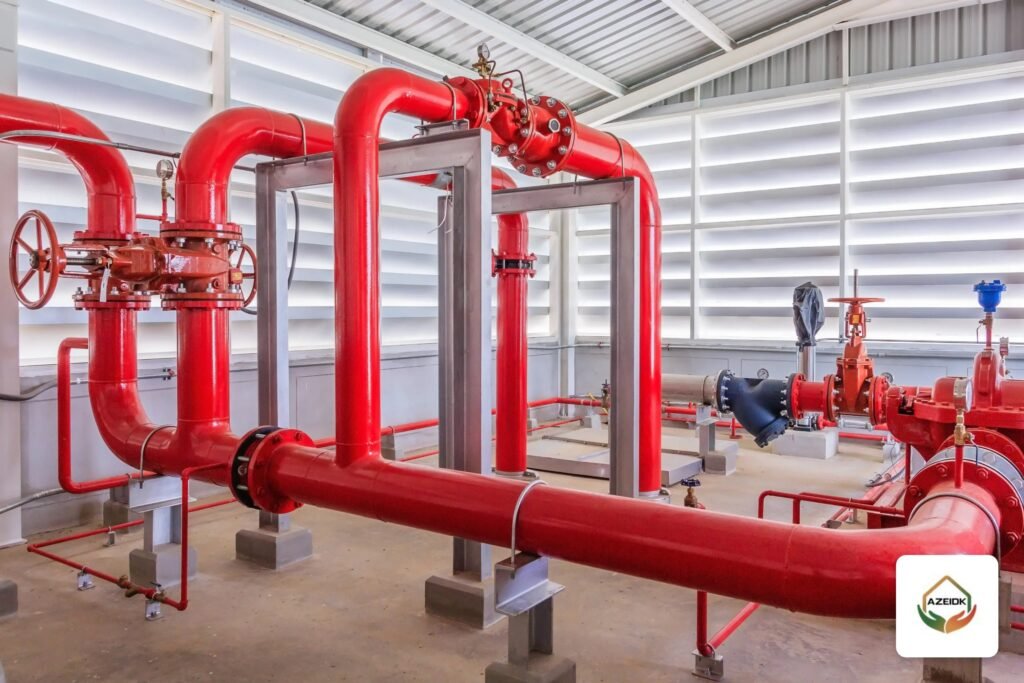
A fire pump raises water pressure and flow from the tank to the sprinklers and hose cabinets as the design requires. A typical pump set has a main electric or diesel pump, a small jockey pump that holds pressure, and a controller for each pump. The type is chosen from the required flow and pressure and the tank water level.
This is a reference hub that brings fire pump types together in one place: electric vs diesel vs jockey, end-suction vs split-case vs vertical turbine, and the NFPA 20 basics a Saudi consultant reviews. Each part has a detailed article on the AZEIDK site, linked where relevant. For hydraulic calculations and approval steps, start with the Fire Pump Selection Guide for Projects in Saudi Arabia.
Key points
- A fire pump is selected by its duty point (flow and pressure) from the hydraulic calculation, not by motor power alone.
- The driver is electric or diesel; the jockey pump does not fight fire, it maintains network pressure.
- Pump construction (end-suction, split-case, vertical turbine) depends on flow and on the water level in the tank or well.
- The usual technical reference is NFPA 20, in the edition set by SBC 801 and the authority having jurisdiction.
- Verify the UL listing or FM approval of the exact model, and the SABER certificate of conformity.
In this article
- What is a fire pump and why does the network need one?
- What are the fire pump types by driver: electric, diesel or jockey?
- What is the difference between end-suction, split-case and vertical turbine pumps?
- How do electric, diesel and jockey pumps work together in the pump room?
- Which NFPA 20 basics does the consultant check on a fire pump?
- Which documents are needed to approve a fire pump in Saudi Arabia?
- Which fire pumps does AZEIDK supply?
- Evaluating the brand and the supply chain behind it
- Service and spare parts: questions to ask
- What are common mistakes when choosing a fire pump?
- Frequently asked questions
- Summary
What is a fire pump and why does the network need one?
A fire network needs a set flow at a set pressure at the most remote sprinkler or highest hose cabinet. In most buildings, mains or roof-tank pressure cannot deliver this, so fire pumps are installed in a dedicated room next to the ground tank to boost pressure when needed.
The pump normally sits on standby. When a sprinkler or hose opens, network pressure drops, the controller senses it through a pressure switch and starts the pump automatically. That is why the pump, controller and valves matter together. NFPA 20: The Essential Requirements for Fire Pumps in Facilities covers pump room components and general requirements.
What are the fire pump types by driver: electric, diesel or jockey?
Electric fire pump
Driven by an electric motor with a controller listed for fire pump service. It is simple to operate and maintain but depends entirely on the power supply, so the consultant asks how reliable that supply is: a single source, or an alternate source or generator?
Diesel fire pump
Driven by a diesel engine independent of mains power, with a fuel tank, starting batteries and its own controller. It is often the standby pump beside an electric pump, or the main pump where reliable power is not available. It needs a weekly run and engine checks. See Electric vs Diesel Fire Pumps: Comparison and Selection Criteria.
Jockey pump
A small pump that makes up minor leakage and keeps the network pressurised so the main pump does not start on every small drop. It is not a firefighting pump. Its start and stop pressures sit above the main pump’s start pressure. Details: Jockey Pumps: Sizing and Start/Stop Pressure Settings.
What is the difference between end-suction, split-case and vertical turbine pumps?
Construction is independent of the driver: a split-case pump, for example, can be electric or diesel.
| Type | Concept | Typically chosen for | Approval note |
|---|---|---|---|
| End-suction | Suction at the end, discharge at the top, compact design | Small and medium projects with lower flows | Needs water reaching the suction under positive pressure |
| Horizontal split-case | Horizontally split casing, double-suction impeller | Medium and large flows, major projects | Serviceable without removing piping; needs more room space |
| Vertical turbine | Impellers submerged, driver above the tank or well | Water level below the pump: wells, deep tanks | Submergence and minimum water level checked carefully |
| Vertical in-line | Pump and motor on a vertical axis in the pipe line | Tight spaces and limited flows | Confirm a listed model exists at the required flow |
Construction follows the duty point and how water reaches the suction. Where the ground-tank water level is below the pump centreline, a vertical turbine pump is the case to review. Jack Pump Fire Pump Types: End-Suction, Split Case and Vertical Turbine covers the three main types in more depth.
How do electric, diesel and jockey pumps work together in the pump room?
Many Saudi projects use what the market calls a fire pump set: a main electric pump, a diesel standby pump of equal performance, a jockey pump, and a controller for each. This is a common arrangement, not a fixed rule; the design may use a single pump or diesel pumps only, depending on system demand, power reliability and the authority’s requirements. For an example, see our guide to the 3PUMP fire pump package, covering models from 500 to 1500 GPM, what Non-Listed means and when to ask for a UL/FM version.
| Element | Role | What is reviewed |
|---|---|---|
| Electric pump | Main pump on pressure drop | Supply reliability, listed controller, starting method |
| Diesel pump | Standby or main, independent of power | Fuel tank, batteries, ventilation and exhaust, weekly run |
| Jockey pump | Maintains pressure, makes up leakage | Start/stop pressures, avoiding short cycling |
| Controllers | Start each pump and signal the fire alarm panel | Listing, required signals, pressure sequence |
| Test header and valves | Performance testing and isolation for maintenance | Supervised valves, flow meter or test header per design |
The pressure sequence sets which pump runs first: jockey, then electric, then diesel. Errors here later show up as short cycling or failure to start.
Which NFPA 20 basics does the consultant check on a fire pump?
NFPA 20 is the US standard for installing stationary fire pumps and is used as a technical reference in Saudi projects, in the edition set by SBC 801 and the authority. A summary is no substitute for the standard, but these are the points usually raised, stated approximately:
- Listing: the pump and controller are models listed or approved for fire service (UL Listed or FM Approved), checked for the exact model, size and speed.
- Performance curve: the standard limits pressure at zero flow (churn) and at 150% of rated flow. Our Jack Pump page states churn between 101% and 140% of rated pressure, and at least 65% of rated pressure at 150% of rated flow.
- Suction: horizontal pumps are normally designed for positive suction; water below the pump is handled with suitable types such as vertical turbine.
- Pump room: fire-rated separation, drainage, ventilation and lighting, with specific provisions for the diesel engine and fuel.
- Testing: a factory test, then a field acceptance test comparing performance with the curve.
For periodic maintenance see Electric Fire Pump Maintenance: Weekly, Monthly and Annual Checks and Diesel Fire Pump Engine Maintenance.
Which documents are needed to approve a fire pump in Saudi Arabia?
- Datasheet and performance curve showing the duty point.
- Evidence of the model’s UL listing or FM approval where specified.
- Motor or engine and controller datasheets.
- Hydraulic calculation and suction check at minimum tank level.
- Pump room drawings.
- SABER certificate of conformity, as the SASO technical regulation for fire control equipment covers fire pumps.
After installation comes the field acceptance test, then the file submitted for Civil Defense procedures.
Which fire pumps does AZEIDK supply?
AZEIDK supplies Jack Pump in three series, each available with an electric motor or diesel engine, as stated on the Jack Pump in Saudi Arabia page:
| Series | Type | Flow range (gpm) | Product page |
|---|---|---|---|
| VES | End-suction | 50 to 1,000 | VES end-suction pump |
| MSC | Horizontal split-case | 300 to 8,000 | MSC split-case pump |
| VTP | Vertical turbine | 50 to 5,000 | VTP vertical turbine pump |
The brand page itself advises checking the listing record for the specific model offered and requesting FM approval where specified. These are series ranges; the model is chosen from the curve and duty point. To understand what drives the final cost and how to prepare a quotation request, see our article on fire pump price in Saudi Arabia.
Evaluating the brand and the supply chain behind it
Two offers labeled “UL Listed” can differ widely in what stands behind them. Before shortlisting a brand, check:
- Range: listed models of the right type around your duty point, so a design change does not force a change of brand.
- Water source: a vertical turbine pump is the usual choice where the water level sits below the pump, as in many below-grade tanks, so check for a listed model of that type.
- Package responsibility: who assembles the pump, driver, controller and accessories, and who signs for the whole package in the submittal.
- Factory testing: a certified shop test curve for each serial number, the reference for the field acceptance test.
- Support: documents for the exact models, and a local engineer who answers comments, attends tests and diagnoses faults.
Our submittal checklist for UL Listed and FM Approved equipment covers how to record each item in the submittal register.
Service and spare parts: questions to ask
A fire pump runs only for short test runs yet should work on demand for decades. Ask each supplier:
- Who will attend the field acceptance test? NFPA 20 (2025 edition, Section 14.2.1 per the technical committee’s second draft) requires the pump and controller manufacturers and, when supplied, the engine and transfer switch manufacturers, or their factory-authorized representatives; see our fire pump acceptance testing guide.
- Who supports the annual flow test? Under the 2023 edition of NFPA 25, as Inspect Point summarizes it (2026 is now current; check the adopted edition), results are compared with the acceptance test curve and a pressure drop of more than 5% must be investigated; see our NFPA 25 inspection, testing and maintenance guide.
- Which wear parts should be stocked on site, and which will the supplier hold locally?
- Are replacement parts supplied by the manufacturer for the listed model, so repairs stay within the original design?
- What operator training and technician response are offered, and who holds the controller and engine service documents?
What are common mistakes when choosing a fire pump?
- Choosing by motor power or price before calculating the duty point.
- Ignoring minimum tank water level in the suction check.
- Comparing quotes for pumps with different flow, pressure and listing.
- Setting jockey and main pump pressures without a clear sequence.
- Accepting a controller not listed for fire service with a listed pump.
- Neglecting the weekly diesel run after handover.
Frequently asked questions
What is a fire pump?
A dedicated pump that raises water pressure and flow from the tank to sprinklers and hose cabinets, starting automatically when network pressure drops.
Does a jockey pump fight fire?
No. It maintains network pressure and makes up minor leakage; firefighting relies on the main pump.
Do I need a diesel pump if I have an electric pump?
It depends on power supply reliability, the design and the authority’s requirements. Many projects add a diesel standby pump.
When should I choose a vertical turbine pump?
Usually when the water level is below the pump, as with wells and deep tanks, after the consultant reviews suction conditions.
Must a fire pump be UL listed or FM approved?
The main pump is normally a model listed or approved for fire service; the specification states which. Verify the exact model in the issuer’s record.
Summary
A fire pump is part of a system: an electric or diesel main pump, a jockey pump, controllers, valves and testing. Construction and driver follow the duty point, suction conditions and power reliability; listing and conformity are verified before supply.
Need a fire pump for a new project or a replacement? Send the duty point or network drawings and AZEIDK’s team will review the suitable Jack Pump type and the approval documents required. Contact the AZEIDK team